23.5 Derivatives of Further Trigonometric Functions
AHL 5.15
This section is for HL students. It builds on 23.4.
- the derivatives of \(\tan x\), \(\sec x\), \(\operatorname{cosec} x\) and \(\cot x\)
- how to use the chain rule with these functions
- the derivatives of the inverse functions \(\arcsin x\), \(\arccos x\) and \(\arctan x\)
As in 23.4, angles are always measured in radians.
The other trigonometric functions
Once we know the derivatives of \(\sin x\) and \(\cos x\), the quotient rule and the chain rule give the rest.
Example 1 (a) Use the quotient rule to show that \(\dfrac{\mathrm{d}}{\mathrm{d}x}(\tan x) = \sec^2 x\).
(b) Use the chain rule to show that \(\dfrac{\mathrm{d}}{\mathrm{d}x}(\sec x) = \sec x \tan x\).
(a) \(\tan x = \dfrac{\sin x}{\cos x}\). With \(u = \sin x\) and \(v = \cos x\):
\[ \frac{\mathrm{d}}{\mathrm{d}x}(\tan x) = \frac{\cos x \cdot \cos x - \sin x \cdot (-\sin x)}{\cos^2 x} = \frac{\cos^2 x + \sin^2 x}{\cos^2 x} = \frac{1}{\cos^2 x} = \sec^2 x . \]
(b) \(\sec x = (\cos x)^{-1}\). By the chain rule,
\[ \frac{\mathrm{d}}{\mathrm{d}x}(\sec x) = -1(\cos x)^{-2} \times (-\sin x) = \frac{\sin x}{\cos^2 x} = \frac{1}{\cos x} \cdot \frac{\sin x}{\cos x} = \sec x \tan x . \]
In the same way you can show the results for \(\operatorname{cosec} x\) and \(\cot x\) (try it).
Derivatives of the six trigonometric functions (\(x\) in radians) In the formula booklet
| \(f(x)\) | \(f'(x)\) | \(f(x)\) | \(f'(x)\) | |
|---|---|---|---|---|
| \(\sin x\) | \(\cos x\) | \(\operatorname{cosec} x\) | \(-\operatorname{cosec} x \cot x\) | |
| \(\cos x\) | \(-\sin x\) | \(\sec x\) | \(\sec x \tan x\) | |
| \(\tan x\) | \(\sec^2 x\) | \(\cot x\) | \(-\operatorname{cosec}^2 x\) |
The derivatives of \(\tan x\), \(\sec x\), \(\operatorname{cosec} x\) and \(\cot x\) are AHL 5.15. (\(\operatorname{cosec} x\) is also written \(\csc x\).)
\(\tan x\), \(\sec x\), \(\operatorname{cosec} x\) and \(\cot x\) are only in the HL booklet.
A memory aid: the derivatives of the “co-” functions (\(\cos\), \(\operatorname{cosec}\), \(\cot\)) all start with a minus sign.
Using the chain rule
If \(f(x)\) is any function, the chain rule gives the following.
Further trigonometric functions of a function Not in the formula booklet
| \(y\) | \(\dfrac{\mathrm{d}y}{\mathrm{d}x}\) | \(y\) | \(\dfrac{\mathrm{d}y}{\mathrm{d}x}\) | |
|---|---|---|---|---|
| \(\tan f(x)\) | \(f'(x)\sec^2 f(x)\) | \(\operatorname{cosec} f(x)\) | \(-f'(x)\operatorname{cosec} f(x)\cot f(x)\) | |
| \(\cot f(x)\) | \(-f'(x)\operatorname{cosec}^2 f(x)\) | \(\sec f(x)\) | \(f'(x)\sec f(x)\tan f(x)\) |
- \(f(x)\): the inside function
- \(f'(x)\): the derivative of the inside function
Example 2 Differentiate with respect to \(x\):
(a) \(\cot(x^2 - 3x + 1)\)
(b) \(\sqrt{\tan 2x}\)
(a) \(\;-(2x - 3)\operatorname{cosec}^2(x^2 - 3x + 1)\).
(b) \(y = (\tan 2x)^{\frac{1}{2}}\). Two layers of the chain rule:
\[ \begin{aligned} \frac{\mathrm{d}y}{\mathrm{d}x} &= \frac{1}{2}(\tan 2x)^{-\frac{1}{2}} \times 2\sec^2 2x \\ &= \frac{\sec^2 2x}{\sqrt{\tan 2x}} . \end{aligned} \]
Derivatives of inverse trigonometric functions
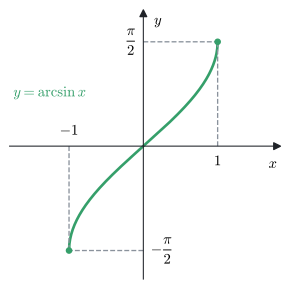
Recall the inverse sine function (Figure 1):
\[ y = \arcsin x \quad\Longleftrightarrow\quad x = \sin y, \qquad -1 \le x \le 1, \quad -\frac{\pi}{2} \le y \le \frac{\pi}{2} . \]
Differentiate \(x = \sin y\) with respect to \(y\): \(\;\dfrac{\mathrm{d}x}{\mathrm{d}y} = \cos y\), so
\[ \frac{\mathrm{d}y}{\mathrm{d}x} = \frac{1}{\cos y} . \]
We need the answer in terms of \(x\). Since \(-\dfrac{\pi}{2} \le y \le \dfrac{\pi}{2}\), \(\cos y \ge 0\), so
\[ \cos y = \sqrt{1 - \sin^2 y} = \sqrt{1 - x^2} \qquad\Rightarrow\qquad \frac{\mathrm{d}}{\mathrm{d}x}(\arcsin x) = \frac{1}{\sqrt{1 - x^2}} . \]
Be careful with the notation: \(\sin^{-1}x\) means \(\arcsin x\). It is not \(\dfrac{1}{\sin x}\), and it is not the same as \((\sin x)^{-1}\).
Example 3 Let \(y = \arctan x\). By writing \(x = \tan y\), show that \(\dfrac{\mathrm{d}y}{\mathrm{d}x} = \dfrac{1}{1 + x^2}\).
\(x = \tan y\), so \(\dfrac{\mathrm{d}x}{\mathrm{d}y} = \sec^2 y = 1 + \tan^2 y = 1 + x^2\).
Therefore \(\dfrac{\mathrm{d}y}{\mathrm{d}x} = \dfrac{1}{\;\frac{\mathrm{d}x}{\mathrm{d}y}\;} = \dfrac{1}{1 + x^2}\).
Derivatives of the inverse trigonometric functions In the HL formula booklet
\[ \begin{aligned} f(x) = \arcsin x \;&\Rightarrow\; f'(x) = \frac{1}{\sqrt{1 - x^2}} \\ f(x) = \arccos x \;&\Rightarrow\; f'(x) = -\frac{1}{\sqrt{1 - x^2}} \\ f(x) = \arctan x \;&\Rightarrow\; f'(x) = \frac{1}{1 + x^2} \end{aligned} \]
The first two need \(|x| < 1\); the third is true for all real \(x\).
Example 4 Differentiate with respect to \(x\):
(a) \(\arcsin 3x\)
(b) \(\arccos(x^3)\), \(\;|x| < 1\)
(c) \(\arctan\sqrt{x}\), \(\;x > 0\)
Use the chain rule: replace \(x\) by the inside function, then multiply by its derivative.
(a) \(\;\dfrac{1}{\sqrt{1 - (3x)^2}} \times 3 = \dfrac{3}{\sqrt{1 - 9x^2}}\).
(b) \(\;-\dfrac{1}{\sqrt{1 - (x^3)^2}} \times 3x^2 = -\dfrac{3x^2}{\sqrt{1 - x^6}}\).
(c) \(\;\dfrac{1}{1 + (\sqrt{x})^2} \times \dfrac{1}{2\sqrt{x}} = \dfrac{1}{2\sqrt{x}\,(1 + x)}\).
Common errors
| ✗ Wrong | ✓ Right | Why |
|---|---|---|
| \(\dfrac{\mathrm{d}}{\mathrm{d}x}(\arcsin x) = \dfrac{-\cos x}{\sin^2 x}\) | \(\dfrac{1}{\sqrt{1 - x^2}}\) | \(\arcsin x = \sin^{-1}x\) is the inverse function, not \(\dfrac{1}{\sin x}\). |
Exercises
1 Differentiate \(y = \operatorname{cosec}^3 x\).
\(y = (\operatorname{cosec} x)^3\), so \(\dfrac{\mathrm{d}y}{\mathrm{d}x} = 3\operatorname{cosec}^2 x \times (-\operatorname{cosec} x\cot x) = -3\operatorname{cosec}^3 x\cot x\).
2 Show that \(\dfrac{\mathrm{d}}{\mathrm{d}x}\arctan\left(\dfrac{x}{3}\right) = \dfrac{3}{9 + x^2}\).
\[ \frac{1}{1 + \left(\frac{x}{3}\right)^2} \times \frac{1}{3} = \frac{1}{3\left(1 + \frac{x^2}{9}\right)} = \frac{1}{3 + \frac{x^2}{3}} = \frac{3}{9 + x^2} . \]