Unit 9 Exam Practice
Functions
These questions are written in the style of IB examination questions, and they are harder than the review exercises. The marks for each part are shown in square brackets on the right, for example [3]. Paper 1 means no calculator; Paper 2 means a graphic display calculator (GDC) is allowed. Try each question under exam conditions first, then open the markscheme.
| Mark | Meaning |
|---|---|
| M | Method mark: a correct method is used, even with a small slip |
| A | Accuracy mark: a correct answer or line of working (usually needs the M mark before it) |
| R | Reasoning mark: a clear reason or justification is given |
| N | Mark for a correct final answer with no working shown |
| AG | “Answer given” in the question, so no extra mark is awarded for writing it |
The number after the letter is the number of marks, so A2 is worth 2 marks. In the exam, give answers exactly or correct to 3 significant figures (s.f.) unless the question says otherwise.
SL questions
SL 1 Paper 1
The functions \(f\) and \(g\) are defined by \(f(x) = 2x - x^{2}\), for \(x \in \mathbb{R}\), and \(g(x) = \sqrt{x + 3}\), for \(x \geq -3\).
(a) Find \((g \circ f)(x)\), and find its largest possible domain. [2]
(b) Solve the equation \((g \circ f)(x) = x - 1\). [3]
(c) Find \((f \circ g)(x)\), and find the range of \(f \circ g\). [3]
Total 8 marks
(a)
\((g \circ f)(x) = \sqrt{3 + 2x - x^{2}}\), so we need \((3 - x)(1 + x) \geq 0\) M1
\(-1 \leq x \leq 3\) A1
[2 marks]
(b)
\(3 + 2x - x^{2} = (x - 1)^{2} \;\Rightarrow\; x^{2} - 2x - 1 = 0\) M1
\(x = 1 \pm \sqrt{2}\) A1
the square root is never negative, so \(x - 1 \geq 0\); reject \(1 - \sqrt{2}\), so \(x = 1 + \sqrt{2}\) R1
Do not award the R1 if both values are given as answers.
[3 marks]
(c)
\((f \circ g)(x) = 2\sqrt{x + 3} - (x + 3)\), \(\;x \geq -3\) A1
let \(u = \sqrt{x + 3} \geq 0\): \(\;2u - u^{2} = 1 - (u - 1)^{2}\), greatest value \(1\) at \(u = 1\) M1
range: \((f \circ g)(x) \leq 1\) A1
[3 marks]
SL 2 Paper 1
The function \(f\) is defined by \(f(x) = \dfrac{2x + 3}{x - 1}\), for \(x > 1\).
(a) Find the range of \(f\). [2]
(b) Find \(f^{-1}(x)\), and state the domain of \(f^{-1}\). [3]
(c) Find the exact coordinates of the point where the graphs of \(y = f(x)\) and \(y = f^{-1}(x)\) meet. [3]
Total 8 marks
(a)
\(f(x) = \dfrac{2(x - 1) + 5}{x - 1} = 2 + \dfrac{5}{x - 1}\) M1
for \(x > 1\), \(\dfrac{5}{x - 1}\) takes every positive value, so \(f(x) > 2\) A1
[2 marks]
(b)
\(y(x - 1) = 2x + 3 \;\Rightarrow\; x(y - 2) = y + 3\) M1
\(f^{-1}(x) = \dfrac{x + 3}{x - 2}\) A1
domain of \(f^{-1}\): \(x > 2\) (the range of \(f\)) A1
[3 marks]
(c)
\(\dfrac{2x + 3}{x - 1} = \dfrac{x + 3}{x - 2}\), for \(x > 2\) M1
\((2x + 3)(x - 2) = (x + 3)(x - 1) \;\Rightarrow\; x^{2} - 3x - 3 = 0\) A1
\(x = \dfrac{3 \pm \sqrt{21}}{2}\), and only \(\dfrac{3 + \sqrt{21}}{2}\) is greater than \(2\)
point \(\left(\dfrac{3 + \sqrt{21}}{2},\, \dfrac{3 + \sqrt{21}}{2}\right)\) A1
\(f\) is decreasing, so a meeting point need not lie on \(y = x\). The equation \(f(x) = x\) gives the same quadratic here, but do not award the M1 for it unless \(f(x) = f^{-1}(x)\) is used or the restriction is justified.
[3 marks]
SL 3 Paper 2
Let \(f(x) = \left(x^{2} - 4\right)\mathrm{e}^{-\frac{x}{2}}\), for \(x \in \mathbb{R}\).
(a) Find the \(y\)-intercept and the zeros of \(f\). [2]
(b) Find the coordinates of the local minimum point and of the local maximum point of the graph of \(f\). [2]
(c) Write down the equation of the horizontal asymptote of the graph of \(f\). [1]
(d) Find the set of values of \(k\) for which the equation \(f(x) = k\) has exactly three solutions. [2]
Total 7 marks
(a)
\(y\)-intercept: \(f(0) = -4\) A1
\(\mathrm{e}^{-\frac{x}{2}} > 0\), so the zeros are where \(x^{2} - 4 = 0\): \(\;x = -2\) and \(x = 2\) A1
[2 marks]
(b)
local minimum \((-0.828,\, -5.01)\) \(\;(-0.828427\ldots,\, -5.01423\ldots)\) A1
local maximum \((4.83,\, 1.73)\) \(\;(4.828427\ldots,\, 1.727372\ldots)\) A1
[2 marks]
(c)
\(y = 0\) A1
[1 mark]
(d)
the line \(y = k\) must meet the left branch, the part between \(x = 2\) and the maximum, and the tail that approaches \(y = 0\) R1
\(0 < k < 1.73\) A1
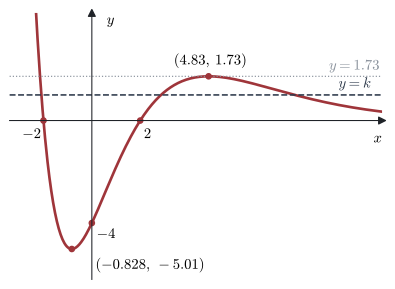
Do not award the A1 for \(0 \leq k \leq 1.73\): \(k = 0\) and \(k = 1.73\) each give exactly two solutions.
[2 marks]
SL 4 Paper 1
The functions \(f\) and \(g\) are defined by \[ f(x) = \mathrm{e}^{2x} - 3, \quad x \in \mathbb{R}, \qquad\qquad g(x) = \ln(x + 4), \quad x > -4 . \]
(a) Write down the range of \(f\). [1]
(b) Find \(f^{-1}(x)\), and state the domain of \(f^{-1}\). [3]
(c) Explain why \(g \circ f\) exists, and show that \((g \circ f)(x) = \ln\left(\mathrm{e}^{2x} + 1\right)\). [2]
(d) Find the range of \(g \circ f\). [2]
(e) Solve the equation \((g \circ f)(x) = x + \ln\left(\dfrac{5}{2}\right)\), giving your answers in exact form. [4]
(f) Find \((f \circ g)(x)\) in the form \((x + p)^{2} + q\), where \(p, q \in \mathbb{Z}\), and state the domain and the range of \(f \circ g\). [3]
Total 15 marks
(a)
\(f(x) > -3\) A1
[1 mark]
(b)
\(y = \mathrm{e}^{2x} - 3 \;\Rightarrow\; 2x = \ln(y + 3)\) M1
\(f^{-1}(x) = \dfrac{1}{2}\ln(x + 3)\) A1
domain of \(f^{-1}\): \(x > -3\) A1
[3 marks]
(c)
the range of \(f\), \(f(x) > -3\), lies inside the domain of \(g\), \(x > -4\) R1
\((g \circ f)(x) = \ln\left(\mathrm{e}^{2x} - 3 + 4\right) = \ln\left(\mathrm{e}^{2x} + 1\right)\) A1 AG
[2 marks]
(d)
\(\mathrm{e}^{2x} > 0\), so \(\mathrm{e}^{2x} + 1\) takes every value greater than \(1\) M1
\((g \circ f)(x) > 0\) A1
[2 marks]
(e)
\(\mathrm{e}^{2x} + 1 = \mathrm{e}^{x}\,\mathrm{e}^{\ln\left(\frac{5}{2}\right)} = \dfrac{5}{2}\,\mathrm{e}^{x}\) M1
with \(u = \mathrm{e}^{x}\): \(\;2u^{2} - 5u + 2 = 0\) A1
\((2u - 1)(u - 2) = 0\), so \(u = \dfrac{1}{2}\) or \(u = 2\) A1
\(x = -\ln 2\) or \(x = \ln 2\) A1
[4 marks]
(f)
the range of \(g\) is \(\mathbb{R}\), which is the domain of \(f\)
\((f \circ g)(x) = \mathrm{e}^{2\ln(x + 4)} - 3 = \left(\mathrm{e}^{\ln(x + 4)}\right)^{2} - 3\) M1
\((f \circ g)(x) = (x + 4)^{2} - 3\), with domain \(x > -4\) A1
range: \((f \circ g)(x) > -3\) A1
[3 marks]
SL 5 Paper 2
A factory starts to make phones. The number of phones that it makes per day, \(t\) days after it opens, is modelled by \[ N(t) = 400 - 300\,\mathrm{e}^{-0.05t}, \qquad t \geq 0 . \] The cost, in dollars, of making \(n\) phones in one day is \(C(n) = 2000 + 15n\).
(a) Write down \(N(0)\). [1]
(b) Write down the equation of the horizontal asymptote of the graph of \(N\), and explain what it means in this context. [2]
(c) Find \((C \circ N)(t)\) in the form \(a - b\,\mathrm{e}^{-0.05t}\), and explain what \((C \circ N)(t)\) represents. [3]
(d) Find the range of \(C \circ N\). [2]
(e) Find \(N^{-1}(x)\), and state the domain of \(N^{-1}\). [3]
(f) Find the value of \(N^{-1}(350)\), and explain what it means in this context. [2]
A second factory opens on the same day. The number of phones that it makes per day is modelled by \(M(t) = 50\,(1.04)^{t}\), \(t \geq 0\).
(g) Find the value of \(t\) when the two factories make the same number of phones per day, and find this number. [3]
Total 16 marks
(a)
\(N(0) = 100\) A1
[1 mark]
(b)
\(N = 400\) A1
the number of phones made per day gets closer and closer to \(400\), but never reaches it R1
[2 marks]
(c)
\((C \circ N)(t) = 2000 + 15\left(400 - 300\,\mathrm{e}^{-0.05t}\right)\) M1
\(= 8000 - 4500\,\mathrm{e}^{-0.05t}\) A1
the cost, in dollars, of the phones made on day \(t\) after the factory opens R1
[3 marks]
(d)
\(t \geq 0\), so \(0 < \mathrm{e}^{-0.05t} \leq 1\) M1
\(3500 \leq (C \circ N)(t) < 8000\) A1
[2 marks]
(e)
\(x = 400 - 300\,\mathrm{e}^{-0.05t} \;\Rightarrow\; \mathrm{e}^{-0.05t} = \dfrac{400 - x}{300}\) M1
\(N^{-1}(x) = -20\ln\left(\dfrac{400 - x}{300}\right) = 20\ln\left(\dfrac{300}{400 - x}\right)\) A1
domain of \(N^{-1}\): \(100 \leq x < 400\) (the range of \(N\)) A1
[3 marks]
(f)
\(N^{-1}(350) = 20\ln 6 = 35.8\) \((35.835\ldots)\) A1
the factory first makes \(350\) phones per day about \(35.8\) days after it opens R1
[2 marks]
(g)
\(400 - 300\,\mathrm{e}^{-0.05t} = 50\,(1.04)^{t}\) (for example, using the intersection of the two graphs on a GDC) M1
\(t = 51.5\) \((51.521\ldots)\) A1
\(377\) phones per day \((377.17\ldots)\) A1
[3 marks]
HL questions
HL questions on this unit also use the AHL content: restricting the domain so that an inverse exists, even and odd functions, self-inverse functions and \(f \circ f\).
HL 1 Paper 2
The function \(f\) is defined by \(f(x) = x^{3} - 6x + 3\), for \(x \geq a\).
(a) Find the least value of \(a\) for which \(f\) has an inverse function. [2]
For the rest of this question, \(a\) takes this least value.
(b) Write down the domain of \(f^{-1}\). [1]
(c) Find \(f^{-1}(5)\). [2]
(d) Find the coordinates of the point where the graphs of \(y = f(x)\) and \(y = f^{-1}(x)\) meet. [3]
Total 8 marks
(a)
\(f\) is decreasing between its local maximum and its local minimum, so the domain must start at the local minimum, \(x = 1.41\) R1
\(a = 1.41\) \((1.41421\ldots)\) A1
Accept \(a = \sqrt{2}\).
[2 marks]
(b)
\(f(a) = -2.66\), so the domain of \(f^{-1}\) is \(x \geq -2.66\) \(\;(-2.65685\ldots)\) A1
[1 mark]
(c)
\(f^{-1}(5)\) is the solution of \(x^{3} - 6x + 3 = 5\) with \(x \geq 1.41\) M1
\(f^{-1}(5) = 2.60\) \((2.60167\ldots)\) A1
[2 marks]
(d)
\(f\) is increasing on its domain, so the graphs meet on the line \(y = x\) R1
\(x^{3} - 6x + 3 = x\), with \(x \geq 1.41\) (for example, using the intersection of \(y = f(x)\) and \(y = x\) on a GDC) M1
\((2.40,\, 2.40)\) \(\;(2.39766\ldots)\) A1
[3 marks]
HL 2 Paper 1
Let \(f\) be any function defined for all \(x \in \mathbb{R}\).
(a) Show that \(E(x) = f(x) + f(-x)\) is an even function and that \(O(x) = f(x) - f(-x)\) is an odd function. [3]
(b) Hence write \(3^{x}\) as the sum of an even function and an odd function. [2]
(c) The function \(q\) is odd and one-to-one, with domain \(\mathbb{R}\). Prove that \(q^{-1}\) is also an odd function. [3]
Total 8 marks
(a)
replacing \(x\) by \(-x\): \(\;E(-x) = f(-x) + f\big(-(-x)\big) = f(-x) + f(x)\) M1
\(E(-x) = E(x)\), so \(E\) is even A1
\(O(-x) = f(-x) - f(x) = -\big(f(x) - f(-x)\big) = -O(x)\), so \(O\) is odd A1
[3 marks]
(b)
\(f(x) = \dfrac{1}{2}E(x) + \dfrac{1}{2}O(x)\) M1
\(3^{x} = \dfrac{3^{x} + 3^{-x}}{2} + \dfrac{3^{x} - 3^{-x}}{2}\) A1
[2 marks]
(c)
let \(y\) be in the domain of \(q^{-1}\), and let \(x = q^{-1}(y)\), so \(q(x) = y\) M1
\(q\) is odd, so \(q(-x) = -q(x) = -y\) R1
so \(q^{-1}(-y) = -x = -q^{-1}(y)\) for every \(y\) in the domain of \(q^{-1}\), and \(q^{-1}\) is odd R1
[3 marks]
See 9.5.
HL 3 Paper 1
The function \(f\) is defined by \[ f(x) = \ln\left(\frac{\mathrm{e}^{x} + 1}{\mathrm{e}^{x} - 1}\right), \qquad x > 0 . \]
(a) Show that \(f(x) > 0\) for all \(x > 0\). [2]
(b) Show that \(f\) is a self-inverse function. [4]
(c) Hence solve the equation \(f(x) = \ln 3\). [2]
Total 8 marks
(a)
\(\dfrac{\mathrm{e}^{x} + 1}{\mathrm{e}^{x} - 1} = 1 + \dfrac{2}{\mathrm{e}^{x} - 1}\) M1
\(x > 0\) gives \(\mathrm{e}^{x} - 1 > 0\), so the fraction is greater than \(1\), and \(f(x) > 0\) R1 AG
[2 marks]
(b)
by (a), \(f(x)\) is in the domain of \(f\), so \((f \circ f)(x)\) is defined for all \(x > 0\) R1
\(\mathrm{e}^{f(x)} = \dfrac{\mathrm{e}^{x} + 1}{\mathrm{e}^{x} - 1}\) M1
\(\mathrm{e}^{f(x)} + 1 = \dfrac{2\mathrm{e}^{x}}{\mathrm{e}^{x} - 1}\) and \(\mathrm{e}^{f(x)} - 1 = \dfrac{2}{\mathrm{e}^{x} - 1}\) A1
\(f\big(f(x)\big) = \ln\left(\dfrac{2\mathrm{e}^{x}}{2}\right) = \ln \mathrm{e}^{x} = x\), so \(f\) is self-inverse A1 AG
[4 marks]
(c)
\(f\) is self-inverse, so \(x = f^{-1}(\ln 3) = f(\ln 3)\) M1
\(x = \ln\left(\dfrac{3 + 1}{3 - 1}\right) = \ln 2\) A1
[2 marks]
See 9.5.
HL 4 Paper 1
The function \(f\) is defined by \(f(x) = \dfrac{4x}{x^{2} + 4}\), for \(x \in \mathbb{R}\).
(a) Show that \(f\) is an odd function. [2]
(b) By considering the equation \(f(x) = k\) as a quadratic equation in \(x\), show that the range of \(f\) is \(-1 \leq f(x) \leq 1\). [4]
(c) Show that if \(f(a) = f(b)\), then \((a - b)(4 - ab) = 0\). [2]
(d) Hence show that \(f\) is one-to-one on the domain \(-2 \leq x \leq 2\). Explain why \(f\) is not one-to-one on any interval that contains both \(0\) and a number \(c\) with \(|c| > 2\). [3]
The function \(g\) is defined by \(g(x) = \dfrac{4x}{x^{2} + 4}\), for \(-2 \leq x \leq 2\).
(e) Show that \(g^{-1}(x) = \dfrac{2x}{1 + \sqrt{1 - x^{2}}}\), and state the domain of \(g^{-1}\). [5]
Total 16 marks
(a)
\(f(-x) = \dfrac{4(-x)}{(-x)^{2} + 4} = \dfrac{-4x}{x^{2} + 4}\) M1
\(= -f(x)\) for all \(x\), so \(f\) is odd A1
[2 marks]
(b)
\(\dfrac{4x}{x^{2} + 4} = k \;\Rightarrow\; kx^{2} - 4x + 4k = 0\) M1
for \(k \neq 0\) there is a real solution only if the discriminant \(16 - 16k^{2} \geq 0\) M1
\(k^{2} \leq 1\), so \(-1 \leq k \leq 1\) (with \(k \neq 0\)) A1
\(k = 0\) is also in the range, since \(f(0) = 0\); so the range is \(-1 \leq f(x) \leq 1\) R1 AG
[4 marks]
(c)
\(\dfrac{4a}{a^{2} + 4} = \dfrac{4b}{b^{2} + 4} \;\Rightarrow\; ab^{2} + 4a = a^{2}b + 4b\) M1
\(4(a - b) - ab(a - b) = 0\), so \((a - b)(4 - ab) = 0\) A1 AG
[2 marks]
(d)
if \(-2 \leq a, b \leq 2\), then \(ab = 4\) only when \(a = b = 2\) or \(a = b = -2\) R1
so in every case \(f(a) = f(b)\) gives \(a = b\), and \(f\) is one-to-one on \(-2 \leq x \leq 2\) A1
\(\dfrac{4}{c}\) lies between \(0\) and \(c\), so it is in the interval, and \(f\left(\dfrac{4}{c}\right) = \dfrac{4c}{4 + c^{2}} = f(c)\) with \(\dfrac{4}{c} \neq c\) R1
[3 marks]
(e)
\(y = \dfrac{4x}{x^{2} + 4} \;\Rightarrow\; yx^{2} - 4x + 4y = 0\) M1
for \(y \neq 0\), \(\;x = \dfrac{4 \pm \sqrt{16 - 16y^{2}}}{2y} = \dfrac{2\left(1 \pm \sqrt{1 - y^{2}}\right)}{y}\) A1
with the \(+\) sign, \(|x| \geq \dfrac{2}{|y|} \geq 2\), with equality only when \(y = \pm 1\); so we need the \(-\) sign R1
\(x = \dfrac{2\left(1 - \sqrt{1 - y^{2}}\right)\left(1 + \sqrt{1 - y^{2}}\right)}{y\left(1 + \sqrt{1 - y^{2}}\right)}\)
\(= \dfrac{2\left(1 - \left(1 - y^{2}\right)\right)}{y\left(1 + \sqrt{1 - y^{2}}\right)} = \dfrac{2y}{1 + \sqrt{1 - y^{2}}}\) A1
this also gives \(x = 0\) when \(y = 0\), so \(g^{-1}(x) = \dfrac{2x}{1 + \sqrt{1 - x^{2}}}\) AG
domain of \(g^{-1}\): \(-1 \leq x \leq 1\) (the range of \(g\)) A1
[5 marks]
HL 5 Paper 1
The function \(f\) is defined by \(f(x) = \dfrac{4 - x^{2}}{2}\), for \(x \geq 0\).
(a) Find \(f^{-1}(x)\), and state the domain of \(f^{-1}\). [3]
(b) Explain why \(f \circ f\) is not defined for all \(x \geq 0\). Find the largest domain of \(f \circ f\), and show that \((f \circ f)(x) = \dfrac{x^{2}\left(8 - x^{2}\right)}{8}\). [4]
(c) Show that the equation \((f \circ f)(x) = x\) can be written as \(x(x - 2)\left(x^{2} + 2x - 4\right) = 0\). Hence solve this equation for \(x\) in the domain of \(f \circ f\). [5]
(d) Hence find the coordinates of all the points where the graphs of \(y = f(x)\) and \(y = f^{-1}(x)\) meet. [4]
Total 16 marks
(a)
\(y = \dfrac{4 - x^{2}}{2} \;\Rightarrow\; x^{2} = 4 - 2y\), and \(x \geq 0\), so \(x = \sqrt{4 - 2y}\) M1 A1
\(f^{-1}(x) = \sqrt{4 - 2x}\), with domain \(x \leq 2\) (the range of \(f\)) A1
[3 marks]
(b)
\(f\big(f(x)\big)\) needs \(f(x) \geq 0\) (the domain of \(f\)), but, for example, \(f(3) = -\dfrac{5}{2}\) R1
\(4 - x^{2} \geq 0\) and \(x \geq 0\), so the domain is \(0 \leq x \leq 2\) A1
\((f \circ f)(x) = \dfrac{1}{2}\left(4 - \dfrac{\left(4 - x^{2}\right)^{2}}{4}\right) = \dfrac{16 - \left(4 - x^{2}\right)^{2}}{8}\) M1
\(= \dfrac{16 - 16 + 8x^{2} - x^{4}}{8} = \dfrac{x^{2}\left(8 - x^{2}\right)}{8}\) A1 AG
[4 marks]
(c)
\(x^{2}\left(8 - x^{2}\right) = 8x \;\Rightarrow\; x^{4} - 8x^{2} + 8x = 0\) M1 A1
\((x - 2)\left(x^{2} + 2x - 4\right) = x^{3} + 2x^{2} - 4x - 2x^{2} - 4x + 8 = x^{3} - 8x + 8\)
so \(x(x - 2)\left(x^{2} + 2x - 4\right) = x^{4} - 8x^{2} + 8x = 0\) A1 AG
\(x = 0\), \(x = 2\) or \(x = -1 \pm \sqrt{5}\) A1
\(0 \leq x \leq 2\), so \(x = 0\), \(x = 2\) or \(x = \sqrt{5} - 1\) (reject \(-1 - \sqrt{5}\)) A1
[5 marks]
(d)
if \((a, b)\) is on both graphs, then \(b = f(a)\) and \(a = f(b)\), so \(f\big(f(a)\big) = a\) R1
each solution \(a\) of (c) gives \(f\big(f(a)\big) = a\), so \(f^{-1}(a) = f(a)\) and \(\big(a, f(a)\big)\) is on both graphs R1
\(f(0) = 2\), \(\;f(2) = 0\), \(\;f\left(\sqrt{5} - 1\right) = \dfrac{4 - \left(6 - 2\sqrt{5}\right)}{2} = \sqrt{5} - 1\) A1
\((0,\, 2)\), \(\;(2,\, 0)\) and \(\left(\sqrt{5} - 1,\, \sqrt{5} - 1\right)\) A1
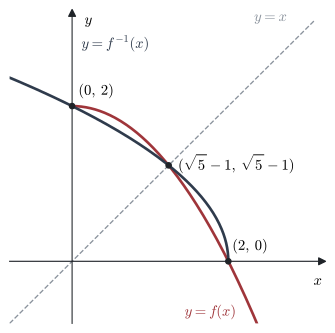
\(f\) is decreasing, so not every meeting point lies on \(y = x\). Do not award the final A1 if only \(\left(\sqrt{5} - 1,\, \sqrt{5} - 1\right)\) is given.
[4 marks]