10.2 Further Rational Functions
AHL 2.13
- how to find the asymptotes of \(y = \dfrac{ax + b}{cx^2 + dx + e}\) (linear over quadratic)
- how to use a sign diagram to describe the behaviour near several vertical asymptotes
- how to find unknown coefficients from information about the asymptotes
- how to use polynomial division to write \(y = \dfrac{ax^2 + bx + c}{dx + e}\) as \(px + q + \dfrac{r}{dx + e}\)
- how to find an oblique (slant) asymptote, and sketch the graph
Rational functions of the form \(y = \frac{ax + b}{cx^2 + dx + e}\)
Here the top is linear and the bottom is quadratic, so the function is proper. When \(x\) is very large, the \(x^2\) in the denominator grows much faster than the top, so \(y \to 0\).
Asymptotes of \(y = \dfrac{ax + b}{cx^2 + dx + e}\) \(\quad(c \neq 0)\) Not in the formula booklet
- horizontal asymptote: \(y = 0\)
- vertical asymptotes: the zeros of the denominator \(cx^2 + dx + e\)
- \(a\): the coefficient of \(x\) in the numerator
- \(b\): the constant term in the numerator
- \(c\): the coefficient of \(x^2\) in the denominator (\(c \neq 0\))
- \(d\): the coefficient of \(x\) in the denominator
- \(e\): the constant term in the denominator
The number of vertical asymptotes depends on the discriminant \(\Delta = d^2 - 4ce\) of the denominator:
| \(\Delta > 0\) | \(\Delta = 0\) | \(\Delta < 0\) |
|---|---|---|
| two vertical asymptotes | one vertical asymptote | no vertical asymptote |
Two cautions.
- If a zero of the denominator is also a zero of the numerator, the factor cancels. There is then a hole in the graph, not an asymptote. For example, \(\dfrac{x - 2}{x^2 - 4} = \dfrac{1}{x + 2}\) for \(x \neq 2\), so \(x = 2\) is not an asymptote.
- Unlike the graphs in Section 10.1, these graphs can cross the horizontal asymptote \(y = 0\). They cross it at the \(x\)-intercept.
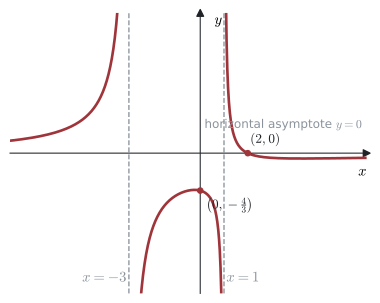
Example 1 Consider the function \(f(x) = \dfrac{4 - 2x}{(x + 3)(x - 1)}\).
(a) Find the equations of the asymptotes.
(b) Find the axis intercepts.
(c) Draw a sign diagram of \(f(x)\). Hence describe the behaviour of the function near its asymptotes.
(d) Sketch the graph of \(y = f(x)\), showing the features you have found.
(a) Vertical asymptotes: \(x = -3\) and \(x = 1\) (the numerator is not zero there). The degree of the bottom is larger, so the horizontal asymptote is \(y = 0\).
(b) \(x\)-intercept: \(4 - 2x = 0 \Rightarrow x = 2\). \(\;y\)-intercept: \(f(0) = \dfrac{4}{3 \times (-1)} = -\dfrac{4}{3}\).
(c) Critical values: \(x = -3\) and \(x = 1\) (undefined), \(x = 2\) (zero).
| \(x\) | \(x < -3\) | \(-3\) | \(-3 < x < 1\) | \(1\) | \(1 < x < 2\) | \(2\) | \(x > 2\) |
|---|---|---|---|---|---|---|---|
| \(4 - 2x\) | \(+\) | \(+\) | \(+\) | \(0\) | \(-\) | ||
| \((x + 3)(x - 1)\) | \(+\) | \(0\) | \(-\) | \(0\) | \(+\) | \(+\) | |
| \(f(x)\) | \(+\) | undefined | \(-\) | undefined | \(+\) | \(0\) | \(-\) |
Behaviour near the vertical asymptotes:
- as \(x \to -3^-\), \(f(x) \to +\infty\); \(\quad\) as \(x \to -3^+\), \(f(x) \to -\infty\)
- as \(x \to 1^-\), \(f(x) \to -\infty\); \(\quad\) as \(x \to 1^+\), \(f(x) \to +\infty\)
Behaviour near the horizontal asymptote: for large positive \(x\), \(f(x) < 0\), so \(f(x) \to 0^-\) (from below). For large negative \(x\), \(f(x) > 0\), so \(f(x) \to 0^+\) (from above).
(d) The middle branch lies between \(x = -3\) and \(x = 1\), below the \(x\)-axis. The right branch comes down from \(+\infty\), crosses the \(x\)-axis at \((2, 0)\), then rises back towards \(y = 0\) from below.
When some coefficients are unknown, turn each piece of information into an equation. “Exactly one vertical asymptote” for a quadratic denominator means a repeated root, so \(\Delta = 0\).
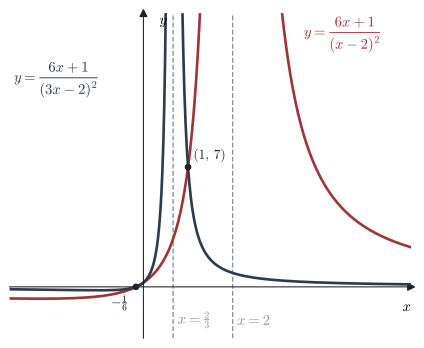
Example 2 The function \(f(x) = \dfrac{6x + 1}{cx^2 + dx + 4}\), \(c \neq 0\), passes through the point \((1, 7)\). The equation \(cx^2 + dx + 4 = 0\) has exactly one real solution, so the graph of \(f\) has exactly one vertical asymptote.
(a) Show that \(f(x)\) can take two possible forms. Find the vertical asymptote in each case.
(b) Sketch both possible graphs of \(y = f(x)\) on the same set of axes.
(a) Through \((1, 7)\):
\[ \frac{6 + 1}{c + d + 4} = 7 \;\Longrightarrow\; c + d + 4 = 1 \;\Longrightarrow\; c = -3 - d . \]
One real solution means \(\Delta = d^2 - 4 \times c \times 4 = d^2 - 16c = 0\). Substitute \(c = -3 - d\):
\[ d^2 + 16d + 48 = 0 \;\Longrightarrow\; (d + 4)(d + 12) = 0 \;\Longrightarrow\; d = -4 \text{ or } d = -12 . \]
- \(d = -4\), \(c = 1\): \(\;f(x) = \dfrac{6x + 1}{x^2 - 4x + 4} = \dfrac{6x + 1}{(x - 2)^2}\). Vertical asymptote \(x = 2\).
- \(d = -12\), \(c = 9\): \(\;f(x) = \dfrac{6x + 1}{9x^2 - 12x + 4} = \dfrac{6x + 1}{(3x - 2)^2}\). Vertical asymptote \(x = \dfrac{2}{3}\).
(b) Both graphs have horizontal asymptote \(y = 0\), \(x\)-intercept \(-\dfrac{1}{6}\) and \(y\)-intercept \(\dfrac{1}{4}\). The denominator is a square, so it is never negative. So \(f(x) > 0\) for \(x > -\frac{1}{6}\) and \(f(x) \to +\infty\) on both sides of the vertical asymptote.
Rational functions of the form \(y = \frac{ax^2 + bx + c}{dx + e}\)
Now the top is quadratic and the bottom is linear, so the function is improper. We use polynomial division (or the method of 10.1: write the top using the bottom) to write
\[ y = \frac{ax^2 + bx + c}{dx + e} = px + q + \frac{r}{dx + e} . \]
- The function is undefined when \(dx + e = 0\), so there is a vertical asymptote \(x = -\dfrac{e}{d}\).
- As \(|x| \to \infty\), \(\dfrac{r}{dx + e} \to 0\), so the graph gets closer and closer to the line \(y = px + q\).
Oblique asymptote Not in the formula booklet
If \(\;y = px + q + \dfrac{r}{dx + e}\), \(\;r \neq 0\), then
- the vertical asymptote is \(x = -\dfrac{e}{d}\)
- the oblique (slant) asymptote is \(y = px + q\)
- the sign of \(\dfrac{r}{dx + e}\) tells you whether the graph is above or below the oblique asymptote
- \(p\): the coefficient of \(x\) in the linear part
- \(q\): the constant term in the linear part
- \(r\): the constant numerator of the fraction (\(r \neq 0\))
- \(d\): the coefficient of \(x\) in the denominator
- \(e\): the constant term in the denominator
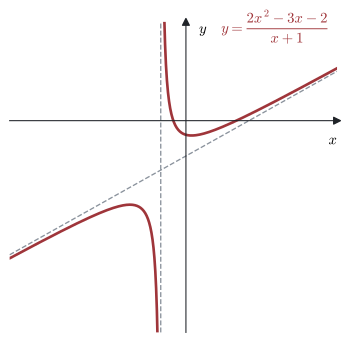
Example 3 The graph of \(y = \dfrac{2x^2 - 3x - 2}{x + 1}\) is shown in Figure 3.
(a) Find the equation of the vertical asymptote.
(b) Find the axis intercepts.
(c) Write the function in the form \(y = px + q + \dfrac{r}{x + 1}\), and hence find the equation of the oblique asymptote.
(a) \(x + 1 = 0\), so \(x = -1\).
(b) \(2x^2 - 3x - 2 = (2x + 1)(x - 2) = 0\), so the \(x\)-intercepts are \(x = -\dfrac{1}{2}\) and \(x = 2\). \(y\)-intercept: \(y = \dfrac{-2}{1} = -2\).
(c) Divide \(2x^2 - 3x - 2\) by \(x + 1\):
\[ 2x^2 - 3x - 2 = (x + 1)(2x - 5) + 3 . \]
(Check: \((x + 1)(2x - 5) = 2x^2 - 3x - 5\), and \(-5 + 3 = -2\) ✓.) So
\[ y = 2x - 5 + \frac{3}{x + 1} . \]
As \(|x| \to \infty\), \(\dfrac{3}{x + 1} \to 0\), so the oblique asymptote is \(y = 2x - 5\).
Example 4 Consider the function \(f(x) = \dfrac{2x^2 + x - 6}{3 - x}\).
(a) Find the equation of the vertical asymptote.
(b) Find the axis intercepts.
(c) Find the equation of the oblique asymptote.
(d) Draw a sign diagram of \(f(x)\).
(e) Hence describe the behaviour of the function near its asymptotes.
(f) Sketch the graph of the function.
(a) \(3 - x = 0\), so \(x = 3\).
(b) \(2x^2 + x - 6 = (2x - 3)(x + 2)\), so the \(x\)-intercepts are \(x = \dfrac{3}{2}\) and \(x = -2\). \(y\)-intercept: \(f(0) = \dfrac{-6}{3} = -2\).
(c) Write the top using \(3 - x\). Since \(2x^2 = (3 - x)(-2x) + 6x\), try \((3 - x)(-2x - 7)\):
\[ (3 - x)(-2x - 7) = -6x - 21 + 2x^2 + 7x = 2x^2 + x - 21 . \]
So \(2x^2 + x - 6 = (3 - x)(-2x - 7) + 15\) and
\[ f(x) = -2x - 7 + \frac{15}{3 - x} . \]
The oblique asymptote is \(y = -2x - 7\).
(d) Critical values \(x = -2\), \(x = \dfrac{3}{2}\) (zeros) and \(x = 3\) (undefined).
| \(x\) | \(x < -2\) | \(-2\) | \(-2 < x < \frac{3}{2}\) | \(\frac{3}{2}\) | \(\frac{3}{2} < x < 3\) | \(3\) | \(x > 3\) |
|---|---|---|---|---|---|---|---|
| \((2x - 3)(x + 2)\) | \(+\) | \(0\) | \(-\) | \(0\) | \(+\) | \(+\) | |
| \(3 - x\) | \(+\) | \(+\) | \(+\) | \(0\) | \(-\) | ||
| \(f(x)\) | \(+\) | \(0\) | \(-\) | \(0\) | \(+\) | undefined | \(-\) |
(e) As \(x \to 3^-\), \(f(x) \to +\infty\). \(\quad\) As \(x \to 3^+\), \(f(x) \to -\infty\).
As \(x \to +\infty\), \(\dfrac{15}{3 - x} < 0\), so the graph approaches \(y = -2x - 7\) from below. As \(x \to -\infty\), \(\dfrac{15}{3 - x} > 0\), so the graph approaches \(y = -2x - 7\) from above.
(f)
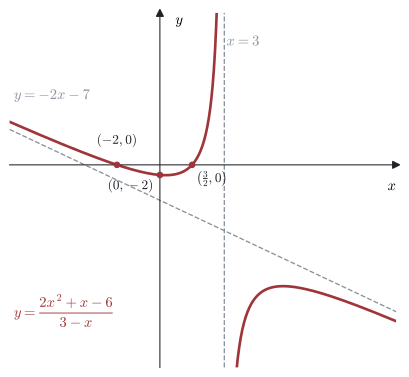
A sketch should show turning points when the question asks for them. On Paper 2, use the GDC. Graphs page: enter \(f_1(x) = \dfrac{2x^2 + x - 6}{3 - x}\), then Menu → Analyze Graph → Minimum (or Maximum) and choose a left and right bound around the turning point.
For Example 4 you get a local minimum at about \((0.261, -2.05)\) and a local maximum at about \((5.74, -24.0)\). You can also enter \(f_2(x) = -2x - 7\) to check the oblique asymptote.
Common errors
| ✗ Wrong | ✓ Right | Why |
|---|---|---|
| Horizontal asymptote of \(\dfrac{4 - 2x}{(x + 3)(x - 1)}\) is \(y = -2\) | \(y = 0\) | Bottom degree > top degree, so \(y \to 0\). |
| “The graph never crosses \(y = 0\)” | It crosses at the \(x\)-intercept | A horizontal asymptote only describes very large \(\lvert x\rvert\). |
| \(x = 2\) is an asymptote of \(\dfrac{x - 2}{x^2 - 4}\) | Hole at \(x = 2\); asymptote \(x = -2\) | The factor \((x - 2)\) cancels. |
| Oblique asymptote of \(2x - 5 + \dfrac{3}{x + 1}\) is \(y = 2x - 5 + 3\) | \(y = 2x - 5\) | The remainder term tends to \(0\); leave it out. |
| Sign of \(\dfrac{1}{(x - 2)^2}\) changes at \(x = 2\) | It is positive on both sides | A squared factor does not change sign. |
Exercises
1 Let \(f(x) = \dfrac{x + 5}{x^2 - x - 6}\). Find the equations of the asymptotes and the axis intercepts.
\(x^2 - x - 6 = (x - 3)(x + 2)\), so the vertical asymptotes are \(x = 3\) and \(x = -2\). Horizontal asymptote \(y = 0\).
\(x\)-intercept: \(x = -5\). \(\;y\)-intercept: \(f(0) = \dfrac{5}{-6} = -\dfrac{5}{6}\).
2 Explain why the graph of \(y = \dfrac{4}{x^2 + 2x + 5}\) has no vertical asymptote. Find its \(y\)-intercept and its maximum value.
\(\Delta = 2^2 - 4 \times 1 \times 5 = -16 < 0\), so the denominator is never zero: no vertical asymptote.
\(y\)-intercept: \(\dfrac{4}{5}\). Also \(x^2 + 2x + 5 = (x + 1)^2 + 4 \geq 4\), so \(y \leq \dfrac{4}{4} = 1\). The maximum value is \(1\), at \(x = -1\).
3 Let \(f(x) = \dfrac{2x - 1}{x^2 - 4x + 4}\).
(a) Find the asymptotes and the axis intercepts.
(b) Describe the behaviour of \(f\) on each side of the vertical asymptote.
(a) \(x^2 - 4x + 4 = (x - 2)^2\): one vertical asymptote \(x = 2\). Horizontal asymptote \(y = 0\). \(x\)-intercept \(\dfrac{1}{2}\); \(y\)-intercept \(f(0) = -\dfrac{1}{4}\).
(b) Near \(x = 2\) the top is \(2(2) - 1 = 3 > 0\) and the bottom \((x - 2)^2 > 0\). So \(f(x) \to +\infty\) as \(x \to 2^-\) and as \(x \to 2^+\).
4 Draw a sign diagram for \(f(x) = \dfrac{x + 2}{(x - 1)(x - 5)}\).
Critical values: \(-2\) (zero), \(1\) and \(5\) (undefined).
| \(x\) | \(x < -2\) | \(-2\) | \(-2 < x < 1\) | \(1\) | \(1 < x < 5\) | \(5\) | \(x > 5\) |
|---|---|---|---|---|---|---|---|
| sign | \(-\) | \(0\) | \(+\) | undefined | \(-\) | undefined | \(+\) |
5 Let \(y = \dfrac{x}{x^2 + 4}\). By writing the equation as a quadratic in \(x\), show that \(-\dfrac{1}{4} \leq y \leq \dfrac{1}{4}\).
\(y(x^2 + 4) = x \Rightarrow yx^2 - x + 4y = 0\). For a real \(x\) to exist (when \(y \neq 0\)) we need \(\Delta \geq 0\):
\[ (-1)^2 - 4 \times y \times 4y \geq 0 \;\Longrightarrow\; 1 - 16y^2 \geq 0 \;\Longrightarrow\; y^2 \leq \frac{1}{16} \;\Longrightarrow\; -\frac{1}{4} \leq y \leq \frac{1}{4} . \]
(\(y = 0\) is also reached, at \(x = 0\).)
6 Write \(\dfrac{x^2 + 3x + 5}{x + 1}\) in the form \(px + q + \dfrac{r}{x + 1}\). Hence state the equations of the asymptotes of its graph.
\(x^2 + 3x + 5 = (x + 1)(x + 2) + 3\), so \(\dfrac{x^2 + 3x + 5}{x + 1} = x + 2 + \dfrac{3}{x + 1}\).
Asymptotes: \(x = -1\) and \(y = x + 2\).
7 Let \(f(x) = \dfrac{2x^2 - 5x + 1}{x - 2}\).
(a) Find the oblique asymptote.
(b) As \(x \to +\infty\), is the graph above or below the oblique asymptote?
(c) Describe the behaviour of \(f\) as \(x \to 2^-\) and as \(x \to 2^+\).
(a) \(2x^2 - 5x + 1 = (x - 2)(2x - 1) - 1\), so \(f(x) = 2x - 1 - \dfrac{1}{x - 2}\). Oblique asymptote \(y = 2x - 1\).
(b) For large positive \(x\), \(-\dfrac{1}{x - 2} < 0\): the graph is below the asymptote.
(c) As \(x \to 2^+\), \(-\dfrac{1}{x - 2} \to -\infty\), so \(f(x) \to -\infty\). As \(x \to 2^-\), \(f(x) \to +\infty\).
8 Let \(f(x) = \dfrac{x^2 - 4}{x + 3}\). Find the axis intercepts and the equations of all asymptotes.
\(x\)-intercepts: \(x = \pm 2\). \(\;y\)-intercept: \(f(0) = -\dfrac{4}{3}\).
\(x^2 - 4 = (x + 3)(x - 3) + 5\), so \(f(x) = x - 3 + \dfrac{5}{x + 3}\). Asymptotes: \(x = -3\) and \(y = x - 3\).
9 The graph of \(y = \dfrac{ax^2 + bx + c}{x - 1}\) has oblique asymptote \(y = 2x + 3\) and passes through \((0, 4)\). Find \(a\), \(b\) and \(c\).
Write \(y = 2x + 3 + \dfrac{r}{x - 1}\). At \((0, 4)\): \(3 + \dfrac{r}{-1} = 4\), so \(r = -1\).
\[ y = \frac{(2x + 3)(x - 1) - 1}{x - 1} = \frac{2x^2 + x - 4}{x - 1} . \]
So \(a = 2\), \(b = 1\), \(c = -4\).
10 Let \(f(x) = \dfrac{x^2 + 2x - 3}{x - 2}\).
(a) Find the axis intercepts and the asymptotes.
(b) Draw a sign diagram for \(f(x)\).
(c) Describe the behaviour of \(f\) near its asymptotes.
(a) \(x^2 + 2x - 3 = (x + 3)(x - 1)\): \(x\)-intercepts \(-3\) and \(1\). \(\;y\)-intercept \(f(0) = \dfrac{-3}{-2} = \dfrac{3}{2}\).
\(x^2 + 2x - 3 = (x - 2)(x + 4) + 5\), so \(f(x) = x + 4 + \dfrac{5}{x - 2}\). Asymptotes: \(x = 2\) and \(y = x + 4\).
(b)
| \(x\) | \(x < -3\) | \(-3\) | \(-3 < x < 1\) | \(1\) | \(1 < x < 2\) | \(2\) | \(x > 2\) |
|---|---|---|---|---|---|---|---|
| sign | \(-\) | \(0\) | \(+\) | \(0\) | \(-\) | undefined | \(+\) |
(c) As \(x \to 2^-\), \(f(x) \to -\infty\); as \(x \to 2^+\), \(f(x) \to +\infty\). As \(x \to +\infty\), \(\dfrac{5}{x - 2} > 0\): the graph approaches \(y = x + 4\) from above. As \(x \to -\infty\), it approaches from below.