20.3 The Ratio Theorem and Collinear Points
AHL 3.12
- the ratio theorem: the position vector of a point that divides \(AB\) in the ratio \(\lambda : \mu\)
- the position vector of the midpoint of \(AB\)
- how to show that three points are collinear, and how to find unknowns from collinearity
- how to use vectors to prove simple geometrical properties
The ratio theorem
Suppose the point \(P\) lies on the segment \(AB\) and divides it internally in the ratio \(\lambda : \mu\), so that
\[ \frac{AP}{PB} = \frac{\lambda}{\mu} . \]
Let \(\boldsymbol{a}\), \(\boldsymbol{b}\) and \(\boldsymbol{p}\) be the position vectors of \(A\), \(B\) and \(P\).
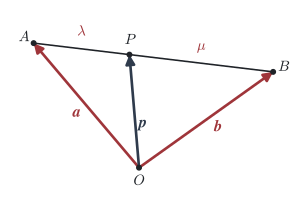
The vectors \(\overrightarrow{AP}\) and \(\overrightarrow{PB}\) point in the same direction, and their lengths are in the ratio \(\lambda : \mu\), so
\[ \mu\,\overrightarrow{AP} = \lambda\,\overrightarrow{PB} \quad\Longrightarrow\quad \mu(\boldsymbol{p} - \boldsymbol{a}) = \lambda(\boldsymbol{b} - \boldsymbol{p}) \quad\Longrightarrow\quad (\lambda + \mu)\boldsymbol{p} = \mu\boldsymbol{a} + \lambda\boldsymbol{b} . \]
The ratio theorem Not in the formula booklet
If \(P\) divides \(AB\) internally in the ratio \(AP : PB = \lambda : \mu\), then
\[ \boldsymbol{p} = \frac{\mu\boldsymbol{a} + \lambda\boldsymbol{b}}{\lambda + \mu} . \]
In particular, the midpoint \(M\) of \(AB\) (\(\lambda = \mu = 1\)) has position vector \(\;\boldsymbol{m} = \dfrac{1}{2}(\boldsymbol{a} + \boldsymbol{b})\).
- \(A\), \(B\): the end points of the line segment \(AB\)
- \(P\): the point that divides \(AB\)
- \(\lambda\), \(\mu\): the parts of the ratio \(AP : PB\) (positive numbers)
- \(\boldsymbol{p}\), \(\boldsymbol{a}\), \(\boldsymbol{b}\): the position vectors of \(P\), \(A\) and \(B\)
- \(\boldsymbol{m}\): the position vector of the midpoint \(M\)
The midpoint formula in coordinates is in the SL section (3.1).
Notice the “cross-over”: \(\boldsymbol{a}\) is multiplied by \(\mu\), the part of the ratio next to \(B\). The nearer \(P\) is to \(A\), the more weight \(\boldsymbol{a}\) gets.
You do not need to memorise the ratio theorem
Start at \(A\) and move \(\dfrac{\lambda}{\lambda + \mu}\) of the way along \(\overrightarrow{AB}\):
\[ \boldsymbol{p} = \boldsymbol{a} + \frac{\lambda}{\lambda + \mu}\,\overrightarrow{AB} . \]
This gives the same answer as the formula, and it is easier to remember.
Example 1 The points \(C\) and \(D\) have coordinates \((1, 4, -2)\) and \((7, 1, 4)\). The point \(B\) divides \(CD\) internally in the ratio \(2 : 1\), and \(M\) is the midpoint of \(CB\).
(a) Find the position vectors of \(B\) and \(M\).
(b) The point \(E\) has position vector \(-\boldsymbol{i} + 5\boldsymbol{j} - 4\boldsymbol{k}\). Show that \(CE\) is parallel to \(MD\).
(a) \(CB : BD = 2 : 1\), so
\[ \boldsymbol{b} = \frac{1 \cdot \boldsymbol{c} + 2\boldsymbol{d}}{3} = \frac{1}{3}\left[\begin{pmatrix} 1 \\ 4 \\ -2 \end{pmatrix} + \begin{pmatrix} 14 \\ 2 \\ 8 \end{pmatrix}\right] = \frac{1}{3}\begin{pmatrix} 15 \\ 6 \\ 6 \end{pmatrix} = \begin{pmatrix} 5 \\ 2 \\ 2 \end{pmatrix} . \]
\[ \boldsymbol{m} = \frac{1}{2}(\boldsymbol{c} + \boldsymbol{b}) = \frac{1}{2}\begin{pmatrix} 6 \\ 6 \\ 0 \end{pmatrix} = \begin{pmatrix} 3 \\ 3 \\ 0 \end{pmatrix} . \]
(Check with the method: \(\boldsymbol{c} + \frac{2}{3}\overrightarrow{CD} = \begin{pmatrix} 1 \\ 4 \\ -2 \end{pmatrix} + \frac{2}{3}\begin{pmatrix} 6 \\ -3 \\ 6 \end{pmatrix} = \begin{pmatrix} 5 \\ 2 \\ 2 \end{pmatrix}\) ✓.)
(b)
\[ \overrightarrow{CE} = \begin{pmatrix} -1 - 1 \\ 5 - 4 \\ -4 + 2 \end{pmatrix} = \begin{pmatrix} -2 \\ 1 \\ -2 \end{pmatrix}, \qquad \overrightarrow{MD} = \begin{pmatrix} 7 - 3 \\ 1 - 3 \\ 4 - 0 \end{pmatrix} = \begin{pmatrix} 4 \\ -2 \\ 4 \end{pmatrix} . \]
\(\overrightarrow{MD} = -2\,\overrightarrow{CE}\), a scalar multiple, so \(CE\) is parallel to \(MD\).
Collinear points
Three points \(A\), \(B\), \(C\) are collinear if they lie on one straight line.
Test for collinear points Not in the formula booklet
\(A\), \(B\) and \(C\) are collinear if \(\overrightarrow{AB}\) and \(\overrightarrow{BC}\) (or \(\overrightarrow{AB}\) and \(\overrightarrow{AC}\)) are parallel:
\[ \overrightarrow{AB} = \lambda\,\overrightarrow{BC} \quad\text{for some scalar } \lambda \neq 0 . \]
- \(A\), \(B\), \(C\): three points
- \(\lambda\): a non-zero scalar (real number)
Parallel is not enough for two separate lines. Here it is enough, because the two vectors share the point \(B\) (or \(A\)): parallel lines through the same point are the same line.
Example 2 The position vectors of \(A\), \(B\) and \(C\) relative to \(O\) are
\[ \begin{pmatrix} 2 \\ -1 \end{pmatrix}, \qquad \begin{pmatrix} 5 \\ 3 \end{pmatrix} \qquad\text{and}\qquad \begin{pmatrix} p \\ 11 \end{pmatrix} \]
respectively. Find
(a) the value of \(p\), given that \(A\), \(B\) and \(C\) are collinear,
(b) the midpoint of \(AB\).
(a) \(\overrightarrow{AB} = \begin{pmatrix} 3 \\ 4 \end{pmatrix}\) and \(\overrightarrow{AC} = \begin{pmatrix} p - 2 \\ 12 \end{pmatrix}\).
Collinear, so \(\overrightarrow{AC} = t\,\overrightarrow{AB}\). The \(y\)-components give \(12 = 4t\), so \(t = 3\). Then \(p - 2 = 9\) and \(p = 11\).
(b) \(\boldsymbol{m} = \dfrac{1}{2}\left[\begin{pmatrix} 2 \\ -1 \end{pmatrix} + \begin{pmatrix} 5 \\ 3 \end{pmatrix}\right] = \begin{pmatrix} 3.5 \\ 1 \end{pmatrix}\), so the midpoint is \((3.5, 1)\).
Example 3 Show that the points \(A(1, -2, 3)\), \(B(3, 1, 2)\) and \(C(7, 7, 0)\) are collinear, and find the ratio \(AB : BC\).
\[ \overrightarrow{AB} = \begin{pmatrix} 2 \\ 3 \\ -1 \end{pmatrix}, \qquad \overrightarrow{BC} = \begin{pmatrix} 4 \\ 6 \\ -2 \end{pmatrix} = 2\begin{pmatrix} 2 \\ 3 \\ -1 \end{pmatrix} = 2\,\overrightarrow{AB} . \]
So \(\overrightarrow{AB} \parallel \overrightarrow{BC}\), and they share the point \(B\). Hence \(A\), \(B\), \(C\) are collinear.
Since \(\overrightarrow{BC} = 2\overrightarrow{AB}\), \(\;AB : BC = 1 : 2\). (\(B\) lies between \(A\) and \(C\), because the scalar \(2\) is positive.)
Proofs using vectors
Vectors give short proofs of geometrical facts. The usual plan is:
- Choose an origin and name two (or three) basic vectors, for example \(\overrightarrow{OA} = \boldsymbol{a}\) and \(\overrightarrow{OB} = \boldsymbol{b}\).
- Write every other vector you need in terms of the basic vectors.
- Compare the vectors: equal, parallel (scalar multiple), or sharing a point.
Example 4 In triangle \(OAB\), \(P\) is the midpoint of \(OA\) and \(Q\) is the midpoint of \(OB\). Prove that \(PQ\) is parallel to \(AB\) and that \(PQ = \frac{1}{2}AB\).
Let \(\overrightarrow{OA} = \boldsymbol{a}\) and \(\overrightarrow{OB} = \boldsymbol{b}\). Then \(\overrightarrow{OP} = \frac{1}{2}\boldsymbol{a}\) and \(\overrightarrow{OQ} = \frac{1}{2}\boldsymbol{b}\).
\[ \overrightarrow{PQ} = \overrightarrow{OQ} - \overrightarrow{OP} = \tfrac{1}{2}\boldsymbol{b} - \tfrac{1}{2}\boldsymbol{a} = \tfrac{1}{2}(\boldsymbol{b} - \boldsymbol{a}) = \tfrac{1}{2}\overrightarrow{AB} . \]
\(\overrightarrow{PQ}\) is a scalar multiple of \(\overrightarrow{AB}\), so \(PQ \parallel AB\). Taking magnitudes, \(PQ = \frac{1}{2}AB\). \(\;\blacksquare\)
(This is the midpoint theorem.)
Common errors
| ✗ Wrong | ✓ Right | Why |
|---|---|---|
| \(AP : PB = 2 : 1 \Rightarrow \boldsymbol{p} = \frac{2\boldsymbol{a} + \boldsymbol{b}}{3}\) | \(\boldsymbol{p} = \frac{\boldsymbol{a} + 2\boldsymbol{b}}{3}\) | \(P\) is nearer to \(B\), so \(\boldsymbol{b}\) gets the bigger weight. |
| “\(AP : PB = 2 : 1\), so \(\overrightarrow{AP} = \frac{2}{1}\overrightarrow{AB}\)” | \(\overrightarrow{AP} = \frac{2}{3}\overrightarrow{AB}\) | \(AP\) is \(2\) parts out of \(2 + 1 = 3\) parts of \(AB\). |
| \(\overrightarrow{AB} \parallel \overrightarrow{CD}\), so \(A\), \(B\), \(C\), \(D\) are collinear | Need a common point too | Two parallel vectors may lie on two different parallel lines. |
| Using only one component to find \(t\), then stopping | Check all components with the same \(t\) | All components must be in the same ratio. |
Exercises
1 \(A\) is \((2, 5)\) and \(B\) is \((10, -3)\). Find the coordinates of the point \(P\) that divides \(AB\) internally in the ratio \(3 : 1\).
\(\boldsymbol{p} = \dfrac{1 \cdot \boldsymbol{a} + 3\boldsymbol{b}}{4} = \dfrac{1}{4}\begin{pmatrix} 2 + 30 \\ 5 - 9 \end{pmatrix} = \begin{pmatrix} 8 \\ -1 \end{pmatrix}\). So \(P\) is \((8, -1)\).
2 Find the position vector of the midpoint of \(AB\), where \(A\) is \((3, -2, 7)\) and \(B\) is \((-1, 6, 1)\).
\(\dfrac{1}{2}\begin{pmatrix} 3 - 1 \\ -2 + 6 \\ 7 + 1 \end{pmatrix} = \begin{pmatrix} 1 \\ 2 \\ 4 \end{pmatrix}\).
3 \(\boldsymbol{a} = \begin{pmatrix} -4 \\ 1 \\ 5 \end{pmatrix}\) and \(\boldsymbol{b} = \begin{pmatrix} 6 \\ -9 \\ 0 \end{pmatrix}\). \(P\) divides \(AB\) internally in the ratio \(2 : 3\). Find \(\boldsymbol{p}\).
\(\boldsymbol{p} = \dfrac{3\boldsymbol{a} + 2\boldsymbol{b}}{5} = \dfrac{1}{5}\begin{pmatrix} -12 + 12 \\ 3 - 18 \\ 15 + 0 \end{pmatrix} = \begin{pmatrix} 0 \\ -3 \\ 3 \end{pmatrix}\).
4 \(M(2, 1, -3)\) is the midpoint of \(AB\), and \(A\) is \((5, -2, 0)\). Find the coordinates of \(B\).
\(\boldsymbol{m} = \frac{1}{2}(\boldsymbol{a} + \boldsymbol{b})\), so \(\boldsymbol{b} = 2\boldsymbol{m} - \boldsymbol{a} = \begin{pmatrix} 4 - 5 \\ 2 + 2 \\ -6 - 0 \end{pmatrix} = \begin{pmatrix} -1 \\ 4 \\ -6 \end{pmatrix}\). \(B\) is \((-1, 4, -6)\).
5 Show that \(A(1, 1, 2)\), \(B(2, 3, 1)\) and \(C(5, 9, -2)\) are collinear, and find the ratio \(AB : BC\).
\(\overrightarrow{AB} = \begin{pmatrix} 1 \\ 2 \\ -1 \end{pmatrix}\), \(\overrightarrow{BC} = \begin{pmatrix} 3 \\ 6 \\ -3 \end{pmatrix} = 3\overrightarrow{AB}\). Parallel with the common point \(B\), so collinear, and \(AB : BC = 1 : 3\).
6 The points \(P(2, 1, 3)\), \(Q(4, 0, 5)\) and \(R(a, b, 11)\) are collinear. Find \(a\) and \(b\).
\(\overrightarrow{PQ} = \begin{pmatrix} 2 \\ -1 \\ 2 \end{pmatrix}\) and \(\overrightarrow{PR} = \begin{pmatrix} a - 2 \\ b - 1 \\ 8 \end{pmatrix} = t\,\overrightarrow{PQ}\).
\(z\): \(8 = 2t\), so \(t = 4\). Then \(a - 2 = 8\), \(a = 10\); and \(b - 1 = -4\), \(b = -3\).
7 The points \(A(0, k)\), \(B(k, 4)\) and \(C(6, 8)\) are collinear. Find the possible values of \(k\).
\(\overrightarrow{AB} = \begin{pmatrix} k \\ 4 - k \end{pmatrix}\) and \(\overrightarrow{BC} = \begin{pmatrix} 6 - k \\ 4 \end{pmatrix}\). Parallel means the components are in the same ratio: \(\dfrac{k}{6 - k} = \dfrac{4 - k}{4}\), so
\[ 4k = (4 - k)(6 - k) = 24 - 10k + k^2 \;\Longrightarrow\; k^2 - 14k + 24 = 0 \;\Longrightarrow\; (k - 2)(k - 12) = 0 . \]
\(k = 2\) or \(k = 12\). (Check \(k = 2\): \(\overrightarrow{AB} = \begin{pmatrix} 2 \\ 2 \end{pmatrix}\), \(\overrightarrow{BC} = \begin{pmatrix} 4 \\ 4 \end{pmatrix}\) ✓. \(k = 12\): \(\overrightarrow{AB} = \begin{pmatrix} 12 \\ -8 \end{pmatrix}\), \(\overrightarrow{BC} = \begin{pmatrix} -6 \\ 4 \end{pmatrix}\) ✓.)
8 In triangle \(OAB\), \(\overrightarrow{OA} = \boldsymbol{a}\) and \(\overrightarrow{OB} = \boldsymbol{b}\). \(P\) lies on \(OA\) with \(OP : PA = 2 : 1\), and \(Q\) lies on \(OB\) with \(OQ : QB = 2 : 1\). Show that \(PQ\) is parallel to \(AB\), and find the ratio \(PQ : AB\).
\(\overrightarrow{OP} = \frac{2}{3}\boldsymbol{a}\) and \(\overrightarrow{OQ} = \frac{2}{3}\boldsymbol{b}\), so \(\overrightarrow{PQ} = \frac{2}{3}(\boldsymbol{b} - \boldsymbol{a}) = \frac{2}{3}\overrightarrow{AB}\).
So \(PQ \parallel AB\) and \(PQ : AB = 2 : 3\).
9 \(OABC\) is a parallelogram with \(\overrightarrow{OA} = \boldsymbol{a}\) and \(\overrightarrow{OC} = \boldsymbol{c}\). \(M\) is the midpoint of \(AB\). The point \(X\) lies on \(OM\) with \(OX : XM = 2 : 1\).
(a) Express \(\overrightarrow{OM}\) and \(\overrightarrow{OX}\) in terms of \(\boldsymbol{a}\) and \(\boldsymbol{c}\).
(b) Hence show that \(X\) lies on the diagonal \(AC\), and find the ratio \(AX : XC\).
(a) \(\overrightarrow{AB} = \boldsymbol{c}\), so \(\overrightarrow{OM} = \boldsymbol{a} + \frac{1}{2}\boldsymbol{c}\), and \(\overrightarrow{OX} = \frac{2}{3}\overrightarrow{OM} = \frac{2}{3}\boldsymbol{a} + \frac{1}{3}\boldsymbol{c}\).
(b) \(\overrightarrow{AX} = \overrightarrow{OX} - \boldsymbol{a} = -\frac{1}{3}\boldsymbol{a} + \frac{1}{3}\boldsymbol{c} = \frac{1}{3}(\boldsymbol{c} - \boldsymbol{a}) = \frac{1}{3}\overrightarrow{AC}\).
So \(X\) lies on \(AC\) (parallel with the common point \(A\)), one third of the way from \(A\) to \(C\): \(AX : XC = 1 : 2\).
(Or: \(\overrightarrow{OX} = \dfrac{2\boldsymbol{a} + 1\boldsymbol{c}}{1 + 2}\) is the ratio theorem with \(\lambda : \mu = 1 : 2\).)
10 Triangle \(ABC\) has vertices with position vectors \(\boldsymbol{a}\), \(\boldsymbol{b}\), \(\boldsymbol{c}\). \(M\) is the midpoint of \(BC\), and \(G\) divides \(AM\) internally in the ratio \(2 : 1\).
(a) Show that \(\boldsymbol{g} = \frac{1}{3}(\boldsymbol{a} + \boldsymbol{b} + \boldsymbol{c})\).
(b) Find the coordinates of \(G\) when \(A\), \(B\), \(C\) are \((1, 2, 3)\), \((4, -1, 0)\) and \((1, 5, 6)\).
(a) \(\boldsymbol{m} = \frac{1}{2}(\boldsymbol{b} + \boldsymbol{c})\). By the ratio theorem with \(\lambda : \mu = 2 : 1\):
\[ \boldsymbol{g} = \frac{1 \cdot \boldsymbol{a} + 2\boldsymbol{m}}{3} = \frac{\boldsymbol{a} + \boldsymbol{b} + \boldsymbol{c}}{3} . \]
(\(G\) is the centroid of the triangle. The formula is symmetric, so \(G\) also lies on the other two medians.)
(b) \(\boldsymbol{g} = \dfrac{1}{3}\begin{pmatrix} 1 + 4 + 1 \\ 2 - 1 + 5 \\ 3 + 0 + 6 \end{pmatrix} = \begin{pmatrix} 2 \\ 2 \\ 3 \end{pmatrix}\), so \(G\) is \((2, 2, 3)\).