2.2 Arithmetic Sequences and Series
SL 1.2
- what an arithmetic sequence is, and the common difference \(d\)
- the formula for the \(n\)th term, \(u_n = u_1 + (n - 1)d\)
- how to write an arithmetic sequence as a recurrence relation, and how to show a sequence is arithmetic
- the formulae for the sum of the first \(n\) terms, and why they work
- how to use these formulae to find unknown terms, sums and the least value of \(n\)
Arithmetic sequences
A sequence is arithmetic if the difference between consecutive terms is always the same. So \(u_1, u_2, u_3, \ldots\) is arithmetic if there is a number \(d\) with
\[ u_2 - u_1 = u_3 - u_2 = u_4 - u_3 = \cdots = d . \]
The number \(d\) is the common difference. (An arithmetic sequence is also called an arithmetic progression, or AP.)
| Sequence | First term \(u_1\) | Common difference \(d\) |
|---|---|---|
| \(2, 5, 8, 11, \ldots\) | \(2\) | \(3\) |
| \(40, 36, 32, 28, \ldots\) | \(40\) | \(-4\) |
| \(1.2,\; 0.7,\; 0.2,\; -0.3, \ldots\) | \(1.2\) | \(-0.5\) |
| \(p,\; p + 2q,\; p + 4q, \ldots\) | \(p\) | \(2q\) |
To find \(d\), always calculate a term minus the term before it.
The \(n\)th term
Start at \(u_1\) and add \(d\) again and again:
\[ u_1, \quad u_2 = u_1 + d, \quad u_3 = u_1 + 2d, \quad u_4 = u_1 + 3d, \quad \ldots \]
To reach the \(n\)th term we add \(d\) exactly \((n - 1)\) times.
The \(n\)th term of an arithmetic sequence In the formula booklet
\[ u_n = u_1 + (n - 1)\,d \]
- \(u_n\): the \(n\)th term (general term)
- \(u_1\): the first term
- \(n\): the position of the term (\(n = 1, 2, 3, \ldots\))
- \(d\): the common difference
Example 1 Find the 30th term of the arithmetic sequence \(5, 9, 13, 17, \ldots\)
\(u_1 = 5\) and \(d = 9 - 5 = 4\).
\[ u_{30} = 5 + (30 - 1) \times 4 = 5 + 116 = 121 \]
When two terms are given, write each one with the formula. This gives two equations for \(u_1\) and \(d\).
Example 2 The fourth term of an arithmetic sequence is \(17\) and the ninth term is \(42\). Find the first term and the common difference. Hence find the fifteenth term.
\[ u_4 = u_1 + 3d = 17 \qquad (1) \qquad\qquad u_9 = u_1 + 8d = 42 \qquad (2) \]
\((2) - (1)\): \(\;5d = 25\), so \(d = 5\). Then \(u_1 = 17 - 15 = 2\).
\[ u_{15} = 2 + 14 \times 5 = 72 \]
For three consecutive terms, it is easiest to call them \(a - d\), \(a\), \(a + d\). Then their sum is simply \(3a\).
Example 3 Three consecutive terms of an arithmetic sequence have a sum of \(27\) and a product of \(585\). Find the three terms.
Let the terms be \(a - d\), \(a\), \(a + d\).
Sum: \((a - d) + a + (a + d) = 3a = 27\), so \(a = 9\).
Product: \((9 - d) \times 9 \times (9 + d) = 585\), so \(81 - d^2 = 65\), \(d^2 = 16\), \(d = \pm 4\).
The terms are \(5, 9, 13\) (for \(d = 4\)) or \(13, 9, 5\) (for \(d = -4\)).
Arithmetic sequences as recurrence relations
The sequence \(10, 15, 20, 25, \ldots\) adds \(5\) each time, so
\[ u_1 = 10, \qquad u_{n+1} = u_n + 5 . \]
In general, an arithmetic sequence with first term \(u_1\) and common difference \(d\) is
\[ u_{n+1} = u_n + d, \qquad n \in \mathbb{Z}^+ . \]
This gives a test.
To show that a sequence is arithmetic
Find \(u_{n+1} - u_n\) and show that it is a constant (it does not depend on \(n\)). That constant is \(d\).
Example 4 (a) A sequence has general term \(u_n = 7 - 3n\). Show that the sequence is arithmetic.
(b) A sequence has general term \(u_n = \dfrac{3}{4}n + \dfrac{1}{2}\). Show that it is arithmetic, and state its common difference.
(a)
\[ u_{n+1} - u_n = \big(7 - 3(n + 1)\big) - (7 - 3n) = 7 - 3n - 3 - 7 + 3n = -3 . \]
The difference is the constant \(-3\), so the sequence is arithmetic.
(b)
\[ u_{n+1} - u_n = \left(\frac{3}{4}(n + 1) + \frac{1}{2}\right) - \left(\frac{3}{4}n + \frac{1}{2}\right) = \frac{3}{4} . \]
This is constant, so the sequence is arithmetic with \(d = \dfrac{3}{4}\).
Notice: if \(u_n\) is a linear expression \(pn + q\), the sequence is always arithmetic, with \(d = p\).
Arithmetic series
Sum of the first \(n\) terms of an arithmetic sequence In the formula booklet
\[ S_n = \frac{n}{2}\big(2u_1 + (n - 1)d\big)\;;\qquad S_n = \frac{n}{2}\big(u_1 + u_n\big) \]
- \(S_n\): the sum of the first \(n\) terms
- \(n\): the number of terms
- \(u_1\): the first term
- \(d\): the common difference
- \(u_n\): the \(n\)th term (the last term in the sum)
Use the second form when you know the last term \(u_n\).
Why the formula works
Write the sum forwards and backwards, then add the two lines:
\[ \begin{aligned} S_n &= u_1 + (u_1 + d) + (u_1 + 2d) + \cdots + u_n \\ S_n &= u_n + (u_n - d) + (u_n - 2d) + \cdots + u_1 \end{aligned} \]
Add the two lines, term by term:
\[ 2S_n = (u_1 + u_n) + (u_1 + u_n) + (u_1 + u_n) + \cdots + (u_1 + u_n) \]
Each pair adds to \(u_1 + u_n\), and there are \(n\) pairs. So \(2S_n = n(u_1 + u_n)\) and
\[ S_n = \frac{n}{2}(u_1 + u_n) . \]
Replacing \(u_n\) by \(u_1 + (n - 1)d\) gives the other form.
Example 5 Find the sum of each arithmetic series.
(a) \(3 + 10 + 17 + \cdots\) (20 terms)
(b) \(50 + 46 + 42 + \cdots + (-30)\)
(a) \(u_1 = 3\), \(d = 7\), \(n = 20\):
\[ S_{20} = \frac{20}{2}\big(2 \times 3 + 19 \times 7\big) = 10 \times 139 = 1390 . \]
(b) First find how many terms there are. \(u_1 = 50\), \(d = -4\), last term \(-30\):
\[ 50 + (n - 1)(-4) = -30 \;\Longrightarrow\; (n - 1)(-4) = -80 \;\Longrightarrow\; n = 21 . \]
Then use the last-term form:
\[ S_{21} = \frac{21}{2}\big(50 + (-30)\big) = \frac{21}{2} \times 20 = 210 . \]
Example 6 The sum of the first 15 terms of an arithmetic series is \(105\), and the 15th term is \(0\). Find the common difference and the sum of the first 40 terms.
Use the last-term form with \(n = 15\) and \(u_{15} = 0\):
\[ \frac{15}{2}(u_1 + 0) = 105 \;\Longrightarrow\; u_1 = 14 . \]
Then \(u_{15} = 14 + 14d = 0\), so \(d = -1\).
\[ S_{40} = \frac{40}{2}\big(2 \times 14 + 39 \times (-1)\big) = 20 \times (-11) = -220 \]
Example 7 The first term of an arithmetic sequence is \(2\) and the sixth term is \(22\). Find the least value of \(n\) for which the sum of the first \(n\) terms exceeds \(1000\).
\(u_6 = 2 + 5d = 22\), so \(d = 4\).
\[ S_n = \frac{n}{2}\big(2 \times 2 + (n - 1) \times 4\big) = \frac{n}{2}(4n) = 2n^2 . \]
We need \(2n^2 > 1000\), so \(n^2 > 500\). Since \(22^2 = 484\) and \(23^2 = 529\), the least value is \(n = 23\).
When \(S_n\) is not as simple as \(2n^2\), use the GDC. There are three ways; the first is usually the quickest.
Method 1 — graph and intersection (Graphs page)
- Enter \(f_1(x) = \frac{x}{2}\big(2 \times 2 + (x - 1) \times 4\big)\) and \(f_2(x) = 1000\).
- Menu → Window / Zoom → Window Settings (for example \(0 \le x \le 40\), \(0 \le y \le 1500\)).
- Menu → Analyze Graph → Intersection. You get \(x = 22.36\ldots\)
- \(n\) must be a whole number, so round up: \(n = 23\).
Method 2 — nSolve (Calculator page)
- Menu → Algebra → Numerical Solve.
- Type
nSolve(x/2*(2*2+(x-1)*4)=1000, x)→ \(22.36\ldots\), so \(n = 23\).
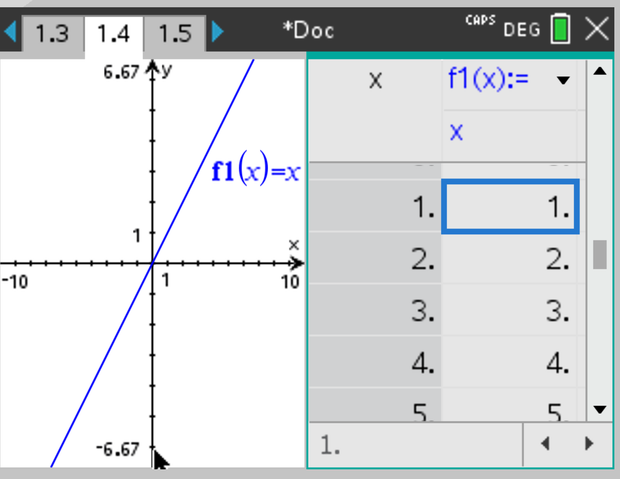
Method 3 — table (Graphs page)
- Enter \(f_1(x)\) as in Method 1.
- Press ctrl + T: the table appears next to the graph (split screen).
- Scroll down until the value first passes \(1000\): \(f_1(22) = 968\), \(f_1(23) = 1058\), so \(n = 23\).
Applications
Arithmetic sequences model situations where something goes up or down by the same amount each time.
Example 8 A theatre has 25 rows of seats. The first row has 20 seats, and each row has 2 more seats than the row in front of it.
(a) How many seats are there in the last row?
(b) How many seats are there in total?
(a) \(u_{25} = 20 + 24 \times 2 = 68\) seats.
(b) \(S_{25} = \dfrac{25}{2}(20 + 68) = 1100\) seats.
Real data is rarely perfectly arithmetic. If the differences are only approximately equal, an arithmetic model can still be used for estimates, but predictions far from the data become less reliable.
Common errors
| ✗ Wrong | ✓ Right | Why |
|---|---|---|
| \(u_n = u_1 + nd\) | \(u_n = u_1 + (n - 1)d\) | From \(u_1\) to \(u_n\) you add \(d\) only \((n - 1)\) times. |
| \(d = u_1 - u_2\) | \(d = u_2 - u_1\) | Later term minus earlier term; \(d\) can be negative. |
| Using \(n = -30\) in (b) of Example 5 | Find \(n\) first from \(u_n = -30\) | \(n\) is the number of terms, never a term itself. |
| \(S_n > 1000\) gives \(n = 22.4\), so \(n = 22\) | \(n = 23\) | \(n\) must be a whole number large enough: round up. |
| Three terms as \(a, a + d, a + 2d\) | \(a - d, a, a + d\) | This choice makes the sum \(3a\) and keeps the algebra short. |
Exercises
1 Find the common difference and the 40th term of \(11, 8, 5, 2, \ldots\)
\(d = 8 - 11 = -3\). \(\;u_{40} = 11 + 39 \times (-3) = 11 - 117 = -106\).
2 Which term of the sequence \(7, 13, 19, \ldots\) is \(301\)?
\(7 + (n - 1) \times 6 = 301 \Rightarrow 6(n - 1) = 294 \Rightarrow n - 1 = 49 \Rightarrow n = 50\). It is the 50th term.
3 The 5th term of an arithmetic sequence is \(23\) and the 12th term is \(2\). Find \(u_1\) and \(d\).
\(u_1 + 4d = 23\) and \(u_1 + 11d = 2\). Subtracting: \(7d = -21\), so \(d = -3\), and \(u_1 = 23 + 12 = 35\).
4 The numbers \(2k + 1\), \(5k\) and \(6k + 3\) are consecutive terms of an arithmetic sequence. Find \(k\).
The differences must be equal: \(5k - (2k + 1) = (6k + 3) - 5k\).
\[ 3k - 1 = k + 3 \;\Longrightarrow\; 2k = 4 \;\Longrightarrow\; k = 2 . \]
(The terms are \(5, 10, 15\) ✓.)
5 Show that the sequence with general term \(u_n = 5n - 8\) is arithmetic.
\(u_{n+1} - u_n = \big(5(n + 1) - 8\big) - (5n - 8) = 5\), a constant. So the sequence is arithmetic with \(d = 5\).
6 Find the sum of the first 30 terms of \(4 + 9 + 14 + \cdots\)
\(S_{30} = \dfrac{30}{2}\big(2 \times 4 + 29 \times 5\big) = 15 \times 153 = 2295\).
7 Find the sum \(12 + 15 + 18 + \cdots + 99\).
\(12 + (n - 1) \times 3 = 99 \Rightarrow n - 1 = 29 \Rightarrow n = 30\).
\(S_{30} = \dfrac{30}{2}(12 + 99) = 15 \times 111 = 1665\).
8 Find the sum of all the multiples of 7 between 100 and 300.
The smallest is \(105 = 7 \times 15\) and the largest is \(294 = 7 \times 42\). So there are \(42 - 15 + 1 = 28\) terms.
\(S_{28} = \dfrac{28}{2}(105 + 294) = 14 \times 399 = 5586\).
9 An arithmetic series has \(u_1 = 6\) and \(S_{10} = 195\). Find \(d\), and then find \(S_{20}\).
\(\dfrac{10}{2}(12 + 9d) = 195 \Rightarrow 12 + 9d = 39 \Rightarrow d = 3\).
\(S_{20} = \dfrac{20}{2}(12 + 19 \times 3) = 10 \times 69 = 690\).
10 Mia saves $50 in the first week. Each week after that she saves $5 more than the week before.
(a) How much does she save in week 12?
(b) After how many weeks will her total savings first exceed $2000?
(a) \(u_{12} = 50 + 11 \times 5 = \$105\).
(b) \(S_n = \dfrac{n}{2}\big(100 + 5(n - 1)\big) = \dfrac{n}{2}(5n + 95)\).
Solve \(\dfrac{n}{2}(5n + 95) = 2000\), that is \(5n^2 + 95n - 4000 = 0\), or \(n^2 + 19n - 800 = 0\):
\[ n = \frac{-19 + \sqrt{19^2 + 3200}}{2} = \frac{-19 + \sqrt{3561}}{2} = 20.3\ldots \]
So the total first exceeds $2000 after 21 weeks. (Check: \(S_{20} = 10 \times 195 = 1950\) and \(S_{21} = 10.5 \times 200 = 2100\).)