1.5 Logarithmic Equations and Graphs
SL 1.7 SL 2.9
- how to solve logarithmic equations, and why some answers must be rejected
- how to solve any exponential equation, such as \(5^{x+1} = 40\), by taking logarithms
- the graph of \(y = \log_a x\) and its link with the graph of \(y = a^x\)
- how logarithms are used in real-life scales such as pH
Solving logarithmic equations
A logarithmic equation contains the logarithm of an expression with the unknown in it. The simplest ones are solved with the definition of a logarithm from 1.4 In the formula booklet
\[ a^x = b \;\Leftrightarrow\; x = \log_a b \]
So an equation such as \(\log_a b = x\) is solved by writing it in index form, \(b = a^x\).
Example 1 Solve each of the following equations.
(a) \(\log_3 x = 4\)
(b) \(\log_{\frac{1}{2}} 32 = x\)
(c) \(\log_x (3x + 10) = 2\)
(a) Index form: \(x = 3^{4} = 81\).
(b) Index form: \(\left(\frac{1}{2}\right)^{x} = 32\), so \(2^{-x} = 2^{5}\) and \(x = -5\).
(c) Index form: \(x^{2} = 3x + 10\).
\[ x^{2} - 3x - 10 = 0 \;\Longrightarrow\; (x - 5)(x + 2) = 0 \;\Longrightarrow\; x = 5 \;\text{ or }\; x = -2 \]
\(x\) is the base of a logarithm, so \(x > 0\) and \(x \neq 1\). Reject \(x = -2\). Answer: \(x = 5\).
When there is more than one logarithm, use the laws of logarithms to make a single logarithm on each side first. Then remove the logarithms.
Method — logarithmic equations
- Use the laws to write the equation as \(\log_a (\text{something}) = k\) or \(\log_a A = \log_a B\).
- Remove the logarithms: \(\text{something} = a^{k}\), or \(A = B\).
- Solve.
- Check every answer in the original equation. The number inside each log must be positive, and a base must be positive and not 1. Reject any answer that breaks these rules.
Example 2 Solve each of the following equations. Explain why any answer is rejected.
(a) \(\log_2 (x - 1) + \log_2 (x + 1) = 3\)
(b) \(2\log_x 6 - \log_x 4 = 2\)
(a) Product law: \(\log_2 \big((x - 1)(x + 1)\big) = 3\). Index form:
\[ (x - 1)(x + 1) = 2^{3} \;\Longrightarrow\; x^{2} - 1 = 8 \;\Longrightarrow\; x = 3 \;\text{ or }\; x = -3 . \]
Check \(x = -3\): then \(x - 1 = -4\), and \(\log_2 (-4)\) does not exist. Reject \(x = -3\). Check \(x = 3\): \(\log_2 2 + \log_2 4 = 1 + 2 = 3\) ✓. Answer: \(x = 3\).
(b) Power law, then quotient law:
\[ \log_x 6^{2} - \log_x 4 = \log_x \frac{36}{4} = \log_x 9 = 2 . \]
Index form: \(x^{2} = 9\), so \(x = 3\) or \(x = -3\). A base cannot be negative, so reject \(x = -3\). Answer: \(x = 3\).
Example 3 Solve \(\ln (x + 2) - \ln x = \ln 3\).
Quotient law: \(\ln \dfrac{x + 2}{x} = \ln 3\). If two logs with the same base are equal, the numbers inside are equal:
\[ \frac{x + 2}{x} = 3 \;\Longrightarrow\; x + 2 = 3x \;\Longrightarrow\; x = 1 . \]
Check: \(\ln 3 - \ln 1 = \ln 3 - 0 = \ln 3\) ✓
Solving exponential equations with logarithms
In Section 1.1 we solved \(a^{x} = b\) only when \(b\) was a power of the same base. With logarithms we can solve every equation of this type.
Method — exponential equations
Take logarithms of both sides (usually \(\ln\)), then use the power law to bring the unknown down from the exponent:
\[ a^{x} = b \;\Longrightarrow\; \ln a^{x} = \ln b \;\Longrightarrow\; x \ln a = \ln b \;\Longrightarrow\; x = \frac{\ln b}{\ln a} \;\left(= \log_a b\right). \]
- \(a\): the base (\(a > 0\), \(a \neq 1\))
- \(x\): the unknown exponent
- \(b\): a positive number
On Paper 1 leave the answer exact, for example \(x = \dfrac{\ln 11}{\ln 4}\) or \(x = \log_4 11\). On Paper 2 you may also be asked for a decimal answer.
Example 4 (a) Solve \(5^{x+1} = 40\), giving your answer in the form \(\log_5 k\), and correct to 3 s.f.
(b) Solve \(3^{2x - 1} = 2^{x + 3}\), giving your answer in the form \(\dfrac{\ln p}{\ln q}\) where \(p, q \in \mathbb{Q}\).
(a) By the definition, \(x + 1 = \log_5 40\). So
\[ x = \log_5 40 - 1 = \log_5 40 - \log_5 5 = \log_5 \frac{40}{5} = \log_5 8 \approx 1.29 . \]
(b) Take \(\ln\) of both sides and use the power law:
\[ (2x - 1)\ln 3 = (x + 3)\ln 2 . \]
Expand, and collect the terms with \(x\) on one side:
\[ 2x\ln 3 - x\ln 2 = 3\ln 2 + \ln 3 \;\Longrightarrow\; x\,(2\ln 3 - \ln 2) = 3\ln 2 + \ln 3 . \]
Use the laws to tidy each side: \(2\ln 3 - \ln 2 = \ln \dfrac{9}{2}\) and \(3\ln 2 + \ln 3 = \ln 24\). So
\[ x = \frac{\ln 24}{\ln \frac{9}{2}} \;(\approx 2.11). \]
The substitution method of Section 1.1 also works with \(\mathrm{e}\).
Example 5 Solve \(\mathrm{e}^{2x} - 5\mathrm{e}^{x} + 6 = 0\), giving exact answers.
Let \(u = \mathrm{e}^{x}\), so \(\mathrm{e}^{2x} = u^{2}\):
\[ u^{2} - 5u + 6 = 0 \;\Longrightarrow\; (u - 2)(u - 3) = 0 \;\Longrightarrow\; u = 2 \;\text{ or }\; u = 3 . \]
Both are positive. \(\mathrm{e}^{x} = 2 \Rightarrow x = \ln 2\), and \(\mathrm{e}^{x} = 3 \Rightarrow x = \ln 3\).
The graph of \(y = \log_a x\)
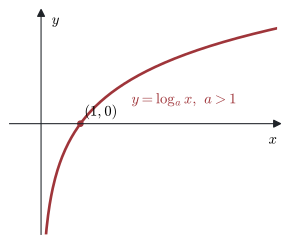
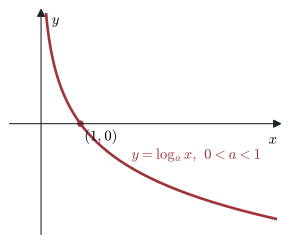
Key features of \(y = \log_a x\) (for every base \(a > 0\), \(a \neq 1\)) Not in the formula booklet
- The graph passes through \((1, 0)\), because \(\log_a 1 = 0\).
- Domain: \(x > 0\). The graph exists only to the right of the \(y\)-axis.
- The line \(x = 0\) (the \(y\)-axis) is a vertical asymptote.
- Range: \(y \in \mathbb{R}\).
- Increasing when \(a > 1\) (Figure 1); decreasing when \(0 < a < 1\) (Figure 2).
The link with \(y = a^x\)
\(y = a^{x}\) and \(y = \log_a x\) undo each other: \(\log_a\) takes the exponent back out of \(a^{x}\). If the point \((p, q)\) is on \(y = a^{x}\), then \((q, p)\) is on \(y = \log_a x\). So each graph is the reflection of the other in the line \(y = x\).
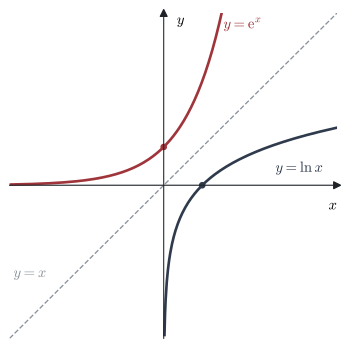
In Figure 3: the intercept \((0, 1)\) of \(y = \mathrm{e}^{x}\) becomes the intercept \((1, 0)\) of \(y = \ln x\), and the horizontal asymptote \(y = 0\) becomes the vertical asymptote \(x = 0\). (You will meet this idea again as inverse functions in Unit 9.)
Because \(a = \mathrm{e}^{\ln a}\), every exponential function can be written with base \(\mathrm{e}\) In the formula booklet
\[ a^{x} = \mathrm{e}^{x \ln a}. \]
Example 6 Let \(f(x) = \ln (x - 2) + 1\).
(a) Write down the domain of \(f\) and the equation of its vertical asymptote.
(b) Find the exact \(x\)-intercept of the graph of \(f\).
(a) We need \(x - 2 > 0\), so the domain is \(x > 2\). The vertical asymptote is \(x = 2\).
(b) Solve \(\ln (x - 2) + 1 = 0\):
\[ \ln (x - 2) = -1 \;\Longrightarrow\; x - 2 = \mathrm{e}^{-1} \;\Longrightarrow\; x = 2 + \mathrm{e}^{-1} . \]
The \(x\)-intercept is \(\left(2 + \dfrac{1}{\mathrm{e}},\, 0\right)\).
Logarithmic scales
When a quantity can range from tiny to huge, scientists often use a logarithmic scale. Each step of 1 on the scale means multiplying by 10. Examples are the pH scale in chemistry, the decibel scale for sound, and the moment magnitude scale for earthquakes.
Example 7 The acidity of a solution is measured by its pH:
\[ \text{pH} = -\log [\mathrm{H}^{+}], \]
where \([\mathrm{H}^{+}]\) is the hydrogen ion concentration in mol/L.
(a) Black coffee has \([\mathrm{H}^{+}] = 1 \times 10^{-5}\) mol/L. Find its pH.
(b) Vinegar has a pH of \(2.4\). Find its hydrogen ion concentration.
(c) A solution is diluted so that its hydrogen ion concentration is divided by \(100\). How does its pH change?
(a) \(\text{pH} = -\log 10^{-5} = -(-5) = 5\).
(b) \(2.4 = -\log [\mathrm{H}^{+}] \Rightarrow \log [\mathrm{H}^{+}] = -2.4\), so \([\mathrm{H}^{+}] = 10^{-2.4} \approx 3.98 \times 10^{-3}\) mol/L.
(c) New pH \(= -\log \dfrac{[\mathrm{H}^{+}]}{100} = -\left(\log [\mathrm{H}^{+}] - \log 100\right) = \text{pH} + 2\).
The pH increases by 2.
Common errors
| ✗ Wrong | ✓ Right | Why |
|---|---|---|
| Keeping \(x = -3\) in \(\log_2 (x - 1) + \ldots\) | Reject it | The number inside a log must be positive. |
| \(\log_2 (x - 1) + \log_2 (x + 1) = 3 \Rightarrow (x - 1) + (x + 1) = 8\) | \((x - 1)(x + 1) = 8\) | Adding logs multiplies the numbers inside. |
| \(\dfrac{\ln 24}{\ln 4.5} = \ln \dfrac{24}{4.5}\) | leave as \(\dfrac{\ln 24}{\ln 4.5}\) | A quotient of logs is not the log of a quotient. |
| \(\ln 3^{2x-1} = 2x - 1\ln 3\) | \((2x - 1)\ln 3\) | Keep brackets around the whole exponent. |
| \(y = \log_a x\) has a horizontal asymptote | It has a vertical asymptote \(x = 0\) | Reflecting in \(y = x\) turns horizontal into vertical. |
Exercises
1 Solve
(a) \(\log_2 x = 5\)
(b) \(\log_x 64 = 3\)
(c) \(\ln (2x - 1) = 0\)
(d) \(\log_9 x = -\dfrac{1}{2}\)
(a) \(x = 2^{5} = 32\) \(\qquad\) (b) \(x^{3} = 64 \Rightarrow x = 4\)
(c) \(2x - 1 = \mathrm{e}^{0} = 1 \Rightarrow x = 1\)
(d) \(x = 9^{-\frac{1}{2}} = \dfrac{1}{3}\)
2 Solve \(\log_3 (x + 4) + \log_3 (x - 4) = 2\).
\((x + 4)(x - 4) = 3^{2} \Rightarrow x^{2} - 16 = 9 \Rightarrow x = \pm 5\).
For \(x = -5\), \(x - 4 < 0\): reject. Answer: \(x = 5\).
3 Solve \(\log x + \log (x - 15) = 2\).
\(x(x - 15) = 10^{2} \Rightarrow x^{2} - 15x - 100 = 0 \Rightarrow (x - 20)(x + 5) = 0\).
\(x = -5\) makes \(\log x\) undefined: reject. Answer: \(x = 20\).
4 Solve \(2\ln x = \ln (x + 6)\).
\(\ln x^{2} = \ln (x + 6) \Rightarrow x^{2} = x + 6 \Rightarrow (x - 3)(x + 2) = 0\).
\(x = -2\) makes \(\ln x\) undefined: reject. Answer: \(x = 3\).
5 Solve \(4^{x} = 11\). Give your answer
(a) exactly,
(b) correct to 3 significant figures.
(a) \(x = \log_4 11 = \dfrac{\ln 11}{\ln 4}\)
(b) \(x \approx 1.73\)
6 Solve \(2^{x + 1} = 3^{x}\), giving your answer in the form \(\dfrac{\ln a}{\ln b}\), where \(a, b \in \mathbb{Q}\).
\((x + 1)\ln 2 = x\ln 3 \Rightarrow \ln 2 = x(\ln 3 - \ln 2) = x\ln \dfrac{3}{2}\).
\[ x = \frac{\ln 2}{\ln \frac{3}{2}} \;(\approx 1.71) \]
7 Solve \(\mathrm{e}^{2x} - 7\mathrm{e}^{x} + 12 = 0\), giving exact answers.
\(u = \mathrm{e}^{x}\): \(\;u^{2} - 7u + 12 = 0 \Rightarrow (u - 3)(u - 4) = 0\).
\(x = \ln 3\) or \(x = \ln 4\).
8 The population of a town is modelled by \(P = 12\,000 \times 1.025^{t}\) (see Section 1.2). Without a GDC, find an exact expression for the value of \(t\) when \(P = 20\,000\).
\(1.025^{t} = \dfrac{20\,000}{12\,000} = \dfrac{5}{3}\). Take \(\ln\) of both sides:
\[ t\ln 1.025 = \ln \frac{5}{3} \;\Longrightarrow\; t = \frac{\ln \frac{5}{3}}{\ln 1.025} \;(\approx 20.7). \]
9 Let \(f(x) = \log_2 (x + 4) - 1\).
(a) Write down the domain of \(f\) and the equation of the vertical asymptote.
(b) Find the intercepts of the graph with both axes.
(a) \(x + 4 > 0\), so the domain is \(x > -4\); asymptote \(x = -4\).
(b) \(y\)-intercept: \(f(0) = \log_2 4 - 1 = 2 - 1 = 1\), so \((0, 1)\).
\(x\)-intercept: \(\log_2 (x + 4) = 1 \Rightarrow x + 4 = 2 \Rightarrow x = -2\), so \((-2, 0)\).
10 The loudness \(L\) of a sound, in decibels, is \(L = 10\log \left(\dfrac{I}{I_0}\right)\), where \(I\) is the intensity of the sound and \(I_0\) is a fixed reference intensity.
(a) Find \(L\) for a sound with \(I = 10^{6}\,I_0\).
(b) Show that if the intensity is multiplied by 100, the loudness increases by 20 decibels.
(a) \(L = 10\log 10^{6} = 10 \times 6 = 60\) decibels.
(b) New loudness:
\[ 10\log \left(\frac{100I}{I_0}\right) = 10\left(\log 100 + \log \frac{I}{I_0}\right) = 20 + 10\log \frac{I}{I_0} = L + 20 . \]