20.4 The Scalar Product
AHL 3.13
- the definition of the scalar product (dot product) \(\boldsymbol{a} \cdot \boldsymbol{b} = |\boldsymbol{a}||\boldsymbol{b}|\cos\theta\)
- the properties of the scalar product, and how to use them in proofs
- the component formula \(\boldsymbol{a} \cdot \boldsymbol{b} = a_1 b_1 + a_2 b_2 + a_3 b_3\)
- how to find the angle between two vectors
- the tests for perpendicular and parallel vectors
- (Extension) the length of projection and the vector projection of one vector onto another
Definition
The scalar product of \(\boldsymbol{v}\) and \(\boldsymbol{w}\) is a number (a scalar), not a vector.
Scalar product (dot product) In the HL formula booklet
\[ \boldsymbol{v} \cdot \boldsymbol{w} = |\boldsymbol{v}|\,|\boldsymbol{w}|\cos\theta, \quad \text{where } \theta \text{ is the angle between } \boldsymbol{v} \text{ and } \boldsymbol{w} \]
- \(\boldsymbol{v}\), \(\boldsymbol{w}\): vectors
- \(|\boldsymbol{v}|\), \(|\boldsymbol{w}|\): the magnitudes of \(\boldsymbol{v}\) and \(\boldsymbol{w}\)
- \(\theta\): the angle between \(\boldsymbol{v}\) and \(\boldsymbol{w}\) (\(0 \leq \theta \leq \pi\))
We read \(\boldsymbol{v} \cdot \boldsymbol{w}\) as “\(\boldsymbol{v}\) dot \(\boldsymbol{w}\)”. (Any letters can be used: below we often use \(\boldsymbol{a}\) and \(\boldsymbol{b}\).) The angle \(\theta\) must be measured with the two vectors tail to tail (both pointing away from the same point). If the vectors are drawn head to tail, extend one of them first.
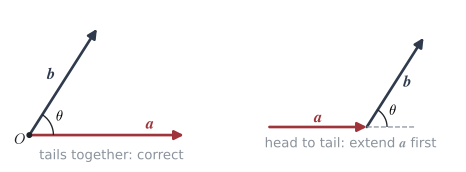
Properties of the scalar product
Properties of the scalar product Not in the formula booklet
- \(\boldsymbol{a} \cdot \boldsymbol{b} = \boldsymbol{b} \cdot \boldsymbol{a}\) (commutative)
- \(\boldsymbol{a} \cdot (\boldsymbol{b} + \boldsymbol{c}) = \boldsymbol{a} \cdot \boldsymbol{b} + \boldsymbol{a} \cdot \boldsymbol{c}\) (distributive)
- \(\lambda(\boldsymbol{a} \cdot \boldsymbol{b}) = (\lambda\boldsymbol{a}) \cdot \boldsymbol{b} = \boldsymbol{a} \cdot (\lambda\boldsymbol{b})\)
- \(\boldsymbol{a} \cdot \boldsymbol{a} = |\boldsymbol{a}|^2\) (because \(\theta = 0\) and \(\cos 0 = 1\))
- \(\boldsymbol{a} \cdot \boldsymbol{0} = 0\)
- For non-zero vectors: \(\;\boldsymbol{a} \perp \boldsymbol{b} \iff \boldsymbol{a} \cdot \boldsymbol{b} = 0\) (because \(\cos 90^\circ = 0\))
- If \(\boldsymbol{a} \parallel \boldsymbol{b}\) in the same direction, \(\boldsymbol{a} \cdot \boldsymbol{b} = |\boldsymbol{a}||\boldsymbol{b}|\); in opposite directions, \(\boldsymbol{a} \cdot \boldsymbol{b} = -|\boldsymbol{a}||\boldsymbol{b}|\)
- \(\boldsymbol{a}\), \(\boldsymbol{b}\), \(\boldsymbol{c}\): vectors
- \(\lambda\): a scalar (real number)
- \(\theta\): the angle between the two vectors
- \(\boldsymbol{0}\): the zero vector
Property 4 is the key to many problems: to find a length, find its square as a dot product, \(|\boldsymbol{v}|^2 = \boldsymbol{v} \cdot \boldsymbol{v}\), and then expand like algebra.
Example 1 Prove that the diagonals of a rhombus are perpendicular.
Let the rhombus be \(OACB\) with \(\overrightarrow{OA} = \boldsymbol{a}\) and \(\overrightarrow{OB} = \boldsymbol{b}\). In a rhombus all sides are equal, so \(|\boldsymbol{a}| = |\boldsymbol{b}|\).
The diagonals are \(\overrightarrow{OC} = \boldsymbol{a} + \boldsymbol{b}\) and \(\overrightarrow{BA} = \boldsymbol{a} - \boldsymbol{b}\).
\[ (\boldsymbol{a} + \boldsymbol{b}) \cdot (\boldsymbol{a} - \boldsymbol{b}) = \boldsymbol{a} \cdot \boldsymbol{a} - \boldsymbol{a} \cdot \boldsymbol{b} + \boldsymbol{b} \cdot \boldsymbol{a} - \boldsymbol{b} \cdot \boldsymbol{b} = |\boldsymbol{a}|^2 - |\boldsymbol{b}|^2 = 0 . \]
The scalar product is \(0\) and both diagonals are non-zero, so the diagonals are perpendicular. \(\;\blacksquare\) (A square is a special rhombus, so this is true for a square too.)
Example 2 Use vectors to prove the cosine rule \(c^2 = a^2 + b^2 - 2ab\cos C\) for a triangle \(ABC\).
Let \(\overrightarrow{CB} = \boldsymbol{p}\) and \(\overrightarrow{CA} = \boldsymbol{q}\). Then \(|\boldsymbol{p}| = a\), \(|\boldsymbol{q}| = b\), and the angle between \(\boldsymbol{p}\) and \(\boldsymbol{q}\) (tail to tail at \(C\)) is \(C\).
The third side is \(\overrightarrow{AB} = \boldsymbol{p} - \boldsymbol{q}\), with length \(c\). So
\[ \begin{aligned} c^2 = |\boldsymbol{p} - \boldsymbol{q}|^2 &= (\boldsymbol{p} - \boldsymbol{q}) \cdot (\boldsymbol{p} - \boldsymbol{q}) \\ &= \boldsymbol{p} \cdot \boldsymbol{p} - 2\,\boldsymbol{p} \cdot \boldsymbol{q} + \boldsymbol{q} \cdot \boldsymbol{q} \\ &= a^2 - 2ab\cos C + b^2 . \end{aligned} \]
So \(c^2 = a^2 + b^2 - 2ab\cos C\). \(\;\blacksquare\)
Example 3 Given that \(|\boldsymbol{a}| = 2\), \(|\boldsymbol{b}| = 3\) and the angle between \(\boldsymbol{a}\) and \(\boldsymbol{b}\) is \(120^\circ\), find
(a) \(\boldsymbol{a} \cdot \boldsymbol{b}\)
(b) \((2\boldsymbol{a} - \boldsymbol{b}) \cdot (\boldsymbol{a} + 3\boldsymbol{b})\)
(c) \(|\boldsymbol{a} - \boldsymbol{b}|\)
(a) \(\boldsymbol{a} \cdot \boldsymbol{b} = 2 \times 3 \times \cos 120^\circ = 6 \times \left(-\dfrac{1}{2}\right) = -3\).
(b) Expand like brackets:
\[ \begin{aligned} (2\boldsymbol{a} - \boldsymbol{b}) \cdot (\boldsymbol{a} + 3\boldsymbol{b}) &= 2\,\boldsymbol{a} \cdot \boldsymbol{a} + 6\,\boldsymbol{a} \cdot \boldsymbol{b} - \boldsymbol{b} \cdot \boldsymbol{a} - 3\,\boldsymbol{b} \cdot \boldsymbol{b} \\ &= 2|\boldsymbol{a}|^2 + 5\,\boldsymbol{a} \cdot \boldsymbol{b} - 3|\boldsymbol{b}|^2 \\ &= 2(4) + 5(-3) - 3(9) \\ &= -34 . \end{aligned} \]
(c) \(|\boldsymbol{a} - \boldsymbol{b}|^2 = |\boldsymbol{a}|^2 - 2\,\boldsymbol{a} \cdot \boldsymbol{b} + |\boldsymbol{b}|^2 = 4 + 6 + 9 = 19\), so \(|\boldsymbol{a} - \boldsymbol{b}| = \sqrt{19}\).
The scalar product in components
The base vectors are unit vectors and are perpendicular to each other, so
\[ \boldsymbol{i} \cdot \boldsymbol{i} = \boldsymbol{j} \cdot \boldsymbol{j} = \boldsymbol{k} \cdot \boldsymbol{k} = 1, \qquad \boldsymbol{i} \cdot \boldsymbol{j} = \boldsymbol{j} \cdot \boldsymbol{k} = \boldsymbol{k} \cdot \boldsymbol{i} = 0 . \]
Expanding \((a_1\boldsymbol{i} + a_2\boldsymbol{j} + a_3\boldsymbol{k}) \cdot (b_1\boldsymbol{i} + b_2\boldsymbol{j} + b_3\boldsymbol{k})\) gives nine terms, but only three are not zero.
Scalar product in components In the HL formula booklet
\[ \boldsymbol{v} \cdot \boldsymbol{w} = v_1 w_1 + v_2 w_2 + v_3 w_3, \quad \text{where } \boldsymbol{v} = \begin{pmatrix} v_1 \\ v_2 \\ v_3 \end{pmatrix}, \; \boldsymbol{w} = \begin{pmatrix} w_1 \\ w_2 \\ w_3 \end{pmatrix} \]
In 2D: \(\;\begin{pmatrix} v_1 \\ v_2 \end{pmatrix} \cdot \begin{pmatrix} w_1 \\ w_2 \end{pmatrix} = v_1 w_1 + v_2 w_2\).
- \(\boldsymbol{v}\), \(\boldsymbol{w}\): vectors
- \(v_1\), \(v_2\), \(v_3\): the components of \(\boldsymbol{v}\)
- \(w_1\), \(w_2\), \(w_3\): the components of \(\boldsymbol{w}\)
Example 4 It is given that \(\boldsymbol{a} = 2\boldsymbol{i} - \boldsymbol{j} + 3\boldsymbol{k}\) and \(\boldsymbol{b} = 4\boldsymbol{i} + 2\boldsymbol{j} - \boldsymbol{k}\).
(a) Find \(\boldsymbol{a} \cdot \boldsymbol{b}\).
(b) The vector \(\boldsymbol{c} = \boldsymbol{i} + \lambda\boldsymbol{j} - 2\boldsymbol{k}\) is perpendicular to \(\boldsymbol{a}\). Find \(\lambda\).
(a) \(\boldsymbol{a} \cdot \boldsymbol{b} = 2(4) + (-1)(2) + 3(-1) = 8 - 2 - 3 = 3\).
(b) \(\boldsymbol{a} \cdot \boldsymbol{c} = 2(1) + (-1)\lambda + 3(-2) = -4 - \lambda = 0\), so \(\lambda = -4\).
The angle between two vectors
Rearranging the definition gives the angle.
Angle between two vectors In the HL formula booklet
\[ \cos\theta = \frac{v_1 w_1 + v_2 w_2 + v_3 w_3}{|\boldsymbol{v}|\,|\boldsymbol{w}|} = \frac{\boldsymbol{v} \cdot \boldsymbol{w}}{|\boldsymbol{v}|\,|\boldsymbol{w}|}, \qquad 0 \leq \theta \leq \pi \]
- \(\theta\): the angle between \(\boldsymbol{v}\) and \(\boldsymbol{w}\)
- \(v_1\), \(v_2\), \(v_3\): the components of \(\boldsymbol{v}\)
- \(w_1\), \(w_2\), \(w_3\): the components of \(\boldsymbol{w}\)
- \(|\boldsymbol{v}|\), \(|\boldsymbol{w}|\): the magnitudes of \(\boldsymbol{v}\) and \(\boldsymbol{w}\)
- If \(\boldsymbol{v} \cdot \boldsymbol{w} > 0\), the angle is acute.
- If \(\boldsymbol{v} \cdot \boldsymbol{w} = 0\), the angle is a right angle.
- If \(\boldsymbol{v} \cdot \boldsymbol{w} < 0\), the angle is obtuse.
To find an angle of a triangle, such as \(\angle ABC\), use the two vectors that start at the vertex \(B\): \(\overrightarrow{BA}\) and \(\overrightarrow{BC}\). Both must point away from \(B\) (or both towards \(B\)).
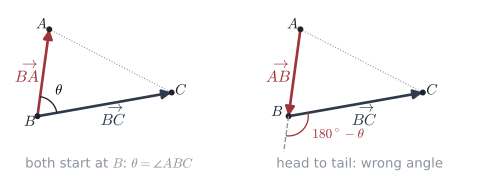
Example 5 The points \(A(1, 0, 2)\), \(B(3, -1, 4)\) and \(C(2, 2, 1)\) are given. Use scalar products to find
(a) \(\angle ABC\) \(\qquad\) (b) \(\angle CAB\)
(a) \(\overrightarrow{BA} = \begin{pmatrix} -2 \\ 1 \\ -2 \end{pmatrix}\) and \(\overrightarrow{BC} = \begin{pmatrix} -1 \\ 3 \\ -3 \end{pmatrix}\).
\(\overrightarrow{BA} \cdot \overrightarrow{BC} = 2 + 3 + 6 = 11\), \(\;\big|\overrightarrow{BA}\big| = \sqrt{9} = 3\), \(\;\big|\overrightarrow{BC}\big| = \sqrt{19}\).
\[ \cos \angle ABC = \frac{11}{3\sqrt{19}} \quad\Longrightarrow\quad \angle ABC = 32.7^\circ \;(3 \text{ s.f.}). \]
(b) \(\overrightarrow{AB} = \begin{pmatrix} 2 \\ -1 \\ 2 \end{pmatrix}\) and \(\overrightarrow{AC} = \begin{pmatrix} 1 \\ 2 \\ -1 \end{pmatrix}\).
\(\overrightarrow{AB} \cdot \overrightarrow{AC} = 2 - 2 - 2 = -2\), \(\;\big|\overrightarrow{AB}\big| = 3\), \(\;\big|\overrightarrow{AC}\big| = \sqrt{6}\).
\[ \cos \angle CAB = \frac{-2}{3\sqrt{6}} \quad\Longrightarrow\quad \angle CAB = 105.8^\circ \;(\text{1 d.p.}). \]
The dot product is negative, so this angle is obtuse, as expected. On Paper 1 you would usually be asked only for the exact value of the cosine.
On a Calculator page, enter vectors in square brackets, for example [-2,1,-2].
- Menu → Matrix & Vector → Vector → Dot Product gives
dotP([-2,1,-2],[-1,3,-3])\(= 11\). - Menu → Matrix & Vector → Norms → Norm gives the magnitude, for example
norm([-1,3,-3])\(= \sqrt{19}\).
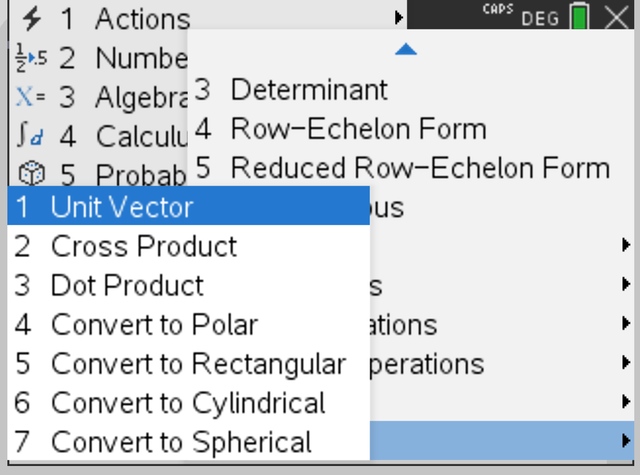
For the angle (in Degree mode), type
cos⁻¹(dotP(u,v)/(norm(u)·norm(v)))
after storing the vectors as u and v (for example [-2,1,-2]→u). This gives \(32.73\ldots^\circ\) for Example 5 (a).
Perpendicular and parallel vectors
Tests for non-zero vectors \(\boldsymbol{a}\) and \(\boldsymbol{b}\) Not in the formula booklet
- Perpendicular: \(\;\boldsymbol{a} \cdot \boldsymbol{b} = 0\).
- Parallel: \(\;|\boldsymbol{a} \cdot \boldsymbol{b}| = |\boldsymbol{a}|\,|\boldsymbol{b}|\) (that is, \(\cos\theta = \pm 1\)). In practice, it is often quicker to check that \(\boldsymbol{a} = k\boldsymbol{b}\).
- \(\boldsymbol{a}\), \(\boldsymbol{b}\): non-zero vectors
- \(\theta\): the angle between \(\boldsymbol{a}\) and \(\boldsymbol{b}\)
- \(k\): a non-zero scalar (real number)
Example 6 Let \(\boldsymbol{a} = \begin{pmatrix} 2 \\ -1 \\ 2 \end{pmatrix}\), \(\boldsymbol{b} = \begin{pmatrix} 1 \\ 4 \\ 1 \end{pmatrix}\) and \(\boldsymbol{c} = \begin{pmatrix} -4 \\ 2 \\ -4 \end{pmatrix}\). Show that \(\boldsymbol{a}\) is perpendicular to \(\boldsymbol{b}\), and that \(\boldsymbol{a}\) is parallel to \(\boldsymbol{c}\).
\(\boldsymbol{a} \cdot \boldsymbol{b} = 2 - 4 + 2 = 0\), so \(\boldsymbol{a} \perp \boldsymbol{b}\).
\(\boldsymbol{a} \cdot \boldsymbol{c} = -8 - 2 - 8 = -18\), and \(|\boldsymbol{a}||\boldsymbol{c}| = 3 \times 6 = 18\). So \(|\boldsymbol{a} \cdot \boldsymbol{c}| = |\boldsymbol{a}||\boldsymbol{c}|\): the vectors are parallel. The dot product is negative, so they point in opposite directions. (Indeed \(\boldsymbol{c} = -2\boldsymbol{a}\).)
Extension Length of projection
The IB guide does not list projections for AA. They are included here because they give a quick way to find distances. They also appear again in later vector units.
In the diagram, \(C\) is the foot of the perpendicular from \(A\) to the line \(OB\). The length \(OC\) is the length of projection of \(\boldsymbol{a}\) onto \(\boldsymbol{b}\).
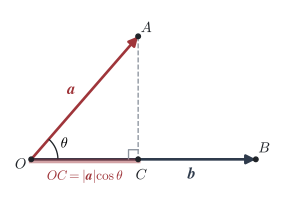
In the right-angled triangle \(OCA\), \(\;OC = |\boldsymbol{a}|\cos\theta\). Since \(\boldsymbol{a} \cdot \hat{\boldsymbol{b}} = |\boldsymbol{a}| \times 1 \times \cos\theta\),
Length of projection of \(\boldsymbol{a}\) onto \(\boldsymbol{b}\) Not in the formula booklet
\[ \big|\boldsymbol{a} \cdot \hat{\boldsymbol{b}}\big| = \frac{|\boldsymbol{a} \cdot \boldsymbol{b}|}{|\boldsymbol{b}|} \]
- \(\boldsymbol{a}\), \(\boldsymbol{b}\): non-zero vectors
- \(\hat{\boldsymbol{b}}\): the unit vector in the direction of \(\boldsymbol{b}\)
- \(|\boldsymbol{b}|\): the magnitude of \(\boldsymbol{b}\)
(The absolute value is needed when \(\theta\) is obtuse, because then \(\cos\theta < 0\) but a length is positive.)
Extension Vector projection
The vector projection of \(\boldsymbol{a}\) onto \(\boldsymbol{b}\) is the vector \(\overrightarrow{OC}\). It has length \(\boldsymbol{a} \cdot \hat{\boldsymbol{b}}\) and the direction of \(\hat{\boldsymbol{b}}\):
Vector projection of \(\boldsymbol{a}\) onto \(\boldsymbol{b}\) Not in the formula booklet
\[ \overrightarrow{OC} = \big(\boldsymbol{a} \cdot \hat{\boldsymbol{b}}\big)\,\hat{\boldsymbol{b}} = \frac{\boldsymbol{a} \cdot \boldsymbol{b}}{|\boldsymbol{b}|^2}\,\boldsymbol{b} \]
- \(\overrightarrow{OC}\): the vector projection (\(C\) is the foot of the perpendicular from \(A\) to the line \(OB\))
- \(\boldsymbol{a}\), \(\boldsymbol{b}\): non-zero vectors
- \(\hat{\boldsymbol{b}}\): the unit vector in the direction of \(\boldsymbol{b}\)
- \(|\boldsymbol{b}|\): the magnitude of \(\boldsymbol{b}\)
Example 7 Given \(\boldsymbol{a} = \begin{pmatrix} 4 \\ -1 \\ 3 \end{pmatrix}\) and \(\boldsymbol{b} = \begin{pmatrix} 2 \\ 2 \\ 1 \end{pmatrix}\), find the length of projection of
(a) \(\boldsymbol{a}\) onto \(\boldsymbol{b}\),
(b) \(\boldsymbol{b}\) onto \(\boldsymbol{a}\).
\(\boldsymbol{a} \cdot \boldsymbol{b} = 8 - 2 + 3 = 9\), \(\;|\boldsymbol{b}| = 3\), \(\;|\boldsymbol{a}| = \sqrt{16 + 1 + 9} = \sqrt{26}\).
(a) \(\dfrac{9}{3} = 3\).
(b) \(\dfrac{9}{\sqrt{26}} = \dfrac{9\sqrt{26}}{26}\).
The two answers are different: projecting \(\boldsymbol{a}\) onto \(\boldsymbol{b}\) is not the same as projecting \(\boldsymbol{b}\) onto \(\boldsymbol{a}\).
Example 8 The points \(A\), \(B\), \(C\), \(D\) are \((1, 2, 0)\), \((4, 6, 1)\), \((0, 1, 3)\) and \((2, 3, 4)\). Find the length of projection of \(\overrightarrow{AB}\) onto \(\overrightarrow{CD}\), and the vector projection of \(\overrightarrow{AB}\) onto \(\overrightarrow{CD}\).
\(\overrightarrow{AB} = \begin{pmatrix} 3 \\ 4 \\ 1 \end{pmatrix}\), \(\overrightarrow{CD} = \begin{pmatrix} 2 \\ 2 \\ 1 \end{pmatrix}\), \(\big|\overrightarrow{CD}\big| = 3\), and \(\overrightarrow{AB} \cdot \overrightarrow{CD} = 6 + 8 + 1 = 15\).
Length of projection: \(\dfrac{15}{3} = 5\).
Vector projection: \(5 \times \dfrac{1}{3}\begin{pmatrix} 2 \\ 2 \\ 1 \end{pmatrix} = \dfrac{5}{3}\begin{pmatrix} 2 \\ 2 \\ 1 \end{pmatrix} = \begin{pmatrix} 10/3 \\ 10/3 \\ 5/3 \end{pmatrix}\).
Common errors
| ✗ Wrong | ✓ Right | Why |
|---|---|---|
| \(\boldsymbol{a} \cdot \boldsymbol{b} = \begin{pmatrix} a_1 b_1 \\ a_2 b_2 \\ a_3 b_3 \end{pmatrix}\) | \(\boldsymbol{a} \cdot \boldsymbol{b} = a_1 b_1 + a_2 b_2 + a_3 b_3\) | The scalar product is a number, not a vector. |
| \(\angle ABC\) from \(\overrightarrow{AB}\) and \(\overrightarrow{BC}\) | Use \(\overrightarrow{BA}\) and \(\overrightarrow{BC}\) | Both vectors must start at the vertex \(B\); otherwise you get \(180^\circ - \angle ABC\). |
| \(\vert\boldsymbol{a} + \boldsymbol{b}\vert^2 = \vert\boldsymbol{a}\vert^2 + \vert\boldsymbol{b}\vert^2\) | \(\vert\boldsymbol{a}\vert^2 + 2\,\boldsymbol{a} \cdot \boldsymbol{b} + \vert\boldsymbol{b}\vert^2\) | Expand \((\boldsymbol{a} + \boldsymbol{b}) \cdot (\boldsymbol{a} + \boldsymbol{b})\) fully. |
| \(\boldsymbol{a} \cdot \boldsymbol{a} = \boldsymbol{a}^2\), so \(\vert\boldsymbol{a}\vert = \boldsymbol{a}\) | \(\boldsymbol{a} \cdot \boldsymbol{a} = \vert\boldsymbol{a}\vert^2\) | A vector is not a number; take the magnitude. |
| \(\boldsymbol{a} \cdot \boldsymbol{b} = \boldsymbol{a} \cdot \boldsymbol{c} \Rightarrow \boldsymbol{b} = \boldsymbol{c}\) | \(\boldsymbol{a} \cdot (\boldsymbol{b} - \boldsymbol{c}) = 0\) | You cannot “divide by \(\boldsymbol{a}\)”: \(\boldsymbol{b} - \boldsymbol{c}\) may just be perpendicular to \(\boldsymbol{a}\). |
Exercises
1 Find \(\boldsymbol{a} \cdot \boldsymbol{b}\) for \(\boldsymbol{a} = \begin{pmatrix} 3 \\ -2 \\ 1 \end{pmatrix}\) and \(\boldsymbol{b} = \begin{pmatrix} -1 \\ 4 \\ 5 \end{pmatrix}\). Is the angle between them acute or obtuse?
\(\boldsymbol{a} \cdot \boldsymbol{b} = -3 - 8 + 5 = -6\). It is negative, so the angle is obtuse.
2 (a) \(|\boldsymbol{a}| = 5\), \(|\boldsymbol{b}| = 2\) and the angle between them is \(45^\circ\). Find \(\boldsymbol{a} \cdot \boldsymbol{b}\).
(b) \(|\boldsymbol{p}| = 4\), \(|\boldsymbol{q}| = 3\) and \(\boldsymbol{p} \cdot \boldsymbol{q} = 6\). Find the angle between \(\boldsymbol{p}\) and \(\boldsymbol{q}\).
(a) \(5 \times 2 \times \cos 45^\circ = 10 \times \dfrac{\sqrt{2}}{2} = 5\sqrt{2}\).
(b) \(\cos\theta = \dfrac{6}{12} = \dfrac{1}{2}\), so \(\theta = 60^\circ\).
3 Find the angle between \(\boldsymbol{u} = \boldsymbol{i} + 2\boldsymbol{j} + 2\boldsymbol{k}\) and \(\boldsymbol{v} = 2\boldsymbol{i} - \boldsymbol{j} + 2\boldsymbol{k}\), to the nearest \(0.1^\circ\).
\(\boldsymbol{u} \cdot \boldsymbol{v} = 2 - 2 + 4 = 4\), \(\;|\boldsymbol{u}| = |\boldsymbol{v}| = 3\). \(\;\cos\theta = \dfrac{4}{9}\), so \(\theta = 63.6^\circ\).
4 (a) Find \(t\) such that \(\begin{pmatrix} t \\ -3 \\ 2 \end{pmatrix}\) is perpendicular to \(\begin{pmatrix} 4 \\ t \\ 5 \end{pmatrix}\).
(b) Use the scalar product to show that \(\begin{pmatrix} 2 \\ -4 \\ 6 \end{pmatrix}\) and \(\begin{pmatrix} -3 \\ 6 \\ -9 \end{pmatrix}\) are parallel.
(a) \(4t - 3t + 10 = 0\), so \(t = -10\).
(b) Dot product: \(-6 - 24 - 54 = -84\). Magnitudes: \(\sqrt{56}\) and \(\sqrt{126}\), with \(\sqrt{56}\sqrt{126} = \sqrt{7056} = 84\). So \(|\boldsymbol{a} \cdot \boldsymbol{b}| = |\boldsymbol{a}||\boldsymbol{b}|\), \(\cos\theta = -1\): parallel, in opposite directions.
5 \(|\boldsymbol{a}| = 3\), \(|\boldsymbol{b}| = 5\) and \(\boldsymbol{a} \cdot \boldsymbol{b} = -4\). Find
(a) \((\boldsymbol{a} + \boldsymbol{b}) \cdot (\boldsymbol{a} - 2\boldsymbol{b})\)
(b) \(|\boldsymbol{a} + \boldsymbol{b}|\)
(a) \(|\boldsymbol{a}|^2 - 2\,\boldsymbol{a} \cdot \boldsymbol{b} + \boldsymbol{b} \cdot \boldsymbol{a} - 2|\boldsymbol{b}|^2 = 9 - \boldsymbol{a} \cdot \boldsymbol{b} - 50 = 9 + 4 - 50 = -37\).
(b) \(|\boldsymbol{a} + \boldsymbol{b}|^2 = 9 + 2(-4) + 25 = 26\), so \(|\boldsymbol{a} + \boldsymbol{b}| = \sqrt{26}\).
6 The points \(A(2, 1, 0)\), \(B(4, 3, 1)\) and \(C(3, -1, 2)\) form a triangle. Show that the triangle has a right angle at \(A\), and find its area.
\(\overrightarrow{AB} = \begin{pmatrix} 2 \\ 2 \\ 1 \end{pmatrix}\), \(\overrightarrow{AC} = \begin{pmatrix} 1 \\ -2 \\ 2 \end{pmatrix}\), and \(\overrightarrow{AB} \cdot \overrightarrow{AC} = 2 - 4 + 2 = 0\). So \(\angle BAC = 90^\circ\).
Area \(= \dfrac{1}{2} \times AB \times AC = \dfrac{1}{2} \times 3 \times 3 = \dfrac{9}{2}\).
7 The points \(A(3, 0, 1)\), \(B(1, 2, 0)\) and \(C(4, 3, 3)\) are given. Find the exact value of \(\cos\angle ABC\), and hence find \(\angle ABC\).
\(\overrightarrow{BA} = \begin{pmatrix} 2 \\ -2 \\ 1 \end{pmatrix}\), \(\overrightarrow{BC} = \begin{pmatrix} 3 \\ 1 \\ 3 \end{pmatrix}\). Dot product \(= 6 - 2 + 3 = 7\); magnitudes \(3\) and \(\sqrt{19}\).
\(\cos\angle ABC = \dfrac{7}{3\sqrt{19}}\), so \(\angle ABC = 57.6^\circ\) (1 d.p.).
8 \(\boldsymbol{a}\) and \(\boldsymbol{b}\) are unit vectors and the angle between them is \(\dfrac{\pi}{3}\).
(a) Find \(|2\boldsymbol{a} - \boldsymbol{b}|\).
(b) Show that \(2\boldsymbol{a} - \boldsymbol{b}\) is perpendicular to \(\boldsymbol{b}\).
\(\boldsymbol{a} \cdot \boldsymbol{b} = 1 \times 1 \times \cos\dfrac{\pi}{3} = \dfrac{1}{2}\).
(a) \(|2\boldsymbol{a} - \boldsymbol{b}|^2 = 4|\boldsymbol{a}|^2 - 4\,\boldsymbol{a} \cdot \boldsymbol{b} + |\boldsymbol{b}|^2 = 4 - 2 + 1 = 3\), so \(|2\boldsymbol{a} - \boldsymbol{b}| = \sqrt{3}\).
(b) \((2\boldsymbol{a} - \boldsymbol{b}) \cdot \boldsymbol{b} = 2\,\boldsymbol{a} \cdot \boldsymbol{b} - |\boldsymbol{b}|^2 = 1 - 1 = 0\), so they are perpendicular.
9 \(AB\) is a diameter of a circle with centre \(O\), and \(P\) is any other point on the circle. Let \(\overrightarrow{OB} = \boldsymbol{b}\) and \(\overrightarrow{OP} = \boldsymbol{p}\). Use the scalar product to prove that \(\angle APB = 90^\circ\).
\(\overrightarrow{OA} = -\boldsymbol{b}\), and \(|\boldsymbol{p}| = |\boldsymbol{b}|\) (both are radii).
\(\overrightarrow{AP} = \boldsymbol{p} + \boldsymbol{b}\) and \(\overrightarrow{BP} = \boldsymbol{p} - \boldsymbol{b}\). Then
\[ \overrightarrow{AP} \cdot \overrightarrow{BP} = (\boldsymbol{p} + \boldsymbol{b}) \cdot (\boldsymbol{p} - \boldsymbol{b}) = |\boldsymbol{p}|^2 - |\boldsymbol{b}|^2 = 0 . \]
Both vectors are non-zero, so \(AP \perp BP\) and \(\angle APB = 90^\circ\) (the angle in a semicircle). \(\;\blacksquare\)
10 Extension Given \(\boldsymbol{a} = \begin{pmatrix} 1 \\ 2 \\ -2 \end{pmatrix}\) and \(\boldsymbol{b} = \begin{pmatrix} 6 \\ 2 \\ 3 \end{pmatrix}\), find the length of projection and the vector projection of \(\boldsymbol{a}\) onto \(\boldsymbol{b}\).
\(\boldsymbol{a} \cdot \boldsymbol{b} = 6 + 4 - 6 = 4\) and \(|\boldsymbol{b}| = \sqrt{36 + 4 + 9} = 7\).
Length of projection \(= \dfrac{4}{7}\). \(\qquad\) Vector projection \(= \dfrac{4}{49}\begin{pmatrix} 6 \\ 2 \\ 3 \end{pmatrix}\).