24.8 Further Optimisation
AHL 5.14
This section is for HL students. It builds on 24.7.
- how to solve optimisation problems that use the HL derivatives of \(\sec\), \(\csc\) and \(\arctan\)
- why you must also check the end points of the domain: sometimes the optimum is there
Optimisation with further functions
The method of 24.7 works for any function you can differentiate. At HL this includes \(\sec\theta\), \(\csc\theta\) and \(\arctan x\) (see 23.5).
Example 1 Two corridors meet at right angles. They are \(3\) m and \(2.4\) m wide. A long thin straight pipe \(AB\) is carried horizontally around the corner. In the position shown it touches the inner corner and makes an angle \(\theta\) with the walls of the narrower corridor.
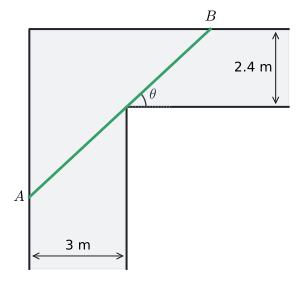
(a) Show that the length of \(AB\) is \(L = 3\sec\theta + 2.4\csc\theta\).
(b) Show that \(\frac{dL}{d\theta} = 0\) when \(\tan^3\theta = 0.8\).
(c) Find \(L\) for this value of \(\theta\). Explain what this value means.
(a) The inner corner divides \(AB\) into two parts. In the \(3\) m corridor, \(\cos\theta = \frac{3}{\text{part}}\), so this part is \(\frac{3}{\cos\theta} = 3\sec\theta\). In the \(2.4\) m corridor, \(\sin\theta = \frac{2.4}{\text{part}}\), so this part is \(2.4\csc\theta\). Add them.
(b) \(\frac{dL}{d\theta} = 3\sec\theta\tan\theta - 2.4\csc\theta\cot\theta = \frac{3\sin\theta}{\cos^2\theta} - \frac{2.4\cos\theta}{\sin^2\theta}\).
Setting this to \(0\): \(3\sin^3\theta = 2.4\cos^3\theta\), so \(\tan^3\theta = \frac{2.4}{3} = 0.8\).
(c) \(\theta = \arctan\sqrt[3]{0.8} \approx 0.748\) rad (\(\approx 42.9°\)). Then \(L \approx 7.62\) m.
As \(\theta \to 0\) or \(\theta \to \frac{\pi}{2}\), \(L \to \infty\), so this stationary value is the minimum of \(L\). A pipe can turn the corner only if it fits in every position, so the longest pipe that can be carried around the corner is about \(7.62\) m.
When the optimum is at an end point
A stationary point gives a local maximum or minimum. In a practical problem the variable often has a restricted domain \(a \le x \le b\). The greatest or least value may then be at an end point, where \(f'(x)\) need not be zero.
Global maximum and minimum on \([a, b]\)
Find \(f\) at every stationary point and at \(x = a\) and \(x = b\). The largest of these values is the global maximum, and the smallest is the global minimum.
Example 2 A wire of length \(40\) cm is cut into two pieces. A piece of length \(x\) cm is bent into a square, and the rest is bent into a circle.
(a) Show that the total area enclosed is \(A = \dfrac{x^2}{16} + \dfrac{(40 - x)^2}{4\pi}\), for \(0 \le x \le 40\).
(b) Find the value of \(x\) that gives the minimum total area.
(c) How should the wire be used to make the total area as large as possible?
(a) Square: side \(\frac{x}{4}\), area \(\frac{x^2}{16}\). Circle: \(2\pi r = 40 - x\), so \(r = \frac{40 - x}{2\pi}\) and the area is \(\pi r^2 = \frac{(40 - x)^2}{4\pi}\).
(b) \(\frac{dA}{dx} = \frac{x}{8} - \frac{40 - x}{2\pi} = 0 \Rightarrow \pi x = 4(40 - x) \Rightarrow x = \frac{160}{\pi + 4} \approx 22.4\) cm.
\(\frac{d^2A}{dx^2} = \frac{1}{8} + \frac{1}{2\pi} > 0\), so this is a minimum (area \(\frac{400}{\pi + 4} \approx 56.0\) cm\(^2\)).
(c) The only stationary point is a minimum, so the maximum must be at an end point:
\[ A(0) = \frac{1600}{4\pi} = \frac{400}{\pi} \approx 127 \text{ cm}^2, \qquad A(40) = \frac{1600}{16} = 100 \text{ cm}^2 . \]
The largest area is \(\frac{400}{\pi}\) cm\(^2\), when \(x = 0\): do not cut the wire; bend all of it into a circle.
Common errors
| ✗ Wrong | ✓ Right | Why |
|---|---|---|
| Checking only the stationary points on \(a \le x \le b\) | Also find \(f(a)\) and \(f(b)\) | The global maximum or minimum may be at an end point, where \(f'(x) \neq 0\). |
| Calling a local maximum the greatest value | Compare it with the end-point values | A local maximum is only the largest value near that point. |
Exercises
1 A picture on a wall has its bottom edge \(1\) m and its top edge \(4\) m above a viewer’s eye level. The viewer stands \(x\) m from the wall. The angle \(\theta\) subtended by the picture at the eye is \(\theta = \arctan\frac{4}{x} - \arctan\frac{1}{x}\).
(a) Show that \(\frac{d\theta}{dx} = \frac{1}{x^2 + 1} - \frac{4}{x^2 + 16}\).
(b) Find the distance \(x\) that gives the largest viewing angle, and this angle.
(a) \(\frac{d}{dx}\arctan\frac{a}{x} = \frac{1}{1 + \frac{a^2}{x^2}} \times \left(-\frac{a}{x^2}\right) = -\frac{a}{x^2 + a^2}\). So \(\frac{d\theta}{dx} = -\frac{4}{x^2 + 16} + \frac{1}{x^2 + 1}\).
(b) \(\frac{1}{x^2 + 1} = \frac{4}{x^2 + 16} \Rightarrow x^2 + 16 = 4x^2 + 4 \Rightarrow x^2 = 4 \Rightarrow x = 2\).
For \(x < 2\), \(\frac{d\theta}{dx} > 0\); for \(x > 2\), \(\frac{d\theta}{dx} < 0\): maximum.
\(\tan\theta = \frac{2 - \frac{1}{2}}{1 + 2 \times \frac{1}{2}} = \frac{3}{4}\), so \(\theta = \arctan\frac{3}{4} \approx 0.644\) rad (\(\approx 36.9°\)).
2 Find the global maximum and global minimum values of \(f(x) = x^3 - 12x + 1\) on the interval \(-3 \le x \le 5\).
\(f'(x) = 3x^2 - 12 = 0 \Rightarrow x = \pm 2\): \(f(-2) = 17\), \(f(2) = -15\).
End points: \(f(-3) = -27 + 36 + 1 = 10\), \(f(5) = 125 - 60 + 1 = 66\).
Global maximum \(66\) at \(x = 5\) (an end point, not the local maximum); global minimum \(-15\) at \(x = 2\).