Unit 10 Exam Practice
Further Functions
These questions are written in the style of IB examination questions, and they are harder than the review exercises. The marks for each part are shown in square brackets on the right, for example [3]. Paper 1 means no calculator; Paper 2 means a graphic display calculator (GDC) is allowed. Try each question under exam conditions first, then open the markscheme.
| Mark | Meaning |
|---|---|
| M | Method mark: a correct method is used, even with a small slip |
| A | Accuracy mark: a correct answer or line of working (usually needs the M mark before it) |
| R | Reasoning mark: a clear reason or justification is given |
| N | Mark for a correct final answer with no working shown |
| AG | “Answer given” in the question, so no extra mark is awarded for writing it |
The number after the letter is the number of marks, so A2 is worth 2 marks. In the exam, give answers exactly or correct to 3 significant figures (s.f.) unless the question says otherwise.
SL questions
SL 1 Paper 1
Let \(f(x) = \dfrac{x + 10}{x - 2}\), \(x \neq 2\), and \(g(x) = 2x + k\), \(x \in \mathbb{R}\), where \(k\) is a constant.
(a) Find an expression for \((f \circ g)(x)\) in terms of \(x\) and \(k\). [2]
The graph of \(y = (f \circ g)(x)\) has a vertical asymptote \(x = -1\).
(b) Find the value of \(k\). [2]
(c) Write down the equation of the horizontal asymptote of the graph of \(y = (f \circ g)(x)\). [1]
(d) Solve the equation \((f \circ g)(x) = g(x)\). [3]
Total 8 marks
(a)
\((f \circ g)(x) = f(2x + k)\) M1
\(= \dfrac{2x + k + 10}{2x + k - 2}\) A1
[2 marks]
(b)
the denominator is zero at \(x = -1\): \(2(-1) + k - 2 = 0\) M1
\(k = 4\) A1
[2 marks]
(c)
\(y = 1\) A1
[1 mark]
(d)
\(\dfrac{2x + 14}{2x + 2} = 2x + 4\) M1
\(2x + 14 = 4x^{2} + 12x + 8 \;\Rightarrow\; 2x^{2} + 5x - 3 = 0\) A1
\((2x - 1)(x + 3) = 0\), so \(x = \dfrac{1}{2}\) or \(x = -3\) A1
[3 marks]
SL 2 Paper 1
The diagram shows the graph of \(f(x) = \dfrac{ax + b}{x + c}\), \(x \neq -c\). The lines \(x = -3\) and \(y = 2\) are asymptotes of the graph, and the graph meets the \(y\)-axis at \((0, -1)\).
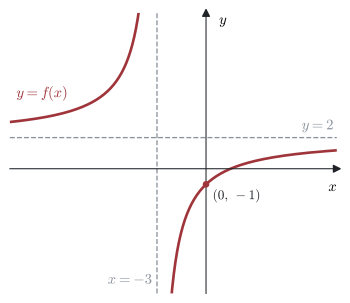
(a) Write down the value of \(a\) and the value of \(c\). Hence find the value of \(b\). [3]
(b) Find \(f^{-1}(x)\). [2]
(c) Show that the graphs of \(y = f(x)\) and \(y = f^{-1}(x)\) do not intersect. [3]
Total 8 marks
(a)
\(c = 3\) A1
\(a = 2\) A1
\(f(0) = \dfrac{b}{3} = -1\), so \(b = -3\) A1
[3 marks]
(b)
\(x = \dfrac{2y - 3}{y + 3}\) (interchanging \(x\) and \(y\)) M1
\(xy + 3x = 2y - 3 \;\Rightarrow\; y(2 - x) = 3x + 3\)
\(f^{-1}(x) = \dfrac{3x + 3}{2 - x}\) A1
[2 marks]
(c)
\(\dfrac{2x - 3}{x + 3} = \dfrac{3x + 3}{2 - x}\) M1
\(-2x^{2} + 7x - 6 = 3x^{2} + 12x + 9 \;\Rightarrow\; x^{2} + x + 3 = 0\) A1
\(\Delta = 1 - 12 = -11 < 0\), so there are no real solutions and the graphs do not meet R1
Solving \(f(x) = x\) gives the same quadratic, but it is not enough on its own, because the graphs of a function and its inverse can meet away from \(y = x\): unless this is justified, award only the A1 for \(x^{2} + x + 3 = 0\).
[3 marks]
SL 3 Paper 1
Let \(f(x) = \dfrac{2x + 1}{x + 1}\), \(x \neq -1\).
(a) Show that \((f \circ f)(x) = \dfrac{5x + 3}{3x + 2}\). [2]
(b) Find the domain of \(f \circ f\). [2]
(c) The graph of \(y = (f \circ f)(x)\) has one vertical asymptote and one horizontal asymptote. Write down their equations. [2]
(d) Show that the equation \((f \circ f)(x) = 2\) has no solution. [2]
Total 8 marks
(a)
\((f \circ f)(x) = \dfrac{2\left(\frac{2x + 1}{x + 1}\right) + 1}{\frac{2x + 1}{x + 1} + 1}\) M1
\(= \dfrac{2(2x + 1) + (x + 1)}{(2x + 1) + (x + 1)} = \dfrac{5x + 3}{3x + 2}\) A1 AG
[2 marks]
(b)
\(x \neq -1\), because \(f(x)\) must be defined A1
\(f(x) = -1 \;\Leftrightarrow\; x = -\dfrac{2}{3}\), so also \(x \neq -\dfrac{2}{3}\) A1
[2 marks]
(c)
\(x = -\dfrac{2}{3}\) A1
\(y = \dfrac{5}{3}\) A1
Do not award the first A1 for \(x = -1\): as \(x \to -1\), \(\frac{5x + 3}{3x + 2} \to 2\), so the graph only has a missing point \((-1, 2)\) there.
[2 marks]
(d)
\(5x + 3 = 2(3x + 2) \;\Rightarrow\; x = -1\) M1
but \(x = -1\) is not in the domain of \(f \circ f\), so there is no solution R1
[2 marks]
SL 4 Paper 1
Let \(f(x) = \dfrac{4x - 7}{x - 2}\), \(x \neq 2\).
(a) Show that \(f(x) = 4 + \dfrac{1}{x - 2}\). [2]
(b) Write down the equations of the asymptotes of the graph of \(f\). [2]
(c) Sketch the graph of \(y = f(x)\), showing the asymptotes and the coordinates of the axis intercepts. [3]
The asymptotes meet at the point \(P(2, 4)\). A line \(L\) passes through \(P\) and has gradient \(m\), where \(m > 0\).
(d) Show that the \(x\)-coordinates of the points where \(L\) meets the graph of \(f\) satisfy \((x - 2)^{2} = \dfrac{1}{m}\). [2]
The line \(L\) meets the graph of \(f\) at the points \(A\) and \(B\), where \(A\) has the larger \(x\)-coordinate.
(e) Find the coordinates of \(A\) and \(B\) in terms of \(m\). Hence show that \(P\) is the midpoint of \([AB]\). [3]
(f) Given that \(AB = \sqrt{17}\), find the possible values of \(m\). [4]
Total 16 marks
(a)
\(4x - 7 = 4(x - 2) + 1\) M1
\(f(x) = \dfrac{4(x - 2) + 1}{x - 2} = 4 + \dfrac{1}{x - 2}\) A1 AG
[2 marks]
(b)
\(x = 2\) A1
\(y = 4\) A1
[2 marks]
(c)
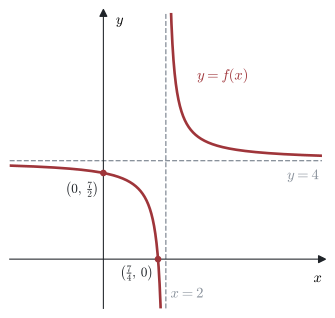
two branches, top-right and bottom-left of \(P\), approaching both asymptotes A1
\(x\)-intercept \(\left(\dfrac{7}{4}, 0\right)\) A1
\(y\)-intercept \(\left(0, \dfrac{7}{2}\right)\) A1
[3 marks]
(d)
\(L\): \(y = 4 + m(x - 2)\), so \(4 + \dfrac{1}{x - 2} = 4 + m(x - 2)\) M1
\(1 = m(x - 2)^{2}\), so \((x - 2)^{2} = \dfrac{1}{m}\) A1 AG
[2 marks]
(e)
\(x - 2 = \pm\dfrac{1}{\sqrt{m}}\), and then \(y - 4 = m(x - 2) = \pm\sqrt{m}\) M1
\(A\left(2 + \dfrac{1}{\sqrt{m}},\ 4 + \sqrt{m}\right)\), \(\;B\left(2 - \dfrac{1}{\sqrt{m}},\ 4 - \sqrt{m}\right)\) A1
midpoint \(= \left(\dfrac{2 + 2}{2},\ \dfrac{4 + 4}{2}\right) = (2, 4)\), which is \(P\) A1
[3 marks]
(f)
\(AB^{2} = \left(\dfrac{2}{\sqrt{m}}\right)^{2} + \left(2\sqrt{m}\right)^{2}\) M1
\(= \dfrac{4}{m} + 4m\) A1
\(\dfrac{4}{m} + 4m = 17 \;\Rightarrow\; 4m^{2} - 17m + 4 = 0\) A1
\((4m - 1)(m - 4) = 0\), so \(m = \dfrac{1}{4}\) or \(m = 4\) A1
[4 marks]
See 10.1.
SL 5 Paper 2
A new worker in a warehouse packs boxes. The number of boxes the worker packs per hour, \(t\) days after starting the job, is modelled by \[ N(t) = \frac{at + 12}{t + b}, \qquad t \geq 0, \] where \(a\) and \(b\) are positive constants. When \(t = 0\), the worker packs \(4\) boxes per hour. In the long term, the number of boxes packed per hour approaches \(30\).
(a) Show that \(b = 3\) and \(a = 30\). [3]
(b) Show that \(N(t) = 30 - \dfrac{78}{t + 3}\). Hence explain why \(N(t) < 30\) for all \(t \geq 0\), and why \(N(t)\) increases as \(t\) increases. [4]
(c) Find the value of \(t\) when the worker first packs \(25\) boxes per hour. [2]
A second worker starts at the same time. The number of boxes this worker packs per hour is modelled by \(M(t) = 26 - 20\,(0.75)^{t}\), \(t \geq 0\).
(d) Find the value of \(t\) for which the two workers pack the same number of boxes per hour, and find this number. [3]
(e) Find \(N^{-1}(x)\), and state the domain of \(N^{-1}\). Find \(N^{-1}(20)\) and explain what it means in this context. [4]
Total 16 marks
(a)
\(N(0) = \dfrac{12}{b}\) M1
\(\dfrac{12}{b} = 4\) A1
\(b = 3\) AG
as \(t \to \infty\), \(N(t) \to \dfrac{a}{1} = a\) (the horizontal asymptote), so \(a = 30\) R1
[3 marks]
(b)
\(30t + 12 = 30(t + 3) - 78\) M1
\(N(t) = \dfrac{30(t + 3) - 78}{t + 3} = 30 - \dfrac{78}{t + 3}\) A1 AG
for \(t \geq 0\), \(\dfrac{78}{t + 3} > 0\), so \(N(t) < 30\) R1
as \(t\) increases, \(t + 3\) increases, so \(\dfrac{78}{t + 3}\) decreases and \(N(t)\) increases R1
[4 marks]
(c)
\(30 - \dfrac{78}{t + 3} = 25 \;\Rightarrow\; t + 3 = \dfrac{78}{5}\) M1
\(t = 12.6\) days A1
[2 marks]
(d)
\(\dfrac{30t + 12}{t + 3} = 26 - 20\,(0.75)^{t}\) (for example, the intersection of the two graphs on a GDC) M1
\(t = 15.4\) days \((15.4056\ldots)\) A1
\(25.8\) boxes per hour \((25.762\ldots)\) A1
[3 marks]
(e)
\(x = 30 - \dfrac{78}{y + 3} \;\Rightarrow\; y + 3 = \dfrac{78}{30 - x}\) M1
\(N^{-1}(x) = \dfrac{78}{30 - x} - 3\) \(\left(= \dfrac{3x - 12}{30 - x}\right)\) A1
domain of \(N^{-1}\): \(4 \leq x < 30\) A1
\(N^{-1}(20) = 4.8\): the worker first packs \(20\) boxes per hour after \(4.8\) days A1
[4 marks]
HL questions
HL questions on this unit also use the AHL content: rational functions with a quadratic numerator or denominator (including oblique asymptotes), and modulus equations.
HL 1 Paper 1
Consider the equation \(|x - 1| + |2x + 4| = k\), where \(k \in \mathbb{R}\).
(a) Solve the equation when \(k = 9\). [5]
(b) Find the value of \(k\) for which the equation has exactly one solution, and the set of values of \(k\) for which it has exactly two solutions. [3]
Total 8 marks
(a)
split the number line at \(x = -2\) and \(x = 1\) M1
\(x < -2\): \(\;-(x - 1) - (2x + 4) = 9 \;\Rightarrow\; -3x - 3 = 9\) A1
\(x = -4\), which is in the interval \(x < -2\) A1
\(-2 \leq x \leq 1\): \(\;x + 5 = 9\) gives \(x = 4\), not in the interval, so reject R1
\(x > 1\): \(\;3x + 3 = 9 \;\Rightarrow\; x = 2\) A1
[5 marks]
(b)
the left side decreases for \(x < -2\) and increases for \(x > -2\); its least value is \(3\) (at \(x = -2\)) M1
exactly one solution: \(k = 3\) A1
exactly two solutions: \(k > 3\) A1
[3 marks]
See 10.3.
HL 2 Paper 1
Let \(f(x) = \dfrac{x^{2} + kx - 2}{x - 1}\), \(x \neq 1\), where \(k \in \mathbb{R}\).
(a) Show that \(f(x) = x + k + 1 + \dfrac{k - 1}{x - 1}\). [2]
(b) Find the value of \(k\) for which the graph of \(f\) has no vertical asymptote. For this value of \(k\), describe the graph of \(f\). [3]
Now let \(k \neq 1\). The oblique asymptote of the graph of \(f\) passes through the point \((3, 0)\).
(c) Find the value of \(k\). Hence state whether the graph of \(f\) lies above or below its oblique asymptote for \(x > 1\), giving a reason. [3]
Total 8 marks
(a)
\((x - 1)(x + k + 1) = x^{2} + kx - k - 1\) M1
so \(x^{2} + kx - 2 = (x - 1)(x + k + 1) + (k - 1)\), which gives the result A1 AG
[2 marks]
(b)
no vertical asymptote when the remainder is zero (then \(x - 1\) is a factor of the numerator) M1
\(k = 1\) A1
the graph is the line \(y = x + 2\) with a hole (a missing point) at \((1, 3)\) A1
[3 marks]
(c)
oblique asymptote \(y = x + k + 1\), so \(3 + k + 1 = 0\) and \(k = -4\) A1
\(f(x) = x - 3 - \dfrac{5}{x - 1}\) A1
for \(x > 1\), \(-\dfrac{5}{x - 1} < 0\), so the graph lies below the asymptote R1
[3 marks]
See 10.2.
HL 3 Paper 2
Let \(f(x) = \dfrac{3x + 2}{x - 2}\), \(x \neq 2\).
(a) Write down the equations of the asymptotes of the graph of \(y = |f(x)|\). [2]
(b) Solve the equation \(|f(x)| = 4\). [3]
(c) Solve the equation \(|f(x)| = 2^{x}\). [3]
Total 8 marks
(a)
\(x = 2\) A1
\(y = 3\) A1
[2 marks]
(b)
\(\dfrac{3x + 2}{x - 2} = 4\) or \(\dfrac{3x + 2}{x - 2} = -4\) M1
\(3x + 2 = 4x - 8 \;\Rightarrow\; x = 10\) A1
\(3x + 2 = -4x + 8 \;\Rightarrow\; x = \dfrac{6}{7}\) A1
[3 marks]
(c)
intersection of the graphs of \(y = |f(x)|\) and \(y = 2^{x}\) on a GDC M1
\(x = -1.14\) \((-1.1413\ldots)\), \(\;x = 0\), \(\;x = 3.24\) \((3.2403\ldots)\) A2
Award A1 for two correct values.
[3 marks]
HL 4 Paper 1
Let \(f(x) = \dfrac{2x^{2} - 3x - 5}{x - 1}\), \(x \neq 1\).
(a) Write \(f(x)\) in the form \(px + q + \dfrac{r}{x - 1}\), where \(p, q, r \in \mathbb{Z}\). [3]
(b) Write down the equations of the asymptotes of the graph of \(f\). [2]
(c) Sketch the graph of \(y = f(x)\), showing the asymptotes and the coordinates of the axis intercepts. [3]
(d) Show that every line with equation \(y = 2x + c\), where \(c \neq -1\), meets the graph of \(f\) at exactly one point. [3]
(e) Solve the equation \(|f(x)| = |2x - 1|\). [4]
Total 15 marks
(a)
\(2x^{2} - 3x - 5 = (x - 1)(2x - 1) + r\) (or long division) M1
\((x - 1)(2x - 1) = 2x^{2} - 3x + 1\), so \(r = -6\) A1
\(f(x) = 2x - 1 - \dfrac{6}{x - 1}\) A1
[3 marks]
(b)
\(x = 1\) A1
\(y = 2x - 1\) A1
[2 marks]
(c)
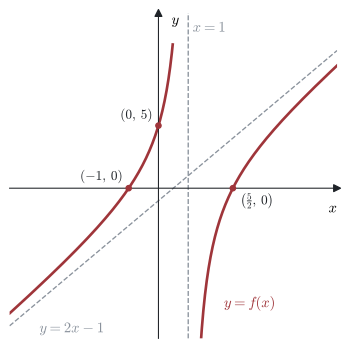
intercepts \((-1, 0)\), \(\left(\dfrac{5}{2}, 0\right)\) and \((0, 5)\) A1
both asymptotes shown, with the graph approaching them A1
left branch above \(y = 2x - 1\), rising to \(+\infty\) as \(x \to 1^{-}\); right branch below it A1
[3 marks]
(d)
\(2x - 1 - \dfrac{6}{x - 1} = 2x + c \;\Rightarrow\; \dfrac{6}{x - 1} = -(c + 1)\) M1
\(x = 1 - \dfrac{6}{c + 1}\) A1
\(c \neq -1\), so this is one real value, and it is not \(1\); so exactly one point R1
[3 marks]
(e)
\(f(x) = 2x - 1\) or \(f(x) = -(2x - 1)\) M1
\(f(x) = 2x - 1\) needs \(\dfrac{6}{x - 1} = 0\), which is impossible R1
\(4x - 2 = \dfrac{6}{x - 1} \;\Rightarrow\; 2x^{2} - 3x - 2 = 0\) A1
\((2x + 1)(x - 2) = 0\), so \(x = -\dfrac{1}{2}\) or \(x = 2\) A1
[4 marks]
HL 5 Paper 1
Let \(f(x) = \dfrac{ax + b}{x^{2} + cx + d}\), where \(a, b, c, d \in \mathbb{R}\). The graph of \(y = f(x)\) has vertical asymptotes \(x = -1\) and \(x = 3\). It meets the \(x\)-axis at \((1, 0)\) and the \(y\)-axis at \(\left(0, \dfrac{4}{3}\right)\).
(a) Show that \(a = 4\), \(b = -4\), \(c = -2\) and \(d = -3\). [4]
(b) Draw a sign diagram for \(f(x)\). Hence describe the behaviour of the graph of \(f\) on each side of each vertical asymptote. [3]
(c) Show that, for \(k \neq 0\), the equation \(f(x) = k\) can be written as \(kx^{2} - (2k + 4)x + (4 - 3k) = 0\). Hence show that the equation \(f(x) = k\) has exactly two distinct real solutions for every \(k \neq 0\). [4]
(d) Hence write down the range of \(f\). [1]
(e) Solve the equation \(|f(x)| = 1\). Give your answers in the form \(p + q\sqrt{2}\), where \(p, q \in \mathbb{Z}\). [4]
Total 16 marks
(a)
the denominator is zero at \(x = -1\) and \(x = 3\): \(x^{2} + cx + d = (x + 1)(x - 3)\) M1
\(x^{2} - 2x - 3\), so \(c = -2\), \(d = -3\) A1
\(f(1) = 0 \;\Rightarrow\; a + b = 0\) A1
\(f(0) = \dfrac{b}{-3} = \dfrac{4}{3} \;\Rightarrow\; b = -4\), so \(a = 4\) A1
[4 marks]
(b)
| \(x\) | \(x < -1\) | \(-1\) | \(-1 < x < 1\) | \(1\) | \(1 < x < 3\) | \(3\) | \(x > 3\) |
|---|---|---|---|---|---|---|---|
| sign of \(f(x)\) | \(-\) | undefined | \(+\) | \(0\) | \(-\) | undefined | \(+\) |
correct sign diagram for \(f(x) = \dfrac{4(x - 1)}{(x + 1)(x - 3)}\) A1
as \(x \to -1^{-}\), \(f(x) \to -\infty\); as \(x \to -1^{+}\), \(f(x) \to +\infty\) A1
as \(x \to 3^{-}\), \(f(x) \to -\infty\); as \(x \to 3^{+}\), \(f(x) \to +\infty\) A1
[3 marks]
(c)
\(k\left(x^{2} - 2x - 3\right) = 4x - 4\) M1
\(kx^{2} - 2kx - 3k - 4x + 4 = 0\), so \(kx^{2} - (2k + 4)x + (4 - 3k) = 0\) A1 AG
\(\Delta = (2k + 4)^{2} - 4k(4 - 3k) = 16k^{2} + 16\) A1
\(\Delta > 0\) for all \(k\); also \(x = -1\) and \(x = 3\) give \(8 \neq 0\) and \(-8 \neq 0\), so neither is a root R1
[4 marks]
(d)
\(f(1) = 0\) as well, so the range is \(\mathbb{R}\) (all real numbers) A1
[1 mark]
(e)
\(|4x - 4| = \left|x^{2} - 2x - 3\right|\), so \(x^{2} - 2x - 3 = \pm(4x - 4)\) M1
\(x^{2} - 6x + 1 = 0\) or \(x^{2} + 2x - 7 = 0\) A1
\(x = 3 \pm 2\sqrt{2}\) A1
\(x = -1 \pm 2\sqrt{2}\) A1
[4 marks]