Unit 8 Exam Practice
Quadratic Functions
These questions are written in the style of IB examination questions, and they are harder than the review exercises. The marks for each part are shown in square brackets on the right, for example [3]. Paper 1 means no calculator; Paper 2 means a graphic display calculator (GDC) is allowed. Try each question under exam conditions first, then open the markscheme.
| Mark | Meaning |
|---|---|
| M | Method mark: a correct method is used, even with a small slip |
| A | Accuracy mark: a correct answer or line of working (usually needs the M mark before it) |
| R | Reasoning mark: a clear reason or justification is given |
| N | Mark for a correct final answer with no working shown |
| AG | “Answer given” in the question, so no extra mark is awarded for writing it |
The number after the letter is the number of marks, so A2 is worth 2 marks. In the exam, give answers exactly or correct to 3 significant figures (s.f.) unless the question says otherwise.
SL questions
SL 1 Paper 1
Let \(f(x) = 2x^{2} - 10x + 7\).
(a) Express \(f(x)\) in the form \(a(x - h)^{2} + k\), where \(a\), \(h\) and \(k\) are constants. [3]
(b) Hence write down the coordinates of the vertex of the graph of \(y = f(x)\), and the equation of its axis of symmetry. [2]
(c) Find the least value and the greatest value of \(f(x)\) for \(0 \leq x \leq 4\). [3]
Total 8 marks
(a)
\(2\left(x^{2} - 5x\right) + 7 = 2\left[\left(x - \dfrac{5}{2}\right)^{2} - \dfrac{25}{4}\right] + 7\) M1 A1
\(= 2\left(x - \dfrac{5}{2}\right)^{2} - \dfrac{11}{2}\) A1
[3 marks]
(b)
vertex \(\left(\dfrac{5}{2},\ -\dfrac{11}{2}\right)\) A1
axis of symmetry \(x = \dfrac{5}{2}\) A1
[2 marks]
(c)
\(x = \dfrac{5}{2}\) is in the interval and \(a = 2 > 0\), so the least value is \(-\dfrac{11}{2}\) R1
the greatest value is at the end further from the axis: \(f(0) = 7\), \(f(4) = -1\) M1
greatest value \(7\) (when \(x = 0\)) A1
Award M1 for finding both \(f(0)\) and \(f(4)\), or for a reason based on the symmetry of the graph.
[3 marks]
SL 2 Paper 1
The diagram shows part of the graph of a quadratic function \(y = f(x)\). The graph meets the \(x\)-axis at \(A(-2,\ 0)\) and \(B(6,\ 0)\), and it meets the \(y\)-axis at \(C(0,\ 6)\). The vertex of the graph is \(V\).
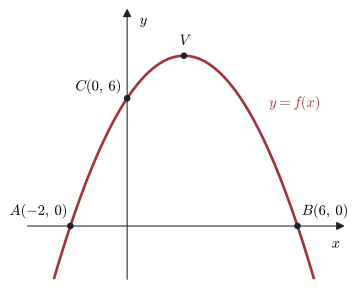
(a) Find \(f(x)\), giving your answer in the form \(f(x) = a(x - p)(x - q)\). [2]
(b) Find the coordinates of \(V\). [2]
(c) Find the equation of the line \(L\) that passes through \(V\) and is perpendicular to the line \(BC\). [2]
(d) The line \(L\) meets the graph of \(f\) at \(V\) and at one other point. Find the coordinates of this other point. [2]
Total 8 marks
(a)
\(f(x) = a(x + 2)(x - 6)\) and \(f(0) = 6\): \(\;-12a = 6\) M1
\(f(x) = -\dfrac{1}{2}(x + 2)(x - 6)\) A1
[2 marks]
(b)
axis of symmetry \(x = \dfrac{-2 + 6}{2} = 2\) M1
\(f(2) = -\dfrac{1}{2}(4)(-4) = 8\), so \(V(2,\ 8)\) A1
[2 marks]
(c)
gradient of \(BC = \dfrac{6 - 0}{0 - 6} = -1\), so gradient of \(L\) is \(1\) M1
\(y - 8 = x - 2\), that is, \(y = x + 6\) A1
[2 marks]
(d)
\(-\dfrac{1}{2}x^{2} + 2x + 6 = x + 6 \;\Rightarrow\; x\left(1 - \dfrac{1}{2}x\right) = 0\) M1
\(x = 0\) (the other root \(x = 2\) is \(V\)), so the point is \((0,\ 6)\), which is \(C\) A1
[2 marks]
SL 3 Paper 1
Consider the curve \(y = 2x^{2} + x + 3\) and the line \(y = kx + 1\), where \(k \in \mathbb{R}\).
(a) Find the values of \(k\) for which the line is a tangent to the curve. [4]
(b) For the positive value of \(k\) found in part (a), find the coordinates of the point where the line touches the curve. [2]
(c) Find the set of values of \(k\) for which the line meets the curve at two distinct points. [2]
Total 8 marks
(a)
\(2x^{2} + x + 3 = kx + 1\) M1
\(2x^{2} + (1 - k)x + 2 = 0\) A1
tangent: \(\Delta = (1 - k)^{2} - 16 = 0\) M1
\(1 - k = \pm 4\), so \(k = -3\) or \(k = 5\) A1
[4 marks]
(b)
\(k = 5\): \(\;2x^{2} - 4x + 2 = 0 \;\Rightarrow\; 2(x - 1)^{2} = 0\) M1
\(x = 1\), \(y = 6\): the point \((1,\ 6)\) A1
[2 marks]
(c)
\((1 - k)^{2} - 16 > 0 \;\Rightarrow\; (k - 5)(k + 3) > 0\) M1
\(k < -3\) or \(k > 5\) A1
[2 marks]
SL 4 Paper 2
A volleyball is hit at a height of \(2.2\) m above the ground. Its path is modelled by \[ y = ax^{2} + bx + 2.2, \qquad x \geq 0, \] where \(y\) m is the height of the ball above the ground and \(x\) m is the horizontal distance from the point where it is hit. The ball passes through the points \((5,\ 3.45)\) and \((10,\ 3.2)\).
(a) Find the value of \(a\) and the value of \(b\). [4]
(b) Find the greatest height of the ball, and the horizontal distance at which it occurs. [3]
The net is at a horizontal distance of \(9\) m from the point where the ball is hit. The top of the net is \(2.43\) m above the ground.
(c) Find the vertical distance by which the ball passes above the top of the net. [2]
The far end of the court is at a horizontal distance of \(18\) m from the point where the ball is hit.
(d) Find the horizontal distance at which the ball hits the ground. Hence determine whether the ball lands inside the court. [3]
(e) Find the set of values of \(x\) for which the ball is more than \(2.8\) m above the ground. [3]
Total 15 marks
(a)
substituting both points M1
\(25a + 5b = 1.25\) and \(100a + 10b = 1\) A1
\(a = -0.03\) A1
\(b = 0.4\) A1
[4 marks]
(b)
\(x = -\dfrac{b}{2a} = \dfrac{0.4}{0.06}\) (or the maximum on a GDC) M1
greatest height \(3.53\) m \((3.5333\ldots)\) A1
at a horizontal distance of \(6.67\) m \((6.6666\ldots)\) A1
[3 marks]
(c)
\(y(9) = -0.03(81) + 0.4(9) + 2.2 = 3.37\) M1
\(3.37 - 2.43 = 0.94\) m A1
[2 marks]
(d)
\(-0.03x^{2} + 0.4x + 2.2 = 0\) (for example, using the zero of the graph on a GDC) M1
\(x = 17.5\) m \((17.519\ldots)\) (the other root, \(-4.19\), is not in the domain) A1
\(17.5 < 18\), so the ball lands inside the court R1
[3 marks]
(e)
\(-0.03x^{2} + 0.4x + 2.2 > 2.8\), that is, \(0.03x^{2} - 0.4x + 0.6 < 0\) M1
roots \(x = 1.72\) \((1.7224\ldots)\) and \(x = 11.6\) \((11.610\ldots)\) A1
\(1.72 < x < 11.6\) A1
[3 marks]
SL 5 Paper 1
A farmer has \(96\) m of fencing. She builds a rectangular enclosure against a long straight wall, so the wall itself needs no fence. She also uses the fencing for two more fences at right angles to the wall, which divide the enclosure into three pens. Each of the four fences at right angles to the wall has length \(x\) m. All \(96\) m of fencing are used.
(a) Show that the total area of the enclosure, \(A\) m², is given by \(A = 96x - 4x^{2}\). [2]
(b) Express \(A\) in the form \(a(x - h)^{2} + k\). [3]
(c) Hence find the greatest possible area of the enclosure, and the length of the side of the enclosure parallel to the wall in this case. [3]
The farmer then finds that the wall is only \(40\) m long, so the side of the enclosure parallel to the wall can be at most \(40\) m.
(d) Find the greatest possible area of the enclosure now. Justify your answer. [4]
(e) With the wall of length \(40\) m, find the set of values of \(x\) for which the area of the enclosure is at least \(500\) m². Give your answer in exact form. [3]
Total 15 marks
(a)
the side parallel to the wall is \(96 - 4x\) M1
\(A = x(96 - 4x) = 96x - 4x^{2}\) A1 AG
[2 marks]
(b)
\(A = -4\left(x^{2} - 24x\right)\) M1
\(= -4\left[(x - 12)^{2} - 144\right]\) A1
\(= -4(x - 12)^{2} + 576\) A1
[3 marks]
(c)
\(-4(x - 12)^{2} \leq 0\), so the greatest area is \(576\) m² A1
when \(x = 12\) A1
the side parallel to the wall is \(96 - 48 = 48\) m A1
[3 marks]
(d)
\(96 - 4x \leq 40\) M1
\(x \geq 14\) A1
\(x = 12\) is not allowed; for \(x > 12\) the area decreases as \(x\) increases (right of the vertex) R1
greatest area at \(x = 14\): \(A = 14 \times 40 = 560\) m² A1
[4 marks]
(e)
\(96x - 4x^{2} \geq 500 \;\Rightarrow\; x^{2} - 24x + 125 \leq 0\) M1
roots \(x = \dfrac{24 \pm \sqrt{576 - 500}}{2} = 12 \pm \sqrt{19}\) A1
with \(x \geq 14\): \(\;14 \leq x \leq 12 + \sqrt{19}\) A1
Award the final A1 only if the condition \(x \geq 14\) from part (d) is used.
[3 marks]
HL questions
This unit has no AHL content, so the HL questions test the same syllabus content as SL, but they are longer, use parameters and families of parabolas, and some combine quadratics with Units 1, 2 and 7.
HL 1 Paper 1
Find the set of values of \(k\) for which the equation \[ 9^{x} - k\left(3^{x}\right) + k + 3 = 0 \] has two distinct real solutions. [7]
Total 7 marks
let \(u = 3^{x}\); then \(u^{2} - ku + k + 3 = 0\) M1 A1
\(3^{x} = u\) has one solution if \(u > 0\) and none if \(u \leq 0\), so we need two distinct positive roots \(u\) R1
\(\Delta = k^{2} - 4(k + 3) > 0\) M1
\((k - 6)(k + 2) > 0\), so \(k < -2\) or \(k > 6\) A1
let \(g(u) = u^{2} - ku + k + 3\); both roots positive needs axis \(\dfrac{k}{2} > 0\) and \(g(0) = k + 3 > 0\) R1
\(k > 6\) A1
Accept other valid reasoning for two positive roots, for example a sketch of \(y = g(u)\).
[7 marks]
HL 2 Paper 1
Consider the curve \(y = x^{2} - 2x + 4\) and the point \(P(1,\ -1)\).
(a) Show that the line through \(P\) with gradient \(m\) meets the curve at points whose \(x\)-coordinates satisfy \(x^{2} - (m + 2)x + m + 5 = 0\). [2]
(b) Hence find the equations of the two tangents to the curve that pass through \(P\). [3]
(c) The tangents touch the curve at \(Q\) and \(R\). Find the coordinates of \(Q\) and \(R\). [2]
(d) Find the area of triangle \(PQR\). [1]
Total 8 marks
(a)
the line is \(y + 1 = m(x - 1)\), that is, \(y = mx - m - 1\) M1
\(x^{2} - 2x + 4 = mx - m - 1 \;\Rightarrow\; x^{2} - (m + 2)x + m + 5 = 0\) A1 AG
[2 marks]
(b)
tangent: \(\Delta = (m + 2)^{2} - 4(m + 5) = m^{2} - 16 = 0\) M1
\(m = 4\) or \(m = -4\) A1
\(y = 4x - 5\) and \(y = -4x + 3\) A1
[3 marks]
(c)
repeated root \(x = \dfrac{m + 2}{2}\), so \(x = 3\) or \(x = -1\) M1
\(Q(3,\ 7)\) and \(R(-1,\ 7)\) A1
[2 marks]
(d)
base \(QR = 4\), height \(7 - (-1) = 8\), area \(= 16\) A1
[1 mark]
HL 3 Paper 1
Let \(g(x) = (m - 2)x^{2} - 2mx + 2m - 3\), where \(m \in \mathbb{R}\).
(a) Find the set of values of \(m\) for which \(g(x) < 0\) for all real values of \(x\). [4]
(b) Find all the values of \(m\) for which the equation \(g(x) = 0\) has exactly one real solution. [4]
Total 8 marks
(a)
need \(m - 2 < 0\) and \(\Delta < 0\) M1
\(\Delta = 4m^{2} - 4(m - 2)(2m - 3) = -4\left(m^{2} - 7m + 6\right)\) A1
\(\Delta < 0 \;\Rightarrow\; (m - 1)(m - 6) > 0\), so \(m < 1\) or \(m > 6\) A1
with \(m < 2\): \(\;m < 1\) A1
[4 marks]
(b)
if \(m \neq 2\): one real solution when \(\Delta = 0\) M1
\((m - 1)(m - 6) = 0\), so \(m = 1\) or \(m = 6\) A1
if \(m = 2\): \(g(x) = -4x + 1\), and \(-4x + 1 = 0\) has exactly one solution, \(x = \dfrac{1}{4}\) R1
\(m = 1\), \(m = 2\) or \(m = 6\) A1
[4 marks]
HL 4 Paper 1
For each real number \(k\), let \(f_k(x) = x^{2} - 2kx + 2k + 3\).
(a) Show that the graphs of \(y = f_k(x)\) for all values of \(k\) pass through one fixed point \(P\), and find the coordinates of \(P\). [3]
(b) By completing the square, find the coordinates of the vertex \(V_k\) of the graph of \(y = f_k(x)\), in terms of \(k\). [3]
(c) Show that, for every value of \(k\), the point \(V_k\) lies on the curve \(y = -x^{2} + 2x + 3\). [2]
(d) Find the greatest possible value of the \(y\)-coordinate of \(V_k\), and the value of \(k\) for which it occurs. [2]
(e) Find the values of \(k\) for which the graph of \(y = f_k(x)\) touches the \(x\)-axis. [2]
(f) Find the set of values of \(k\) for which the graph of \(y = f_k(x)\) lies entirely above the line \(y = 2x - 1\). [4]
Total 16 marks
(a)
\(f_k(x) = x^{2} + 3 + 2k(1 - x)\) M1
the value does not depend on \(k\) exactly when \(1 - x = 0\), that is, \(x = 1\) R1
\(f_k(1) = 4\), so \(P(1,\ 4)\) A1
[3 marks]
(b)
\(f_k(x) = (x - k)^{2} - k^{2} + 2k + 3\) M1 A1
\(V_k\left(k,\ -k^{2} + 2k + 3\right)\) A1
[3 marks]
(c)
at \(V_k\): \(x = k\) and \(y = -k^{2} + 2k + 3\) M1
substituting \(k = x\): \(\;y = -x^{2} + 2x + 3\), so \(V_k\) lies on this curve A1 AG
[2 marks]
(d)
\(-k^{2} + 2k + 3 = 4 - (k - 1)^{2}\) M1
greatest value \(4\), when \(k = 1\) (then \(V_1\) is the point \(P\)) A1
[2 marks]
(e)
the vertex is on the \(x\)-axis: \(-k^{2} + 2k + 3 = 0\) (or \(\Delta = 0\)) M1
\((k - 3)(k + 1) = 0\), so \(k = 3\) or \(k = -1\) A1
[2 marks]
(f)
\(x^{2} - 2kx + 2k + 3 > 2x - 1 \;\Rightarrow\; x^{2} - (2k + 2)x + 2k + 4 > 0\) for all \(x\) M1
coefficient of \(x^{2}\) is positive, so need \(\Delta = (2k + 2)^{2} - 4(2k + 4) < 0\) M1
\(4k^{2} - 12 < 0\) A1
\(-\sqrt{3} < k < \sqrt{3}\) A1
[4 marks]
HL 5 Paper 2
A ball bounces along horizontal ground. It leaves the ground at the point \(O\). During its first bounce its path is modelled by \[ y = -0.6x^{2} + 3x, \] where \(y\) m is the height of the ball and \(x\) m is the horizontal distance from \(O\). The first bounce ends when the ball hits the ground at \(A\).
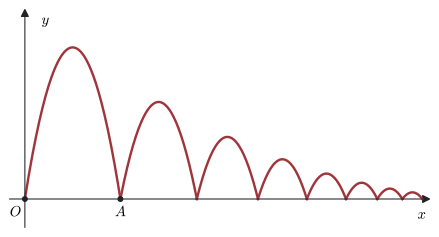
(a) Find the distance \(OA\) and the greatest height of the ball during the first bounce. [3]
Each later bounce starts where the previous one ends. Each bounce is modelled by a quadratic function with the same coefficient of \(x^{2}\), \(-0.6\), and the horizontal length of each bounce is \(80\%\) of the horizontal length of the previous bounce.
(b) Show that the path of the second bounce is \(y = -0.6(x - 5)(x - 9)\), and find the greatest height of the ball during the second bounce. [3]
(c) Show that the greatest heights of the bounces form a geometric sequence, and write down its common ratio. [3]
(d) Find the number of the first bounce whose greatest height is less than \(0.1\) m. [3]
(e) The ball keeps bouncing in this way. Find the total horizontal distance that it can travel. [2]
(f) During the second bounce, find the horizontal distance that the ball travels while it is more than \(1.5\) m above the ground. [2]
Total 16 marks
(a)
\(-0.6x(x - 5) = 0\), so \(OA = 5\) m A1
greatest height at \(x = 2.5\) (halfway between the roots) M1
\(y = -0.6(2.5)^{2} + 3(2.5) = 3.75\) m A1
[3 marks]
(b)
the second bounce has length \(0.8 \times 5 = 4\), so it ends at \(x = 9\) A1
roots \(5\) and \(9\), coefficient of \(x^{2}\) is \(-0.6\), so \(y = -0.6(x - 5)(x - 9)\) A1 AG
at \(x = 7\): \(\;y = -0.6(2)(-2) = 2.4\) m A1
[3 marks]
(c)
the \(n\)th bounce has length \(L_n = 5(0.8)^{n - 1}\) A1
greatest height (at the midpoint) \(= 0.6\left(\dfrac{L_n}{2}\right)^{2} = 0.15L_n^{2}\) M1
\(= 3.75(0.64)^{n - 1}\), a geometric sequence with \(r = 0.64\) A1
[3 marks]
(d)
\(3.75(0.64)^{n - 1} < 0.1\) M1
\(n - 1 > 8.12\) \((8.1211\ldots)\) (or a table: \(n = 9\) gives \(0.106\), \(n = 10\) gives \(0.0676\)) A1
the \(10\)th bounce A1
[3 marks]
(e)
\(S_{\infty} = \dfrac{5}{1 - 0.8}\) M1
\(= 25\) m A1
[2 marks]
(f)
\(-0.6(x - 5)(x - 9) > 1.5\) gives \(5.78 < x < 8.22\) \((5.7752\ldots,\ 8.2247\ldots)\) M1
horizontal distance \(= 2.45\) m \((2.4494\ldots)\) A1
[2 marks]