24.6 Related Rates
AHL 5.14
This section is for HL students. It builds on 24.5.
- how to use the chain rule to connect related rates of change, \(\frac{dy}{dt} = \frac{dy}{dx} \times \frac{dx}{dt}\)
- a step-by-step method for related-rates problems in geometry (Pythagoras, areas, volumes, angles)
Related rates
Often two quantities \(x\) and \(y\) both change with time \(t\), and there is an equation connecting \(x\) and \(y\). Then their rates of change are connected by the chain rule.
Related rates Not in the formula booklet
\[ \frac{dy}{dt} = \frac{dy}{dx} \times \frac{dx}{dt} \]
- \(y\): a quantity that depends on \(x\)
- \(t\): time
- \(x\): a quantity that changes with time
It is the chain rule, which is in the booklet.
The method:
- Draw a diagram. Name the variables. Write down the rate you know and the rate you want (with units and sign: a decreasing quantity has a negative rate).
- Find an equation connecting the variables (geometry: Pythagoras, area, volume, trigonometry).
- Differentiate with respect to \(t\) (chain rule or implicit differentiation).
- Substitute the values at the instant asked for — only after differentiating.
Example 1 The radius of a circular ripple on a pond increases at a constant rate of \(3\) cm s\(^{-1}\). Find the rate of increase of the area of the circle when
(a) the radius is \(10\) cm, \(\qquad\) (b) the area is \(64\pi\) cm\(^2\).
\(A = \pi r^2\), so \(\frac{dA}{dr} = 2\pi r\), and \(\frac{dr}{dt} = 3\).
\[ \frac{dA}{dt} = \frac{dA}{dr} \times \frac{dr}{dt} = 2\pi r \times 3 = 6\pi r . \]
(a) \(r = 10\): \(\frac{dA}{dt} = 60\pi \approx 188\) cm\(^2\) s\(^{-1}\).
(b) \(\pi r^2 = 64\pi\), so \(r = 8\): \(\frac{dA}{dt} = 48\pi \approx 151\) cm\(^2\) s\(^{-1}\).
Example 2 Two boats travel in the same direction on straight parallel courses that are \(6\) km apart. Their speeds are \(30\) km h\(^{-1}\) and \(40\) km h\(^{-1}\). How fast is the distance between them changing at the instant when the slower boat is \(8\) km ahead of the faster one?
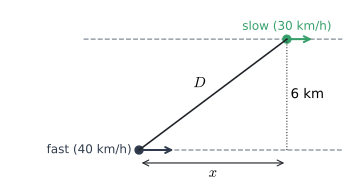
Let \(x\) km be how far the slower boat is ahead, and \(D\) km the distance between the boats. By Pythagoras,
\[ D^2 = x^2 + 36 . \]
The faster boat gains \(40 - 30 = 10\) km every hour, so \(\frac{dx}{dt} = -10\) km h\(^{-1}\).
Differentiate with respect to \(t\): \(2D\frac{dD}{dt} = 2x\frac{dx}{dt}\), so \(\frac{dD}{dt} = \frac{x}{D}\frac{dx}{dt}\).
When \(x = 8\): \(D = \sqrt{64 + 36} = 10\), so
\[ \frac{dD}{dt} = \frac{8}{10} \times (-10) = -8 . \]
The distance between the boats is decreasing at \(8\) km h\(^{-1}\).
Example 3 A water trough is \(6\) m long. Its cross-section is a semicircle with diameter \(1\) m. Water is pumped in at a constant rate of \(0.05\) m\(^3\) per minute. The surface of the water subtends an angle \(\theta\) (radians) at the centre \(O\) of the semicircle, and the depth of the water is \(h\) m.
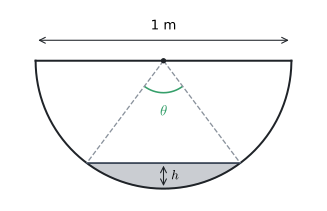
(a) Show that the volume of water is \(V = 0.75(\theta - \sin\theta)\) m\(^3\).
(b) Find the rate at which the water level is rising at the instant when the water is \(10\) cm deep.
(a) The water cross-section is a segment of a circle with radius \(r = 0.5\) and angle \(\theta\):
\[ \text{area} = \tfrac{1}{2}r^2\theta - \tfrac{1}{2}r^2\sin\theta = \tfrac{1}{2}(0.25)(\theta - \sin\theta) = 0.125(\theta - \sin\theta) . \]
Volume \(= 6 \times 0.125(\theta - \sin\theta) = 0.75(\theta - \sin\theta)\).
(b) First find \(\frac{d\theta}{dt}\), then \(\frac{dh}{dt}\).
The centre \(O\) is \(0.5 - h\) above the water surface, and \(\cos\frac{\theta}{2} = \frac{0.5 - h}{0.5}\), so \(h = 0.5 - 0.5\cos\frac{\theta}{2}\).
When \(h = 0.1\): \(\cos\frac{\theta}{2} = 0.8\), \(\sin\frac{\theta}{2} = 0.6\), and \(\cos\theta = 2(0.8)^2 - 1 = 0.28\).
\[ \frac{dV}{dt} = 0.75(1 - \cos\theta)\frac{d\theta}{dt} \;\Rightarrow\; 0.05 = 0.75(0.72)\frac{d\theta}{dt} \;\Rightarrow\; \frac{d\theta}{dt} = \frac{0.05}{0.54} = \frac{5}{54} \text{ rad per minute}. \]
\[ \frac{dh}{dt} = 0.25\sin\frac{\theta}{2} \times \frac{d\theta}{dt} = 0.25 \times 0.6 \times \frac{5}{54} = \frac{1}{72} \text{ m per minute}. \]
The level is rising at \(\frac{1}{72}\) m min\(^{-1}\) \(\approx 1.39\) cm per minute.
Common errors
| ✗ Wrong | ✓ Right | Why |
|---|---|---|
| Substituting the instant values before differentiating | Differentiate first, then substitute | If you put \(x = 8\) first, \(x\) is a constant and its rate becomes \(0\). |
| A decreasing quantity given a positive rate | Use a negative sign: \(\frac{dx}{dt} = -10\) | The sign shows the direction of change. |
| Angles in degrees in related rates | Use radians | \(\frac{d}{d\theta}\sin\theta = \cos\theta\) only in radians. |
Exercises
1 Air is pumped into a spherical balloon at \(100\) cm\(^3\) s\(^{-1}\). Find the rate at which the radius is increasing when the radius is \(5\) cm.
\(V = \frac{4}{3}\pi r^3\), \(\frac{dV}{dt} = 4\pi r^2\frac{dr}{dt}\).
\(100 = 4\pi(25)\frac{dr}{dt}\), so \(\frac{dr}{dt} = \frac{1}{\pi} \approx 0.318\) cm s\(^{-1}\).
2 A \(13\) m ladder leans against a vertical wall. The bottom slides away from the wall at \(0.4\) m s\(^{-1}\). How fast is the top sliding down the wall when the bottom is \(5\) m from the wall?
\(x^2 + y^2 = 169\). When \(x = 5\), \(y = 12\).
\(2x\frac{dx}{dt} + 2y\frac{dy}{dt} = 0 \Rightarrow \frac{dy}{dt} = -\frac{x}{y}\frac{dx}{dt} = -\frac{5}{12}(0.4) = -\frac{1}{6}\).
The top slides down at \(\frac{1}{6}\) m s\(^{-1}\) \(\approx 0.167\) m s\(^{-1}\).
3 A conical tank (vertex down) has radius \(3\) m and height \(6\) m. Water flows in at \(2\) m\(^3\) per minute. Find the rate at which the water level rises when the water is \(4\) m deep.
By similar triangles \(r = \frac{h}{2}\), so \(V = \frac{1}{3}\pi r^2 h = \frac{\pi h^3}{12}\) and \(\frac{dV}{dh} = \frac{\pi h^2}{4}\).
At \(h = 4\): \(\frac{dV}{dh} = 4\pi\), so \(\frac{dh}{dt} = \frac{2}{4\pi} = \frac{1}{2\pi} \approx 0.159\) m per minute.
4 A balloon rises vertically at \(3\) m s\(^{-1}\) from a point on level ground \(40\) m from an observer. Find the rate of change of the angle of elevation \(\theta\) from the observer to the balloon when the balloon is \(30\) m high.
\(\tan\theta = \frac{h}{40}\). Differentiate: \(\sec^2\theta\,\frac{d\theta}{dt} = \frac{1}{40}\frac{dh}{dt}\).
When \(h = 30\): \(\tan\theta = \frac{3}{4}\), \(\sec^2\theta = 1 + \frac{9}{16} = \frac{25}{16}\).
\[ \frac{d\theta}{dt} = \frac{16}{25} \times \frac{3}{40} = \frac{6}{125} = 0.048 \text{ rad s}^{-1} . \]