27.4 Area between a Curve and the y-Axis
AHL 5.17
This section is for HL students. It builds on 27.3.
- how to find the area between a curve and the \(y\)-axis by integrating with respect to \(y\)
- how to write the curve as \(x\) in terms of \(y\) and use \(y\)-values as the limits
- how to use the \(y\)-axis to find an area that is hard to find with respect to \(x\)
Area between a curve and the \(y\)-axis
In 27.3 we used vertical strips of width \(\delta x\). In the same way, we can use horizontal strips of height \(\delta y\) and length \(x\). Then we integrate with respect to \(y\).
Area between a curve and the \(y\)-axis In the HL formula booklet
The area \(A\) bounded by the curve \(x = g(y)\), the \(y\)-axis and the lines \(y = a\) and \(y = b\), where \(a < b\), is
\[ A = \int_a^b \lvert x\rvert\,\mathrm{d}y . \]
If \(g(y) \geq 0\), this is \(\displaystyle A = \int_a^b x\,\mathrm{d}y = \int_a^b g(y)\,\mathrm{d}y\).
- \(A\): the area of the region
- \(a\), \(b\): the lower and upper limits, which are values of \(y\)
- \(x\): the curve written as \(x = g(y)\)
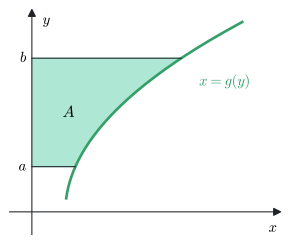
To use it, write the curve as \(x\) in terms of \(y\), and use \(y\)-values as the limits.
Example 1 The region \(P\) is bounded by the curve \(y = \ln x\), the \(x\)-axis and the line \(x = 4\). Find the exact area of \(P\).
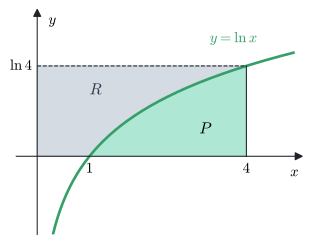
We cannot integrate \(\ln x\) with the SL rules, so use the \(y\)-axis. The rectangle with corners \((0, 0)\) and \((4, \ln 4)\) has area \(4\ln 4\). It is made of \(P\) and the region \(R\) between the curve and the \(y\)-axis, from \(y = 0\) to \(y = \ln 4\).
On the curve, \(x = \mathrm{e}^y\). So
\[ R = \int_0^{\ln 4} \mathrm{e}^y\,\mathrm{d}y = \Big[\mathrm{e}^y\Big]_0^{\ln 4} = 4 - 1 = 3 . \]
\[ P = 4\ln 4 - 3 = 8\ln 2 - 3 . \]
(With integration by parts, \(\displaystyle\int_1^4 \ln x\,\mathrm{d}x = \Big[x\ln x - x\Big]_1^4 = 4\ln 4 - 3\), the same answer.)
Example 2 The line through \(P(0, 6)\) and \(Q(6, 0)\) meets the curve \(x = y^2\) at the point \(R\), where \(y > 0\). Find the area of the region bounded by the \(y\)-axis, the line \(PQ\) and the curve \(x = y^2\).
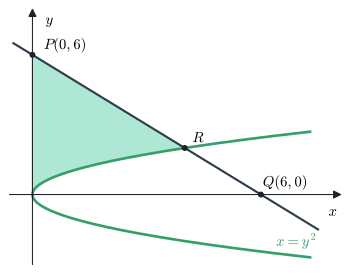
The line \(PQ\) is \(x + y = 6\), so \(x = 6 - y\).
At \(R\): \(y^2 = 6 - y \Rightarrow y^2 + y - 6 = 0 \Rightarrow (y + 3)(y - 2) = 0\). Since \(y > 0\), \(y = 2\) and \(R = (4, 2)\).
Use horizontal strips. For \(0 \leq y \leq 2\) the right edge of the region is the curve \(x = y^2\); for \(2 \leq y \leq 6\) it is the line \(x = 6 - y\).
\[ A = \int_0^2 y^2\,\mathrm{d}y + \int_2^6 (6 - y)\,\mathrm{d}y = \Big[\tfrac{y^3}{3}\Big]_0^2 + \Big[6y - \tfrac{y^2}{2}\Big]_2^6 = \frac{8}{3} + (18 - 10) = \frac{32}{3}. \]
(The second part is a triangle with base 4 and height 4: area 8 ✓.)
Common errors
| ✗ Wrong | ✓ Right | Why |
|---|---|---|
| Using \(x\)-limits in \(\displaystyle\int x\,\mathrm{d}y\) | Use \(y\)-limits | The variable of integration is \(y\). |
| Integrating \(y = \ln x\) with respect to \(y\) without rearranging | Write \(x = \mathrm{e}^y\) first | \(\int x\,\mathrm{d}y\) needs \(x\) as a function of \(y\). |
Exercises
1 Find the area of the region bounded by \(y = x^3\), the \(y\)-axis, and the lines \(y = 1\) and \(y = 8\).
\(x = y^{1/3}\). \(\displaystyle\int_1^8 y^{1/3}\,\mathrm{d}y = \Big[\tfrac{3}{4}y^{4/3}\Big]_1^8 = \tfrac{3}{4}(16 - 1) = \dfrac{45}{4}\).
2 The curve \(C\) has equation \(y = \ln(x - 2)\), for \(x > 2\). The region \(R\) is bounded by \(C\), the \(y\)-axis and the lines \(y = 0\) and \(y = 2\).
(a) Express \(x\) in terms of \(y\).
(b) Find the exact area of \(R\).
(a) \(y = \ln(x - 2) \Rightarrow x - 2 = \mathrm{e}^y \Rightarrow x = \mathrm{e}^y + 2\).
(b) For \(0 \leq y \leq 2\), \(x = \mathrm{e}^y + 2 > 0\), so the curve is to the right of the \(y\)-axis.
\[ \begin{aligned} A &= \int_0^2 (\mathrm{e}^y + 2)\,\mathrm{d}y \\ &= \Big[\mathrm{e}^y + 2y\Big]_0^2 \\ &= (\mathrm{e}^2 + 4) - 1 \\ &= \mathrm{e}^2 + 3 . \end{aligned} \]