1.2 Exponential Functions, Growth and Decay
SL 1.7 SL 2.9
- what an exponential function \(f(x) = a^x\) is, and the shape of its graph
- the difference between exponential growth (\(a > 1\)) and decay (\(0 < a < 1\))
- the number \(\mathrm{e}\) and the natural exponential function \(f(x) = \mathrm{e}^x\)
- how to find the intercept and the horizontal asymptote of graphs like \(y = 2 + 3\mathrm{e}^{-x}\)
- how to use exponential models for populations, money and radioactive decay
Exponential functions
In Section 1.1 we solved equations such as \(2^x = 512\). Now we let \(x\) vary and look at the relationship between \(x\) and \(y = 2^x\) as a whole.
Definition Not in the formula booklet
A function of the form
\[ f(x) = a^x, \qquad a > 0,\; a \neq 1 \]
is called an exponential function with base \(a\).
Why the two conditions?
- If \(a < 0\), some values do not exist as real numbers. For example, \((-4)^{\frac{1}{2}} = \sqrt{-4}\).
- If \(a = 1\), then \(1^x = 1\) for every \(x\). This is a constant function, not an exponential one.
The graph of \(y = a^x\)
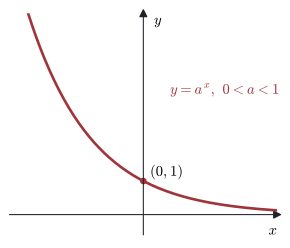
The shape of the graph depends on whether the base is bigger or smaller than \(1\).
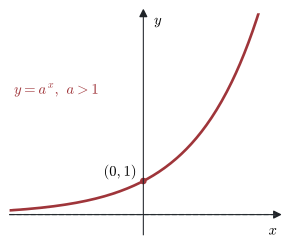
- When \(a > 1\) (Figure 1), \(y\) increases as \(x\) increases. As \(x\) becomes very negative, \(y\) gets closer and closer to \(0\).
- When \(0 < a < 1\) (Figure 2), \(y\) decreases as \(x\) increases. As \(x\) becomes very large, \(y\) gets closer and closer to \(0\).
Key features of \(y = a^x\) (for every base \(a > 0\), \(a \neq 1\)) Not in the formula booklet
- The graph passes through \((0, 1)\), because \(a^0 = 1\).
- \(a^x > 0\) for every \(x\): the graph is always above the \(x\)-axis.
- The line \(y = 0\) (the \(x\)-axis) is a horizontal asymptote: the curve gets closer and closer to it but never touches it.
- Domain: \(x \in \mathbb{R}\). Range: \(y > 0\).
A base between \(0\) and \(1\) can always be written with a negative exponent. For example,
\[ \left(\frac{1}{2}\right)^x = \frac{1}{2^x} = 2^{-x}. \]
So the graph of \(y = 2^{-x}\) is the graph of \(y = 2^x\) reflected in the \(y\)-axis.
Example 1 On the same axes, sketch the graphs of \(y = 3^x\) and \(y = \left(\frac{1}{3}\right)^x\). State the coordinates of any point where they meet, and describe how the two graphs are related.
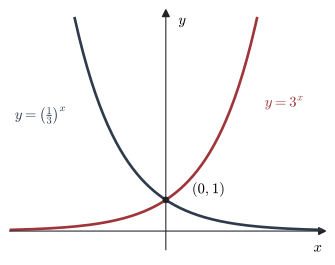
- \(y = 3^x\) is a growth curve; \(y = \left(\frac{1}{3}\right)^x\) is a decay curve.
- Both pass through \((0, 1)\), and this is the only point where they meet.
- Both have the horizontal asymptote \(y = 0\).
- Since \(\left(\frac{1}{3}\right)^x = 3^{-x}\), each graph is the reflection of the other in the \(y\)-axis.
The number \(\mathrm{e}\)
You already know the special number \(\pi\). Another special number is \(\mathrm{e}\), called Euler’s number (after the Swiss mathematician Leonhard Euler). Like \(\pi\), it is irrational:
\[ \mathrm{e} = 2.718\,28\ldots \]
One way to meet \(\mathrm{e}\) is through interest. Put $1 in a bank paying 100% interest per year, and let the bank add the interest \(n\) times a year. After one year you have \(\left(1 + \frac{1}{n}\right)^n\) dollars.
| \(n\) (times per year) | 1 | 10 | 100 | 1000 | 1 000 000 |
|---|---|---|---|---|---|
| \(\left(1 + \frac{1}{n}\right)^n\) | 2 | 2.5937… | 2.7048… | 2.7169… | 2.71828… |
As \(n\) becomes very large, the amount gets closer and closer to \(\mathrm{e}\). This is why \(\mathrm{e}\) appears whenever something grows continuously.
The natural exponential function Not in the formula booklet
\[ f(x) = \mathrm{e}^x \]
Since \(\mathrm{e} > 1\), its graph is a growth curve through \((0, 1)\) with asymptote \(y = 0\). The graph of \(y = \mathrm{e}^{-x}\) is a decay curve.
- \(\mathrm{e}\): Euler’s number, \(\mathrm{e} = 2.718\,28\ldots\)
On the TI-Nspire CX II, use the key marked \(\mathrm{e}^x\). Do not type the letter e followed by ^.
Graphs like \(y = k + b\,a^x\)
Adding a constant \(k\) moves the whole graph up or down by \(k\). So the asymptote moves from \(y = 0\) to \(y = k\).
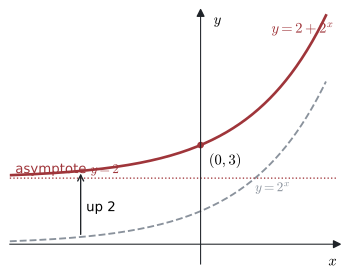
In Figure 3, \(k = 2\) and \(b = 1\): the intercept \((0, 1)\) of \(y = 2^x\) moves to \((0, 3)\), and the asymptote \(y = 0\) moves to \(y = 2\).
For \(y = k + b\,a^x\) Not in the formula booklet
- \(y\)-intercept: put \(x = 0\), so \(y = k + b\).
- Horizontal asymptote: \(y = k\).
- Range: \(y > k\) if \(b > 0\); \(\;y < k\) if \(b < 0\).
- \(k\): a constant (it gives the asymptote \(y = k\))
- \(b\): a constant (\(b \neq 0\))
- \(a\): the base (\(a > 0\), \(a \neq 1\))
Example 2 Let \(f(x) = 2 + 3\mathrm{e}^{-x}\).
(a) Find the \(y\)-intercept of the graph of \(f\).
(b) Write down the equation of the horizontal asymptote.
(c) Write down the range of \(f\).
(d) State whether \(f\) is increasing or decreasing. Explain.
(a) \(f(0) = 2 + 3\mathrm{e}^{0} = 2 + 3 = 5\). The \(y\)-intercept is \((0, 5)\).
(b) As \(x\) becomes very large, \(\mathrm{e}^{-x}\) gets close to \(0\), so \(f(x)\) gets close to \(2\). The asymptote is \(y = 2\).
(c) \(3\mathrm{e}^{-x} > 0\) for every \(x\), so \(f(x) > 2\). The range is \(f(x) > 2\).
(d) \(\mathrm{e}^{-x}\) is a decay curve, so it decreases as \(x\) increases. Multiplying by \(3\) and adding \(2\) does not change this. So \(f\) is decreasing.
Exponential models
Many quantities change by the same factor in each equal time interval. These are modelled by exponential functions.
Exponential models Not in the formula booklet
\[ N = N_0 \times a^{t} \]
- \(N_0\) is the initial value (the value when \(t = 0\)).
- \(a\) is the growth factor per unit of time.
- Increase of \(r\%\) per unit of time: \(a = 1 + \dfrac{r}{100}\) (growth, \(a > 1\))
- Decrease of \(r\%\) per unit of time: \(a = 1 - \dfrac{r}{100}\) (decay, \(0 < a < 1\))
- For continuous growth or decay: \(N = N_0\,\mathrm{e}^{kt}\) (\(k > 0\) for growth, \(k < 0\) for decay).
- \(N\): the value after time \(t\)
- \(t\): the time (the number of units of time)
In an exponential model, the rate at which the quantity changes is proportional to the amount present: the more there is, the faster it grows (or decays).
Example 3 The population of a town \(t\) years after 1 January 2020 is modelled by
\[ P = 12\,000 \times 1.025^{t}. \]
(a) Write down the population on 1 January 2020.
(b) Write down the annual percentage rate of growth.
(c) Find the population predicted for 1 January 2030.
(d) Find the year in which the population first exceeds \(20\,000\).
(a) Put \(t = 0\): \(P = 12\,000 \times 1 = 12\,000\).
(b) The growth factor is \(1.025 = 1 + \frac{2.5}{100}\), so the population grows by \(2.5\%\) per year.
(c) \(t = 10\): \(P = 12\,000 \times 1.025^{10} = 15\,361.01\ldots\), so about \(15\,361\) people.
(d) Solve \(12\,000 \times 1.025^{t} = 20\,000\) on the GDC (graph both sides and find the intersection): \(t = 20.69\ldots\)
So the population first exceeds \(20\,000\) during the 21st year, that is, in 2040.
You will learn to solve this equation exactly with logarithms in Section 1.5.
Method 1 — Graphs page
Enter \(f_1(x) = 12000 \times 1.025^x\) and \(f_2(x) = 20000\).
Menu → Window / Zoom → Window Settings (for example \(0 \le x \le 40\), \(0 \le y \le 30000\)).
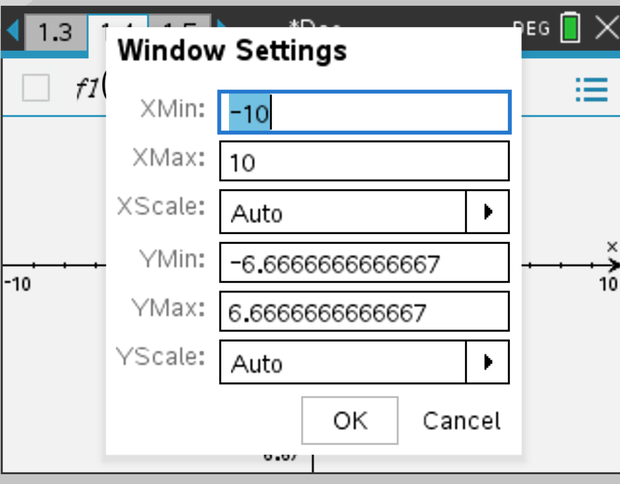
The Window Settings box: type XMin, XMax, YMin and YMax. Menu → Analyze Graph → Intersection.
Method 2 — Calculator page
- Menu → Algebra → Numerical Solve.
- Type
nSolve(12000×1.025^x=20000, x).
Example 4 The mass, \(M\) grams, of a radioactive substance after \(t\) days is
\[ M = 80 \times 2^{-\frac{t}{5}}. \]
(a) Find the initial mass.
(b) Without a calculator, find the mass after \(15\) days.
(c) Show that the mass halves every 5 days.
(a) \(t = 0\): \(M = 80 \times 2^0 = 80\) grams.
(b) \(t = 15\): \(M = 80 \times 2^{-3} = 80 \times \dfrac{1}{8} = 10\) grams.
(c) After another 5 days, the exponent decreases by \(1\):
\[ 80 \times 2^{-\frac{t+5}{5}} = 80 \times 2^{-\frac{t}{5}} \times 2^{-1} = \frac{1}{2}\left(80 \times 2^{-\frac{t}{5}}\right). \]
So every 5 days the mass is multiplied by \(\frac{1}{2}\). (We say the half-life is 5 days.)
Example 5 When interest is added continuously, an amount of $\(A_0\) invested at \(r\%\) per year grows to
\[ A = A_0\,\mathrm{e}^{\frac{rt}{100}} \]
after \(t\) years. Lina invests $2000 at 4% per year, compounded continuously.
(a) Find the value of her investment after 8 years, to the nearest dollar.
(b) Use your GDC to find how long it takes for her money to double.
(c) Would the doubling time be different if she had invested $5000? Justify your answer.
(a) \(A = 2000\,\mathrm{e}^{\frac{4 \times 8}{100}} = 2000\,\mathrm{e}^{0.32} = 2754.25\ldots\), so $2754.
(b) Solve \(2000\,\mathrm{e}^{0.04t} = 4000\) on the GDC: \(t = 17.3\) years (3 s.f.).
(c) No. Doubling means \(A_0\,\mathrm{e}^{0.04t} = 2A_0\). Divide both sides by \(A_0\): \(\mathrm{e}^{0.04t} = 2\). The initial amount has disappeared from the equation, so the doubling time is \(17.3\) years for any initial amount.
Example 6 A new car costs $32 000. Its value falls by 15% each year.
(a) Write down a model for the value \(V\) of the car after \(t\) years.
(b) Find the value of the car after 4 years.
(a) The growth factor is \(1 - \frac{15}{100} = 0.85\), so \(V = 32\,000 \times 0.85^{t}\).
(b) \(V = 32\,000 \times 0.85^{4} = 16\,704.2\), so the value is $16 704.20.
Common errors
| ✗ Wrong | ✓ Right | Why |
|---|---|---|
| The graph of \(y = 2^x\) crosses the \(x\)-axis | It never meets the \(x\)-axis | \(2^x > 0\) for every \(x\); \(y = 0\) is an asymptote. |
| A 15% decrease gives the factor \(0.15\) | The factor is \(0.85\) | You keep \(100\% - 15\% = 85\%\) each year. |
| \(y = 5 + 2^x\) has asymptote \(y = 0\) | Its asymptote is \(y = 5\) | The whole graph moves up by \(5\). |
| \(\mathrm{e}^{0.32}\) typed as e^0.32 with the letter e | Use the \(\mathrm{e}^x\) key | The letter e is just a variable on the GDC. |
| Rounding the growth factor (e.g. \(1.025 \to 1.03\)) | Keep the exact factor | Small changes grow large after many years. |
Exercises
1 State whether each function shows exponential growth or exponential decay.
(a) \(y = 1.2^{x}\)
(b) \(y = 0.7^{x}\)
(c) \(y = 5^{-x}\) (d) \(y = \left(\frac{4}{3}\right)^{x}\)
(e) \(y = \mathrm{e}^{-2x}\)
(a) growth (\(1.2 > 1\)) \(\quad\) (b) decay (\(0 < 0.7 < 1\)) \(\quad\) (c) decay (\(5^{-x} = \left(\frac{1}{5}\right)^x\)) \(\quad\) (d) growth (\(\frac{4}{3} > 1\)) \(\quad\) (e) decay (\(\mathrm{e}^{-2x} = \left(\mathrm{e}^{-2}\right)^x\) and \(0 < \mathrm{e}^{-2} < 1\))
2 Let \(f(x) = 3^{x} - 9\). Find
(a) the \(y\)-intercept, \(\quad\) (b) the \(x\)-intercept, \(\quad\) (c) the horizontal asymptote, \(\quad\) (d) the range of \(f\).
(a) \(f(0) = 1 - 9 = -8\), so \((0, -8)\).
(b) \(3^x - 9 = 0 \Rightarrow 3^x = 3^2 \Rightarrow x = 2\), so \((2, 0)\).
(c) \(y = -9\) \(\qquad\) (d) \(f(x) > -9\)
3 Let \(g(x) = 4 - 2^{x+1}\). Find the intercepts with both axes, the horizontal asymptote and the range of \(g\).
\(y\)-intercept: \(g(0) = 4 - 2 = 2\), so \((0, 2)\).
\(x\)-intercept: \(2^{x+1} = 4 = 2^2 \Rightarrow x + 1 = 2 \Rightarrow x = 1\), so \((1, 0)\).
Asymptote: \(y = 4\). Since \(2^{x+1} > 0\), \(g(x) < 4\). Range: \(g(x) < 4\).
4 The curve \(y = k \times a^{x}\), where \(a > 0\), passes through \((0, 5)\) and \((2, 45)\). Find \(k\) and \(a\).
\((0, 5)\): \(5 = k \times a^0 = k\), so \(k = 5\).
\((2, 45)\): \(45 = 5a^2 \Rightarrow a^2 = 9 \Rightarrow a = 3\) (since \(a > 0\)).
5 The curve \(y = k \times a^{x}\), where \(a > 0\), passes through \((1, 6)\) and \((3, 24)\). Find \(k\) and \(a\).
\(ka = 6\) and \(ka^3 = 24\). Divide the second equation by the first:
\[ \frac{ka^3}{ka} = \frac{24}{6} \;\Longrightarrow\; a^2 = 4 \;\Longrightarrow\; a = 2. \]
Then \(2k = 6\), so \(k = 3\).
6 The number of bacteria in a dish after \(t\) hours is \(N = 400 \times 2^{\frac{t}{3}}\). Without a calculator,
(a) write down the initial number of bacteria,
(b) find the number after 12 hours,
(c) find how long it takes for the number to double.
(a) \(400\) \(\qquad\) (b) \(400 \times 2^{4} = 6400\)
(c) The number doubles when the exponent \(\frac{t}{3}\) increases by \(1\), that is, every 3 hours.
7 After a dose of medicine, the amount in a patient’s blood after \(t\) hours is \(C = 120 \times 0.8^{t}\) mg.
(a) Find the amount after 3 hours.
(b) Use your GDC to find when the amount first falls below 20 mg.
(a) \(120 \times 0.8^{3} = 120 \times 0.512 = 61.44\) mg.
(b) Solve \(120 \times 0.8^{t} = 20\): \(t = 8.03\) hours (3 s.f.).
8 $5000 is invested at 3.5% per year, compounded continuously, so that \(A = 5000\,\mathrm{e}^{0.035t}\).
(a) Find the value after 10 years, to the nearest dollar.
(b) Find how many years it takes for the value to reach $8000.
(a) \(5000\,\mathrm{e}^{0.35} = 7095.33\ldots\), so $7095.
(b) Solve \(5000\,\mathrm{e}^{0.035t} = 8000\) on the GDC: \(t = 13.4\) years (3 s.f.).
9 Explain why the equation \(3^{x} + 5 = 2\) has no real solution.
The equation gives \(3^x = -3\). But \(3^x > 0\) for every real \(x\), so \(3^x\) can never equal a negative number. There is no solution. (On a graph: \(y = 3^x + 5\) is always above its asymptote \(y = 5\), so it never reaches \(y = 2\).)
10 Town A has \(2000\) people and grows by 5% per year. Town B has \(3000\) people and grows by 2% per year.
(a) Write down a model for the population of each town after \(t\) years.
(b) Use your GDC to find when the two populations are equal.
(a) \(A = 2000 \times 1.05^{t}\) \(\quad\) and \(\quad\) \(B = 3000 \times 1.02^{t}\).
(b) Graph both and find the intersection: \(t = 14.0\) years (3 s.f.). At that time each population is about \(3960\) (3 s.f.).