14.6 The Unit Circle and Trigonometric Ratios of Any Angle
SL 3.5
- what a reference angle is, for positive and negative angles in all four quadrants
- the unit circle, and the definitions of \(\cos\theta\) and \(\sin\theta\) as the coordinates of a point on it
- the definition of \(\tan\theta\), why \(\tan\theta = \dfrac{\sin\theta}{\cos\theta}\), and why it is the gradient of a line
- the periodic nature of sine, cosine and tangent
- how to find the sign and the exact value of the ratios of any angle (the ASTC rule)
- the rules for negative angles and the relationships between angles in different quadrants
Reference angles
The axes divide the plane into four quadrants, numbered anticlockwise from the top right. A line segment \(OP\) starts on the positive \(x\)-axis and turns about the origin \(O\).
- If \(OP\) turns anticlockwise, the angle \(\theta\) is positive.
- If \(OP\) turns clockwise, the angle \(\theta\) is negative.
(See also Section 14.5.) Wherever \(OP\) ends, it makes an acute angle with the \(x\)-axis. This angle is the reference angle \(\alpha\). In each diagram below the reference angle is \(30^\circ\).
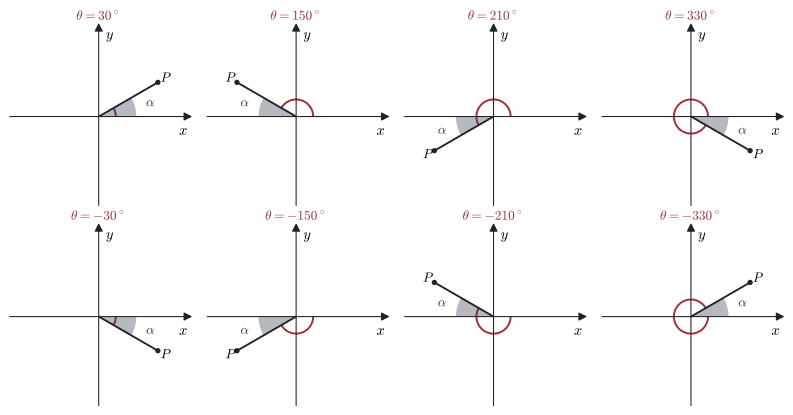
Reference angle Not in the formula booklet
The reference angle \(\alpha\) is the positive acute angle between \(OP\) and the \(x\)-axis. For \(0 < \theta < 2\pi\):
| \(OP\) ends in | Quadrant 1 | Quadrant 2 | Quadrant 3 | Quadrant 4 |
|---|---|---|---|---|
| \(\alpha =\) | \(\theta\) | \(\pi - \theta\) | \(\theta - \pi\) | \(2\pi - \theta\) |
| (degrees) | \(\theta\) | \(180^\circ - \theta\) | \(\theta - 180^\circ\) | \(360^\circ - \theta\) |
- \(\theta\): the angle measured from the positive \(x\)-axis
- \(\alpha\): the reference angle (\(0 < \alpha < \frac{\pi}{2}\))
The reference angle is always measured to the \(x\)-axis, never to the \(y\)-axis.
Example 1 Find the reference angle of
(a) \(200^\circ\)
(b) \(290^\circ\)
(c) \(\dfrac{5\pi}{6}\)
(d) \(-100^\circ\)
(a) \(200^\circ\) is in quadrant 3: \(\;\alpha = 200^\circ - 180^\circ = 20^\circ\).
(b) \(290^\circ\) is in quadrant 4: \(\;\alpha = 360^\circ - 290^\circ = 70^\circ\).
(c) \(\dfrac{5\pi}{6}\) is in quadrant 2: \(\;\alpha = \pi - \dfrac{5\pi}{6} = \dfrac{\pi}{6}\).
(d) Turning \(100^\circ\) clockwise ends in quadrant 3 (the same place as \(260^\circ\)). \(OP\) is \(80^\circ\) from the negative \(x\)-axis, so \(\alpha = 80^\circ\).
The unit circle
The unit circle is the circle with centre \((0, 0)\) and radius \(1\). A point \((x, y)\) is on it when its distance from the origin is \(1\), so by the distance formula \(\sqrt{x^2 + y^2} = 1\).
The unit circle Not in the formula booklet
\[ x^2 + y^2 = 1 \]
- \((x, y)\): any point on the circle with centre \((0, 0)\) and radius \(1\)
Definition of sine and cosine
Let \(P(x, y)\) be a point on the unit circle in the first quadrant, and let \(OP\) make an angle \(\theta\) with the positive \(x\)-axis. The hypotenuse \(OP\) is \(1\), so right-angled trigonometry gives
\[ \begin{aligned} \cos\theta &= \frac{\text{adjacent}}{\text{hypotenuse}} = \frac{x}{1} = x \\[4pt] \sin\theta &= \frac{\text{opposite}}{\text{hypotenuse}} = \frac{y}{1} = y \end{aligned} \]
So \(P\) is the point \((\cos\theta, \sin\theta)\). We now use this as the definition for every angle, not only acute angles.
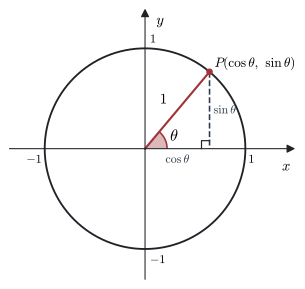
Definition of \(\cos\theta\) and \(\sin\theta\) Not in the formula booklet
Let \(P\) be the point on the unit circle such that \(OP\) makes an angle \(\theta\), measured anticlockwise from the positive \(x\)-axis. Then
- \(\cos\theta\) is the \(x\)-coordinate of \(P\)
- \(\sin\theta\) is the \(y\)-coordinate of \(P\).
- \(O\): the origin, the centre of the unit circle
- \(\theta\): any angle (positive, negative, or larger than \(2\pi\))
Because every point of the unit circle has \(-1 \leq x \leq 1\) and \(-1 \leq y \leq 1\),
\[ -1 \leq \cos\theta \leq 1 \qquad\text{and}\qquad -1 \leq \sin\theta \leq 1 \quad \text{for every } \theta . \]
Definition of tangent
Draw the tangent to the unit circle at \(A(1, 0)\); this is the vertical line \(x = 1\). Extend \(OP\) to meet this tangent at \(Q\). As \(P\) moves round the circle, \(Q\) moves up and down the tangent line. The \(y\)-coordinate of \(Q\) is \(\tan\theta\). (This is where the name tangent comes from.)
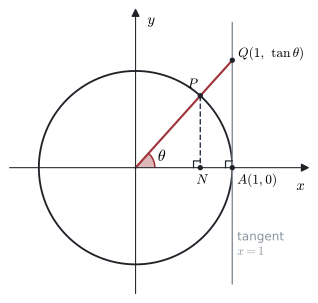
The triangles \(ONP\) and \(OAQ\) have the same angles, so they are similar:
\[ \frac{AQ}{OA} = \frac{NP}{ON} \;\Longrightarrow\; \frac{AQ}{1} = \frac{\sin\theta}{\cos\theta} . \]
Definition of \(\tan\theta\) In the formula booklet
\[ \tan\theta = \frac{\sin\theta}{\cos\theta}, \qquad \cos\theta \neq 0 \]
- \(\theta\): any angle with \(\cos\theta \neq 0\)
- \(\tan\theta\) is undefined when \(\cos\theta = 0\), that is, when \(P\) is at \((0, 1)\) or \((0, -1)\). Then \(OP\) is vertical and never meets the line \(x = 1\).
- \(\tan\theta = \dfrac{\sin\theta}{\cos\theta} = \dfrac{y_P - 0}{x_P - 0}\) is the gradient of \(OP\). So the straight line through the origin that makes an angle \(\theta\) with the positive \(x\)-axis has equation \(y = x\tan\theta\).
Periodicity
There are \(2\pi\) radians in a full turn. If we add a whole number of turns to \(\theta\), the point \(P\) comes back to the same place.
The point directly opposite \(P(\cos\theta, \sin\theta)\) on the circle is \((-\cos\theta, -\sin\theta)\). It is reached by turning a further half turn, \(\pi\).
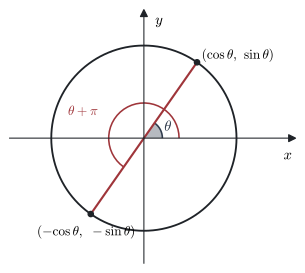
So \(\cos(\theta + \pi) = -\cos\theta\) and \(\sin(\theta + \pi) = -\sin\theta\), and therefore
\[ \tan(\theta + \pi) = \frac{-\sin\theta}{-\cos\theta} = \tan\theta . \]
Periodic properties Not in the formula booklet
For \(\theta\) in radians and \(k \in \mathbb{Z}\):
\[ \begin{gathered} \cos(\theta + 2k\pi) = \cos\theta, \qquad \sin(\theta + 2k\pi) = \sin\theta \\[4pt] \cos(\theta + \pi) = -\cos\theta, \qquad \sin(\theta + \pi) = -\sin\theta \\[4pt] \tan(\theta + k\pi) = \tan\theta \end{gathered} \]
- \(\theta\): any angle, in radians
- \(k\): any integer (the number of turns or half turns)
Sine and cosine repeat every \(2\pi\); tangent repeats every \(\pi\). We use this again for their graphs in Section 14.7.
Example 2 Use the unit circle to complete the table.
| \(\theta\) (degrees) | \(0^\circ\) | \(90^\circ\) | \(180^\circ\) | \(270^\circ\) | \(360^\circ\) | \(630^\circ\) |
|---|---|---|---|---|---|---|
| \(\theta\) (radians) | ||||||
| \(\sin\theta\) | ||||||
| \(\cos\theta\) | ||||||
| \(\tan\theta\) |
The points on the unit circle are \((1, 0)\), \((0, 1)\), \((-1, 0)\), \((0, -1)\) and \((1, 0)\). \(630^\circ = 360^\circ + 270^\circ\) is one full turn plus \(270^\circ\), so it gives the point \((0, -1)\).
| \(\theta\) (degrees) | \(0^\circ\) | \(90^\circ\) | \(180^\circ\) | \(270^\circ\) | \(360^\circ\) | \(630^\circ\) |
|---|---|---|---|---|---|---|
| \(\theta\) (radians) | \(0\) | \(\frac{\pi}{2}\) | \(\pi\) | \(\frac{3\pi}{2}\) | \(2\pi\) | \(\frac{7\pi}{2}\) |
| \(\sin\theta\) | \(0\) | \(1\) | \(0\) | \(-1\) | \(0\) | \(-1\) |
| \(\cos\theta\) | \(1\) | \(0\) | \(-1\) | \(0\) | \(1\) | \(0\) |
| \(\tan\theta\) | \(0\) | undefined | \(0\) | undefined | \(0\) | undefined |
\(\tan\theta\) is undefined whenever \(\cos\theta = 0\).
Example 3 In the diagram, \(P\) is on the unit circle and \(OP\) makes an angle \(\theta\) with the \(y\)-axis. \(X\) is the foot of the perpendicular from \(P\) to the \(y\)-axis.
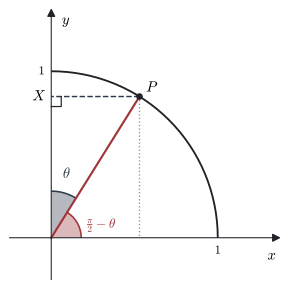
(a) Explain why \(P\) has coordinates \(\left(\cos\left(\frac{\pi}{2} - \theta\right),\ \sin\left(\frac{\pi}{2} - \theta\right)\right)\).
(b) Show that (i) \(XP = \sin\theta\) \(\qquad\) (ii) \(OX = \cos\theta\).
(c) Hence complete:
(i) \(\cos\left(\frac{\pi}{2} - \theta\right) = \ldots\)
(ii) \(\sin\left(\frac{\pi}{2} - \theta\right) = \ldots\)
(d) Check your answers to (c) with a calculator, using
(i) \(\cos\dfrac{\pi}{7}\) and \(\sin\dfrac{5\pi}{14}\)
(ii) \(\sin\dfrac{2\pi}{9}\) and \(\cos\dfrac{5\pi}{18}\).
(e) Write \(\tan\left(\frac{\pi}{2} - \theta\right)\) in terms of \(\tan\theta\).
(a) The angle between \(OP\) and the positive \(x\)-axis is \(\frac{\pi}{2} - \theta\). By the definition, the point of the unit circle at this angle is \(\left(\cos\left(\frac{\pi}{2} - \theta\right), \sin\left(\frac{\pi}{2} - \theta\right)\right)\).
(b) Triangle \(OXP\) has a right angle at \(X\), hypotenuse \(OP = 1\) and angle \(\theta\) at \(O\).
(i) \(XP\) is opposite \(\theta\): \(\;XP = 1 \times \sin\theta = \sin\theta\).
(ii) \(OX\) is adjacent to \(\theta\): \(\;OX = 1 \times \cos\theta = \cos\theta\).
(c) The \(x\)-coordinate of \(P\) is \(XP\) and the \(y\)-coordinate is \(OX\). So
(i) \(\cos\left(\frac{\pi}{2} - \theta\right) = \sin\theta\)
(ii) \(\sin\left(\frac{\pi}{2} - \theta\right) = \cos\theta\).
(d)
(i) \(\frac{\pi}{2} - \frac{\pi}{7} = \frac{5\pi}{14}\), and in RAD mode both values are \(0.900968\ldots\)
(ii) \(\frac{\pi}{2} - \frac{2\pi}{9} = \frac{5\pi}{18}\), and both values are \(0.642787\ldots\)
(e)
\[ \tan\left(\frac{\pi}{2} - \theta\right) = \frac{\sin\left(\frac{\pi}{2} - \theta\right)}{\cos\left(\frac{\pi}{2} - \theta\right)} = \frac{\cos\theta}{\sin\theta} = \frac{1}{\tan\theta} . \]
These are the complementary-angle rules of Section 14.2, now written in radians.
Trigonometric ratios of any angle
Let \(P\) be a point on the unit circle with angle \(\theta\) and reference angle \(\alpha\). The point in quadrant 1 with angle \(\alpha\) is \(P_1(x, y)\), where \(x = \cos\alpha > 0\) and \(y = \sin\alpha > 0\). In the other quadrants, \(P\) is a reflection of \(P_1\), so only the signs of the coordinates change.
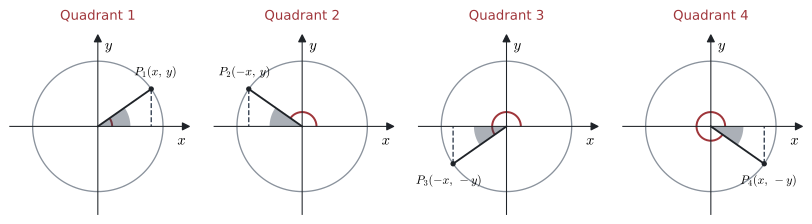
| Quadrant | Point | \(\sin\theta\) | \(\cos\theta\) | \(\tan\theta\) |
|---|---|---|---|---|
| 1: \(\;0 < \theta < \frac{\pi}{2}\) | \(P_1(x, y)\) | \(y = \sin\alpha\) | \(x = \cos\alpha\) | \(\frac{y}{x} = \tan\alpha\) |
| 2: \(\;\frac{\pi}{2} < \theta < \pi\) | \(P_2(-x, y)\) | \(\sin\alpha\) | \(-\cos\alpha\) | \(-\tan\alpha\) |
| 3: \(\;\pi < \theta < \frac{3\pi}{2}\) | \(P_3(-x, -y)\) | \(-\sin\alpha\) | \(-\cos\alpha\) | \(\tan\alpha\) |
| 4: \(\;\frac{3\pi}{2} < \theta < 2\pi\) | \(P_4(x, -y)\) | \(-\sin\alpha\) | \(\cos\alpha\) | \(-\tan\alpha\) |
So the size of each ratio comes from the reference angle, and the sign comes from the quadrant. Recommended way: look at the signs of \(x\) and \(y\). Since \(\cos\theta = x\), \(\sin\theta = y\) and \(\tan\theta = \dfrac{y}{x}\), you only need to know where \(P\) is:
- \(\cos\theta\) has the sign of \(x\): positive on the right of the \(y\)-axis (quadrants 1 and 4).
- \(\sin\theta\) has the sign of \(y\): positive above the \(x\)-axis (quadrants 1 and 2).
- \(\tan\theta\) is positive when \(x\) and \(y\) have the same sign (quadrants 1 and 3).
For example, \(P\) for \(\theta = 240^\circ\) is in quadrant 3, so \(x < 0\) and \(y < 0\). Then \(\cos 240^\circ < 0\), \(\sin 240^\circ < 0\) and \(\tan 240^\circ > 0\).
A short way to remember the same signs is the ASTC rule (“All Students Take Calculus”, or “Add Sugar To Coffee”): it says which ratios are positive in each quadrant.
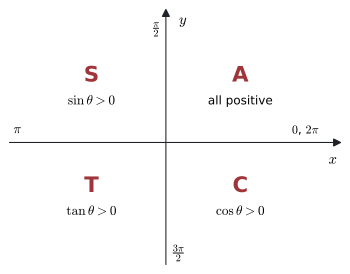
Ratios of any angle Not in the formula booklet
- Find the reference angle \(\alpha\), and the ratio of \(\alpha\) (exact if \(\alpha\) is \(\frac{\pi}{6}\), \(\frac{\pi}{4}\) or \(\frac{\pi}{3}\)).
- Choose the sign from the signs of \(x\) (\(\cos\)) and \(y\) (\(\sin\)) of the point \(P\), or use ASTC.
- Quadrant 1: All ratios are positive.
- Quadrant 2: only Sine is positive.
- Quadrant 3: only Tangent is positive.
- Quadrant 4: only Cosine is positive.
In particular, for any \(\theta\):
\[ \begin{gathered} \sin(\pi - \theta) = \sin\theta, \qquad \cos(\pi - \theta) = -\cos\theta \\[4pt] \tan(\pi - \theta) = -\tan\theta \end{gathered} \]
- \(\theta\): any angle, in radians
- \(\alpha\): the reference angle of \(\theta\)
The last three rules hold because \(\pi - \theta\) is the reflection of \(\theta\) in the \(y\)-axis: the \(y\)-coordinate stays the same and the \(x\)-coordinate changes sign.
Example 4 Given that \(\sin\theta = -\dfrac{7}{25}\) and \(\dfrac{3\pi}{2} < \theta < 2\pi\), find the exact values of \(\cos\theta\) and \(\tan\theta\).
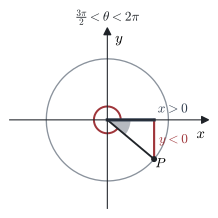
Draw a right-angled triangle for the reference angle \(\alpha\): opposite \(7\), hypotenuse \(25\). The adjacent side is \(\sqrt{25^2 - 7^2} = \sqrt{576} = 24\).
\(\theta\) is in quadrant 4, so \(x > 0\) and \(y < 0\): cosine is positive and tangent is negative.
\[ \cos\theta = +\frac{24}{25}, \qquad \tan\theta = -\frac{7}{24} . \]
Check: \(\tan\theta = \dfrac{\sin\theta}{\cos\theta} = \dfrac{-7/25}{24/25} = -\dfrac{7}{24}\). ✓
Example 5 Without using a calculator, find the exact value of
(a) \(\sin 240^\circ\)
(b) \(\tan 315^\circ\)
(c) \(\cos\dfrac{7\pi}{6}\)
(d) \(\sin\dfrac{11\pi}{4}\)
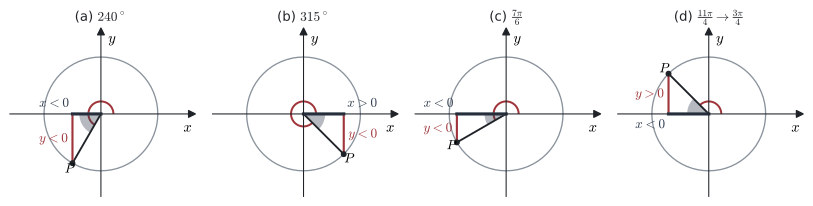
(a) \(240^\circ\) is in quadrant 3 with \(\alpha = 60^\circ\). \(y < 0\), so sine is negative: \(\;\sin 240^\circ = -\sin 60^\circ = -\dfrac{\sqrt{3}}{2}\).
(b) \(315^\circ\) is in quadrant 4 with \(\alpha = 45^\circ\). \(x > 0\) and \(y < 0\), so tangent is negative: \(\;\tan 315^\circ = -\tan 45^\circ = -1\).
(c) \(\dfrac{7\pi}{6} = \pi + \dfrac{\pi}{6}\) is in quadrant 3 with \(\alpha = \dfrac{\pi}{6}\). \(x < 0\), so \(\;\cos\dfrac{7\pi}{6} = -\cos\dfrac{\pi}{6} = -\dfrac{\sqrt{3}}{2}\).
(d) First remove a full turn: \(\dfrac{11\pi}{4} = 2\pi + \dfrac{3\pi}{4}\), so \(\sin\dfrac{11\pi}{4} = \sin\dfrac{3\pi}{4}\). This is in quadrant 2 with \(\alpha = \dfrac{\pi}{4}\), and \(y > 0\), so sine is positive: \(\;\sin\dfrac{11\pi}{4} = \dfrac{\sqrt{2}}{2}\).
Negative angles
Let \(\theta\) be an angle with point \(P(x, y)\) on the unit circle. The angle \(-\theta\) is the same turn made clockwise. Its point \(P'\) is the reflection of \(P\) in the \(x\)-axis, so \(P'\) is \((x, -y)\).
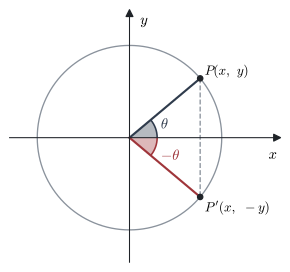
\[ \begin{aligned} \sin(-\theta) &= -y = -\sin\theta \\ \cos(-\theta) &= x = \cos\theta \\ \tan(-\theta) &= \frac{-y}{x} = -\tan\theta \end{aligned} \]
Negative angles Not in the formula booklet
\[ \sin(-\theta) = -\sin\theta, \qquad \cos(-\theta) = \cos\theta, \qquad \tan(-\theta) = -\tan\theta \]
- \(\theta\): any angle
Example 6 Without using a calculator, find the exact values of the sine, cosine and tangent of
(a) \(-60^\circ\) \(\qquad\) (b) \(-\dfrac{5\pi}{6}\)
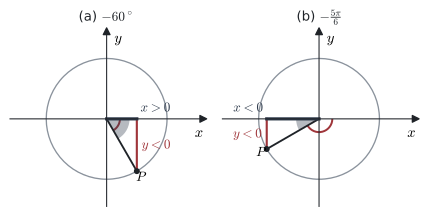
(a) Use the negative-angle rules:
\[ \sin(-60^\circ) = -\frac{\sqrt{3}}{2}, \qquad \cos(-60^\circ) = \frac{1}{2}, \qquad \tan(-60^\circ) = -\sqrt{3}. \]
(b) \(-\dfrac{5\pi}{6}\) ends in quadrant 3 with reference angle \(\dfrac{\pi}{6}\). Here \(x < 0\) and \(y < 0\), so sine and cosine are negative and tangent is positive:
\[ \begin{aligned} \sin\left(-\frac{5\pi}{6}\right) &= -\frac{1}{2} \\[4pt] \cos\left(-\frac{5\pi}{6}\right) &= -\frac{\sqrt{3}}{2} \\[4pt] \tan\left(-\frac{5\pi}{6}\right) &= \frac{\sqrt{3}}{3} \end{aligned} \]
Check with the rules: \(\sin\left(-\frac{5\pi}{6}\right) = -\sin\frac{5\pi}{6} = -\frac{1}{2}\). ✓
Example 7 It is given that \(\cos x = k\), where \(0 < x < \dfrac{\pi}{2}\). Write each of the following in terms of \(k\).
(a) \(\cos(\pi - x)\)
(b) \(\cos(\pi + x)\)
(c) \(\cos(-x)\)
(d) \(\sin\left(\dfrac{\pi}{2} - x\right)\)
(e) \(\cos(x - 2\pi)\)
(a) \(\pi - x\) is in quadrant 2, where cosine is negative: \(\;\cos(\pi - x) = -k\).
(b) \(\pi + x\) is the opposite point: \(\;\cos(\pi + x) = -\cos x = -k\).
(c) \(\cos(-x) = \cos x = k\).
(d) Complementary angles: \(\;\sin\left(\frac{\pi}{2} - x\right) = \cos x = k\).
(e) Subtracting a full turn does not change the point: \(\;\cos(x - 2\pi) = k\).
Common errors
| ✗ Wrong | ✓ Right | Why |
|---|---|---|
| Reference angle of \(200^\circ\) is \(70^\circ\) | \(20^\circ\) | Measure to the \(x\)-axis, not the \(y\)-axis. |
| \(\cos 120^\circ = \frac{1}{2}\) | \(-\frac{1}{2}\) | \(120^\circ\) is in quadrant 2, where cosine is negative. |
| \(\sin(-\theta) = \sin\theta\) | \(-\sin\theta\) | Only cosine keeps its sign: \(\cos(-\theta) = \cos\theta\). |
| \(\tan 90^\circ = 0\) | undefined | \(\cos 90^\circ = 0\), and we cannot divide by \(0\). |
| \(\tan(\theta + \pi) = -\tan\theta\) | \(\tan\theta\) | Both \(\sin\) and \(\cos\) change sign, so the quotient does not. |
| \(\cos\theta = \frac{4}{3}\) is possible | \(-1 \leq \cos\theta \leq 1\) | \(\cos\theta\) is a coordinate on a circle of radius \(1\). |
Exercises
1 Find the reference angle of (a) \(160^\circ\)
(b) \(255^\circ\)
(c) \(\dfrac{7\pi}{4}\)
(d) \(-200^\circ\)
(a) \(180^\circ - 160^\circ = 20^\circ\)
(b) \(255^\circ - 180^\circ = 75^\circ\)
(c) \(2\pi - \dfrac{7\pi}{4} = \dfrac{\pi}{4}\)
(d) \(-200^\circ\) ends in quadrant 2 (the same place as \(160^\circ\)), so \(\alpha = 20^\circ\).
2 Without a calculator, state whether each value is positive or negative.
(a) \(\cos 200^\circ\)
(b) \(\tan 100^\circ\)
(c) \(\sin(-50^\circ)\)
(d) \(\cos 5\) (radians)
(a) Quadrant 3: negative.
(b) Quadrant 2: negative.
(c) Quadrant 4: negative.
(d) \(\dfrac{3\pi}{2} \approx 4.71 < 5 < 2\pi \approx 6.28\), so quadrant 4: positive.
3 Find the exact value of (a) \(\cos 300^\circ\)
(b) \(\sin 135^\circ\)
(c) \(\tan 240^\circ\)
(d) \(\cos\dfrac{5\pi}{4}\)
(a) Q4, \(\alpha = 60^\circ\): \(\;\dfrac{1}{2}\)
(b) Q2, \(\alpha = 45^\circ\): \(\;\dfrac{\sqrt{2}}{2}\)
(c) Q3, \(\alpha = 60^\circ\): \(\;\sqrt{3}\)
(d) Q3, \(\alpha = \dfrac{\pi}{4}\): \(\;-\dfrac{\sqrt{2}}{2}\)
4 Find the exact value of (a) \(\sin\left(-\dfrac{\pi}{3}\right)\)
(b) \(\tan\left(-\dfrac{3\pi}{4}\right)\)
(c) \(\cos\left(-\dfrac{7\pi}{6}\right)\)
(d) \(\sin\dfrac{17\pi}{6}\)
(a) \(-\sin\dfrac{\pi}{3} = -\dfrac{\sqrt{3}}{2}\)
(b) \(-\tan\dfrac{3\pi}{4} = -(-1) = 1\)
(c) \(\cos\dfrac{7\pi}{6} = -\dfrac{\sqrt{3}}{2}\)
(d) \(\dfrac{17\pi}{6} = 2\pi + \dfrac{5\pi}{6}\), so the value is \(\sin\dfrac{5\pi}{6} = \dfrac{1}{2}\).
5 Given that \(\cos\theta = -\dfrac{5}{13}\) and \(\dfrac{\pi}{2} < \theta < \pi\), find the exact values of \(\sin\theta\) and \(\tan\theta\).
The third side is \(\sqrt{13^2 - 5^2} = 12\). In quadrant 2 sine is positive and tangent is negative: \(\;\sin\theta = \dfrac{12}{13}\), \(\;\tan\theta = -\dfrac{12}{5}\).
6 Given that \(\tan\theta = \dfrac{3}{4}\) and \(\pi < \theta < \dfrac{3\pi}{2}\), find the exact values of \(\sin\theta\) and \(\cos\theta\).
The hypotenuse is \(\sqrt{3^2 + 4^2} = 5\). In quadrant 3 both are negative: \(\;\sin\theta = -\dfrac{3}{5}\), \(\;\cos\theta = -\dfrac{4}{5}\).
7 It is given that \(\sin x = p\), where \(0 < x < \dfrac{\pi}{2}\). Write in terms of \(p\):
(a) \(\sin(\pi - x)\)
(b) \(\sin(\pi + x)\)
(c) \(\sin(-x)\)
(d) \(\cos\left(\dfrac{\pi}{2} - x\right)\)
(e) \(\sin(x + 4\pi)\)
(a) \(p\)
(b) \(-p\)
(c) \(-p\)
(d) \(p\)
(e) \(p\) (two full turns)
8 Without a calculator, find the exact value of \(\sin 150^\circ + \cos 240^\circ + \tan 225^\circ\).
\(\sin 150^\circ = \dfrac{1}{2}\), \(\;\cos 240^\circ = -\dfrac{1}{2}\), \(\;\tan 225^\circ = 1\). The sum is \(\dfrac{1}{2} - \dfrac{1}{2} + 1 = 1\).
9 (a) A line through the origin makes an angle of \(\dfrac{3\pi}{4}\) with the positive \(x\)-axis. Find its equation.
(b) Find the angle that the line \(y = \dfrac{\sqrt{3}}{3}x\) makes with the positive \(x\)-axis.
(a) \(y = x\tan\dfrac{3\pi}{4} = -x\).
(b) The gradient is \(\tan\theta = \dfrac{\sqrt{3}}{3}\), so \(\theta = \dfrac{\pi}{6}\) (\(30^\circ\)).
10 The point \(P(-0.28,\ b)\) lies on the unit circle, and \(OP\) makes an angle \(\theta\) with the positive \(x\)-axis, where \(\dfrac{\pi}{2} < \theta < \pi\).
(a) Find \(b\).
(b) Write down \(\cos\theta\) and \(\sin\theta\), and find \(\tan\theta\) as a fraction.
(c) Find \(\cos(\theta + \pi)\) and \(\sin(-\theta)\).
(a) \((-0.28)^2 + b^2 = 1 \Rightarrow b^2 = 0.9216 \Rightarrow b = 0.96\) (positive, since \(P\) is in quadrant 2).
(b) \(\cos\theta = -0.28\), \(\;\sin\theta = 0.96\), \(\;\tan\theta = \dfrac{0.96}{-0.28} = -\dfrac{24}{7}\).
(c) \(\cos(\theta + \pi) = -\cos\theta = 0.28\) and \(\sin(-\theta) = -\sin\theta = -0.96\).