25.5 Rates of Change and Related Rates
SL 5.1 AHL 5.14
- the difference between a constant, an average and an instantaneous rate of change
- that the derivative \(\frac{dy}{dx}\) is the instantaneous rate of change of \(y\) with respect to \(x\)
- how to interpret derivatives in context (for example speed, marginal cost, rate of flow)
- AHL how to use the chain rule to connect related rates of change, \(\frac{dy}{dt} = \frac{dy}{dx} \times \frac{dx}{dt}\)
Average rate of change
A rate of change tells us how one quantity changes compared with another. Speed (metres per second) and heart rate (beats per minute) are examples.
For a function \(y = f(x)\), the average rate of change of \(y\) with respect to \(x\) between the points \((x_1, y_1)\) and \((x_2, y_2)\) is
\[ \frac{y_2 - y_1}{x_2 - x_1} = \frac{\text{change in } y}{\text{change in } x} . \]
This is the gradient of the straight line (the chord) joining the two points.
- For a linear function \(y = mx + c\), the gradient is always \(m\). We say the rate of change is constant. For example, if an electricity bill is \(C = 0.3n + 12\) dollars for \(n\) units, then \(C\) increases at a constant rate of \(0.3\) dollars per unit.
- For a non-linear function, the gradient changes from point to point. The gradient of a chord gives only the average rate of change over that interval.
For example, if a car has travelled \(s = 80\) m after \(5\) s and \(s = 200\) m after \(8\) s, its average speed over this interval is \(\frac{200 - 80}{8 - 5} = 40\) m s\(^{-1}\).
Instantaneous rate of change
Take two points \(P(x_1, y_1)\) and \(Q(x_2, y_2)\) on a curve. As \(Q\) moves towards \(P\) (so \(x_2 - x_1 \to 0\)), the chord \(PQ\) gets closer and closer to the tangent at \(P\).
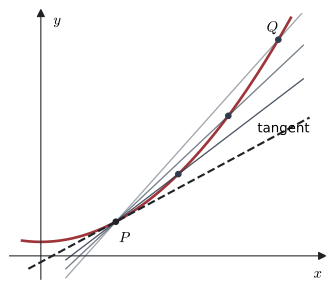
Instantaneous rate of change Not in the formula booklet
The instantaneous rate of change of \(y = f(x)\) with respect to \(x\) at \(x = x_1\) is the limit of the average rate of change. It is the gradient of the tangent:
\[ \left.\frac{dy}{dx}\right|_{x = x_1} = f'(x_1) . \]
- \(x_1\): the value of \(x\) where we find the rate of change
- \(f'(x_1)\): the gradient of the tangent at \(x = x_1\)
The limit idea is studied more carefully in Unit 26.
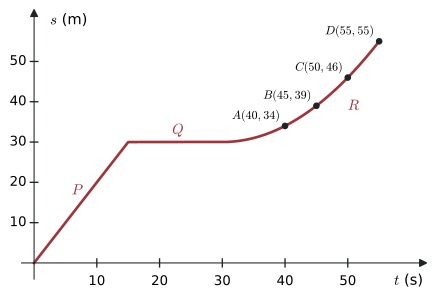
Example 1 The distance–time graph shows a cyclist’s first \(55\) seconds. It is made of two line segments \(P\) and \(Q\), and a curve \(R\) with equation \(s = 30 + \frac{1}{25}(t - 30)^2\) for \(30 \le t \le 55\), where \(s\) is in metres and \(t\) in seconds.
(a)
(i) Find the gradients of \(P\) and \(Q\).
(ii) What type of rate of change do they show?
(iii) Describe the motion for \(0 \le t \le 30\).
(b) Find the gradients of the chords \(AB\), \(AC\) and \(AD\).
(c)
(i) Explain how to find the instantaneous rate of change at \(A\).
(ii) Which chord in (b) gives the best estimate? Find the exact value.
(iii) Is the speed constant, increasing or decreasing for \(30 < t < 55\)?
(a)
(i) \(P\): \(\frac{30 - 0}{15 - 0} = 2\). \(\quad\) \(Q\): \(\frac{30 - 30}{30 - 15} = 0\).
(ii) Straight lines have constant rates of change.
(iii) For \(0 \le t \le 15\) the cyclist moves at a constant speed of \(2\) m s\(^{-1}\). For \(15 \le t \le 30\) she is not moving (speed \(0\)).
(b) \(AB\): \(\frac{39 - 34}{45 - 40} = 1\). \(\quad\) \(AC\): \(\frac{46 - 34}{50 - 40} = 1.2\). \(\quad\) \(AD\): \(\frac{55 - 34}{55 - 40} = 1.4\). These are average rates of change (average speeds).
(c)
(i) Find the gradient of the tangent at \(A\): take chords \(AX\) with \(X\) closer and closer to \(A\), or differentiate.
(ii) \(AB\) is the best, because \(B\) is closest to \(A\). Exactly: \(\frac{ds}{dt} = \frac{2}{25}(t - 30)\), so at \(t = 40\) the speed is \(\frac{2}{25} \times 10 = 0.8\) m s\(^{-1}\).
(iii) Increasing: the curve gets steeper (it is concave up), and \(\frac{ds}{dt} = \frac{2}{25}(t - 30)\) increases with \(t\).
Interpreting derivatives in context
If \(y\) depends on \(x\), then \(\frac{dy}{dx}\) has units “units of \(y\) per unit of \(x\)”. Always give the units, and say in words what the number means.
Example 2 A patch of algae on a lake grows so that its area after \(t\) days is \(A = 9t\) km\(^2\).
(a) The patch is modelled as a circle. Write the radius \(r\) in terms of \(t\).
(b) Find \(\frac{dr}{dt}\).
(c) How fast is the radius increasing after \(4\) days?
(a) \(\pi r^2 = 9t\), so \(r = \sqrt{\frac{9t}{\pi}} = \frac{3}{\sqrt{\pi}}\, t^{\frac{1}{2}}\).
(b) \(\frac{dr}{dt} = \frac{3}{\sqrt{\pi}} \times \frac{1}{2}t^{-\frac{1}{2}} = \frac{3}{2\sqrt{\pi t}}\) km per day.
(c) \(t = 4\): \(\frac{dr}{dt} = \frac{3}{2\sqrt{4\pi}} = \frac{3}{4\sqrt{\pi}} \approx 0.423\) km per day.
In economics, the derivative of the cost function \(C(x)\) is called the marginal cost \(C'(x)\). It estimates the cost of making one more item.
Example 3 The cost of making \(x\) chairs per week is \(C(x) = 2500 + 8x + 0.02x^2\) dollars.
(a) Find the marginal cost function \(C'(x)\).
(b) Find \(C'(150)\). What does it estimate?
(c) Find \(C(151) - C(150)\) and compare it with your answer to (b).
(a) \(C'(x) = 8 + 0.04x\).
(b) \(C'(150) = 8 + 6 = 14\). It estimates that the \(151\)st chair costs about \(14\) dollars to make (when \(150\) chairs are already being made).
(c) \(C(151) - C(150) = 8(1) + 0.02(151^2 - 150^2) = 8 + 0.02 \times 301 = 14.02\) dollars. This is the exact cost of the \(151\)st chair. It is very close to \(C'(150)\), because the graph of \(C\) is almost straight over one unit.
Example 4 A pool holds \(30\,000\) litres of water. When the drain is opened, all the water runs out in \(60\) minutes. The volume left after \(t\) minutes is
\[ V = 30\,000\left(1 - \frac{t}{60}\right)^2 \text{ litres}, \qquad 0 \le t \le 60 . \]
(a) Find \(\frac{dV}{dt}\), and sketch the graph of \(\frac{dV}{dt}\) against \(t\).
(b) At what time is the water flowing out fastest?
(c) Show that \(\frac{d^2V}{dt^2}\) is constant and positive. Interpret this.
(a) Chain rule:
\[ \frac{dV}{dt} = 30\,000 \times 2\left(1 - \frac{t}{60}\right) \times \left(-\frac{1}{60}\right) = -1000\left(1 - \frac{t}{60}\right) = -1000 + \frac{50}{3}t . \]
The graph is a straight line from \((0, -1000)\) to \((60, 0)\).
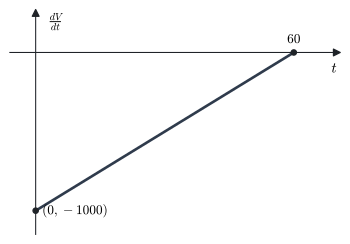
(b) The outflow rate is \(-\frac{dV}{dt}\). It is largest when \(t = 0\) (at the start): \(1000\) litres per minute.
(c) \(\frac{d^2V}{dt^2} = \frac{50}{3} > 0\) for all \(t\). The rate \(\frac{dV}{dt}\) increases (from \(-1000\) towards \(0\)) at a constant rate, so the water flows out more and more slowly, and the outflow rate falls by \(\frac{50}{3}\) litres per minute every minute.
AHL 5.14 Related rates
Often two quantities \(x\) and \(y\) both change with time \(t\), and there is an equation connecting \(x\) and \(y\). Then their rates of change are connected by the chain rule.
Related rates Not in the formula booklet
\[ \frac{dy}{dt} = \frac{dy}{dx} \times \frac{dx}{dt} \]
- \(y\): a quantity that depends on \(x\)
- \(t\): time
- \(x\): a quantity that changes with time
It is the chain rule, which is in the booklet.
The method:
- Draw a diagram. Name the variables. Write down the rate you know and the rate you want (with units and sign: a decreasing quantity has a negative rate).
- Find an equation connecting the variables (geometry: Pythagoras, area, volume, trigonometry).
- Differentiate with respect to \(t\) (chain rule or implicit differentiation).
- Substitute the values at the instant asked for — only after differentiating.
Example 5 The radius of a circular ripple on a pond increases at a constant rate of \(3\) cm s\(^{-1}\). Find the rate of increase of the area of the circle when
(a) the radius is \(10\) cm, \(\qquad\) (b) the area is \(64\pi\) cm\(^2\).
\(A = \pi r^2\), so \(\frac{dA}{dr} = 2\pi r\), and \(\frac{dr}{dt} = 3\).
\[ \frac{dA}{dt} = \frac{dA}{dr} \times \frac{dr}{dt} = 2\pi r \times 3 = 6\pi r . \]
(a) \(r = 10\): \(\frac{dA}{dt} = 60\pi \approx 188\) cm\(^2\) s\(^{-1}\).
(b) \(\pi r^2 = 64\pi\), so \(r = 8\): \(\frac{dA}{dt} = 48\pi \approx 151\) cm\(^2\) s\(^{-1}\).
Example 6 Two boats travel in the same direction on straight parallel courses that are \(6\) km apart. Their speeds are \(30\) km h\(^{-1}\) and \(40\) km h\(^{-1}\). How fast is the distance between them changing at the instant when the slower boat is \(8\) km ahead of the faster one?
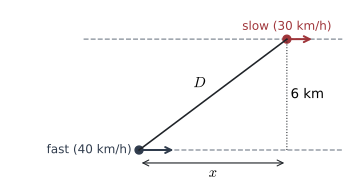
Let \(x\) km be how far the slower boat is ahead, and \(D\) km the distance between the boats. By Pythagoras,
\[ D^2 = x^2 + 36 . \]
The faster boat gains \(40 - 30 = 10\) km every hour, so \(\frac{dx}{dt} = -10\) km h\(^{-1}\).
Differentiate with respect to \(t\): \(2D\frac{dD}{dt} = 2x\frac{dx}{dt}\), so \(\frac{dD}{dt} = \frac{x}{D}\frac{dx}{dt}\).
When \(x = 8\): \(D = \sqrt{64 + 36} = 10\), so
\[ \frac{dD}{dt} = \frac{8}{10} \times (-10) = -8 . \]
The distance between the boats is decreasing at \(8\) km h\(^{-1}\).
Example 7 A water trough is \(6\) m long. Its cross-section is a semicircle with diameter \(1\) m. Water is pumped in at a constant rate of \(0.05\) m\(^3\) per minute. The surface of the water subtends an angle \(\theta\) (radians) at the centre \(O\) of the semicircle, and the depth of the water is \(h\) m.
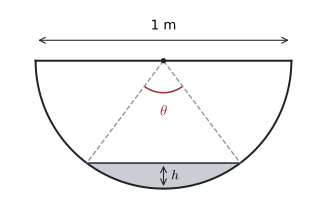
(a) Show that the volume of water is \(V = 0.75(\theta - \sin\theta)\) m\(^3\).
(b) Find the rate at which the water level is rising at the instant when the water is \(10\) cm deep.
(a) The water cross-section is a segment of a circle with radius \(r = 0.5\) and angle \(\theta\):
\[ \text{area} = \tfrac{1}{2}r^2\theta - \tfrac{1}{2}r^2\sin\theta = \tfrac{1}{2}(0.25)(\theta - \sin\theta) = 0.125(\theta - \sin\theta) . \]
Volume \(= 6 \times 0.125(\theta - \sin\theta) = 0.75(\theta - \sin\theta)\).
(b) First find \(\frac{d\theta}{dt}\), then \(\frac{dh}{dt}\).
The centre \(O\) is \(0.5 - h\) above the water surface, and \(\cos\frac{\theta}{2} = \frac{0.5 - h}{0.5}\), so \(h = 0.5 - 0.5\cos\frac{\theta}{2}\).
When \(h = 0.1\): \(\cos\frac{\theta}{2} = 0.8\), \(\sin\frac{\theta}{2} = 0.6\), and \(\cos\theta = 2(0.8)^2 - 1 = 0.28\).
\[ \frac{dV}{dt} = 0.75(1 - \cos\theta)\frac{d\theta}{dt} \;\Rightarrow\; 0.05 = 0.75(0.72)\frac{d\theta}{dt} \;\Rightarrow\; \frac{d\theta}{dt} = \frac{0.05}{0.54} = \frac{5}{54} \text{ rad per minute}. \]
\[ \frac{dh}{dt} = 0.25\sin\frac{\theta}{2} \times \frac{d\theta}{dt} = 0.25 \times 0.6 \times \frac{5}{54} = \frac{1}{72} \text{ m per minute}. \]
The level is rising at \(\frac{1}{72}\) m min\(^{-1}\) \(\approx 1.39\) cm per minute.
Common errors
| ✗ Wrong | ✓ Right | Why |
|---|---|---|
| Substituting the instant values before differentiating | Differentiate first, then substitute | If you put \(x = 8\) first, \(x\) is a constant and its rate becomes \(0\). |
| A decreasing quantity given a positive rate | Use a negative sign: \(\frac{dx}{dt} = -10\) | The sign shows the direction of change. |
| Average rate used as the instantaneous rate | Instantaneous rate \(= f'(x_1)\) | The chord gradient is only an approximation. |
| Answer without units or meaning | “decreasing at \(8\) km h\(^{-1}\)” | Rates in context need units and a direction. |
| Angles in degrees in related rates | Use radians | \(\frac{d}{d\theta}\sin\theta = \cos\theta\) only in radians. |
Exercises
1 For \(f(x) = x^2 + 3x\), find
(a) the average rate of change of \(f\) between \(x = 1\) and \(x = 4\),
(b) the instantaneous rate of change at \(x = 1\).
(a) \(f(1) = 4\), \(f(4) = 28\): \(\frac{28 - 4}{4 - 1} = 8\).
(b) \(f'(x) = 2x + 3\), \(f'(1) = 5\).
2 A cup of tea cools so that its temperature after \(t\) minutes is \(T = 20 + 80\mathrm{e}^{-0.1t}\) °C. Find the rate of change of temperature
(a) at \(t = 0\),
(b) at \(t = 10\) (exact value). Explain the sign.
\(\frac{dT}{dt} = 80 \times (-0.1)\mathrm{e}^{-0.1t} = -8\mathrm{e}^{-0.1t}\).
(a) \(-8\) °C per minute.
(b) \(-8\mathrm{e}^{-1} = -\frac{8}{\mathrm{e}}\) °C per minute (\(\approx -2.94\)).
The sign is negative because the tea is cooling (the temperature decreases).
3 The weekly profit from selling \(x\) items is \(P(x) = -0.5x^2 + 40x - 200\) dollars. Find the marginal profit when \(x = 30\), and the value of \(x\) for which the marginal profit is zero.
\(P'(x) = -x + 40\). \(P'(30) = 10\) dollars per item. \(P'(x) = 0\) when \(x = 40\).
4 A population of bacteria is \(P = 500\mathrm{e}^{0.04t}\) after \(t\) hours. Show that \(\frac{dP}{dt} = 0.04P\), and find the rate of growth when \(P = 1000\).
\(\frac{dP}{dt} = 500 \times 0.04\,\mathrm{e}^{0.04t} = 0.04 \times 500\mathrm{e}^{0.04t} = 0.04P\).
When \(P = 1000\): \(\frac{dP}{dt} = 40\) bacteria per hour.
5 AHL The side of a square increases at \(0.5\) cm s\(^{-1}\). Find the rate of increase of its area when the side is \(8\) cm.
\(A = x^2\), \(\frac{dA}{dt} = 2x\frac{dx}{dt} = 2(8)(0.5) = 8\) cm\(^2\) s\(^{-1}\).
6 AHL Air is pumped into a spherical balloon at \(100\) cm\(^3\) s\(^{-1}\). Find the rate at which the radius is increasing when the radius is \(5\) cm.
\(V = \frac{4}{3}\pi r^3\), \(\frac{dV}{dt} = 4\pi r^2\frac{dr}{dt}\).
\(100 = 4\pi(25)\frac{dr}{dt}\), so \(\frac{dr}{dt} = \frac{1}{\pi} \approx 0.318\) cm s\(^{-1}\).
7 AHL A \(13\) m ladder leans against a vertical wall. The bottom slides away from the wall at \(0.4\) m s\(^{-1}\). How fast is the top sliding down the wall when the bottom is \(5\) m from the wall?
\(x^2 + y^2 = 169\). When \(x = 5\), \(y = 12\).
\(2x\frac{dx}{dt} + 2y\frac{dy}{dt} = 0 \Rightarrow \frac{dy}{dt} = -\frac{x}{y}\frac{dx}{dt} = -\frac{5}{12}(0.4) = -\frac{1}{6}\).
The top slides down at \(\frac{1}{6}\) m s\(^{-1}\) \(\approx 0.167\) m s\(^{-1}\).
8 AHL A conical tank (vertex down) has radius \(3\) m and height \(6\) m. Water flows in at \(2\) m\(^3\) per minute. Find the rate at which the water level rises when the water is \(4\) m deep.
By similar triangles \(r = \frac{h}{2}\), so \(V = \frac{1}{3}\pi r^2 h = \frac{\pi h^3}{12}\) and \(\frac{dV}{dh} = \frac{\pi h^2}{4}\).
At \(h = 4\): \(\frac{dV}{dh} = 4\pi\), so \(\frac{dh}{dt} = \frac{2}{4\pi} = \frac{1}{2\pi} \approx 0.159\) m per minute.
9 AHL A trough is \(4\) m long. Its cross-section is an isosceles trapezium with bottom width \(0.6\) m; the width of the water surface is \(0.6 + 2h\) m when the water is \(h\) m deep. Water leaks out at \(0.08\) m\(^3\) per minute. Find the rate at which the water level is falling when the water is \(20\) cm deep.
Cross-section area \(= \frac{1}{2}(0.6 + 0.6 + 2h)h = 0.6h + h^2\), so \(V = 4(0.6h + h^2)\) and \(\frac{dV}{dh} = 4(0.6 + 2h)\).
At \(h = 0.2\): \(\frac{dV}{dh} = 4(1.0) = 4\). With \(\frac{dV}{dt} = -0.08\): \(\frac{dh}{dt} = \frac{-0.08}{4} = -0.02\) m per minute.
The level is falling at \(2\) cm per minute.
10 AHL A balloon rises vertically at \(3\) m s\(^{-1}\) from a point on level ground \(40\) m from an observer. Find the rate of change of the angle of elevation \(\theta\) from the observer to the balloon when the balloon is \(30\) m high.
\(\tan\theta = \frac{h}{40}\). Differentiate: \(\sec^2\theta\,\frac{d\theta}{dt} = \frac{1}{40}\frac{dh}{dt}\).
When \(h = 30\): \(\tan\theta = \frac{3}{4}\), \(\sec^2\theta = 1 + \frac{9}{16} = \frac{25}{16}\).
\[ \frac{d\theta}{dt} = \frac{16}{25} \times \frac{3}{40} = \frac{6}{125} = 0.048 \text{ rad s}^{-1} . \]