14.8 The Tangent Graph and General Trigonometric Functions
SL 3.7
- why the graph of \(y = \tan x\) has vertical asymptotes
- the key features of \(y = \tan x\): period \(\pi\), range \(\mathbb{R}\), no amplitude
- the general tangent function \(y = a\tan\big(b(x - c)\big) + d\)
- how to sketch a tangent graph by hand, and how to find its equation from a graph
- a summary of the features of the sine, cosine and tangent functions
The tangent function
The tangent of an angle is the sine divided by the cosine.
The tangent function In the formula booklet
\[ \tan\theta = \frac{\sin\theta}{\cos\theta}, \qquad \cos\theta \neq 0 \]
- \(\theta\): an angle (in radians in this section)
On the unit circle (Section 14.6), \(\tan\theta\) is the gradient of the radius to the point \((\cos\theta, \sin\theta)\).
The basic tangent curve
Because \(\tan x = \dfrac{\sin x}{\cos x}\), \(\tan x\) is undefined wherever \(\cos x = 0\), that is, at \(x = \pm\dfrac{\pi}{2}, \pm\dfrac{3\pi}{2}, \ldots\)
Near these values the denominator \(\cos x\) is very small, so \(\tan x\) becomes very large (positive or negative). So each zero of \(\cos x\) gives a vertical asymptote of \(y = \tan x\). The zeros of \(\tan x\) are the zeros of \(\sin x\): \(x = 0, \pm\pi, \pm 2\pi, \ldots\)
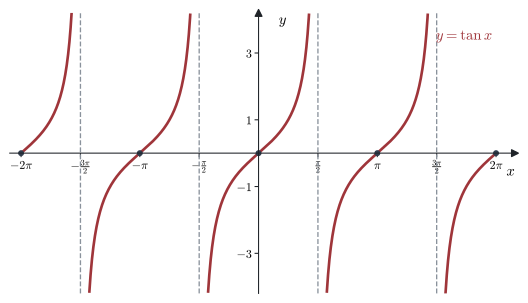
Key features of \(y = \tan x\) Not in the formula booklet
- period \(\pi\)
- domain \(x \neq \dfrac{\pi}{2} + k\pi\); range \(y \in \mathbb{R}\)
- vertical asymptotes \(x = \dfrac{\pi}{2} + k\pi\)
- zeros at \(x = k\pi\)
- no maximum or minimum, so no amplitude
- \(k\): any integer (\(k \in \mathbb{Z}\))
Each branch is the same: it comes up from \(-\infty\) next to one asymptote, passes through a zero, and goes up to \(+\infty\) next to the next asymptote. The graph is increasing on every branch. It has rotational symmetry about each zero, because \(\tan(-x) = -\tan x\).
Useful points on the middle branch: \(\left(-\frac{\pi}{4}, -1\right)\), \((0, 0)\), \(\left(\frac{\pi}{4}, 1\right)\).
The general tangent function
The general tangent function Not in the formula booklet
\[ y = a\tan\big(b(x - c)\big) + d, \qquad a \neq 0,\; b > 0 \]
- principal axis: \(y = d\)
- period \(= \dfrac{\pi}{b}\)
- the amplitude is not defined
- there are infinitely many vertical asymptotes, one period apart
- \(a\): vertical stretch (if \(a < 0\), the graph is also reflected and each branch decreases)
- \(b\): horizontal stretch with scale factor \(\frac{1}{b}\)
- \(c\): horizontal translation; \(d\): vertical translation
Note the period: it is \(\dfrac{\pi}{b}\) for tangent, but \(\dfrac{2\pi}{b}\) for sine and cosine.
To find the asymptotes of a transformed graph, solve “bracket \(= \dfrac{\pi}{2} + k\pi\)”. To find where it meets the principal axis, solve “bracket \(= k\pi\)”.
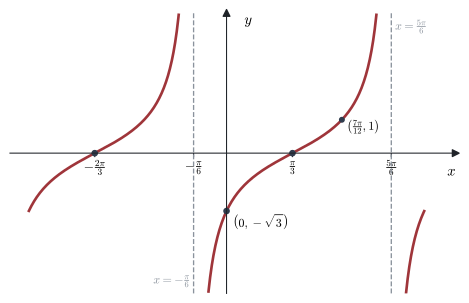
Example 1 Without using technology, sketch the graph of \(y = \tan\left(x - \dfrac{\pi}{3}\right)\) for \(-\pi \le x \le \pi\). Show the asymptotes and the axis intercepts.
The graph is \(y = \tan x\) translated \(\dfrac{\pi}{3}\) to the right, so every feature moves \(\dfrac{\pi}{3}\) to the right.
- Asymptotes: \(x - \dfrac{\pi}{3} = \dfrac{\pi}{2} + k\pi\), so \(x = \dfrac{5\pi}{6} + k\pi\). In the interval: \(x = -\dfrac{\pi}{6}\) and \(x = \dfrac{5\pi}{6}\).
- \(x\)-intercepts: \(x - \dfrac{\pi}{3} = k\pi\), so \(x = \dfrac{\pi}{3} + k\pi\). In the interval: \(x = -\dfrac{2\pi}{3}\) and \(x = \dfrac{\pi}{3}\).
- \(y\)-intercept: \(\tan\left(-\dfrac{\pi}{3}\right) = -\sqrt{3}\).
- A helpful point: at \(x = \dfrac{\pi}{3} + \dfrac{\pi}{4} = \dfrac{7\pi}{12}\), \(\;y = \tan\dfrac{\pi}{4} = 1\).
- End points: \(y = \tan\left(-\dfrac{4\pi}{3}\right) = -\sqrt{3}\) at \(x = -\pi\), and \(y = \tan\dfrac{2\pi}{3} = -\sqrt{3}\) at \(x = \pi\).
Example 2 The graph of \(y = \tan(pt) + q\) is shown, where \(p > 0\). The dashed lines are asymptotes. The graph passes through \((0, -2)\) and \(\left(\dfrac{3\pi}{4}, -1\right)\). Find \(p\) and \(q\).
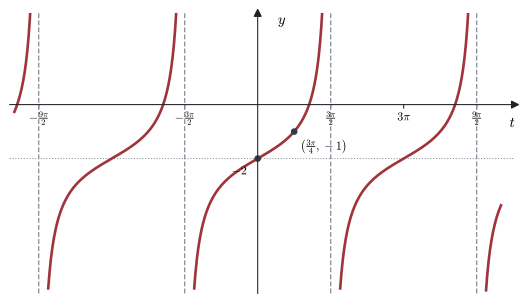
Next to each other, the asymptotes are at \(t = -\dfrac{3\pi}{2}\) and \(t = \dfrac{3\pi}{2}\). So the period is \(3\pi\).
\[ \frac{\pi}{p} = 3\pi \;\Longrightarrow\; p = \frac{1}{3} . \]
At \(t = 0\): \(\;y = \tan 0 + q = q\), so \(q = -2\).
Check with the other point: \(\tan\left(\dfrac{1}{3} \times \dfrac{3\pi}{4}\right) - 2 = \tan\dfrac{\pi}{4} - 2 = -1\). ✓
So \(y = \tan\left(\dfrac{t}{3}\right) - 2\).
Example 3 For \(y = 3\tan(2x) - 1\):
(a) describe the transformations that map \(y = \tan x\) onto this graph;
(b) state the period and the principal axis;
(c) find the equations of the asymptotes for \(0 \le x \le \pi\).
(a) A horizontal stretch with scale factor \(\dfrac{1}{2}\), a vertical stretch with scale factor \(3\), and a translation \(1\) unit down.
(b) Period \(= \dfrac{\pi}{2}\). Principal axis \(y = -1\).
(c) \(2x = \dfrac{\pi}{2} + k\pi\), so \(x = \dfrac{\pi}{4} + \dfrac{k\pi}{2}\). For \(0 \le x \le \pi\): \(\;x = \dfrac{\pi}{4}\) and \(x = \dfrac{3\pi}{4}\).
General trigonometric functions
This section and Section 14.7 together give the main facts about the three circular functions.
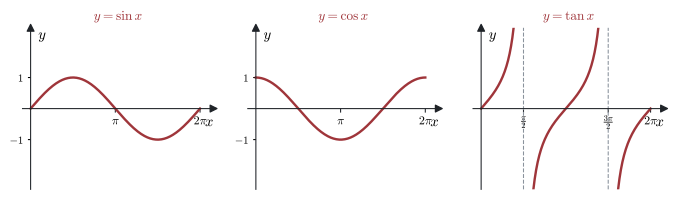
Features of the circular functions Not in the formula booklet
| Function | Period | Amplitude | Domain | Range |
|---|---|---|---|---|
| \(y = \sin x\) | \(2\pi\) | \(1\) | \(x \in \mathbb{R}\) | \(-1 \le y \le 1\) |
| \(y = \cos x\) | \(2\pi\) | \(1\) | \(x \in \mathbb{R}\) | \(-1 \le y \le 1\) |
| \(y = \tan x\) | \(\pi\) | undefined | \(x \neq \frac{\pi}{2} + k\pi\) | \(y \in \mathbb{R}\) |
- \(k\): any integer
General trigonometric functions Not in the formula booklet
| General function | \(a\): vertical stretch | \(b > 0\): horizontal stretch | \(c\): horizontal translation | \(d\): vertical translation |
|---|---|---|---|---|
| \(y = a\sin\big(b(x - c)\big) + d\) \(y = a\cos\big(b(x - c)\big) + d\) |
amplitude \(= \lvert a \rvert\) | period \(= \frac{2\pi}{b}\) | \(c > 0\): right \(c < 0\): left |
\(d > 0\): up \(d < 0\): down |
| \(y = a\tan\big(b(x - c)\big) + d\) | amplitude undefined | period \(= \frac{\pi}{b}\) | \(c > 0\): right \(c < 0\): left |
principal axis \(y = d\) |
- \(a\), \(b\), \(c\), \(d\): real constants, with \(a \neq 0\) and \(b > 0\)
Common errors
| ✗ Wrong | ✓ Right | Why |
|---|---|---|
| The period of \(y = \tan x\) is \(2\pi\) | It is \(\pi\) | The tangent graph repeats after half a turn: \(\tan(x + \pi) = \tan x\). |
| The period of \(y = \tan 3x\) is \(\frac{2\pi}{3}\) | It is \(\frac{\pi}{3}\) | For tangent, divide \(\pi\) (not \(2\pi\)) by \(b\). |
| The amplitude of \(y = 3\tan x\) is \(3\) | It has no amplitude | \(\tan x\) has no maximum or minimum value. |
| Drawing the curve touching or crossing an asymptote | The curve gets closer and closer but never reaches it | \(\tan x\) is undefined at the asymptote. |
| The asymptotes of \(y = \tan\left(x - \frac{\pi}{3}\right)\) are at \(x = \pm\frac{\pi}{2}\) | They move \(\frac{\pi}{3}\) right: \(x = -\frac{\pi}{6}, \frac{5\pi}{6}, \ldots\) | A translation moves the asymptotes too. |
| Joining two branches across an asymptote | Draw each branch separately | The graph is in separate pieces. A calculator may draw a false vertical line. |
Exercises
1 Write down the period of
(a) \(y = \tan 4x\)
(b) \(y = \tan\left(\dfrac{x}{2}\right)\)
(c) \(y = 5\tan(\pi x)\).
(a) \(\dfrac{\pi}{4}\)
(b) \(\pi \div \dfrac{1}{2} = 2\pi\)
(c) \(\dfrac{\pi}{\pi} = 1\)
2 Find the equations of the vertical asymptotes of \(y = \tan 2x\) for \(0 \le x \le 2\pi\).
\(2x = \dfrac{\pi}{2} + k\pi\), so \(x = \dfrac{\pi}{4} + \dfrac{k\pi}{2}\):
\[ x = \frac{\pi}{4},\; \frac{3\pi}{4},\; \frac{5\pi}{4},\; \frac{7\pi}{4} . \]
3 For \(y = \tan\left(x + \dfrac{\pi}{6}\right)\), \(0 \le x \le 2\pi\), find
(a) the equations of the asymptotes
(b) the \(x\)-intercepts
(c) the exact \(y\)-intercept.
(a) \(x + \dfrac{\pi}{6} = \dfrac{\pi}{2} + k\pi \Rightarrow x = \dfrac{\pi}{3} + k\pi\): \(\;x = \dfrac{\pi}{3}\) and \(x = \dfrac{4\pi}{3}\).
(b) \(x + \dfrac{\pi}{6} = k\pi \Rightarrow x = -\dfrac{\pi}{6} + k\pi\): \(\;x = \dfrac{5\pi}{6}\) and \(x = \dfrac{11\pi}{6}\).
(c) \(\tan\dfrac{\pi}{6} = \dfrac{1}{\sqrt{3}} = \dfrac{\sqrt{3}}{3}\), so the \(y\)-intercept is \(\left(0, \dfrac{\sqrt{3}}{3}\right)\).
4 Describe the graph of \(y = -\tan x\) for \(-\pi \le x \le \pi\): its asymptotes, its zeros, and whether each branch increases or decreases.
It is the reflection of \(y = \tan x\) in the \(x\)-axis. The asymptotes do not move: \(x = -\dfrac{\pi}{2}\) and \(x = \dfrac{\pi}{2}\). The zeros do not move: \(x = -\pi\), \(0\), \(\pi\). Every branch now decreases (from \(+\infty\) down to \(-\infty\)).
5 For \(y = 2\tan 3x + 1\), write down the period, the principal axis and the range, and find the asymptotes for \(0 < x < \pi\).
Period \(\dfrac{\pi}{3}\). Principal axis \(y = 1\). Range \(y \in \mathbb{R}\).
\(3x = \dfrac{\pi}{2} + k\pi \Rightarrow x = \dfrac{\pi}{6} + \dfrac{k\pi}{3}\): \(\;x = \dfrac{\pi}{6},\; \dfrac{\pi}{2},\; \dfrac{5\pi}{6}\).
6 The graph shows \(y = a\tan(bx)\), where \(a > 0\) and \(b > 0\). The dashed lines are the asymptotes \(x = -\pi\) and \(x = \pi\), and the graph passes through \(\left(\dfrac{\pi}{2}, 2\right)\). Find \(a\) and \(b\).
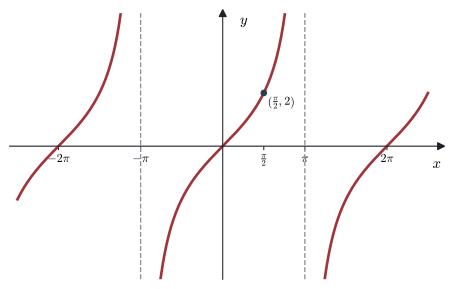
Next to each other, the asymptotes are at \(x = -\pi\) and \(x = \pi\), so the period is \(2\pi\). Then \(\dfrac{\pi}{b} = 2\pi\), so \(b = \dfrac{1}{2}\).
At \(x = \dfrac{\pi}{2}\): \(\;a\tan\dfrac{\pi}{4} = a = 2\).
\(y = 2\tan\left(\dfrac{x}{2}\right)\).
7 Describe a sequence of transformations that maps the graph of \(y = \tan x\) onto the graph of \(y = \tan\left(2x - \dfrac{\pi}{2}\right) + 3\).
Factorise: \(\;y = \tan\left(2\left(x - \dfrac{\pi}{4}\right)\right) + 3\).
A horizontal stretch with scale factor \(\dfrac{1}{2}\), followed by a translation by the vector \(\begin{pmatrix} \frac{\pi}{4} \\ 3 \end{pmatrix}\).
8 \(f(x) = 4\tan\left(x - \dfrac{\pi}{4}\right) + 1\). Find the exact values of \(f(0)\), \(f\left(\dfrac{\pi}{2}\right)\) and \(f\left(\dfrac{7\pi}{12}\right)\).
\(f(0) = 4\tan\left(-\dfrac{\pi}{4}\right) + 1 = -4 + 1 = -3\).
\(f\left(\dfrac{\pi}{2}\right) = 4\tan\dfrac{\pi}{4} + 1 = 5\).
\(f\left(\dfrac{7\pi}{12}\right) = 4\tan\dfrac{\pi}{3} + 1 = 4\sqrt{3} + 1\).
9 The graph of \(y = \tan(kx)\), \(k > 0\), has its two asymptotes nearest to the origin at \(x = \pm\dfrac{\pi}{6}\). Find \(k\) and the period.
The first asymptote is where \(kx = \dfrac{\pi}{2}\), that is, \(x = \dfrac{\pi}{2k}\). So \(\dfrac{\pi}{2k} = \dfrac{\pi}{6}\) and \(k = 3\).
The period is \(\dfrac{\pi}{3}\) (the distance between the two asymptotes).
10 For each function, write down the period, the amplitude (if it exists) and the range.
(a) \(y = 7\sin\left(\dfrac{x}{4}\right)\)
(b) \(y = -\cos 3x + 2\)
(c) \(y = 6\tan\left(\dfrac{x}{3}\right)\)
(a) Period \(2\pi \div \dfrac{1}{4} = 8\pi\); amplitude \(7\); range \(-7 \le y \le 7\).
(b) Period \(\dfrac{2\pi}{3}\); amplitude \(1\); range \(1 \le y \le 3\).
(c) Period \(\pi \div \dfrac{1}{3} = 3\pi\); no amplitude; range \(y \in \mathbb{R}\).