23.6 Roots of Complex Numbers
AHL 1.14
- how to find all \(n\) solutions of \(z^n = w\) (the \(n\)th roots of \(w\))
- why the \(n\)th roots lie on a circle and form a regular polygon
- how to solve harder equations, and factorise polynomials into real quadratic factors, using roots
- the roots of unity, and why their sum is \(0\)
\(n\)th roots of a complex number
Let \(w = r\operatorname{cis}\alpha\) be a given complex number, \(w \neq 0\). We want all the complex numbers \(z\) with \(z^n = w\). Write \(z = s\operatorname{cis}\theta\). By De Moivre’s theorem (Section 23.5),
\[ z^n = s^n\operatorname{cis}n\theta = r\operatorname{cis}\alpha . \]
Compare moduli and arguments:
- Moduli: \(s^n = r\), so \(s = r^{\frac{1}{n}}\) (the positive real \(n\)th root).
- Arguments: \(n\theta\) and \(\alpha\) can differ by any multiple of \(2\pi\): \(\;n\theta = \alpha + 2k\pi\), so \(\theta = \dfrac{\alpha + 2k\pi}{n}\), \(k \in \mathbb{Z}\).
The values \(k = 0, 1, \ldots, n - 1\) give \(n\) different numbers. After that, they repeat (for example \(k = n\) gives the angle \(\dfrac{\alpha}{n} + 2\pi\), the same point as \(k = 0\)).
The \(n\)th roots of \(w = r\operatorname{cis}\alpha = r\mathrm{e}^{i\alpha}\) Not in the formula booklet
The equation \(z^n = w\) has exactly \(n\) roots:
\[ z = r^{\frac{1}{n}}\operatorname{cis}\left(\frac{\alpha + 2k\pi}{n}\right) = r^{\frac{1}{n}}\,\mathrm{e}^{i\left(\frac{\alpha + 2k\pi}{n}\right)}, \qquad k = 0, 1, 2, \ldots, n - 1 . \]
- \(w\): the given complex number
- \(r\): the modulus of \(w\)
- \(\alpha\): an argument of \(w\)
- \(n\): the power in \(z^n = w\); it is also the number of roots (\(n \in \mathbb{Z}^+\))
- \(z\): a root of the equation
- \(k\): an integer that labels the roots, \(k = 0, 1, \ldots, n - 1\)
It comes from De Moivre’s theorem, which is in the HL booklet.
In practice:
- Write \(w\) in polar form: find \(r\) and \(\alpha\).
- Write \(z^n = r\operatorname{cis}(\alpha + 2k\pi)\).
- Take the \(n\)th root: \(z = r^{\frac{1}{n}}\operatorname{cis}\dfrac{\alpha + 2k\pi}{n}\).
- Choose \(n\) values of \(k\) (for example \(k = 0, \pm 1, \pm 2, \ldots\)) so that every argument is in \(-\pi < \theta \leq \pi\).
All the roots have the same modulus \(r^{\frac{1}{n}}\), so they lie on a circle with centre \(O\). Their arguments differ by \(\dfrac{2\pi}{n}\), so they are equally spaced around the circle. For \(n \geq 3\) they are the vertices of a regular \(n\)-sided polygon.
Example 1 Find the cube roots of \(-2 + 2i\). Give your answers exactly in the form
(a) \(r(\cos\theta + i\sin\theta)\),
(b) \(r\mathrm{e}^{i\theta}\), \(\qquad\) where \(r > 0\) and \(-\pi < \theta \leq \pi\).
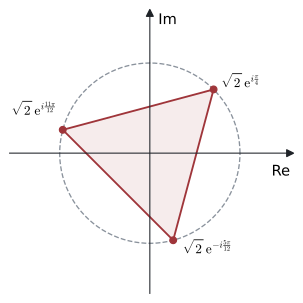
\(|-2 + 2i| = 2\sqrt{2} = 2^{\frac{3}{2}}\) and \(\arg(-2 + 2i) = \dfrac{3\pi}{4}\) (2nd quadrant). So
\[ z^3 = 2^{\frac{3}{2}}\operatorname{cis}\left(\frac{3\pi}{4} + 2k\pi\right) \quad\Longrightarrow\quad z = 2^{\frac{1}{2}}\operatorname{cis}\left(\frac{\pi}{4} + \frac{2k\pi}{3}\right) . \]
\(k = 0\): \(\theta = \dfrac{\pi}{4}\). \(\quad k = 1\): \(\theta = \dfrac{\pi}{4} + \dfrac{2\pi}{3} = \dfrac{11\pi}{12}\). \(\quad k = -1\): \(\theta = \dfrac{\pi}{4} - \dfrac{2\pi}{3} = -\dfrac{5\pi}{12}\).
(a) \(z = \sqrt{2}\left(\cos\dfrac{\pi}{4} + i\sin\dfrac{\pi}{4}\right)\), \(\;\sqrt{2}\left(\cos\dfrac{11\pi}{12} + i\sin\dfrac{11\pi}{12}\right)\), \(\;\sqrt{2}\left(\cos\left(-\dfrac{5\pi}{12}\right) + i\sin\left(-\dfrac{5\pi}{12}\right)\right)\).
(b) \(z = \sqrt{2}\,\mathrm{e}^{i\frac{\pi}{4}}\), \(\;\sqrt{2}\,\mathrm{e}^{i\frac{11\pi}{12}}\), \(\;\sqrt{2}\,\mathrm{e}^{-i\frac{5\pi}{12}}\).
The first root is \(1 + i\). Check: \((1 + i)^3 = (2i)(1 + i) = -2 + 2i\) ✓. The three roots form an equilateral triangle (Figure 1).
Example 2 (a) Find the fourth roots of \(-8 + 8\sqrt{3}\,i\), in the form \(r\mathrm{e}^{i\theta}\) with \(r > 0\) and \(-\pi < \theta \leq \pi\).
(b) Hence solve \(z^8 + 16z^4 + 256 = 0\), giving your answers in the same form.
(a) \(|-8 + 8\sqrt{3}\,i| = \sqrt{64 + 192} = 16\). 2nd quadrant with \(\alpha = \arctan\sqrt{3} = \dfrac{\pi}{3}\), so the argument is \(\dfrac{2\pi}{3}\).
\[ z^4 = 16\mathrm{e}^{i\left(\frac{2\pi}{3} + 2k\pi\right)} \quad\Longrightarrow\quad z = 2\mathrm{e}^{i\left(\frac{\pi}{6} + \frac{k\pi}{2}\right)} . \]
\(k = 0, 1, -1, -2\) give \(z = 2\mathrm{e}^{i\frac{\pi}{6}}\), \(\;2\mathrm{e}^{i\frac{2\pi}{3}}\), \(\;2\mathrm{e}^{-i\frac{\pi}{3}}\), \(\;2\mathrm{e}^{-i\frac{5\pi}{6}}\).
(b) This is a quadratic in \(z^4\):
\[ z^4 = \frac{-16 \pm \sqrt{256 - 1024}}{2} = \frac{-16 \pm 16\sqrt{3}\,i}{2} = -8 \pm 8\sqrt{3}\,i . \]
\(z^4 = -8 + 8\sqrt{3}\,i\) gives the four roots in (a). \(z^4 = -8 - 8\sqrt{3}\,i\) is the conjugate, so its roots are the conjugates of those in (a).
The eight solutions are
\[ z = 2\mathrm{e}^{\pm i\frac{\pi}{6}}, \quad 2\mathrm{e}^{\pm i\frac{\pi}{3}}, \quad 2\mathrm{e}^{\pm i\frac{2\pi}{3}}, \quad 2\mathrm{e}^{\pm i\frac{5\pi}{6}} . \]
Example 3 (a) Solve \(z^6 + 729 = 0\), giving the solutions in the form \(r\mathrm{e}^{i\theta}\), where \(r > 0\) and \(-\pi < \theta \leq \pi\).
(b) Write \(z^6 + 729\) as the product of three quadratic factors with real coefficients, given in exact non-trigonometric form.
(a) \(z^6 = -729 = 729\mathrm{e}^{i(\pi + 2k\pi)}\) and \(729 = 3^6\), so
\[ z = 3\mathrm{e}^{i\frac{(2k + 1)\pi}{6}}, \qquad z = 3\mathrm{e}^{\pm i\frac{\pi}{6}}, \;\; 3\mathrm{e}^{\pm i\frac{\pi}{2}}, \;\; 3\mathrm{e}^{\pm i\frac{5\pi}{6}} . \]
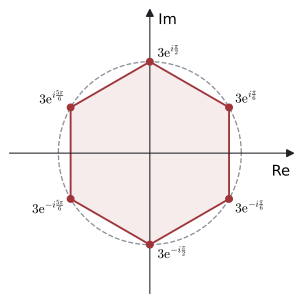
(b) The roots come in conjugate pairs (Figure 2). For a pair \(3\mathrm{e}^{\pm i\theta}\), the quadratic factor is
\[ \left(z - 3\mathrm{e}^{i\theta}\right)\left(z - 3\mathrm{e}^{-i\theta}\right) = z^2 - 6\cos\theta\,z + 9 , \]
because the sum of the pair is \(2 \times 3\cos\theta\) and the product is \(|z|^2 = 9\).
- \(\theta = \dfrac{\pi}{6}\): \(\;z^2 - 6 \times \dfrac{\sqrt{3}}{2}z + 9 = z^2 - 3\sqrt{3}\,z + 9\)
- \(\theta = \dfrac{\pi}{2}\): \(\;z^2 + 9\)
- \(\theta = \dfrac{5\pi}{6}\): \(\;z^2 + 3\sqrt{3}\,z + 9\)
\[ z^6 + 729 = (z^2 - 3\sqrt{3}\,z + 9)(z^2 + 9)(z^2 + 3\sqrt{3}\,z + 9) . \]
Roots of unity
The solutions of \(z^n = 1\) are called the \(n\)th roots of unity. Here \(r = 1\) and \(\alpha = 0\), so
The \(n\)th roots of unity Not in the formula booklet
\[ z = \mathrm{e}^{i\frac{2k\pi}{n}} = \cos\frac{2k\pi}{n} + i\sin\frac{2k\pi}{n}, \qquad k = 0, 1, \ldots, n - 1 . \]
If \(\omega = \mathrm{e}^{i\frac{2\pi}{n}}\), the roots are \(1, \omega, \omega^2, \ldots, \omega^{n-1}\), and
\[ 1 + \omega + \omega^2 + \cdots + \omega^{n-1} = 0 \qquad (n \geq 2) . \]
- \(z\): an \(n\)th root of unity (a root of \(z^n = 1\))
- \(k\): an integer that labels the roots, \(k = 0, 1, \ldots, n - 1\)
- \(n\): the number of roots (\(n \in \mathbb{Z}^+\))
- \(\omega\): the root with the smallest positive argument, \(\mathrm{e}^{i\frac{2\pi}{n}}\)
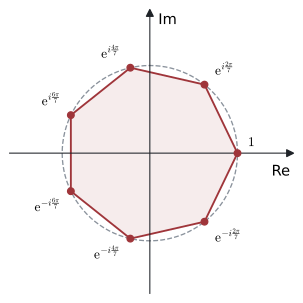
The roots of unity lie on the unit circle \(|z| = 1\). One vertex is always at \(1\), and they form a regular \(n\)-gon (Figure 3).
Why is the sum \(0\)? Two short proofs:
- Geometric series (Unit 2): \(\;1 + \omega + \cdots + \omega^{n-1} = \dfrac{1 - \omega^n}{1 - \omega} = \dfrac{1 - 1}{1 - \omega} = 0\), since \(\omega^n = 1\) and \(\omega \neq 1\).
- Sum of roots (Section 11.3): the roots of \(z^n - 1 = 0\) add up to \(-\dfrac{a_{n-1}}{a_n}\), and the coefficient of \(z^{n-1}\) is \(0\).
The second proof shows more: for \(n \geq 2\), the \(n\) roots of any equation \(z^n = w\) add up to \(0\).
Example 4 Let \(\omega = \mathrm{e}^{i\frac{2\pi}{3}}\), a cube root of unity.
(a) Write the three cube roots of unity in Cartesian form, and show that \(1 + \omega + \omega^2 = 0\).
(b) Find the value of \((1 + \omega)(1 + \omega^2)\).
(a) \(1\), \(\;\omega = \cos\dfrac{2\pi}{3} + i\sin\dfrac{2\pi}{3} = -\dfrac{1}{2} + \dfrac{\sqrt{3}}{2}i\), \(\;\omega^2 = \mathrm{e}^{i\frac{4\pi}{3}} = \mathrm{e}^{-i\frac{2\pi}{3}} = -\dfrac{1}{2} - \dfrac{\sqrt{3}}{2}i\).
\[ 1 + \left(-\frac{1}{2} + \frac{\sqrt{3}}{2}i\right) + \left(-\frac{1}{2} - \frac{\sqrt{3}}{2}i\right) = 0 . \]
(b) Expand and use \(\omega^3 = 1\) and \(\omega + \omega^2 = -1\):
\[ (1 + \omega)(1 + \omega^2) = 1 + \omega^2 + \omega + \omega^3 = 1 + (-1) + 1 = 1 . \]
Example 5 (a) Find all the roots of \(w^7 = 1\), in the form \(\mathrm{e}^{i\theta}\) with \(-\pi < \theta \leq \pi\).
(b) Show that the roots of \((3 + z)^7 = (3 - z)^7\) can be written as \(z = 3i\tan\dfrac{k\pi}{7}\), where \(k = 0, \pm 1, \pm 2, \pm 3\).
(a) \(w = \mathrm{e}^{i\frac{2k\pi}{7}}\) with \(k = 0, \pm 1, \pm 2, \pm 3\): \(\;1\), \(\;\mathrm{e}^{\pm i\frac{2\pi}{7}}\), \(\;\mathrm{e}^{\pm i\frac{4\pi}{7}}\), \(\;\mathrm{e}^{\pm i\frac{6\pi}{7}}\).
(b) \(z = 3\) is not a root (\(6^7 \neq 0\)), so divide by \((3 - z)^7\):
\[ \left(\frac{3 + z}{3 - z}\right)^7 = 1, \qquad\text{so}\qquad \frac{3 + z}{3 - z} = w, \quad w = \mathrm{e}^{i\varphi}, \;\; \varphi = \frac{2k\pi}{7} . \]
Make \(z\) the subject: \(3 + z = 3w - wz\), so \(z(1 + w) = 3(w - 1)\) and \(z = \dfrac{3(w - 1)}{w + 1}\). (\(w \neq -1\) because \(-1\) is not a 7th root of unity.)
Divide the top and bottom by \(\mathrm{e}^{i\frac{\varphi}{2}}\):
\[ \frac{\mathrm{e}^{i\varphi} - 1}{\mathrm{e}^{i\varphi} + 1} = \frac{\mathrm{e}^{i\frac{\varphi}{2}} - \mathrm{e}^{-i\frac{\varphi}{2}}}{\mathrm{e}^{i\frac{\varphi}{2}} + \mathrm{e}^{-i\frac{\varphi}{2}}} = \frac{2i\sin\frac{\varphi}{2}}{2\cos\frac{\varphi}{2}} = i\tan\frac{\varphi}{2} . \]
So \(z = 3i\tan\dfrac{\varphi}{2} = 3i\tan\dfrac{k\pi}{7}\), \(\;k = 0, \pm 1, \pm 2, \pm 3\).
For an equation like \(z^6 + 729 = 0\), use Menu → Algebra → Polynomial Tools → Find Roots of Polynomial with Degree \(6\), Roots Complex, and coefficients \(1, 0, 0, 0, 0, 0, 729\). The six decimal answers (such as \(2.598 + 1.5i\)) let you check your exact roots, but Paper 1 needs the exact working above.
Common errors
| ✗ Wrong | ✓ Right | Why |
|---|---|---|
| Only one cube root, \(z = \sqrt{2}\operatorname{cis}\dfrac{\pi}{4}\) | Three cube roots | \(z^n = w\) has \(n\) roots: add \(2k\pi\) before dividing by \(n\). |
| \(z = 2^{\frac{3}{2}}\operatorname{cis}\dfrac{\pi}{4}\) for \(z^3 = 2^{\frac{3}{2}}\operatorname{cis}\dfrac{3\pi}{4}\) | modulus \(2^{\frac{1}{2}}\) | Take the \(n\)th root of the modulus too. |
| \(\theta = \dfrac{\alpha}{n} + 2k\pi\) | \(\theta = \dfrac{\alpha + 2k\pi}{n} = \dfrac{\alpha}{n} + \dfrac{2k\pi}{n}\) | The roots are \(\dfrac{2\pi}{n}\) apart, not \(2\pi\). |
| Using \(k = 0, 1, 2, 3\) and leaving \(\theta = \dfrac{5\pi}{3}\) | Use \(k\) values that keep \(-\pi < \theta \leq \pi\) | Answers must use the principal argument. |
| \(1 + \omega + \omega^2 = 1\) | \(= 0\) | The sum of all the \(n\)th roots of unity is \(0\). |
Exercises
1 Use the method of this section to find the square roots of \(9i\), in polar form and in Cartesian form.
\(9i = 9\operatorname{cis}\dfrac{\pi}{2}\), so \(z = 3\operatorname{cis}\left(\dfrac{\pi}{4} + k\pi\right)\): \(\;3\operatorname{cis}\dfrac{\pi}{4}\) and \(3\operatorname{cis}\left(-\dfrac{3\pi}{4}\right)\).
In Cartesian form: \(\pm\left(\dfrac{3\sqrt{2}}{2} + \dfrac{3\sqrt{2}}{2}i\right)\).
2 Find the cube roots of \(8i\) in the form \(x + iy\).
\(8i = 8\operatorname{cis}\dfrac{\pi}{2}\), so \(z = 2\operatorname{cis}\left(\dfrac{\pi}{6} + \dfrac{2k\pi}{3}\right)\), \(k = 0, 1, -1\):
\(2\operatorname{cis}\dfrac{\pi}{6} = \sqrt{3} + i\), \(\;2\operatorname{cis}\dfrac{5\pi}{6} = -\sqrt{3} + i\), \(\;2\operatorname{cis}\left(-\dfrac{\pi}{2}\right) = -2i\).
3 Find the five fifth roots of \(-1\) in the form \(\mathrm{e}^{i\theta}\), \(-\pi < \theta \leq \pi\).
\(-1 = \mathrm{e}^{i(\pi + 2k\pi)}\), so \(z = \mathrm{e}^{i\frac{(2k + 1)\pi}{5}}\):
\(\mathrm{e}^{\pm i\frac{\pi}{5}}\), \(\;\mathrm{e}^{\pm i\frac{3\pi}{5}}\), \(\;\mathrm{e}^{i\pi} = -1\).
4 Solve \(z^3 = -4 - 4\sqrt{3}\,i\), giving your answers in the form \(r\mathrm{e}^{i\theta}\), \(-\pi < \theta \leq \pi\).
\(|w| = \sqrt{16 + 48} = 8\); 3rd quadrant with \(\alpha = \dfrac{\pi}{3}\), so \(\arg w = -\dfrac{2\pi}{3}\).
\(z = 2\mathrm{e}^{i\left(-\frac{2\pi}{9} + \frac{2k\pi}{3}\right)}\), \(k = 0, 1, -1\): \(\;2\mathrm{e}^{-i\frac{2\pi}{9}}\), \(\;2\mathrm{e}^{i\frac{4\pi}{9}}\), \(\;2\mathrm{e}^{-i\frac{8\pi}{9}}\).
5 Find the fourth roots of unity in Cartesian form, and check that their sum is \(0\).
\(\mathrm{e}^{i\frac{k\pi}{2}}\), \(k = 0, 1, 2, 3\): \(\;1, \; i, \; -1, \; -i\). Their sum is \(1 + i - 1 - i = 0\) ✓.
6 (a) Solve \(z^5 = 32\), giving your answers in the form \(r\mathrm{e}^{i\theta}\), \(-\pi < \theta \leq \pi\).
(b) The solutions are the vertices of a regular pentagon. Find its perimeter, to 3 significant figures.
(a) \(z = 2\mathrm{e}^{i\frac{2k\pi}{5}}\): \(\;2\), \(\;2\mathrm{e}^{\pm i\frac{2\pi}{5}}\), \(\;2\mathrm{e}^{\pm i\frac{4\pi}{5}}\).
(b) Two neighbouring vertices are \(2\) units from \(O\) with angle \(\dfrac{2\pi}{5}\) between them. Side length \(= 2 \times 2\sin\dfrac{\pi}{5} = 4\sin\dfrac{\pi}{5} = 2.351\ldots\)
Perimeter \(= 5 \times 2.351\ldots = 11.8\) (3 s.f.).
7 Let \(\omega = \mathrm{e}^{i\frac{2\pi}{3}}\). Use \(1 + \omega + \omega^2 = 0\) and \(\omega^3 = 1\) to find the value of \((1 - \omega)(1 - \omega^2)\).
\((1 - \omega)(1 - \omega^2) = 1 - \omega^2 - \omega + \omega^3 = 1 - (\omega + \omega^2) + 1 = 1 - (-1) + 1 = 3\).
8 Solve \(z^6 - 7z^3 - 8 = 0\), giving your answers in the form \(r\mathrm{e}^{i\theta}\), \(-\pi < \theta \leq \pi\).
\((z^3 - 8)(z^3 + 1) = 0\), so \(z^3 = 8\) or \(z^3 = -1\).
\(z^3 = 8\): \(\;z = 2\), \(\;2\mathrm{e}^{\pm i\frac{2\pi}{3}}\). \(\qquad z^3 = -1\): \(\;z = \mathrm{e}^{\pm i\frac{\pi}{3}}\), \(\;\mathrm{e}^{i\pi} = -1\).
9 (a) Solve \(z^4 = -4\), giving your answers in the form \(x + iy\).
(b) Hence write \(z^4 + 4\) as the product of two quadratic factors with real coefficients.
(a) \(z = \sqrt{2}\operatorname{cis}\left(\dfrac{\pi}{4} + \dfrac{k\pi}{2}\right)\): \(\;\sqrt{2}\operatorname{cis}\left(\pm\dfrac{\pi}{4}\right) = 1 \pm i\) and \(\sqrt{2}\operatorname{cis}\left(\pm\dfrac{3\pi}{4}\right) = -1 \pm i\).
(b) Pair the conjugates: \((z - 1 - i)(z - 1 + i) = z^2 - 2z + 2\) and \((z + 1 - i)(z + 1 + i) = z^2 + 2z + 2\).
\[ z^4 + 4 = (z^2 - 2z + 2)(z^2 + 2z + 2) . \]
10 Find the square roots of \(1 + \sqrt{3}\,i\) in the form \(x + iy\), using polar form.
\(1 + \sqrt{3}\,i = 2\operatorname{cis}\dfrac{\pi}{3}\), so \(z = \sqrt{2}\operatorname{cis}\left(\dfrac{\pi}{6} + k\pi\right)\).
\(k = 0\): \(\sqrt{2}\left(\dfrac{\sqrt{3}}{2} + \dfrac{1}{2}i\right) = \dfrac{\sqrt{6}}{2} + \dfrac{\sqrt{2}}{2}i\). The other root is the negative: \(-\dfrac{\sqrt{6}}{2} - \dfrac{\sqrt{2}}{2}i\).