24.5 Derivatives of Exponential and Logarithmic Functions
SL 5.6 AHL 5.15
- that \(\mathrm{e}^x\) is its own derivative, and how to differentiate \(\mathrm{e}^{f(x)}\)
- the derivative of \(a^x\) for any base \(a > 0\) (HL)
- that the derivative of \(\ln x\) is \(\dfrac{1}{x}\), and how to differentiate \(\ln f(x)\)
- the derivative of \(\log_a x\) (HL)
- how to use the laws of logarithms to make differentiation easier
The natural exponential function
The number \(\mathrm{e} \approx 2.718\) is special: the gradient of \(y = \mathrm{e}^x\) at any point is equal to the \(y\)-value at that point (Figure 1).
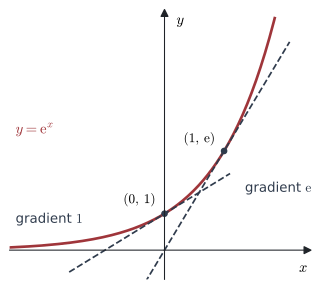
From the definition of the derivative,
\[ \frac{\mathrm{e}^{x + h} - \mathrm{e}^x}{h} = \frac{\mathrm{e}^x\left(\mathrm{e}^h - 1\right)}{h} = \mathrm{e}^x \cdot \frac{\mathrm{e}^h - 1}{h} . \]
The number \(\mathrm{e}\) is exactly the base for which \(\displaystyle\lim_{h \to 0}\frac{\mathrm{e}^h - 1}{h} = 1\) (the gradient of \(y = \mathrm{e}^x\) at \(x = 0\) is \(1\)). So the derivative is \(\mathrm{e}^x \times 1 = \mathrm{e}^x\).
Derivatives of \(\mathrm{e}^x\) and \(\mathrm{e}^{f(x)}\) Partly in the formula booklet
\[ f(x) = \mathrm{e}^x \;\Rightarrow\; f'(x) = \mathrm{e}^x \]
In the booklet
More generally, for any function \(f(x)\),
\[ \frac{\mathrm{d}}{\mathrm{d}x}\left(\mathrm{e}^{f(x)}\right) = f'(x)\,\mathrm{e}^{f(x)} . \]
This second result comes from the chain rule. For example, \(\dfrac{\mathrm{d}}{\mathrm{d}x}\left(\mathrm{e}^{kx}\right) = k\mathrm{e}^{kx}\).
- \(\mathrm{e}\): Euler’s number, \(\mathrm{e} \approx 2.718\)
- \(f(x)\): any function of \(x\) (the power)
- \(k\): a constant
Example 1 Differentiate with respect to \(x\):
(a) \(y = \mathrm{e}^{5 - 2x}\)
(b) \(y = \mathrm{e}^{\sin x}\)
(c) \(y = x^2\mathrm{e}^{-3x}\)
(d) \(y = \dfrac{\mathrm{e}^{2x}}{x + 1}\)
(a) \(\;\dfrac{\mathrm{d}y}{\mathrm{d}x} = -2\mathrm{e}^{5 - 2x}\).
(b) \(\;\dfrac{\mathrm{d}y}{\mathrm{d}x} = \cos x\;\mathrm{e}^{\sin x}\).
(c) Product rule: \(\;\dfrac{\mathrm{d}y}{\mathrm{d}x} = 2x\mathrm{e}^{-3x} + x^2\left(-3\mathrm{e}^{-3x}\right) = x\mathrm{e}^{-3x}(2 - 3x)\).
(d) Quotient rule:
\[ \frac{\mathrm{d}y}{\mathrm{d}x} = \frac{(x + 1) \cdot 2\mathrm{e}^{2x} - \mathrm{e}^{2x} \cdot 1}{(x + 1)^2} = \frac{\mathrm{e}^{2x}(2x + 1)}{(x + 1)^2} . \]
Since \(\mathrm{e}^{f(x)} > 0\) for all \(x\), a factor like \(\mathrm{e}^{-3x}\) is never zero. This is useful when you solve \(\dfrac{\mathrm{d}y}{\mathrm{d}x} = 0\).
Exponential functions with any base
AHL 5.15
For \(a > 0\), we can write \(a\) as a power of \(\mathrm{e}\): \(\;a = \mathrm{e}^{\ln a}\). So
\[ a^x = \left(\mathrm{e}^{\ln a}\right)^x = \mathrm{e}^{(\ln a)x} . \]
Now \(\ln a\) is just a constant, so by the chain rule
\[ \frac{\mathrm{d}}{\mathrm{d}x}\left(a^x\right) = (\ln a)\,\mathrm{e}^{(\ln a)x} = a^x\ln a . \]
Derivatives of \(a^x\) and \(a^{f(x)}\) (\(a > 0\)) Partly in the HL formula booklet
\[ f(x) = a^x \;\Rightarrow\; f'(x) = a^x(\ln a) \]
In the HL booklet
More generally, by the chain rule,
\[ \frac{\mathrm{d}}{\mathrm{d}x}\left(a^{f(x)}\right) = f'(x)\,a^{f(x)}\ln a . \]
- \(a\): the base, a positive constant
- \(f(x)\): a function of \(x\) (the power)
- \(\ln a\): the natural logarithm of \(a\)
Example 2 Find \(\dfrac{\mathrm{d}y}{\mathrm{d}x}\) when
(a) \(y = 2^{x^2}\)
(b) \(y = 7^{1 - 4x}\).
(a) \(\;\dfrac{\mathrm{d}y}{\mathrm{d}x} = 2x \cdot 2^{x^2}\ln 2\).
(b) \(\;\dfrac{\mathrm{d}y}{\mathrm{d}x} = -4 \cdot 7^{1 - 4x}\ln 7\).
The natural logarithm
Let \(y = \ln x\), \(x > 0\). By definition, \(\mathrm{e}^y = x\). Differentiate both sides with respect to \(x\) (the left side needs the chain rule, because \(y\) is a function of \(x\)):
\[ \mathrm{e}^y\,\frac{\mathrm{d}y}{\mathrm{d}x} = 1 \qquad\Rightarrow\qquad \frac{\mathrm{d}y}{\mathrm{d}x} = \frac{1}{\mathrm{e}^y} = \frac{1}{x} . \]
Derivatives of \(\ln x\) and \(\ln f(x)\) Partly in the formula booklet
\[ f(x) = \ln x \;\Rightarrow\; f'(x) = \frac{1}{x}, \quad x > 0 \]
In the booklet
More generally, by the chain rule,
\[ \frac{\mathrm{d}}{\mathrm{d}x}\big(\ln f(x)\big) = \frac{f'(x)}{f(x)}, \quad f(x) > 0 . \]
“The derivative of the inside, over the inside.”
- \(\ln\): the natural logarithm (base \(\mathrm{e}\))
- \(f(x)\): a function of \(x\) with \(f(x) > 0\) (the inside)
For a logarithm with another base, change the base first: \(\log_a x = \dfrac{\ln x}{\ln a}\) (see 1.4). Since \(\dfrac{1}{\ln a}\) is a constant:
Derivative of \(\log_a x\) AHL 5.15 In the HL formula booklet
\[ f(x) = \log_a x \;\Rightarrow\; f'(x) = \frac{1}{x\ln a} \]
- \(a\): the base of the logarithm (\(a > 0\), \(a \neq 1\))
- \(x\): a positive number (\(x > 0\))
Example 3 Differentiate with respect to \(x\):
(a) \(y = \ln(5x - 2)\), \(\;x > \dfrac{2}{5}\)
(b) \(y = \ln(x^2 + \sin x)\), \(\;x > 0\)
(c) \(y = (\ln x)^4\), \(\;x > 0\)
(d) AHL \(y = \log_2(x^2 + 1)\)
(a) \(\;\dfrac{\mathrm{d}y}{\mathrm{d}x} = \dfrac{5}{5x - 2}\).
(b) \(\;\dfrac{\mathrm{d}y}{\mathrm{d}x} = \dfrac{2x + \cos x}{x^2 + \sin x}\).
(c) This is a power of \(\ln x\), not a log of a power. Chain rule: \(\;\dfrac{\mathrm{d}y}{\mathrm{d}x} = 4(\ln x)^3 \times \dfrac{1}{x} = \dfrac{4(\ln x)^3}{x}\).
(d) \(y = \dfrac{\ln(x^2 + 1)}{\ln 2}\), so \(\;\dfrac{\mathrm{d}y}{\mathrm{d}x} = \dfrac{1}{\ln 2} \times \dfrac{2x}{x^2 + 1} = \dfrac{2x}{(x^2 + 1)\ln 2}\).
When the expression inside \(\ln\) is a product, a quotient or a power, use the laws of logarithms first. This turns one hard derivative into several easy ones.
Example 4 Differentiate \(y = \ln\left(\dfrac{(2x + 1)^3}{\sqrt{x - 2}}\right)\), \(\;x > 2\), with respect to \(x\).
Use the laws of logarithms:
\[ y = \ln(2x + 1)^3 - \ln(x - 2)^{\frac{1}{2}} = 3\ln(2x + 1) - \frac{1}{2}\ln(x - 2) . \]
\[ \frac{\mathrm{d}y}{\mathrm{d}x} = 3 \times \frac{2}{2x + 1} - \frac{1}{2} \times \frac{1}{x - 2} = \frac{6}{2x + 1} - \frac{1}{2(x - 2)} . \]
As one fraction: \(\;\dfrac{12(x - 2) - (2x + 1)}{2(2x + 1)(x - 2)} = \dfrac{10x - 25}{2(2x + 1)(x - 2)} = \dfrac{5(2x - 5)}{2(2x + 1)(x - 2)}\).
Menu → Calculus → Numerical Derivative at a Point, variable \(x\), value \(3\), 1st derivative, and the function \(\ln\left(\dfrac{(2x + 1)^3}{\sqrt{x - 2}}\right)\) gives \(0.357143\). The exact answer from the example at \(x = 3\) is \(\dfrac{5 \times 1}{2 \times 7 \times 1} = \dfrac{5}{14} = 0.357142\ldots\) ✓.
Common errors
| ✗ Wrong | ✓ Right | Why |
|---|---|---|
| \(\dfrac{\mathrm{d}}{\mathrm{d}x}\left(\mathrm{e}^{x^2}\right) = x^2\mathrm{e}^{x^2 - 1}\) | \(2x\,\mathrm{e}^{x^2}\) | \(\mathrm{e}^x\) is not a power of \(x\); the power rule does not apply. |
| \(\dfrac{\mathrm{d}}{\mathrm{d}x}\left(3^x\right) = x \cdot 3^{x - 1}\) | \(3^x\ln 3\) | The variable is in the exponent. |
| \(\dfrac{\mathrm{d}}{\mathrm{d}x}\ln(5x - 2) = \dfrac{1}{5x - 2}\) | \(\dfrac{5}{5x - 2}\) | Multiply by the derivative of the inside. |
| \(\dfrac{\mathrm{d}}{\mathrm{d}x}\ln(7x) = \dfrac{7}{x}\) | \(\dfrac{7}{7x} = \dfrac{1}{x}\) | Or: \(\ln 7x = \ln 7 + \ln x\). |
| \((\ln x)^4 = 4\ln x\) | Only \(\ln x^4 = 4\ln x\) | The power law works for the inside of the log only. |
| \(\dfrac{\mathrm{d}}{\mathrm{d}x}\left(\dfrac{1}{x}\right) = \ln x\) | \(-\dfrac{1}{x^2}\) | It is the other way round: \(\dfrac{\mathrm{d}}{\mathrm{d}x}(\ln x) = \dfrac{1}{x}\). |
Exercises
1 Differentiate \(y = 4\mathrm{e}^{3x} - \mathrm{e}^{-x}\).
\(\dfrac{\mathrm{d}y}{\mathrm{d}x} = 12\mathrm{e}^{3x} + \mathrm{e}^{-x}\).
2 Differentiate \(y = \mathrm{e}^{x^2 - 1}\).
\(\dfrac{\mathrm{d}y}{\mathrm{d}x} = 2x\,\mathrm{e}^{x^2 - 1}\).
3 Differentiate \(y = x\mathrm{e}^{2x}\), and find the value of \(x\) where \(\dfrac{\mathrm{d}y}{\mathrm{d}x} = 0\).
\(\dfrac{\mathrm{d}y}{\mathrm{d}x} = \mathrm{e}^{2x} + 2x\mathrm{e}^{2x} = \mathrm{e}^{2x}(1 + 2x)\).
\(\mathrm{e}^{2x} > 0\), so \(\dfrac{\mathrm{d}y}{\mathrm{d}x} = 0\) only when \(1 + 2x = 0\), i.e. \(x = -\dfrac{1}{2}\).
4 Find the gradient of the curve \(y = \mathrm{e}^{2x} - 4x\) at the point where \(x = \ln 3\).
\(\dfrac{\mathrm{d}y}{\mathrm{d}x} = 2\mathrm{e}^{2x} - 4\). At \(x = \ln 3\): \(\;\mathrm{e}^{2\ln 3} = \mathrm{e}^{\ln 9} = 9\), so the gradient is \(18 - 4 = 14\).
5 Differentiate
(a) \(y = \ln(7x)\)
(b) \(y = \ln(x^2 + 4)\).
(a) \(\dfrac{7}{7x} = \dfrac{1}{x}\). \(\qquad\) (b) \(\dfrac{2x}{x^2 + 4}\).
6 Differentiate \(y = x^2\ln x\), \(\;x > 0\).
\(\dfrac{\mathrm{d}y}{\mathrm{d}x} = 2x\ln x + x^2 \times \dfrac{1}{x} = x(2\ln x + 1)\).
7 Differentiate \(y = \dfrac{\ln x}{x}\), \(\;x > 0\).
\[ \frac{\mathrm{d}y}{\mathrm{d}x} = \frac{x \cdot \frac{1}{x} - \ln x \cdot 1}{x^2} = \frac{1 - \ln x}{x^2} . \]
8 Show that \(\dfrac{\mathrm{d}}{\mathrm{d}x}\ln(\cos x) = -\tan x\), for \(0 < x < \dfrac{\pi}{2}\).
\(\dfrac{\mathrm{d}}{\mathrm{d}x}\ln(\cos x) = \dfrac{-\sin x}{\cos x} = -\tan x\).
9 AHL Differentiate \(y = 3^x + \log_3 x\).
\(\dfrac{\mathrm{d}y}{\mathrm{d}x} = 3^x\ln 3 + \dfrac{1}{x\ln 3}\).
10 Let \(f(x) = \ln\sqrt{\dfrac{1 + x}{1 - x}}\), \(\;-1 < x < 1\). Show that \(f'(x) = \dfrac{1}{1 - x^2}\).
Laws of logarithms first: \(\;f(x) = \dfrac{1}{2}\ln(1 + x) - \dfrac{1}{2}\ln(1 - x)\).
\[ f'(x) = \frac{1}{2}\left(\frac{1}{1 + x} + \frac{1}{1 - x}\right) = \frac{1}{2} \times \frac{(1 - x) + (1 + x)}{(1 + x)(1 - x)} = \frac{1}{1 - x^2} . \]