14.11 Trigonometric Identities
SL 3.6 AHL 3.9
- the identity \(\tan\theta = \dfrac{\sin\theta}{\cos\theta}\) and (AHL) \(\cot\theta = \dfrac{\cos\theta}{\sin\theta}\)
- the Pythagorean identity \(\cos^2\theta + \sin^2\theta = 1\), and why it is true
- (AHL) the identities \(1 + \tan^2\theta = \sec^2\theta\) and \(1 + \cot^2\theta = \operatorname{cosec}^2\theta\)
- how to find one trigonometric ratio from another without finding the angle
- how to simplify trigonometric expressions and prove identities
Simple trigonometric identities
An identity is an equation that is true for every value of the variable (where both sides are defined). We use the symbol \(\equiv\) when we want to show that an equation is an identity.
Take a point \(P(x, y)\) on a circle with centre \(O\) and radius \(r\), as in Figure 1. Let \(\theta\) be the angle from the positive \(x\)-axis to \(OP\). As in Section 14.6,
\[ \sin\theta = \frac{y}{r}, \qquad \cos\theta = \frac{x}{r}, \qquad \tan\theta = \frac{y}{x} . \]
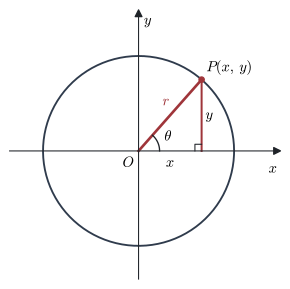
Now divide \(\sin\theta\) by \(\cos\theta\):
\[ \frac{\sin\theta}{\cos\theta} = \frac{y}{r} \div \frac{x}{r} = \frac{y}{r} \times \frac{r}{x} = \frac{y}{x} = \tan\theta . \]
Identity for \(\tan\theta\) In the formula booklet
\[ \tan\theta = \frac{\sin\theta}{\cos\theta}, \qquad \cos\theta \neq 0 \]
- \(\theta\): any angle (in degrees or radians) with \(\cos\theta \neq 0\)
AHL The three reciprocal ratios were introduced in Section 14.9.
Reciprocal trigonometric identities In the HL formula booklet
\[ \sec\theta = \frac{1}{\cos\theta}, \qquad \operatorname{cosec}\theta = \frac{1}{\sin\theta} \]
- \(\sec\theta\): the secant of \(\theta\) (defined when \(\cos\theta \neq 0\))
- \(\operatorname{cosec}\theta\): the cosecant of \(\theta\) (defined when \(\sin\theta \neq 0\))
Identity for \(\cot\theta\) Not in the formula booklet
\[ \cot\theta = \frac{1}{\tan\theta} = \frac{\cos\theta}{\sin\theta}, \qquad \sin\theta \neq 0 \]
- \(\cot\theta\): the cotangent of \(\theta\)
The second form, \(\dfrac{\cos\theta}{\sin\theta}\), also works when \(\cos\theta = 0\) (then \(\cot\theta = 0\), although \(\tan\theta\) is not defined).
Example 1 Given that \(\sin\theta = \dfrac{5}{13}\) and \(\cos\theta = -\dfrac{12}{13}\), find the value of
(a) \(\tan\theta\)
(b) AHL \(\cot\theta\)
(c) AHL \(\sec\theta\)
(a) \(\tan\theta = \dfrac{\sin\theta}{\cos\theta} = \dfrac{5}{13} \div \left(-\dfrac{12}{13}\right) = \dfrac{5}{13} \times \left(-\dfrac{13}{12}\right) = -\dfrac{5}{12}\).
(b) \(\cot\theta = \dfrac{1}{\tan\theta} = -\dfrac{12}{5}\).
(c) \(\sec\theta = \dfrac{1}{\cos\theta} = -\dfrac{13}{12}\).
(Here \(\sin\theta > 0\) and \(\cos\theta < 0\), so \(\theta\) is in the second quadrant, where \(\tan\) is negative. ✓)
Pythagorean identities
For the point \(P(x, y)\) in Figure 1, Pythagoras’ theorem gives
\[ x^2 + y^2 = r^2 . \qquad (1) \]
Divide both sides of (1) by \(r^2\):
\[ \left(\frac{x}{r}\right)^2 + \left(\frac{y}{r}\right)^2 = 1 \;\Longrightarrow\; \cos^2\theta + \sin^2\theta = 1 . \qquad (2) \]
We write \(\sin^2\theta\) for \((\sin\theta)^2\). It does not mean \(\sin(\theta^2)\).
Pythagorean identity In the formula booklet
\[ \cos^2\theta + \sin^2\theta = 1 \]
- \(\theta\): any angle
- \(\cos^2\theta\), \(\sin^2\theta\): \((\cos\theta)^2\) and \((\sin\theta)^2\)
It is often used in one of the rearranged forms
\[ \sin^2\theta = 1 - \cos^2\theta, \qquad \cos^2\theta = 1 - \sin^2\theta . \]
AHL Divide both sides of (2) by \(\cos^2\theta\):
\[ \frac{\cos^2\theta}{\cos^2\theta} + \frac{\sin^2\theta}{\cos^2\theta} = \frac{1}{\cos^2\theta} \;\Longrightarrow\; 1 + \tan^2\theta = \sec^2\theta . \]
Divide both sides of (2) by \(\sin^2\theta\):
\[ \frac{\cos^2\theta}{\sin^2\theta} + \frac{\sin^2\theta}{\sin^2\theta} = \frac{1}{\sin^2\theta} \;\Longrightarrow\; \cot^2\theta + 1 = \operatorname{cosec}^2\theta . \]
Pythagorean identities (AHL) In the HL formula booklet
\[ 1 + \tan^2\theta = \sec^2\theta, \qquad 1 + \cot^2\theta = \operatorname{cosec}^2\theta \]
- \(\theta\): any angle where both sides are defined
- \(\tan^2\theta\), \(\sec^2\theta\), \(\cot^2\theta\), \(\operatorname{cosec}^2\theta\): the squares of \(\tan\theta\), \(\sec\theta\), \(\cot\theta\), \(\operatorname{cosec}\theta\)
You do not need to learn these two by heart: divide \(\cos^2\theta + \sin^2\theta = 1\) by \(\cos^2\theta\) or by \(\sin^2\theta\).
Finding one ratio from another
The Pythagorean identity lets us find \(\cos\theta\) from \(\sin\theta\) (or the other way) without finding \(\theta\). A square root gives two signs. Use the quadrant of \(\theta\) to choose the sign (see Section 14.6).
Example 2 Given that \(\sin\theta = \dfrac{2}{5}\),
(a) find the possible values of \(\tan\theta\), without finding \(\theta\)
(b) find \(\tan\theta\) when it is also given that \(\dfrac{\pi}{2} < \theta < \pi\).
(a) \(\cos^2\theta = 1 - \sin^2\theta = 1 - \dfrac{4}{25} = \dfrac{21}{25}\), so \(\cos\theta = \pm\dfrac{\sqrt{21}}{5}\). Then
\[ \tan\theta = \frac{2/5}{\pm\sqrt{21}/5} = \pm\frac{2}{\sqrt{21}} = \pm\frac{2\sqrt{21}}{21} . \]
(b) In the second quadrant \(\cos\theta < 0\), so \(\tan\theta < 0\): \(\;\tan\theta = -\dfrac{2\sqrt{21}}{21}\).
Simplifying expressions
To simplify, it often helps to write everything in terms of \(\sin\) and \(\cos\), and to look for \(1 - \sin^2\theta\), \(1 - \cos^2\theta\) or (AHL) \(\sec^2\theta - 1\) and \(\operatorname{cosec}^2\theta - 1\).
Example 3 Simplify each expression.
(a) \((1 - \sin^2\theta)\tan\theta\)
(b) AHL \(\sin\theta + \cos\theta\cot\theta\)
(c) AHL \(\sec^2\theta\tan\theta - \tan\theta\)
(d) AHL \(\dfrac{\tan^2\theta}{1 - \cos^2\theta}\)
(a) \((1 - \sin^2\theta)\tan\theta = \cos^2\theta \times \dfrac{\sin\theta}{\cos\theta} = \sin\theta\cos\theta\).
(b) Write \(\cot\theta\) as \(\dfrac{\cos\theta}{\sin\theta}\) and use a common denominator:
\[ \sin\theta + \frac{\cos^2\theta}{\sin\theta} = \frac{\sin^2\theta + \cos^2\theta}{\sin\theta} = \frac{1}{\sin\theta} = \operatorname{cosec}\theta . \]
(c) Take out the common factor \(\tan\theta\):
\[ \tan\theta\left(\sec^2\theta - 1\right) = \tan\theta \times \tan^2\theta = \tan^3\theta . \]
(d) \(1 - \cos^2\theta = \sin^2\theta\), so
\[ \begin{aligned} \frac{\tan^2\theta}{\sin^2\theta} &= \frac{\sin^2\theta}{\cos^2\theta} \times \frac{1}{\sin^2\theta} \\ &= \frac{1}{\cos^2\theta} \\ &= \sec^2\theta . \end{aligned} \]
Proving identities
You already know some identities, for example \(\sin^2\theta \equiv 1 - \cos^2\theta\). The left-hand side (LHS) and the right-hand side (RHS) are equal for every value of \(\theta\).
To prove an identity, it is not enough to put a few numbers into both sides and get the same answer. A few numbers can never check every value. We need a general argument.
How to prove an identity
- Start with one side, usually the more complicated one.
- Change it, step by step, using known identities and algebra, until you reach the other side.
- Do not treat it like an equation: do not move terms from one side to the other, and do not do the same thing to both sides.
- End with “\(=\) RHS” (or “\(=\) LHS”).
Useful moves: write in terms of \(\sin\) and \(\cos\); use a common denominator; expand or factorise; replace \(1 - \sin^2\theta\) by \(\cos^2\theta\) (and so on).
Example 4 Prove each identity.
(a) \((\sin x + \cos x)^2 + (\sin x - \cos x)^2 \equiv 2\)
(b) \(\cos^4 x - \sin^4 x \equiv 1 - 2\sin^2 x\)
(c) AHL \((1 - \cos^2 x)(1 + \tan^2 x) \equiv \tan^2 x\)
(d) AHL \(\dfrac{1 - \sin\theta}{\sin\theta} \equiv \dfrac{\cot^2\theta}{\operatorname{cosec}\theta + 1}\)
(a) Expand both brackets:
\[ \begin{aligned} \text{LHS} &= (\sin^2 x + 2\sin x\cos x + \cos^2 x) \\ &\quad + (\sin^2 x - 2\sin x\cos x + \cos^2 x) \\ &= 2(\sin^2 x + \cos^2 x) = 2 = \text{RHS} . \end{aligned} \]
(b) Factorise the difference of two squares:
\[ \begin{aligned} \text{LHS} &= (\cos^2 x - \sin^2 x)(\cos^2 x + \sin^2 x) \\ &= \cos^2 x - \sin^2 x \\ &= (1 - \sin^2 x) - \sin^2 x = 1 - 2\sin^2 x = \text{RHS} . \end{aligned} \]
(c) Use \(1 - \cos^2 x = \sin^2 x\) and \(1 + \tan^2 x = \sec^2 x\):
\[ \text{LHS} = \sin^2 x \times \sec^2 x = \frac{\sin^2 x}{\cos^2 x} = \tan^2 x = \text{RHS} . \]
(d) Start with the RHS (it looks more complicated). Use \(\cot^2\theta = \operatorname{cosec}^2\theta - 1\) and factorise:
\[ \begin{aligned} \text{RHS} &= \frac{\operatorname{cosec}^2\theta - 1}{\operatorname{cosec}\theta + 1} = \frac{(\operatorname{cosec}\theta - 1)(\operatorname{cosec}\theta + 1)}{\operatorname{cosec}\theta + 1} \\ &= \operatorname{cosec}\theta - 1 = \frac{1}{\sin\theta} - 1 = \frac{1 - \sin\theta}{\sin\theta} = \text{LHS} . \end{aligned} \]
Common errors
| ✗ Wrong | ✓ Right | Why |
|---|---|---|
| \(\sin^2\theta = \sin(\theta^2)\) | \(\sin^2\theta = (\sin\theta)^2\) | The power belongs to the ratio, not to the angle. |
| \(\cos\theta = \sqrt{1 - \sin^2\theta}\) always | \(\cos\theta = \pm\sqrt{1 - \sin^2\theta}\) | Choose the sign from the quadrant of \(\theta\). |
| \(\sin\theta + \cos\theta = 1\) | \(\sin^2\theta + \cos^2\theta = 1\) | The identity is about the squares. Try \(\theta = \frac{\pi}{4}\). |
| \(\tan^2\theta + 1 = \operatorname{cosec}^2\theta\) | \(\tan^2\theta + 1 = \sec^2\theta\) | Divide by \(\cos^2\theta\) to check. |
| “True for \(\theta = 0\) and \(\frac{\pi}{3}\), so it is an identity” | Give a general proof | A few values never prove a statement for all \(\theta\). |
| Doing the same thing to both sides of an identity | Work on one side only | You must not assume what you are trying to prove. |
Exercises
1 Given that \(\sin\theta = \dfrac{3}{5}\) and \(\theta\) is obtuse, find \(\cos\theta\) and \(\tan\theta\).
\(\cos^2\theta = 1 - \dfrac{9}{25} = \dfrac{16}{25}\). \(\theta\) is obtuse, so \(\cos\theta < 0\): \(\;\cos\theta = -\dfrac{4}{5}\), \(\;\tan\theta = \dfrac{3/5}{-4/5} = -\dfrac{3}{4}\).
2 Given that \(\cos x = \dfrac{2}{3}\) and \(\dfrac{3\pi}{2} < x < 2\pi\), find the exact values of \(\sin x\) and \(\tan x\).
\(\sin^2 x = 1 - \dfrac{4}{9} = \dfrac{5}{9}\). In the fourth quadrant \(\sin x < 0\), so \(\sin x = -\dfrac{\sqrt{5}}{3}\) and
\[ \tan x = \frac{-\sqrt{5}/3}{2/3} = -\frac{\sqrt{5}}{2} . \]
3 Given that \(\tan\theta = -2\) and \(\dfrac{\pi}{2} < \theta < \pi\), find the exact values of \(\sin\theta\) and \(\cos\theta\).
\(\sin\theta = -2\cos\theta\). Substitute into \(\sin^2\theta + \cos^2\theta = 1\): \(\;4\cos^2\theta + \cos^2\theta = 1\), so \(\cos^2\theta = \dfrac{1}{5}\).
In the second quadrant \(\cos\theta < 0\): \(\;\cos\theta = -\dfrac{1}{\sqrt{5}} = -\dfrac{\sqrt{5}}{5}\), and \(\sin\theta = -2\cos\theta = \dfrac{2\sqrt{5}}{5}\).
4 Given that \(\sin\theta = \dfrac{1}{3}\), find the possible values of \(\tan\theta\) without finding \(\theta\).
\(\cos^2\theta = 1 - \dfrac{1}{9} = \dfrac{8}{9}\), so \(\cos\theta = \pm\dfrac{2\sqrt{2}}{3}\) and
\[ \tan\theta = \frac{1/3}{\pm 2\sqrt{2}/3} = \pm\frac{1}{2\sqrt{2}} = \pm\frac{\sqrt{2}}{4} . \]
5 Simplify \(\dfrac{\sin^2 x}{1 - \cos x}\).
\[ \frac{1 - \cos^2 x}{1 - \cos x} = \frac{(1 - \cos x)(1 + \cos x)}{1 - \cos x} = 1 + \cos x . \]
6 Simplify \(\dfrac{1 - \cos^2\theta}{1 - \sin^2\theta}\).
\(\dfrac{\sin^2\theta}{\cos^2\theta} = \tan^2\theta\).
7 AHL Simplify \((\operatorname{cosec}^2\theta - 1)\sin^2\theta\).
\(\operatorname{cosec}^2\theta - 1 = \cot^2\theta\), so the expression is \(\dfrac{\cos^2\theta}{\sin^2\theta} \times \sin^2\theta = \cos^2\theta\).
8 AHL Prove that \(\sec\theta - \cos\theta \equiv \sin\theta\tan\theta\).
\[ \begin{aligned} \text{LHS} &= \frac{1}{\cos\theta} - \cos\theta = \frac{1 - \cos^2\theta}{\cos\theta} = \frac{\sin^2\theta}{\cos\theta} \\ &= \sin\theta \times \frac{\sin\theta}{\cos\theta} = \sin\theta\tan\theta = \text{RHS} . \end{aligned} \]
9 Prove that \(\dfrac{1}{1 - \sin x} + \dfrac{1}{1 + \sin x} \equiv \dfrac{2}{\cos^2 x}\).
\[ \begin{aligned} \text{LHS} &= \frac{(1 + \sin x) + (1 - \sin x)}{(1 - \sin x)(1 + \sin x)} \\ &= \frac{2}{1 - \sin^2 x} = \frac{2}{\cos^2 x} = \text{RHS} . \end{aligned} \]
(AHL students may also write the answer as \(2\sec^2 x\).)
10 AHL Given that \(\sec\theta = 3\) and \(\dfrac{3\pi}{2} < \theta < 2\pi\), find the exact values of \(\tan\theta\) and \(\operatorname{cosec}\theta\).
\(\tan^2\theta = \sec^2\theta - 1 = 8\). In the fourth quadrant \(\tan\theta < 0\), so \(\tan\theta = -2\sqrt{2}\).
\(\cos\theta = \dfrac{1}{3}\), so \(\sin\theta = \tan\theta\cos\theta = -\dfrac{2\sqrt{2}}{3}\) and
\[ \operatorname{cosec}\theta = -\frac{3}{2\sqrt{2}} = -\frac{3\sqrt{2}}{4} . \]