28.3 Area between a Curve and an Axis
SL 5.11 AHL 5.17
- how to find the area between a curve and the \(x\)-axis when the curve is above the axis
- why the integral is negative when the curve is below the axis, and how to find the area then
- how to find a total area when the curve crosses the \(x\)-axis
- (AHL) how to find the area between a curve and the \(y\)-axis
Area of a region above the \(x\)-axis
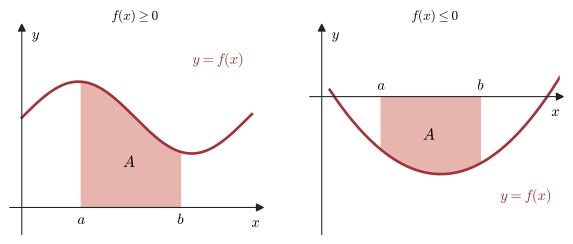
A definite integral gives the exact area between a curve and the \(x\)-axis, when the curve is above the axis.
Area above the \(x\)-axis In the formula booklet
If \(f(x) > 0\) for \(a < x < b\), the area \(A\) of the region bounded by \(y = f(x)\), the \(x\)-axis and the lines \(x = a\) and \(x = b\) is
\[ A = \int_a^b y\,\mathrm{d}x = \int_a^b f(x)\,\mathrm{d}x . \]
Example 1 The diagram shows part of the curve \(y = \dfrac{6}{x^2}\). Region \(A\) lies between \(x = 3\) and \(x = 4\); region \(B\) lies between \(x = 4\) and \(x = k\).
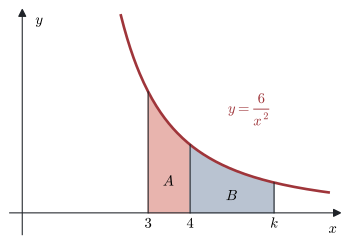
(a) Find the area of region \(A\).
(b) Find the value of \(k\) such that the area of region \(B\) is equal to the area of region \(A\).
\(\displaystyle\int 6x^{-2}\,\mathrm{d}x = -6x^{-1} = -\frac{6}{x}\).
(a) \[ A = \Big[-\tfrac{6}{x}\Big]_3^4 = -\tfrac{6}{4} + \tfrac{6}{3} = -\tfrac{3}{2} + 2 = \tfrac{1}{2}. \]
(b) \[ \Big[-\tfrac{6}{x}\Big]_4^k = -\frac{6}{k} + \frac{3}{2} = \frac{1}{2} \;\Rightarrow\; \frac{6}{k} = 1 \;\Rightarrow\; k = 6 . \]
Example 2 The diagram shows part of the curve \(y = \sqrt{3} + 2\cos 2x\), which meets the \(x\)-axis at \(P\) and \(Q\).
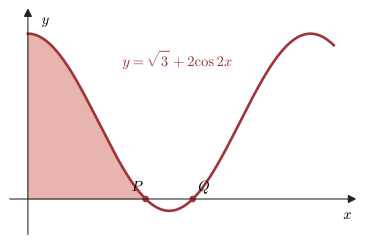
(a) Show that the \(x\)-coordinate of \(P\) is \(\dfrac{5\pi}{12}\), and find the \(x\)-coordinate of \(Q\).
(b) Find the exact area of the shaded region.
(a) \(\sqrt{3} + 2\cos 2x = 0 \Rightarrow \cos 2x = -\dfrac{\sqrt{3}}{2}\). (For solving trigonometric equations see Unit 14.)
The first two positive solutions are \(2x = \dfrac{5\pi}{6}\) and \(2x = \dfrac{7\pi}{6}\). So \(P\) has \(x = \dfrac{5\pi}{12}\) and \(Q\) has \(x = \dfrac{7\pi}{12}\).
(b) The curve is above the axis from \(x = 0\) to \(x = \dfrac{5\pi}{12}\).
\[ A = \int_0^{\frac{5\pi}{12}} (\sqrt{3} + 2\cos 2x)\,\mathrm{d}x = \Big[\sqrt{3}x + \sin 2x\Big]_0^{\frac{5\pi}{12}} = \frac{5\sqrt{3}\pi}{12} + \sin\frac{5\pi}{6} = \frac{5\sqrt{3}\pi}{12} + \frac{1}{2}. \]
Area of a region below the \(x\)-axis
If \(y = f(x)\) is below the \(x\)-axis for \(a \leq x \leq b\), every strip has a negative height \(y\), so \(\displaystyle\int_a^b f(x)\,\mathrm{d}x\) is negative. An area is always positive, so we change the sign.
Area below the \(x\)-axis Partly in the formula booklet
If \(f(x) \leq 0\) for \(a \leq x \leq b\), the area bounded by \(y = f(x)\), the \(x\)-axis and the lines \(x = a\) and \(x = b\) is
\[ A = \int_a^b \lvert y\rvert\,\mathrm{d}x \]
In the booklet
\[ A = -\int_a^b f(x)\,\mathrm{d}x = \left|\int_a^b f(x)\,\mathrm{d}x\right| . \]
- \(A\): the area of the region
- \(a\): the lower limit
- \(b\): the upper limit
- \(y\): the curve, \(y = f(x)\) (here \(y \leq 0\))
In the booklet this is SL 5.11.
If the curve crosses the axis, find the zeros first. Then integrate separately over each part and add the areas. Do not integrate across a zero in one step: the positive and negative parts would cancel. (On a GDC you may use \(\displaystyle\int_a^b |f(x)|\,\mathrm{d}x\), which gives the total area directly.)
Example 3 The diagram shows part of the graph of \(y = x^3 - x^2 - 6x\). The \(x\)-coordinate of \(Q\) is \(-1\) and the \(x\)-coordinate of \(P\) is \(2\). Find the total area of the shaded region, bounded by the curve, the \(x\)-axis and the vertical lines through \(Q\) and \(P\).
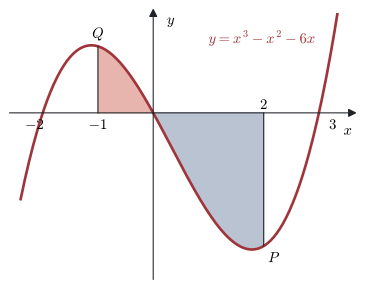
\(x^3 - x^2 - 6x = x(x - 3)(x + 2)\), so the curve crosses the axis at \(x = -2, 0, 3\). On \([-1, 0]\) the curve is above the axis; on \([0, 2]\) it is below.
Let \(F(x) = \dfrac{x^4}{4} - \dfrac{x^3}{3} - 3x^2\).
\[ \int_{-1}^{0} (x^3 - x^2 - 6x)\,\mathrm{d}x = F(0) - F(-1) = 0 - \left(\tfrac{1}{4} + \tfrac{1}{3} - 3\right) = \frac{29}{12}. \]
\[ \int_{0}^{2} (x^3 - x^2 - 6x)\,\mathrm{d}x = F(2) - F(0) = 4 - \tfrac{8}{3} - 12 = -\frac{32}{3}. \]
Total area \(= \dfrac{29}{12} + \dfrac{32}{3} = \dfrac{29}{12} + \dfrac{128}{12} = \dfrac{157}{12}\).
Note: \(\displaystyle\int_{-1}^{2} (x^3 - x^2 - 6x)\,\mathrm{d}x = \frac{29}{12} - \frac{32}{3} = -\frac{99}{12}\), which is not the area.
Calculator page: Menu → Calculus → Numerical Integral, and type the function inside abs( ) (the absolute value template is in the template palette, or type abs(). For Example 3: \(\displaystyle\int_{-1}^{2} \left|x^3 - x^2 - 6x\right|\,\mathrm{d}x = 13.0833\ldots = \frac{157}{12}\).
Still write the integral (with the modulus) in your answer before giving the value.
Area between a curve and the \(y\)-axis
AHL 5.17 In the same way, we can use horizontal strips of height \(\delta y\) and length \(x\). Then we integrate with respect to \(y\).
Area between a curve and the \(y\)-axis In the HL formula booklet
The area \(A\) bounded by the curve \(x = g(y)\), the \(y\)-axis and the lines \(y = a\) and \(y = b\), where \(a < b\), is
\[ A = \int_a^b \lvert x\rvert\,\mathrm{d}y . \]
If \(g(y) \geq 0\), this is \(\displaystyle A = \int_a^b x\,\mathrm{d}y = \int_a^b g(y)\,\mathrm{d}y\).
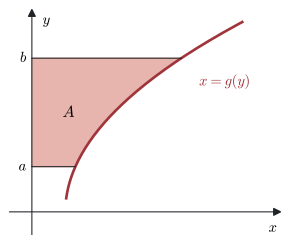
To use it, write the curve as \(x\) in terms of \(y\), and use \(y\)-values as the limits.
Example 4 AHL 5.17 The region \(P\) is bounded by the curve \(y = \ln x\), the \(x\)-axis and the line \(x = 4\). Find the exact area of \(P\).
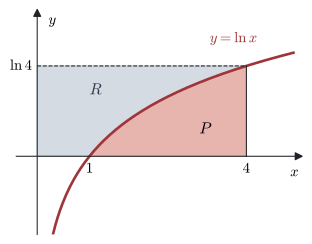
We cannot integrate \(\ln x\) with the SL rules, so use the \(y\)-axis. The rectangle with corners \((0, 0)\) and \((4, \ln 4)\) has area \(4\ln 4\). It is made of \(P\) and the region \(R\) between the curve and the \(y\)-axis, from \(y = 0\) to \(y = \ln 4\).
On the curve, \(x = \mathrm{e}^y\). So
\[ R = \int_0^{\ln 4} \mathrm{e}^y\,\mathrm{d}y = \Big[\mathrm{e}^y\Big]_0^{\ln 4} = 4 - 1 = 3 . \]
\[ P = 4\ln 4 - 3 = 8\ln 2 - 3 . \]
(With integration by parts, \(\displaystyle\int_1^4 \ln x\,\mathrm{d}x = \Big[x\ln x - x\Big]_1^4 = 4\ln 4 - 3\), the same answer.)
Example 5 AHL 5.17 The line through \(P(0, 6)\) and \(Q(6, 0)\) meets the curve \(x = y^2\) at the point \(R\), where \(y > 0\). Find the area of the region bounded by the \(y\)-axis, the line \(PQ\) and the curve \(x = y^2\).
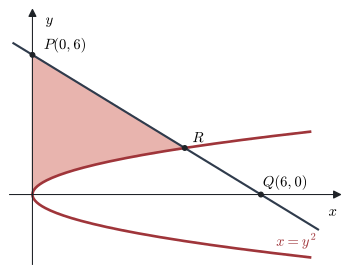
The line \(PQ\) is \(x + y = 6\), so \(x = 6 - y\).
At \(R\): \(y^2 = 6 - y \Rightarrow y^2 + y - 6 = 0 \Rightarrow (y + 3)(y - 2) = 0\). Since \(y > 0\), \(y = 2\) and \(R = (4, 2)\).
Use horizontal strips. For \(0 \leq y \leq 2\) the right edge of the region is the curve \(x = y^2\); for \(2 \leq y \leq 6\) it is the line \(x = 6 - y\).
\[ A = \int_0^2 y^2\,\mathrm{d}y + \int_2^6 (6 - y)\,\mathrm{d}y = \Big[\tfrac{y^3}{3}\Big]_0^2 + \Big[6y - \tfrac{y^2}{2}\Big]_2^6 = \frac{8}{3} + (18 - 10) = \frac{32}{3}. \]
(The second part is a triangle with base 4 and height 4: area 8 ✓.)
Common errors
| ✗ Wrong | ✓ Right | Why |
|---|---|---|
| Area \(= -\dfrac{32}{3}\) | Area \(= \dfrac{32}{3}\) | An area is never negative; change the sign for a region below the axis. |
| \(\displaystyle\int_{-1}^{2} f(x)\,\mathrm{d}x\) when \(f\) changes sign at \(0\) | Split at \(x = 0\) and add the areas | Positive and negative parts cancel in one integral. |
| Using \(x\)-limits in \(\displaystyle\int x\,\mathrm{d}y\) | Use \(y\)-limits | The variable of integration is \(y\). |
| Integrating \(y = \ln x\) with respect to \(y\) without rearranging | Write \(x = \mathrm{e}^y\) first | \(\int x\,\mathrm{d}y\) needs \(x\) as a function of \(y\). |
| Forgetting to find where the curve meets the axis | Solve \(f(x) = 0\) first | You need to know where to split. |
Exercises
1 Find the area of the region bounded by \(y = x^2 + 2\), the \(x\)-axis, and the lines \(x = 0\) and \(x = 3\).
\(\displaystyle\int_0^3 (x^2 + 2)\,\mathrm{d}x = \Big[\tfrac{x^3}{3} + 2x\Big]_0^3 = 9 + 6 = 15\).
2 Find the area of the region enclosed by \(y = 4x - x^2\) and the \(x\)-axis.
Zeros: \(x = 0, 4\); the curve is above the axis between them. \(\displaystyle\int_0^4 (4x - x^2)\,\mathrm{d}x = \Big[2x^2 - \tfrac{x^3}{3}\Big]_0^4 = 32 - \tfrac{64}{3} = \tfrac{32}{3}\).
3 Find the area of the region enclosed by \(y = x^2 - 5x + 4\) and the \(x\)-axis.
\((x - 1)(x - 4) = 0\): \(x = 1, 4\). The curve is below the axis between them.
\(\displaystyle\int_1^4 (x^2 - 5x + 4)\,\mathrm{d}x = \Big[\tfrac{x^3}{3} - \tfrac{5x^2}{2} + 4x\Big]_1^4 = \left(\tfrac{64}{3} - 40 + 16\right) - \left(\tfrac{1}{3} - \tfrac{5}{2} + 4\right) = -\tfrac{9}{2}\).
Area \(= \dfrac{9}{2}\).
4
(a) Find \(\displaystyle\int_{-2}^{2} (x^3 - 4x)\,\mathrm{d}x\).
(b) Find the total area between \(y = x^3 - 4x\) and the \(x\)-axis for \(-2 \leq x \leq 2\).
(a) \(\Big[\tfrac{x^4}{4} - 2x^2\Big]_{-2}^{2} = (4 - 8) - (4 - 8) = 0\).
(b) Zeros at \(-2, 0, 2\). \(\displaystyle\int_{-2}^{0} = 0 - (4 - 8) = 4\) (above the axis), \(\displaystyle\int_0^2 = -4\) (below). Total area \(= 4 + 4 = 8\).
5 Find the total area between \(y = \sin x\) and the \(x\)-axis for \(0 \leq x \leq \dfrac{3\pi}{2}\).
\(\displaystyle\int_0^{\pi} \sin x\,\mathrm{d}x = \Big[-\cos x\Big]_0^{\pi} = 1 + 1 = 2\). \(\quad\displaystyle\int_{\pi}^{\frac{3\pi}{2}} \sin x\,\mathrm{d}x = \Big[-\cos x\Big]_{\pi}^{\frac{3\pi}{2}} = 0 - 1 = -1\).
Total area \(= 2 + 1 = 3\).
6 Find the exact total area between \(y = \mathrm{e}^x - 2\) and the \(x\)-axis for \(0 \leq x \leq 2\).
\(\mathrm{e}^x - 2 = 0 \Rightarrow x = \ln 2\). Let \(F(x) = \mathrm{e}^x - 2x\).
\(\displaystyle\int_0^{\ln 2} = F(\ln 2) - F(0) = (2 - 2\ln 2) - 1 = 1 - 2\ln 2 < 0\), so this part has area \(2\ln 2 - 1\).
\(\displaystyle\int_{\ln 2}^{2} = (\mathrm{e}^2 - 4) - (2 - 2\ln 2) = \mathrm{e}^2 - 6 + 2\ln 2\).
Total area \(= 2\ln 2 - 1 + \mathrm{e}^2 - 6 + 2\ln 2 = \mathrm{e}^2 - 7 + 4\ln 2 \;(\approx 3.16)\).
7 The area between \(y = \dfrac{1}{x}\), the \(x\)-axis and the lines \(x = 1\) and \(x = k\) (\(k > 1\)) is \(2\). Find \(k\).
\(\Big[\ln x\Big]_1^k = \ln k = 2\), so \(k = \mathrm{e}^2\).
8 AHL 5.17 Find the area of the region bounded by \(x = y^2 + 1\), the \(y\)-axis, and the lines \(y = 0\) and \(y = 3\).
\(\displaystyle\int_0^3 (y^2 + 1)\,\mathrm{d}y = \Big[\tfrac{y^3}{3} + y\Big]_0^3 = 9 + 3 = 12\).
9 AHL 5.17 Find the area of the region bounded by \(y = x^3\), the \(y\)-axis, and the lines \(y = 1\) and \(y = 8\).
\(x = y^{1/3}\). \(\displaystyle\int_1^8 y^{1/3}\,\mathrm{d}y = \Big[\tfrac{3}{4}y^{4/3}\Big]_1^8 = \tfrac{3}{4}(16 - 1) = \dfrac{45}{4}\).
10 AHL 5.17 Find the area of the region enclosed by the curve \(x = 9 - y^2\) and the \(y\)-axis.
The curve meets the \(y\)-axis where \(9 - y^2 = 0\): \(y = \pm 3\).
\(\displaystyle\int_{-3}^{3} (9 - y^2)\,\mathrm{d}y = \Big[9y - \tfrac{y^3}{3}\Big]_{-3}^{3} = 18 - (-18) = 36\).