29.1 Kinematics with Differentiation
SL 5.9
- the words used to describe motion: distance, speed, displacement, velocity and acceleration
- how the sign of the displacement \(s\) tells you where a particle is
- how to find the velocity \(v = \dfrac{\mathrm{d}s}{\mathrm{d}t}\), and how its sign tells you the direction of motion
- how to find the acceleration \(a = \dfrac{\mathrm{d}v}{\mathrm{d}t} = \dfrac{\mathrm{d}^2 s}{\mathrm{d}t^2}\), and when a particle speeds up or slows down
This section uses the differentiation rules from Unit 24. Motion in two or three dimensions, with vectors, is in Unit 21.
Kinematics is the mathematics of motion. In this unit a particle P moves along a straight line. We measure its position from a fixed point \(O\) on the line, and \(t\) is the time (usually in seconds).
The language of motion
Five words for motion along a line Not in the formula booklet
- Displacement \(s\): the position of P measured from the fixed origin \(O\). It can be positive, zero or negative.
- Distance travelled: the total length of the path. It only grows, whatever the direction of motion.
- Velocity \(v\): the rate of change of displacement. It has a sign (the direction).
- Speed: how fast P moves. Speed \(= |v|\), so it is never negative.
- Acceleration \(a\): the rate of change of velocity.
Displacement and velocity have a direction (a sign). Distance and speed have no direction.
Displacement
The displacement of a particle at time \(t\) is its position relative to the fixed point \(O\). Draw the line of motion as a number line, the \(s\)-axis. The positive direction is usually to the right.
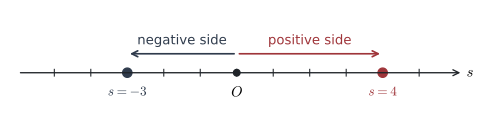
The sign of the displacement \(s\) Not in the formula booklet
- \(s > 0\): the particle is on the positive side of \(O\).
- \(s = 0\): the particle is at \(O\).
- \(s < 0\): the particle is on the negative side of \(O\).
Example 1 A particle starts at a fixed point \(O\) and moves along a straight line. Its displacement from \(O\) after \(t\) seconds is \(s = 8t - 2t^2\) metres, for \(0 \le t \le 5\). The particle moves to the right until \(t = 2\). Then it turns and moves to the left.
(a) Find the displacement when \(t = 1, 2, 3, 4\) and \(5\), and show the positions on the \(s\)-axis.
(b) When does the particle return to \(O\)?
(c) Find the distance travelled from \(t = 0\) to \(t = 2\).
(d) Find the distance travelled from \(t = 2\) to \(t = 5\).
(a)
| \(t\) | 0 | 1 | 2 | 3 | 4 | 5 |
|---|---|---|---|---|---|---|
| \(s = 8t - 2t^2\) | \(0\) | \(6\) | \(8\) | \(6\) | \(0\) | \(-10\) |
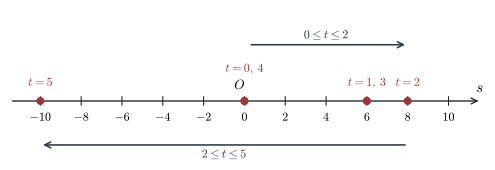
(b) \(8t - 2t^2 = 0 \Rightarrow 2t(4 - t) = 0\), so \(t = 0\) or \(t = 4\). It returns to \(O\) when \(t = 4\) s.
(c) It moves from \(s = 0\) to \(s = 8\) without turning: distance \(= 8\) m.
(d) It moves from \(s = 8\) to \(s = -10\) without turning: distance \(= 8 - (-10) = 18\) m.
Notice: the displacement at \(t = 5\) is \(-10\) m, but the total distance travelled from \(t = 0\) is \(8 + 18 = 26\) m.
Velocity
Velocity is the rate of change of displacement with respect to time.
Velocity Not in the formula booklet
\[ v = \frac{\mathrm{d}s}{\mathrm{d}t} \]
- \(v\): the velocity of the particle
- \(s\): the displacement from the fixed point \(O\)
- \(t\): the time
The booklet gives only the acceleration formula (see below).
Example 2 A particle moves along a straight line. Its displacement from a fixed point \(O\) after \(t\) seconds is \(s = t^2 - 8t\) metres, for \(0 \le t \le 10\) (Figure 3).
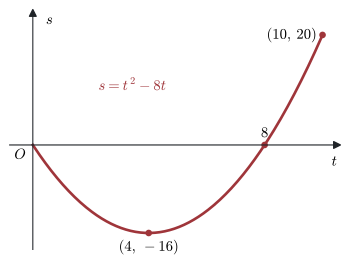
(a) Find an expression for the velocity \(v\).
(b) Complete the table for \(t = 0, 1, 2, \ldots, 8\): the direction of motion, the value of \(v\) and the sign of \(v\).
(c) How is the sign of \(v\) related to the direction of motion?
(a) \(v = \dfrac{\mathrm{d}s}{\mathrm{d}t} = 2t - 8\).
(b) The graph goes down until \(t = 4\) (the particle moves left) and up after \(t = 4\) (it moves right).
| \(t\) | Direction of motion | \(v\) | Sign of \(v\) |
|---|---|---|---|
| 0 | to the left | \(-8\) | \(-\) |
| 1 | to the left | \(-6\) | \(-\) |
| 2 | to the left | \(-4\) | \(-\) |
| 3 | to the left | \(-2\) | \(-\) |
| 4 | at rest (turning) | \(0\) | \(0\) |
| 5 | to the right | \(2\) | \(+\) |
| 6 | to the right | \(4\) | \(+\) |
| 7 | to the right | \(6\) | \(+\) |
| 8 | to the right | \(8\) | \(+\) |
(c) \(v < 0\) when the particle moves to the left (the negative direction), \(v > 0\) when it moves to the right (the positive direction), and \(v = 0\) at the moment it turns.
The sign of the velocity \(v\) Not in the formula booklet
- \(v > 0\): the particle moves in the positive direction (to the right).
- \(v = 0\): the particle is at instantaneous rest.
- \(v < 0\): the particle moves in the negative direction (to the left).
A particle changes direction when \(v\) changes sign. This happens at a zero of \(v\), but not every zero of \(v\) is a change of direction: check the sign of \(v\) on both sides.
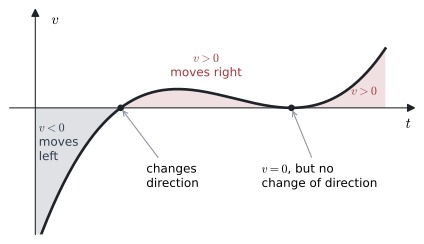
Example 3 A particle moves along a straight line. Its displacement from a fixed point \(O\), \(t\) seconds after passing \(O\), is \(s = t(t - 9)^2\) metres.
(a) Find the value of \(t\) when the particle first comes to instantaneous rest.
The particle returns to \(O\) when \(t = T\), \(T > 0\). Find
(b) the value of \(T\),
(c) the distance travelled from \(t = 0\) to \(t = T\).
(a) Product rule: \[ v = (t - 9)^2 + t \cdot 2(t - 9) = (t - 9)\big[(t - 9) + 2t\big] = (t - 9)(3t - 9) = 3(t - 3)(t - 9). \] \(v = 0\) when \(t = 3\) or \(t = 9\). The first time is \(t = 3\) s.
(b) \(s = 0 \Rightarrow t(t - 9)^2 = 0\), so \(t = 0\) or \(t = 9\). Hence \(T = 9\).
(c) For \(0 < t < 3\), \(v > 0\) (try \(t = 1\): \(v = 3(-2)(-8) = 48\)). For \(3 < t < 9\), \(v < 0\) (try \(t = 4\): \(v = 3(1)(-5) = -15\)). So the particle goes out to \(s(3) = 3 \times 36 = 108\) m and then comes back to \(O\).
Distance \(= 108 + 108 = 216\) m.
Acceleration
Acceleration is the rate of change of velocity with respect to time.
Acceleration In the formula booklet
\[ a = \frac{\mathrm{d}v}{\mathrm{d}t} = \frac{\mathrm{d}^2 s}{\mathrm{d}t^2} \]
- \(a\): the acceleration of the particle
- \(v\): the velocity
- \(t\): the time
- \(s\): the displacement from the fixed point \(O\)
Units: if \(s\) is in metres and \(t\) in seconds, then \(v\) is in \(\mathrm{m\,s^{-1}}\) and \(a\) is in \(\mathrm{m\,s^{-2}}\).
Example 4 A particle starts from rest. Figure 5 shows its velocity–time graph in three stages: \(v = 4t\) for \(0 \le t \le 2\), \(\;v = 8\) for \(2 \le t \le 7\), and \(v = 22 - 2t\) for \(7 \le t \le 11\). The particle comes to rest when \(t = 11\).
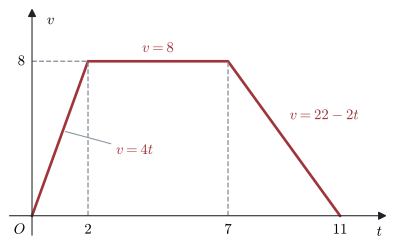
(a) Use \(a = \dfrac{\mathrm{d}v}{\mathrm{d}t}\) to find the acceleration
(i) for \(0 < t < 2\),
(ii) for \(2 < t < 7\),
(iii) for \(7 < t < 11\).
(b) What happens to the velocity when the acceleration is positive, zero or negative?
(a)
(i) \(a = \dfrac{\mathrm{d}}{\mathrm{d}t}(4t) = 4\ \mathrm{m\,s^{-2}}\). \(\quad\) (ii) \(a = \dfrac{\mathrm{d}}{\mathrm{d}t}(8) = 0\). \(\quad\) (iii) \(a = \dfrac{\mathrm{d}}{\mathrm{d}t}(22 - 2t) = -2\ \mathrm{m\,s^{-2}}\).
The acceleration is the gradient of the velocity–time graph.
(b) \(a > 0\): the velocity increases. \(\;a = 0\): the velocity is constant. \(\;a < 0\): the velocity decreases. Here \(v > 0\) the whole time, so the particle speeds up, then moves at constant speed, then slows down.
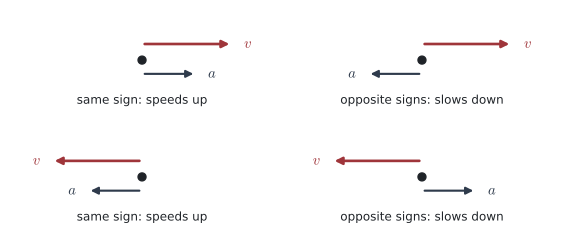
Speeding up or slowing down Not in the formula booklet
- \(a = 0\): the velocity is (momentarily) constant.
- \(v\) and \(a\) have the same sign: the speed increases (the particle speeds up).
- \(v\) and \(a\) have opposite signs: the speed decreases (the particle slows down).
When \(v > 0\) this simply means: \(a > 0\) speeds up, \(a < 0\) slows down. But if \(v < 0\), a positive acceleration makes the particle slow down.
Speed \(= |v|\) is in the syllabus guidance.
Example 5 A particle moves along a straight line. Its displacement from a fixed point \(O\), \(t\) seconds after leaving \(O\), is \(s = 3\mathrm{e}^{-t}\sin 4t\) metres.
(a) Find the value of \(t\) when the particle first returns to \(O\).
The particle first comes to instantaneous rest at the point \(A\).
(b) Find the value of \(t\) at \(A\).
(c) Find the acceleration of the particle at \(A\).
(a) \(s = 0 \Rightarrow \sin 4t = 0\) (since \(\mathrm{e}^{-t} > 0\)), so \(4t = 0, \pi, 2\pi, \ldots\) The first return after leaving \(O\) is when \(4t = \pi\): \(\;t = \dfrac{\pi}{4} \approx 0.785\) s.
(b) Product rule: \[ v = -3\mathrm{e}^{-t}\sin 4t + 12\mathrm{e}^{-t}\cos 4t = 3\mathrm{e}^{-t}(4\cos 4t - \sin 4t). \] \(v = 0 \Rightarrow \tan 4t = 4 \Rightarrow 4t = \arctan 4\) (the first positive solution), so \(t = \dfrac{\arctan 4}{4} \approx 0.331\) s.
(c) Differentiate again: \[ a = -3\mathrm{e}^{-t}(4\cos 4t - \sin 4t) + 3\mathrm{e}^{-t}(-16\sin 4t - 4\cos 4t) = -3\mathrm{e}^{-t}(8\cos 4t + 15\sin 4t). \] At \(A\), \(\tan 4t = 4\) with \(4t\) acute, so \(\cos 4t = \dfrac{1}{\sqrt{17}}\) and \(\sin 4t = \dfrac{4}{\sqrt{17}}\): \[ a = -3\mathrm{e}^{-t}\cdot\frac{8 + 60}{\sqrt{17}} = -12\sqrt{17}\,\mathrm{e}^{-t} \approx -35.5\ \mathrm{m\,s^{-2}} \quad (t \approx 0.331). \]
In Paper 2 you can do Example 5 without the algebra.
- Graphs page. Enter \(f1(x) = 3\mathrm{e}^{-x}\sin(4x)\) (use \(x\) for \(t\); radian mode).
- Return to \(O\): Menu → Analyze Graph → Zero, and choose a lower and upper bound around the first positive zero. You get \(x = 0.785\).
- Instantaneous rest: \(v = 0\) where \(s\) has a turning point. Menu → Analyze Graph → Maximum gives \(x = 0.331\).
- Acceleration: on a Calculator page, Menu → Calculus → Numerical Derivative at a Point, and choose the 2nd derivative, with \(x = 0.331454\) (store the exact \(x\)-value; do not type the rounded one). You get \(-35.5\).
You can also graph the velocity directly: enter \(f2(x) = \dfrac{\mathrm{d}}{\mathrm{d}x}\big(f1(x)\big)\) (the derivative template is in the template palette) and find its zeros.
Common errors
| ✗ Wrong | ✓ Right | Why |
|---|---|---|
| Distance from \(t = 0\) to \(t = 5\) is \(\lvert s(5) - s(0)\rvert\) | Find where \(v = 0\) and add the distance for each part | The particle may turn back; see Example 1. |
| \(v = 0\) means the particle changes direction | Check that \(v\) changes sign | For example \(v = (t - 2)^2\) is zero at \(t = 2\) but never negative. |
| \(a > 0\) means “speeding up” | Speeding up when \(v\) and \(a\) have the same sign | With \(v < 0\) and \(a > 0\) the particle slows down. |
| Speed \(= v\) | Speed \(= \lvert v \rvert\) | Speed is never negative. |
| “At rest” means \(a = 0\) | “At rest” means \(v = 0\) | \(a\) can be non-zero at the instant the particle turns. |
| Using degrees for \(\sin 4t\) | Radians | Calculus with trigonometric functions always uses radians. |
Exercises
1 A particle moves in a straight line so that its displacement from \(O\) is \(s = t^3 - 6t^2 + 9t\) metres at time \(t\) seconds, \(t \ge 0\).
(a) Find expressions for \(v\) and \(a\).
(b) Find the times when the particle is at rest, and the acceleration at each of these times.
(a) \(v = 3t^2 - 12t + 9\), \(\;a = 6t - 12\).
(b) \(v = 3(t - 1)(t - 3) = 0 \Rightarrow t = 1\) or \(t = 3\). \(a(1) = -6\ \mathrm{m\,s^{-2}}\), \(\;a(3) = 6\ \mathrm{m\,s^{-2}}\).
2 A particle leaves \(O\) and moves in a straight line with displacement \(s = 12t - 3t^2\) metres, \(0 \le t \le 5\).
(a) When does it return to \(O\)?
(b) Find the total distance travelled from \(t = 0\) to \(t = 5\).
(a) \(3t(4 - t) = 0 \Rightarrow t = 4\) s.
(b) \(v = 12 - 6t = 0\) at \(t = 2\). \(s(0) = 0\), \(s(2) = 12\), \(s(5) = 60 - 75 = -15\). Distance \(= 12 + (12 - (-15)) = 12 + 27 = 39\) m.
3 The displacement of a particle is \(s = 2t^3 - 15t^2 + 24t + 5\) metres, \(t \ge 0\). For which values of \(t\) does the particle move in the negative direction?
\(v = 6t^2 - 30t + 24 = 6(t - 1)(t - 4)\). This is negative between the roots: \(1 < t < 4\).
4 A car brakes. Its velocity is \(v = 20 - 4t\ \mathrm{m\,s^{-1}}\) for \(0 \le t \le 5\). Find its acceleration, and the time when it stops.
\(a = \dfrac{\mathrm{d}v}{\mathrm{d}t} = -4\ \mathrm{m\,s^{-2}}\) (constant). \(\;v = 0 \Rightarrow t = 5\) s.
5 A particle moves with displacement \(s = 4\sin 3t\) metres, \(t \ge 0\).
(a) Show that \(a = -9s\).
(b) Find the first time when the particle is at rest, and its acceleration then.
(a) \(v = 12\cos 3t\), \(\;a = -36\sin 3t = -9(4\sin 3t) = -9s\).
(b) \(\cos 3t = 0 \Rightarrow 3t = \dfrac{\pi}{2}\), \(\;t = \dfrac{\pi}{6}\) s. Then \(s = 4\), so \(a = -36\ \mathrm{m\,s^{-2}}\).
6 A particle has displacement \(s = t^2\mathrm{e}^{-t}\) metres, \(t \ge 0\). Find the times when it is at rest, and its greatest displacement from \(O\).
\(v = 2t\mathrm{e}^{-t} - t^2\mathrm{e}^{-t} = t(2 - t)\mathrm{e}^{-t}\). At rest when \(t = 0\) and \(t = 2\).
\(v > 0\) for \(0 < t < 2\) and \(v < 0\) for \(t > 2\), and \(s \ge 0\) always. So the greatest displacement is \(s(2) = 4\mathrm{e}^{-2} \approx 0.541\) m.
7 A particle has velocity \(v = t^2 - 4t + 3\ \mathrm{m\,s^{-1}}\). When \(t = 2.5\), find its speed, and decide whether it is speeding up or slowing down.
\(v(2.5) = 6.25 - 10 + 3 = -0.75\), so the speed is \(0.75\ \mathrm{m\,s^{-1}}\).
\(a = 2t - 4\), \(\;a(2.5) = 1 > 0\). \(v\) and \(a\) have opposite signs, so it is slowing down.
8 A particle has displacement \(s = \ln(t^2 + 1) - t\) metres, \(t \ge 0\).
(a) Show that \(v = -\dfrac{(t - 1)^2}{t^2 + 1}\). (b) Does the particle ever change direction? Explain.
(c) Find \(a\) when \(t = 1\).
(a) \(v = \dfrac{2t}{t^2 + 1} - 1 = \dfrac{2t - t^2 - 1}{t^2 + 1} = -\dfrac{(t - 1)^2}{t^2 + 1}\).
(b) No. \(v \le 0\) for all \(t\); \(v = 0\) only at \(t = 1\), and \(v\) does not change sign there.
(c) \(a = \dfrac{\mathrm{d}}{\mathrm{d}t}\left(\dfrac{2t}{t^2 + 1}\right) = \dfrac{2(t^2 + 1) - 2t \cdot 2t}{(t^2 + 1)^2} = \dfrac{2 - 2t^2}{(t^2 + 1)^2}\). At \(t = 1\): \(a = 0\).
9 A particle has displacement \(s = \sqrt{2t + 1}\) metres, \(t \ge 0\). Find \(v\) and \(a\) when \(t = 4\).
\(v = \dfrac{1}{2}(2t + 1)^{-\frac{1}{2}} \cdot 2 = (2t + 1)^{-\frac{1}{2}}\), \(\;a = -(2t + 1)^{-\frac{3}{2}}\).
At \(t = 4\): \(v = \dfrac{1}{3}\ \mathrm{m\,s^{-1}}\), \(\;a = -\dfrac{1}{27}\ \mathrm{m\,s^{-2}}\).
10 Paper 2 A particle has displacement \(s = 2t\cos t\) metres, \(0 \le t \le 3\). Find the time when it first comes to rest, and its acceleration at that time.
\(v = 2\cos t - 2t\sin t\). Use the GDC (Zero of \(v\), or Maximum of \(s\)): \(t \approx 0.860\) s.
\(a = -4\sin t - 2t\cos t\). At \(t = 0.86033\ldots\): \(a \approx -4.15\ \mathrm{m\,s^{-2}}\).