8.2 Graphs of Quadratic Functions
SL 2.6
- the words for the parts of a quadratic graph: parabola, vertex, axis of symmetry, intercepts
- the three forms of a quadratic function — general, factorised and vertex form — and what each one tells you
- how to find the turning point and the intercepts of a quadratic graph
- a step-by-step method for sketching a quadratic graph
Graphs of quadratic functions
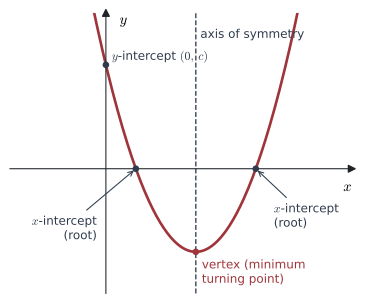
The graph of a quadratic function is called a parabola.
- The point where the graph turns is the vertex (or turning point).
- If the graph opens upwards (\(a > 0\)), the vertex is a minimum turning point. The graph is concave up.
- If the graph opens downwards (\(a < 0\)), the vertex is a maximum turning point. The graph is concave down.
- The vertical line through the vertex is the axis of symmetry. Every parabola is symmetrical about this line.
- The \(y\)-intercept is where the graph crosses the \(y\)-axis. Put \(x = 0\): for \(y = ax^2 + bx + c\) it is \((0, c)\).
- The \(x\)-intercepts (if they exist) are where the graph crosses the \(x\)-axis. They are the roots (or zeros) of the equation \(ax^2 + bx + c = 0\).
Three forms of a quadratic function
The same quadratic can be written in three ways. Each form shows different features of the graph directly. How to get the vertex form by completing the square is in 8.1; here we use the forms to read and sketch the graph.
The three forms Partly in the formula booklet
| Form | Equation | What you can read off |
|---|---|---|
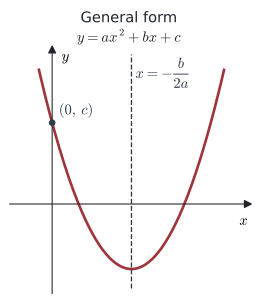
| General form | \(f(x) = ax^2 + bx + c\) | \(y\)-intercept \((0, c)\); axis of symmetry \(x = -\dfrac{b}{2a}\) In the booklet |
| Factorised (intercept) form | \(f(x) = a(x - p)(x - q)\) | \(x\)-intercepts \((p, 0)\) and \((q, 0)\); axis \(x = \dfrac{p + q}{2}\) |
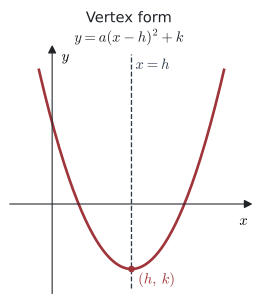
| Vertex (completed square) form | \(f(x) = a(x - h)^2 + k\) | vertex \((h, k)\); axis \(x = h\) |
In every form, \(a > 0\) means the graph opens upwards, and \(a < 0\) means it opens downwards.
- \(a\): the coefficient of \(x^2\) (\(a \neq 0\))
- \(b\): the coefficient of \(x\)
- \(c\): the constant term
- \(p\): one \(x\)-intercept (root)
- \(q\): the other \(x\)-intercept (root)
- \(h\): the \(x\)-coordinate of the vertex
- \(k\): the \(y\)-coordinate of the vertex
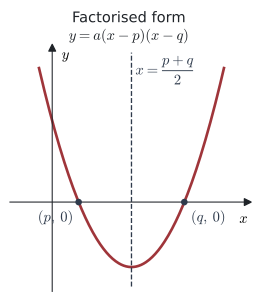
The axis of symmetry is halfway between the two \(x\)-intercepts. That is why it is \(x = \frac{p + q}{2}\).
To move between the forms:
- vertex or factorised → general: expand the brackets;
- general → factorised: factorise (this is not always possible with whole numbers);
- general → vertex: complete the square (Section 8.1).
For example, \(f(x) = 2(x - 3)^2 - 8\) is in vertex form, with vertex \((3, -8)\). Expanding gives the general form \(2x^2 - 12x + 10\), and factorising gives \(2(x - 1)(x - 5)\), so the \(x\)-intercepts are \(1\) and \(5\).
Example 1 (a) Find the coordinates of the turning point and the \(y\)-intercept of the graph of \(y = -3x^2 + 6x + 2\).
(b) Find the exact values of \(x\) for which \(y = 0\).
(a) Complete the square:
\[ -3x^2 + 6x + 2 = -3(x^2 - 2x) + 2 = -3\big[(x - 1)^2 - 1\big] + 2 = -3(x - 1)^2 + 5 . \]
The turning point is \((1, 5)\). Since \(a = -3 < 0\), it is a maximum. The \(y\)-intercept is \((0, 2)\).
(b)
\[ -3(x - 1)^2 + 5 = 0 \;\Longrightarrow\; (x - 1)^2 = \frac{5}{3} \;\Longrightarrow\; x = 1 \pm \sqrt{\frac{5}{3}} = 1 \pm \frac{\sqrt{15}}{3} . \]
(The quadratic formula gives the same answer: \(x = \dfrac{-6 \pm \sqrt{36 + 24}}{-6} = 1 \mp \dfrac{\sqrt{60}}{6}\), and \(\dfrac{\sqrt{60}}{6} = \dfrac{\sqrt{15}}{3}\).)
Example 2 (a) Find the \(x\)-intercepts and the coordinates of the turning point of the graph of \(y = 3x^2 - 3x - 18\).
(b) Hence explain why \(3x^2 - 3x - 18 = 0\) has two distinct real roots.
(a) Factorise: \(3x^2 - 3x - 18 = 3(x^2 - x - 6) = 3(x - 3)(x + 2)\).
The \(x\)-intercepts are \((-2, 0)\) and \((3, 0)\).
The axis of symmetry is halfway between them: \(x = \dfrac{-2 + 3}{2} = \dfrac{1}{2}\).
\[ y = 3\left(\frac{1}{2} - 3\right)\left(\frac{1}{2} + 2\right) = 3 \times \left(-\frac{5}{2}\right) \times \frac{5}{2} = -\frac{75}{4} . \]
The turning point is \(\left(\dfrac{1}{2}, -\dfrac{75}{4}\right)\).
(b) The graph opens upwards (\(a = 3 > 0\)) and its lowest point is below the \(x\)-axis (\(-\frac{75}{4} < 0\)). So the graph must cross the \(x\)-axis twice. The equation has two distinct real roots.
Sketching quadratic functions
A sketch is not an accurate plot. It must show the correct shape and label the key points.
Sketching \(y = f(x)\) for a quadratic
- \(x\)-intercepts: solve \(f(x) = 0\) (factorised form, or the quadratic formula).
- \(y\)-intercept: put \(x = 0\).
- Vertex:
- from factorised form \(a(x - p)(x - q)\): the axis is \(x = \frac{p + q}{2}\); substitute it to get the \(y\)-coordinate;
- from vertex form \(a(x - h)^2 + k\): the vertex is \((h, k)\) (complete the square to get this form).
- Shape: a minimum if \(a > 0\) (U shape), a maximum if \(a < 0\) (∩ shape).
- Draw a smooth, symmetrical curve, and label all the points you found.
Example 3 Sketch the graph of each function.
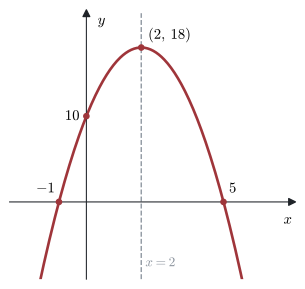
(a) \(f(x) = -2(x + 1)(x - 5)\) \(\qquad\) (b) \(g(x) = 2x^2 - 8x + 5\)
(a) Factorised form, with \(a = -2 < 0\): the graph is ∩-shaped.
- \(x\)-intercepts: \(x = -1\) and \(x = 5\).
- \(y\)-intercept: \(f(0) = -2(1)(-5) = 10\).
- Axis: \(x = \dfrac{-1 + 5}{2} = 2\). Vertex: \(f(2) = -2(3)(-3) = 18\), so \((2, 18)\) is a maximum.
(b) \(a = 2 > 0\): the graph is U-shaped. Complete the square:
\[ 2x^2 - 8x + 5 = 2(x^2 - 4x) + 5 = 2\big[(x - 2)^2 - 4\big] + 5 = 2(x - 2)^2 - 3 . \]
- Vertex: \((2, -3)\), a minimum.
- \(y\)-intercept: \(g(0) = 5\).
- \(x\)-intercepts: \(2(x - 2)^2 = 3 \Rightarrow x = 2 \pm \sqrt{\dfrac{3}{2}} = 2 \pm \dfrac{\sqrt{6}}{2}\) (about \(0.78\) and \(3.22\)).
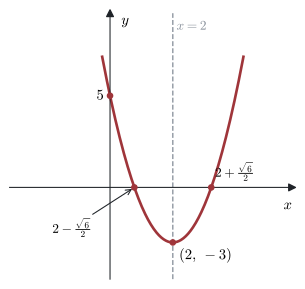
Graphs page: enter \(f_1(x) = 2x^2 - 8x + 5\). Use Menu → Analyze Graph → Zero for the \(x\)-intercepts and Minimum for the vertex. Use Menu → Window / Zoom → Zoom – Fit if the vertex is off the screen. Copy the shape to your paper and label the points: a picture without labels earns few marks.
Common errors
| ✗ Wrong | ✓ Right | Why |
|---|---|---|
| \(y = 2(x + 1)(x - 5)\) has intercepts \(1\) and \(-5\) | \(-1\) and \(5\) | Solve \(x + 1 = 0\) and \(x - 5 = 0\). |
| \(y = (x - 3)^2 + 4\) has vertex \((-3, 4)\) | \((3, 4)\) | In \(a(x - h)^2 + k\) the vertex is \((h, k)\). |
| \(y\)-intercept of \(-2(x + 1)(x - 5)\) is \(-2\) | \(f(0) = 10\) | Substitute \(x = 0\) into the whole expression. |
| Axis of symmetry \(x = -\frac{b}{a}\) | \(x = -\dfrac{b}{2a}\) | Check the booklet. |
| A sketch with no labels | Label intercepts and vertex | A sketch must show the key points. |
Exercises
1 For \(y = (x - 4)(x + 6)\), write down the \(x\)-intercepts and the \(y\)-intercept, and find the vertex.
\(x\)-intercepts: \((4, 0)\) and \((-6, 0)\). \(y\)-intercept: \(y = (0 - 4)(0 + 6) = -24\), so \((0, -24)\).
Axis: \(x = \dfrac{4 + (-6)}{2} = -1\). \(\;y = (-5)(5) = -25\). Vertex \((-1, -25)\).
2 Write down the vertex and the axis of symmetry of \(y = -2(x + 3)^2 + 7\). Is the vertex a maximum or a minimum?
Vertex \((-3, 7)\); axis \(x = -3\). Since \(a = -2 < 0\), it is a maximum.
3 Find the equation of the axis of symmetry of \(y = 4x^2 - 10x + 1\).
\(x = -\dfrac{b}{2a} = -\dfrac{-10}{8} = \dfrac{5}{4}\).
4 Write \(f(x) = 3(x - 2)^2 - 12\) in general form and in factorised form.
General: \(3(x^2 - 4x + 4) - 12 = 3x^2 - 12x\).
Factorised: \(3x^2 - 12x = 3x(x - 4)\) (that is, \(3(x - 0)(x - 4)\)).
5 Find the coordinates of the vertex and the \(x\)-intercepts of \(y = x^2 + 2x - 15\).
\(y = (x + 5)(x - 3)\): \(x\)-intercepts \((-5, 0)\) and \((3, 0)\).
Axis \(x = -1\); \(y = (4)(-4) = -16\). Vertex \((-1, -16)\).
6 Sketch \(y = -x^2 + 4x + 5\), showing the intercepts and the vertex.
\(-x^2 + 4x + 5 = -(x^2 - 4x - 5) = -(x - 5)(x + 1)\): \(x\)-intercepts \(-1\) and \(5\).
\(y\)-intercept \(5\). Axis \(x = 2\): \(y = -4 + 8 + 5 = 9\). Vertex \((2, 9)\), a maximum.
The sketch is a ∩-shaped curve through \((-1, 0)\), \((0, 5)\), \((2, 9)\) and \((5, 0)\).
7 Find the exact \(x\)-intercepts of \(y = 2x^2 + 4x - 3\), and the coordinates of its vertex.
\(2(x^2 + 2x) - 3 = 2\big[(x + 1)^2 - 1\big] - 3 = 2(x + 1)^2 - 5\). Vertex \((-1, -5)\).
\(2(x + 1)^2 = 5 \Rightarrow x = -1 \pm \sqrt{\dfrac{5}{2}} = -1 \pm \dfrac{\sqrt{10}}{2}\).
8 A parabola has \(x\)-intercepts \((-1, 0)\) and \((7, 0)\) and passes through \((0, -14)\). Find its equation in the form \(y = ax^2 + bx + c\).
\(y = a(x + 1)(x - 7)\). At \(x = 0\): \(a(1)(-7) = -14\), so \(a = 2\).
\(y = 2(x^2 - 6x - 7) = 2x^2 - 12x - 14\).
9 A parabola has vertex \((-2, 5)\) and passes through \((1, -13)\). Find its equation in the form \(y = a(x - h)^2 + k\).
\(y = a(x + 2)^2 + 5\). At \((1, -13)\): \(9a + 5 = -13\), so \(a = -2\).
\(y = -2(x + 2)^2 + 5\).
10 The graph of \(y = x^2 + bx + c\) has its vertex at \((3, -4)\).
(a) Find \(b\) and \(c\). \(\qquad\) (b) Find the \(x\)-intercepts.
(a) \(y = (x - 3)^2 - 4 = x^2 - 6x + 5\), so \(b = -6\) and \(c = 5\).
(b) \(x^2 - 6x + 5 = (x - 1)(x - 5) = 0\): the \(x\)-intercepts are \((1, 0)\) and \((5, 0)\).