8.3 The Discriminant
SL 2.7
- what the discriminant \(\Delta = b^2 - 4ac\) is
- how \(\Delta\) tells you the nature of the roots: two distinct real roots, two equal real roots, or no real roots
- how \(\Delta\) tells you how many times the graph meets the \(x\)-axis
- how to find an unknown constant so that a quadratic has a given type of roots
- how to show that a quadratic is always positive or always negative
Nature of the roots
In the quadratic formula
\[ x = \frac{-b \pm \sqrt{b^2 - 4ac}}{2a} \]
the expression under the square root decides everything. It is called the discriminant.
The discriminant of \(ax^2 + bx + c = 0\) Partly in the formula booklet
\[ \Delta = b^2 - 4ac \]
In the booklet
| Discriminant | Roots of \(ax^2 + bx + c = 0\) | Number of \(x\)-intercepts of \(y = ax^2 + bx + c\) |
|---|---|---|
| \(\Delta > 0\) | two distinct real roots | 2 (the graph crosses the \(x\)-axis twice) |
| \(\Delta = 0\) | two equal real roots (a repeated root) | 1 (the graph touches the \(x\)-axis) |
| \(\Delta < 0\) | no real roots | 0 (the graph does not meet the \(x\)-axis) |
- \(\Delta\): the discriminant
- \(a\): the coefficient of \(x^2\) (\(a \neq 0\))
- \(b\): the coefficient of \(x\)
- \(c\): the constant term
Why? If \(\Delta > 0\), the \(\pm\) gives two different numbers. If \(\Delta = 0\), both signs give \(x = -\frac{b}{2a}\). If \(\Delta < 0\), there is no real square root.
The roots of the equation are the \(x\)-intercepts of the graph, so \(\Delta\) also tells us how the graph sits relative to the \(x\)-axis.
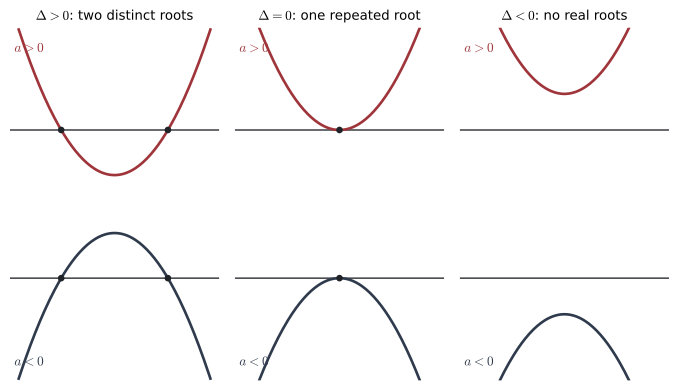
Look at the last column of Figure 1. When \(\Delta < 0\), the graph is entirely above the \(x\)-axis if \(a > 0\), and entirely below it if \(a < 0\).
Always positive or always negative Not in the formula booklet
- \(\Delta < 0\) and \(a > 0\) \(\iff\) \(ax^2 + bx + c > 0\) for all real \(x\) (positive definite).
- \(\Delta < 0\) and \(a < 0\) \(\iff\) \(ax^2 + bx + c < 0\) for all real \(x\) (negative definite).
- \(\Delta\): the discriminant, \(b^2 - 4ac\)
- \(a\): the coefficient of \(x^2\) (\(a \neq 0\))
- \(b\): the coefficient of \(x\)
- \(c\): the constant term
Notice the words in questions:
- “two distinct real roots” or “cuts the \(x\)-axis twice”: \(\Delta > 0\);
- “equal roots”, “repeated root” or “touches the \(x\)-axis”: \(\Delta = 0\);
- “real roots” (equal or not): \(\Delta \geq 0\);
- “no real roots” or “does not meet the \(x\)-axis”: \(\Delta < 0\).
Example 1 Use the discriminant to find the number of \(x\)-intercepts of the graph of each function.
(a) \(y = 4x^2 - 12x + 9\)
(b) \(y = 2 - (x + 1)^2\)
(c) \(y = 3x^2 + 2x + 5\)
(a) \(a = 4\), \(b = -12\), \(c = 9\): \(\;\Delta = 144 - 4(4)(9) = 144 - 144 = 0\). One \(x\)-intercept (the graph touches the axis).
(b) First write it in general form: \(2 - (x^2 + 2x + 1) = -x^2 - 2x + 1\).
\(\Delta = (-2)^2 - 4(-1)(1) = 4 + 4 = 8 > 0\). Two \(x\)-intercepts.
(c) \(\Delta = 4 - 4(3)(5) = 4 - 60 = -56 < 0\). No \(x\)-intercepts.
When the quadratic contains an unknown constant, set up an equation or inequality for \(\Delta\).
Example 2 Find the values of \(k\), \(k \neq 0\), for which the graph of \(y = kx^2 - 6x + k - 8\) touches the \(x\)-axis.
“Touches” means \(\Delta = 0\). Here \(a = k\), \(b = -6\), \(c = k - 8\):
\[ \Delta = 36 - 4k(k - 8) = 36 - 4k^2 + 32k = 0 . \]
Divide by \(-4\): \(\;k^2 - 8k - 9 = 0 \;\Longrightarrow\; (k - 9)(k + 1) = 0\).
So \(k = 9\) or \(k = -1\).
(Check \(k = 9\): \(9x^2 - 6x + 1 = (3x - 1)^2\) ✓. Check \(k = -1\): \(-x^2 - 6x - 9 = -(x + 3)^2\) ✓.)
Example 3 (a) Show that the graph of \(y = x^2 + 4kx + 5k^2 + 2\) lies entirely above the \(x\)-axis, for every real value of \(k\).
(b) Show that \(-3x^2 + 6kx - 3k^2 - 2\) is negative for all real values of \(x\).
(a) \(a = 1\), \(b = 4k\), \(c = 5k^2 + 2\):
\[ \Delta = 16k^2 - 4(5k^2 + 2) = 16k^2 - 20k^2 - 8 = -4k^2 - 8 . \]
Since \(k^2 \geq 0\), \(\;\Delta = -4k^2 - 8 \leq -8 < 0\). Also \(a = 1 > 0\). So the graph is entirely above the \(x\)-axis.
(b) \(a = -3\), \(b = 6k\), \(c = -3k^2 - 2\):
\[ \Delta = 36k^2 - 4(-3)(-3k^2 - 2) = 36k^2 - 36k^2 - 24 = -24 < 0 . \]
Also \(a = -3 < 0\). So the expression is negative for all real \(x\).
(Another way: \(-3x^2 + 6kx - 3k^2 - 2 = -3(x - k)^2 - 2 \leq -2 < 0\).)
Common errors
| ✗ Wrong | ✓ Right | Why |
|---|---|---|
| \(\Delta = b^2 + 4ac\), or \(\sqrt{b^2 - 4ac}\) | \(\Delta = b^2 - 4ac\) | No square root, and a minus sign. |
| Using \(b = 6\) for \(kx^2 - 6x + \ldots\) | \(b = -6\) | Keep the sign. (\(b^2\) is the same here, but \(-4ac\) often is not.) |
| Using \(c = k\) for \(kx^2 - 6x + k - 8\) | \(c = k - 8\) | \(c\) is the whole constant term. |
| Finding \(\Delta\) of \(2 - (x + 1)^2\) with \(a = 1\) | Expand first: \(a = -1\) | Write the general form before reading \(a, b, c\). |
| “Real roots” means \(\Delta > 0\) | \(\Delta \geq 0\) | Equal roots are real roots too. |
| \(\Delta < 0\), so the quadratic is positive | Also need \(a > 0\) | If \(a < 0\) it is always negative. |
Exercises
1 Find the discriminant and state the nature of the roots.
(a) \(x^2 - 7x + 10 = 0\)
(b) \(9x^2 + 6x + 1 = 0\)
(c) \(2x^2 - 3x + 4 = 0\)
(a) \(49 - 40 = 9 > 0\): two distinct real roots.
(b) \(36 - 36 = 0\): two equal real roots.
(c) \(9 - 32 = -23 < 0\): no real roots.
2 How many times does the graph of \(y = 5 + 3x - 2x^2\) meet the \(x\)-axis?
\(a = -2\), \(b = 3\), \(c = 5\): \(\;\Delta = 9 + 40 = 49 > 0\). It meets the \(x\)-axis twice.
3 Find the value of \(p\) for which \(x^2 + px + 16 = 0\) has equal roots, given that \(p > 0\).
\(p^2 - 64 = 0 \Rightarrow p = \pm 8\). Since \(p > 0\), \(p = 8\).
4 Find the range of values of \(c\) for which \(3x^2 - 6x + c = 0\) has no real roots.
\(36 - 12c < 0 \Rightarrow c > 3\).
5 Find the range of values of \(m\) for which \(2x^2 + 5x + m = 0\) has two distinct real roots.
\(25 - 8m > 0 \Rightarrow m < \dfrac{25}{8}\).
6 The equation \(kx^2 + 4x + (k - 3) = 0\) has equal roots. Find the possible values of \(k\).
\(16 - 4k(k - 3) = 0 \Rightarrow 4 - k^2 + 3k = 0 \Rightarrow k^2 - 3k - 4 = 0 \Rightarrow (k - 4)(k + 1) = 0\).
\(k = 4\) or \(k = -1\).
7 Show that the equation \(x^2 + (k - 2)x - 2k = 0\) has real roots for every real value of \(k\).
\(\Delta = (k - 2)^2 + 8k = k^2 - 4k + 4 + 8k = k^2 + 4k + 4 = (k + 2)^2 \geq 0\).
Since \(\Delta \geq 0\) for every \(k\), the roots are always real.
8 Show that \(2x^2 - 4x + 7\) is positive for all real \(x\).
\(\Delta = 16 - 56 = -40 < 0\) and \(a = 2 > 0\), so \(2x^2 - 4x + 7 > 0\) for all real \(x\).
9 The line \(y = 2x + c\) is a tangent to the curve \(y = x^2 - 4x + 3\). Find \(c\).
At the meeting points, \(x^2 - 4x + 3 = 2x + c\), so \(x^2 - 6x + (3 - c) = 0\).
A tangent meets the curve at exactly one point, so \(\Delta = 0\):
\(36 - 4(3 - c) = 0 \Rightarrow 36 - 12 + 4c = 0 \Rightarrow c = -6\).
10 Find the range of values of \(k\) for which \(kx^2 + 2x + k\) is negative for all real \(x\).
We need \(a = k < 0\) and \(\Delta = 4 - 4k^2 < 0\).
\(4 - 4k^2 < 0 \Rightarrow k^2 > 1 \Rightarrow k < -1\) or \(k > 1\).
Together with \(k < 0\): \(\;k < -1\).