8.4 Applications of Quadratic Functions
SL 2.6
- how quadratic functions model real situations, such as the path of a ball or the shape of an arch
- how to answer “greatest height”, “when” and “does it hit / does it fit” questions with the vertex and with substitution
- how to build a quadratic model from information about a shape
Quadratic models
Quadratic functions model many practical situations:
- the path (trajectory) of a ball or a jet of water;
- parabolic structures such as arches, bridges and satellite dishes;
- areas, where one length grows while another shrinks;
- profit or revenue, which rise and then fall.
The vertex gives the greatest or least value. The intercepts give the start and the end.
Working with a quadratic model
- Read carefully what each variable means, and its units.
- “Greatest” or “least” value: find the vertex (complete the square, or use \(x = -\frac{b}{2a}\)).
- “At the start”, “when \(x = \ldots\)”: substitute into the function.
- “When does it reach \(\ldots\)”: solve an equation.
- Answer in words, in the context, with units. Check that the answer makes sense.
Example 1 A stone is thrown from the top of a small wall. Its height, \(h\) m, above the ground is given by
\[ h = -0.5x^2 + 3x + 1.5, \]
where \(x\) m is the horizontal distance from the wall.
(a) Find the height of the stone at the moment it is thrown.
(b) Find the greatest height of the stone.
(c) A target is \(4\) m horizontally from the wall and \(5\) m above the ground. Determine whether the stone hits the target.
(a) At the moment it is thrown, \(x = 0\): \(\;h = 1.5\) m.
(b) Complete the square:
\[ -0.5x^2 + 3x + 1.5 = -0.5(x^2 - 6x) + 1.5 = -0.5\big[(x - 3)^2 - 9\big] + 1.5 = -0.5(x - 3)^2 + 6 . \]
The greatest height is \(6\) m, when the stone is \(3\) m from the wall.
(c) At \(x = 4\): \(\;h = -0.5(16) + 12 + 1.5 = 5.5\) m.
The stone is \(5.5\) m high at that point, not \(5\) m. It passes \(0.5\) m above the target, so it does not hit it.
Sometimes you must build the model yourself. Choose the axes so that the numbers are simple, then use the vertex form \(y = a(x - h)^2 + k\).
Example 2 A tunnel entrance has the shape of a parabolic arch. The road under the arch is \(8\) m wide, and the greatest height of the arch is \(6\) m. Take the origin at one end of the arch, as in the diagram, with \(x\) m the horizontal distance and \(y\) m the height.
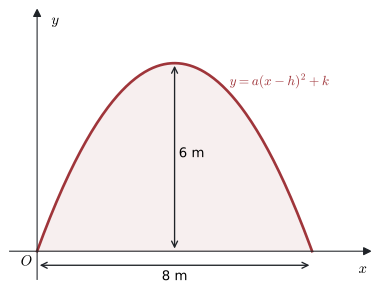
(a) Find a quadratic function in the form \(y = a(x - h)^2 + k\) for the arch.
(b) Find the height of the arch at the points where its width is \(4\) m.
(c) A lorry is \(4\) m wide and \(4.6\) m tall. It drives through the middle of the road. Decide whether it can pass under the arch.
(a) By symmetry the vertex is halfway across: \((4, 6)\). So \(y = a(x - 4)^2 + 6\).
The arch passes through \((0, 0)\): \(\;a(16) + 6 = 0\), so \(a = -\dfrac{3}{8}\).
\[ y = -\frac{3}{8}(x - 4)^2 + 6 . \]
(b) A width of \(4\) m, centred on \(x = 4\), goes from \(x = 2\) to \(x = 6\).
\[ y = -\frac{3}{8}(2 - 4)^2 + 6 = -\frac{3}{8}(4) + 6 = 4.5 \text{ m}. \]
(c) The lorry, in the middle, fills \(x = 2\) to \(x = 6\). At its edges the arch is only \(4.5\) m high, but the lorry is \(4.6\) m tall. So the lorry cannot pass under the arch.
Graphs page: enter the model as \(f_1(x)\) and set a sensible window (only \(x \geq 0\) and \(y \geq 0\) usually make sense).
- Greatest value: Menu → Analyze Graph → Maximum.
- Height at a given \(x\): Menu → Trace → Graph Trace, then type the \(x\)-value and press enter.
- When the height is a given value: graph $f_2(x) = $ that value and use Menu → Analyze Graph → Intersection.
Common errors
| ✗ Wrong | ✓ Right | Why |
|---|---|---|
| Greatest height at \(x = 0\) | At the vertex | \(x = 0\) gives the starting height. |
| Answer “\((3, 6)\)” for “greatest height” | “\(6\) m” | Answer the question that was asked, with units. |
| Width \(4\) m means \(x = 4\) | \(x\) from \(2\) to \(6\) | The width is measured across the axis of symmetry. |
| Using the model far outside the data | Comment on the limits | For example, a negative height is not possible. |
Exercises
1 A ball is kicked from the ground. Its height after \(t\) seconds is \(h = 20t - 5t^2\) metres.
(a) Find the greatest height. \(\qquad\) (b) Find when the ball lands.
(a) \(h = -5(t^2 - 4t) = -5(t - 2)^2 + 20\). Greatest height \(20\) m (at \(t = 2\) s).
(b) \(5t(4 - t) = 0\), so \(t = 0\) or \(t = 4\). It lands after \(4\) s.
2 A farmer has \(60\) m of fencing to make a rectangular pen. Let one side be \(x\) m.
(a) Show that the area is \(A = 30x - x^2\).
(b) Find the greatest possible area.
(a) The perimeter is \(60\), so the other side is \(30 - x\). \(\;A = x(30 - x) = 30x - x^2\).
(b) \(A = -(x - 15)^2 + 225\). The greatest area is \(225\ \text{m}^2\) (a square of side \(15\) m).
3 A rectangular garden is next to a wall. Fencing is used on the other three sides only, and there is \(40\) m of fencing. Find the greatest possible area.
Let the two sides perpendicular to the wall be \(x\) m. The side parallel to the wall is \(40 - 2x\).
\(A = x(40 - 2x) = -2x^2 + 40x = -2(x - 10)^2 + 200\). The greatest area is \(200\ \text{m}^2\) (when \(x = 10\)).
4 A shop sells \(200 - 4p\) caps per week when the price is $\(p\). Find the price that gives the greatest weekly revenue, and that revenue.
\(R = p(200 - 4p) = -4p^2 + 200p = -4(p - 25)^2 + 2500\).
Price $25 gives the greatest revenue, $2500.
5 The height of a model rocket is \(h = -4.9t^2 + 29.4t\) metres, \(t\) seconds after launch. Find its greatest height and the time when it reaches it.
\(t = -\dfrac{29.4}{2(-4.9)} = 3\) s. \(\;h = -4.9(9) + 29.4(3) = -44.1 + 88.2 = 44.1\) m.
6 The cost, $\(C\), of making \(n\) items per day is \(C = 0.5n^2 - 40n + 1000\). Find the number of items that gives the least cost, and that cost.
\(C = 0.5(n^2 - 80n) + 1000 = 0.5(n - 40)^2 - 800 + 1000 = 0.5(n - 40)^2 + 200\).
Least cost $200, when \(40\) items are made.
7 The path of a jet of water from a fountain is \(y = -0.8x^2 + 3.2x\), where \(x\) m is the horizontal distance and \(y\) m the height.
(a) How far from the fountain does the water land?
(b) What is the greatest height?
(a) \(-0.8x(x - 4) = 0\): \(x = 0\) or \(x = 4\). It lands \(4\) m away.
(b) At \(x = 2\): \(\;y = -3.2 + 6.4 = 3.2\) m.
8 A parabolic bridge support is \(20\) m wide at road level and \(5\) m high in the middle. Taking the origin at the top, write its equation in the form \(y = ax^2\), and find the height of the support \(4\) m from the centre.
The ends are at \((\pm 10, -5)\). \(\;-5 = a(100)\), so \(a = -\dfrac{1}{20}\) and \(y = -\dfrac{1}{20}x^2\).
At \(x = 4\): \(y = -\dfrac{16}{20} = -0.8\), so the support is \(0.8\) m below the top, that is, \(5 - 0.8 = 4.2\) m above the road.
9 A ball’s height is \(h = -t^2 + 6t + 1\) metres after \(t\) seconds. For how long is the ball higher than \(6\) m?
\(-t^2 + 6t + 1 = 6 \Rightarrow t^2 - 6t + 5 = 0 \Rightarrow (t - 1)(t - 5) = 0\).
The ball is above \(6\) m between \(t = 1\) and \(t = 5\), so for \(4\) seconds.
10 The stretch, \(s\) mm, of a spring with a load of \(m\) g is modelled by \(s = 0.001m^2 + 0.05m\), for \(0 \leq m \leq 300\).
(a) Find the stretch for a load of \(150\) g.
(b) Explain why the model should not be used to predict the stretch for a load of \(5\) kg.
(a) \(s = 0.001(22\,500) + 0.05(150) = 22.5 + 7.5 = 30\) mm.
(b) \(5\) kg \(= 5000\) g is far outside the range \(0 \leq m \leq 300\) used to make the model. The model would give \(s = 25\,250\) mm, about \(25\) m, which is not realistic — the spring would break or behave differently.