9.7 Solving Equations Analytically and Graphically
SL 2.10
- the difference between solving an equation analytically (by algebra) and graphically (with a graph or GDC)
- which method to use on Paper 1 and on Paper 2, and how the command terms tell you
- how to spot equations that become quadratics after a substitution
- how to solve \(f(x) = g(x)\), both by rearranging to \(h(x) = 0\) and by finding points of intersection
- what to do when there is no analytic method, for example \(\mathrm{e}^x = 3 - x\)
- how to apply these methods to real-life models
Two ways to solve an equation
An equation can be solved in two different ways.
| Method | What you do | Answers | Where |
|---|---|---|---|
| Analytic | Use algebra: factorise, use the quadratic formula, use logarithms, … | exact values, such as \(\ln 3\) or \(\frac{1 + \sqrt{5}}{2}\) | Paper 1 (no calculator) and Paper 2 |
| Graphical | Draw graphs (on a GDC) and read off zeros or intersections | decimal values, usually to 3 s.f. | Paper 2 only |
Which method?
- “Solve” allows any method: algebraic, numerical or graphical.
- “Solve algebraically”, “show that”, “find the exact value” or “hence” mean you must show algebraic working.
- On Paper 2, if no method is asked for, the GDC is often the fastest and safest way. Write down what you did (for example “using GDC, intersection of \(y = \ldots\) and \(y = \ldots\)”).
- The solutions of \(f(x) = 0\) are the \(x\)-intercepts (zeros) of \(y = f(x)\); see Section 9.6.
Equations that lead to quadratics
Some equations do not look like quadratic equations, but they become quadratic equations after a substitution. Look for an expression that appears squared and also on its own. Call it \(u\); then the equation becomes a quadratic in \(u\):
| Equation | Substitution | Quadratic |
|---|---|---|
| \(\mathrm{e}^{2x} - 7\mathrm{e}^x + 12 = 0\) | \(u = \mathrm{e}^x\), so \(\mathrm{e}^{2x} = u^2\) | \(u^2 - 7u + 12 = 0\) |
| \(x - 3\sqrt{x} - 10 = 0\) | \(u = \sqrt{x}\), so \(x = u^2\) | \(u^2 - 3u - 10 = 0\) |
| \((\ln x)^2 - \ln x - 6 = 0\) | \(u = \ln x\) | \(u^2 - u - 6 = 0\) |
| \(x^4 - 10x^2 + 9 = 0\) | \(u = x^2\) | \(u^2 - 10u + 9 = 0\) |
Solving by substitution
- Choose \(u\) so that the equation becomes \(au^2 + bu + c = 0\).
- Solve for \(u\) (factorise, or use the quadratic formula).
- Go back to \(x\), and reject values of \(u\) that are impossible (for example \(\mathrm{e}^x = -2\) or \(\sqrt{x} = -2\)).
Solutions of a quadratic equation In the formula booklet
\[ ax^2 + bx + c = 0 \;\Rightarrow\; x = \frac{-b \pm \sqrt{b^2 - 4ac}}{2a}, \quad a \neq 0 \]
- \(x\): the solutions (roots) of the equation
- \(a\): the coefficient of \(x^2\) (\(a \neq 0\))
- \(b\): the coefficient of \(x\)
- \(c\): the constant term
The substitution method was first met in Section 1.1.
Example 1 Solve each equation, giving exact answers.
(a) \(\mathrm{e}^{2x} - 7\mathrm{e}^x + 12 = 0\)
(b) \(\mathrm{e}^x - 2\mathrm{e}^{-x} = 1\)
(a) Let \(u = \mathrm{e}^x\). Then \(u^2 - 7u + 12 = 0\), so \((u - 3)(u - 4) = 0\) and \(u = 3\) or \(u = 4\).
\[ \mathrm{e}^x = 3 \Rightarrow x = \ln 3, \qquad \mathrm{e}^x = 4 \Rightarrow x = \ln 4 . \]
(b) Multiply every term by \(\mathrm{e}^x\) (which is never \(0\)): \(\;\mathrm{e}^{2x} - 2 = \mathrm{e}^x\).
Let \(u = \mathrm{e}^x\): \(\;u^2 - u - 2 = 0\), so \((u - 2)(u + 1) = 0\) and \(u = 2\) or \(u = -1\).
\(\mathrm{e}^x = -1\) is impossible, because \(\mathrm{e}^x > 0\). So \(\mathrm{e}^x = 2\) and \(x = \ln 2\).
Example 2 Solve
(a) \(2^{2x+1} - 9 \times 2^x + 4 = 0\)
(b) \(x - 3\sqrt{x} - 10 = 0\).
(a) \(2^{2x+1} = 2 \times (2^x)^2\). Let \(u = 2^x\): \(\;2u^2 - 9u + 4 = 0\), so \((2u - 1)(u - 4) = 0\).
\[ 2^x = \frac{1}{2} \Rightarrow x = -1, \qquad 2^x = 4 \Rightarrow x = 2 . \]
(b) Let \(u = \sqrt{x}\): \(\;u^2 - 3u - 10 = 0\), so \((u - 5)(u + 2) = 0\).
\(\sqrt{x} = -2\) is impossible (a square root is never negative). So \(\sqrt{x} = 5\) and \(x = 25\).
Check: \(25 - 3 \times 5 - 10 = 0\) ✓.
Solving \(f(x) = g(x)\)
The solutions of \(f(x) = g(x)\) are the \(x\)-coordinates of the points where the graphs of \(y = f(x)\) and \(y = g(x)\) meet.
Two ways to solve \(f(x) = g(x)\)
- Analytically: rearrange to \(f(x) - g(x) = 0\) and solve with algebra.
- Graphically (Method 1): graph \(y = f(x)\) and \(y = g(x)\), and find the intersections.
- Graphically (Method 2): graph \(y = f(x) - g(x)\), and find its zeros.
Both graphical methods give the same \(x\)-values. Method 1 also gives the \(y\)-coordinates of the meeting points.
Example 3 Find the coordinates of the points where the graphs of \(y = \dfrac{6}{x}\) and \(y = x + 1\) meet.
Set the two expressions equal and multiply by \(x\) (\(x \neq 0\)):
\[ \begin{gathered} \frac{6}{x} = x + 1 \;\Longrightarrow\; 6 = x^2 + x \\ x^2 + x - 6 = 0 \;\Longrightarrow\; (x + 3)(x - 2) = 0 \end{gathered} \]
\(x = 2\) gives \(y = 3\); \(\;x = -3\) gives \(y = -2\). The points are \((2, 3)\) and \((-3, -2)\).
Points of intersection on a GDC
Many equations \(f(x) = g(x)\) cannot be solved by hand (see the next section). On Paper 2 the GDC finds the points of intersection directly (Method 1).
- Open a Graphs page and enter both functions, as \(f_1(x)\) and \(f_2(x)\).
- Choose Menu → Analyze Graph → Intersection.
- Click on the first graph, then on the second graph.
- Set the lower bound (click to the left of one intersection point), then the upper bound (click to the right of it).
- Repeat for each intersection. Zoom out first to make sure you have found all of them.
Example 4 Find the coordinates of the points of intersection of the graphs of \(y = 5 - x^2\) and \(y = 2^x\).
Graph \(f_1(x) = 5 - x^2\) and \(f_2(x) = 2^x\), then use Analyze Graph → Intersection twice.
The points are \((-2.19,\, 0.220)\) and \((1.48,\, 2.80)\).
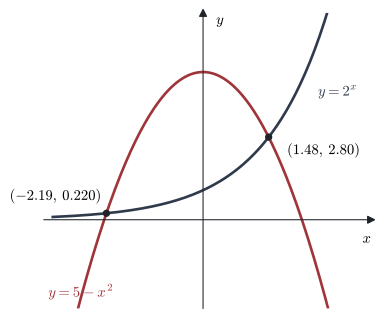
There is no third point: for \(x > 1.48\) the exponential keeps increasing and the parabola keeps decreasing, and for \(x < -2.19\) the parabola is negative while \(2^x\) is positive.
When there is no analytic method
Some equations cannot be solved with algebra. For example, in
\[ \mathrm{e}^x = 3 - x \]
the unknown \(x\) is both in an exponent and outside it. Taking logarithms gives \(x = \ln(3 - x)\), which still has \(x\) on both sides. No algebraic step makes \(x\) the subject. In the same way, most polynomial equations of degree 3 or more, such as \(x^4 + 2x - 5 = 0\), do not factorise nicely.
For equations like these you must use technology (so they appear only on Paper 2). You can still use a sketch to see how many solutions there are.
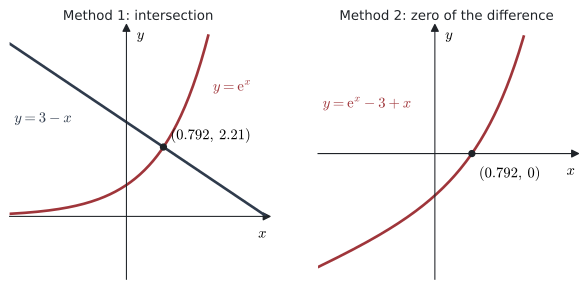
Graphs page (Method 1): enter \(f_1(x) = \mathrm{e}^x\) and \(f_2(x) = 3 - x\), then use Intersection as in the steps above.
Graphs page (Method 2): enter \(f_1(x) = \mathrm{e}^x - 3 + x\), then Menu → Analyze Graph → Zero.
Calculator page: nSolve(e^(x)=3-x, x) returns one solution. To look for another one, add a starting value or a range, for example nSolve(e^(x)=3-x, x, -5, 0) searches only between \(-5\) and \(0\). Always check the graph to see how many solutions there are: nSolve finds only one at a time.
Polynomials (Calculator page): Menu → Algebra → Polynomial Tools → Find Roots of Polynomial. Choose the degree and “Real” roots, then type the coefficients.
Example 5 Solve (a) \(\mathrm{e}^x = 3 - x\) \(\qquad\) (b) \(x^4 + 2x - 5 = 0\).
(a) \(y = \mathrm{e}^x\) is increasing and \(y = 3 - x\) is decreasing, so they meet exactly once (Figure 2). Using the GDC: \(x = 0.792\) (3 s.f.).
(b) Using Find Roots of Polynomial (degree 4, coefficients \(1, 0, 0, 2, -5\)):
\[ x = -1.70 \quad\text{or}\quad x = 1.26 . \]
The other two roots are not real. (A sketch of \(y = x^4 + 2x - 5\) shows a U-shape crossing the \(x\)-axis twice.)
Applications
Real-life models often lead to equations with no analytic method, for example an exponential model equal to a linear one. Always check that your answer makes sense in the context, and reject solutions outside the domain (for example, negative time).
Example 6 The population of town A, \(t\) years after the start of 2020, is modelled by \(A(t) = 2000\mathrm{e}^{0.06t}\). The population of town B is modelled by \(B(t) = 3500 + 40t\).
(a) Find the populations of the two towns at the start of 2020.
(b) Find the value of \(t\) when the two populations are equal. Hence find the year in which town A first has the larger population.
(a) \(A(0) = 2000\) and \(B(0) = 3500\).
(b) Solve \(2000\mathrm{e}^{0.06t} = 3500 + 40t\). There is no analytic method, so use the GDC (intersection of \(y = 2000\mathrm{e}^{0.06x}\) and \(y = 3500 + 40x\), with window \(0 \le x \le 30\)):
\[ t = 11.4 \text{ (3 s.f.)} \]
(The graphs also meet at a large negative value of \(t\); it is rejected because the model starts at \(t = 0\).)
\(t = 11.36\ldots\) is during the year that starts at \(t = 11\), that is 2031. Town A has the larger population from then on.
Common errors
| ✗ Wrong | ✓ Right | Why |
|---|---|---|
| \(\mathrm{e}^x = -1 \Rightarrow x = \ln(-1)\) | \(\mathrm{e}^x = -1\) has no solution; reject it | \(\mathrm{e}^x > 0\) for all \(x\), and \(\ln\) of a negative number is not defined. |
| Stopping at \(u = 3\) or \(u = 4\) | Go back: \(\mathrm{e}^x = 3 \Rightarrow x = \ln 3\) | The question asks for \(x\), not \(u\). |
| \(x^2 = 3x \Rightarrow x = 3\) (dividing by \(x\)) | \(x^2 - 3x = 0 \Rightarrow x(x - 3) = 0 \Rightarrow x = 0\) or \(3\) | Never divide both sides by an expression that could be \(0\): you lose solutions. |
| Taking logs of \(\mathrm{e}^x = 3 - x\) and “solving” | Use the GDC | \(x = \ln(3 - x)\) still has \(x\) on both sides: there is no analytic method. |
Stopping after the first intersection or the first nSolve answer |
Zoom out, sketch the graph and count the solutions | Two curves can meet more than once (Example 4 has two points); nSolve returns one solution at a time. |
| Keeping a negative time | Reject it | The model is only valid for \(t \ge 0\). |
Exercises
1 Solve \(\mathrm{e}^{2x} - 6\mathrm{e}^x + 8 = 0\), giving exact answers.
Let \(u = \mathrm{e}^x\): \(\;u^2 - 6u + 8 = (u - 2)(u - 4) = 0\). So \(\mathrm{e}^x = 2\) or \(\mathrm{e}^x = 4\), and
\[ x = \ln 2 \quad\text{or}\quad x = \ln 4 \;(= 2\ln 2) . \]
2 Solve \(x - 5\sqrt{x} + 4 = 0\).
Let \(u = \sqrt{x}\): \(\;u^2 - 5u + 4 = (u - 1)(u - 4) = 0\). So \(\sqrt{x} = 1\) or \(\sqrt{x} = 4\), giving \(x = 1\) or \(x = 16\).
3 Solve \((\ln x)^2 - 3\ln x + 2 = 0\), giving exact answers.
Let \(u = \ln x\): \(\;u^2 - 3u + 2 = (u - 1)(u - 2) = 0\). So \(\ln x = 1\) or \(\ln x = 2\), giving \(x = \mathrm{e}\) or \(x = \mathrm{e}^2\).
4 Solve \(3\mathrm{e}^x - 2\mathrm{e}^{-x} = 5\), giving your answer exactly.
Multiply by \(\mathrm{e}^x\): \(\;3\mathrm{e}^{2x} - 2 = 5\mathrm{e}^x\). Let \(u = \mathrm{e}^x\):
\[ 3u^2 - 5u - 2 = 0 \;\Longrightarrow\; (3u + 1)(u - 2) = 0 . \]
\(u = -\dfrac{1}{3}\) is rejected (\(\mathrm{e}^x > 0\)). So \(\mathrm{e}^x = 2\) and \(x = \ln 2\).
5 Find the coordinates of the points of intersection of \(y = x^2 - x - 4\) and \(y = 2x + 6\).
\(x^2 - x - 4 = 2x + 6 \Rightarrow x^2 - 3x - 10 = 0 \Rightarrow (x - 5)(x + 2) = 0\).
\(x = 5\): \(y = 16\). \(\;x = -2\): \(y = 2\). The points are \((5, 16)\) and \((-2, 2)\).
6 Solve \(x + \dfrac{8}{x} = 6\).
Multiply by \(x\) (\(x \neq 0\)): \(\;x^2 + 8 = 6x \Rightarrow x^2 - 6x + 8 = 0 \Rightarrow (x - 2)(x - 4) = 0\).
So \(x = 2\) or \(x = 4\).
7 Find the coordinates of all the points where the graphs of \(y = x^3 - 2x\) and \(y = 1 - x^2\) intersect.
Use Analyze Graph → Intersection three times:
\((-1.80,\, -2.25)\), \(\;(-0.445,\, 0.802)\), \(\;(1.25,\, -0.555)\).
8 (a) Explain why the equation \(\ln(x + 1) = 4 - x^2\) cannot be solved analytically.
(b) Use your GDC to solve it.
(a) The unknown \(x\) appears inside a logarithm and also in a polynomial. No algebraic step can make \(x\) the subject.
(b) Graph \(y = \ln(x + 1)\) and \(y = 4 - x^2\) (domain \(x > -1\)) and use Intersection. There is only one point:
\[ x = 1.73 \text{ (3 s.f.)} \]
(Near \(x = -1\), \(\ln(x + 1)\) is very negative while \(4 - x^2 \approx 3\), so the graphs do not meet there.)
9 Solve \(x^3 = 2^x\). (Hint: there is more than one solution. Choose your window carefully.)
With a small window you see only one intersection, near \(x = 1.4\). Zoom out (for example \(0 \le x \le 12\), \(0 \le y \le 1200\)) to see the second one, where \(2^x\) catches up with \(x^3\).
\[ x = 1.37 \quad\text{or}\quad x = 9.94 \text{ (3 s.f.)} \]
(For \(x < 0\), \(x^3 < 0 < 2^x\), so there are no negative solutions.)
10 The concentration of a medicine in the blood, in mg/L, \(t\) hours after it is taken is \(C(t) = 12t\,\mathrm{e}^{-0.4t}\).
(a) Use your GDC to find the maximum concentration and when it happens.
(b) The medicine is effective when \(C(t) \ge 6\). Find the length of time for which it is effective.
(a) Using Analyze Graph → Maximum: the maximum is \(11.0\) mg/L at \(t = 2.5\) hours.
(b) Intersect \(y = 12x\,\mathrm{e}^{-0.4x}\) with \(y = 6\): \(\;t = 0.648\) and \(t = 6.36\).
The medicine is effective for \(6.357\ldots - 0.6479\ldots = 5.71\) hours (3 s.f.).