14.1 Three-Dimensional Solids
SL 3.1
- how to find the distance between two points and the midpoint of a line segment in three dimensions
- the volume and surface area of prisms, cylinders, pyramids, cones, spheres and hemispheres
- how to work with combinations of these solids
- how to find unknown lengths by using right-angled triangles inside a solid
Coordinates in three dimensions
In three dimensions we need a third axis, the \(z\)-axis. The three axes meet at the origin \(O\), and each axis is perpendicular to the other two. A point is written \(P(x, y, z)\).
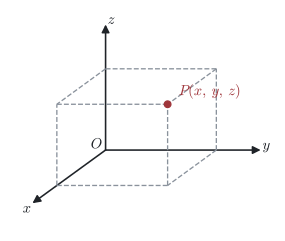
To find a distance in 3D, we use Pythagoras’ theorem twice: once across the “floor” of the box in Figure 1, and once up the vertical edge. The result is the 2D formula with one extra term.
Distance and midpoint in three dimensions In the formula booklet
\[ d = \sqrt{(x_1 - x_2)^2 + (y_1 - y_2)^2 + (z_1 - z_2)^2} \]
\[ \text{Midpoint} = \left( \frac{x_1 + x_2}{2},\; \frac{y_1 + y_2}{2},\; \frac{z_1 + z_2}{2} \right) \]
- \(d\): the distance between the two points
- \((x_1, y_1, z_1)\), \((x_2, y_2, z_2)\): the coordinates of the two points (the end points of the line segment)
Example 1 The points \(A(2, -1, 5)\) and \(B(6, 3, -2)\) are given.
(a) Find the distance \(AB\).
(b) Find the coordinates of the midpoint \(M\) of \(AB\).
(a) The differences are \(6 - 2 = 4\), \(\;3 - (-1) = 4\) and \(-2 - 5 = -7\).
\[ AB = \sqrt{4^2 + 4^2 + (-7)^2} = \sqrt{16 + 16 + 49} = \sqrt{81} = 9 . \]
(b)
\[ M = \left( \frac{2 + 6}{2},\; \frac{-1 + 3}{2},\; \frac{5 + (-2)}{2} \right) = (4,\; 1,\; 1.5) . \]
Example 2 (a) The distance between \(P(1, k, 3)\) and \(Q(4, 2, -1)\) is \(\sqrt{34}\). Find the possible values of \(k\).
(b) The midpoint of \(CD\) is \(M(3, 0, -2)\), and \(C\) is the point \((-1, 4, 1)\). Find the coordinates of \(D\).
(a) Square both sides of the distance formula:
\[ (4 - 1)^2 + (2 - k)^2 + (-1 - 3)^2 = 34 \;\Longrightarrow\; 9 + (2 - k)^2 + 16 = 34 \;\Longrightarrow\; (2 - k)^2 = 9 . \]
So \(2 - k = \pm 3\), which gives \(k = -1\) or \(k = 5\).
(b) Let \(D = (x, y, z)\). Then \(\dfrac{-1 + x}{2} = 3\), \(\;\dfrac{4 + y}{2} = 0\), \(\;\dfrac{1 + z}{2} = -2\). So \(x = 7\), \(y = -4\), \(z = -5\), and \(D = (7, -4, -5)\).
(Quick check: from \(C\) to \(M\) the coordinates change by \(+4, -4, -3\); from \(M\) to \(D\) they change by the same amounts.)
Prisms and cylinders
A prism has the same cross-section all the way along its length. A cylinder is like a prism with a circular cross-section.
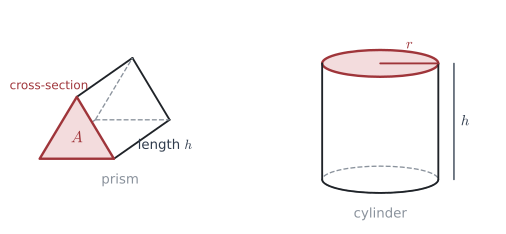
Volume of a prism and a cylinder In the formula booklet
\[ V = Ah \qquad\qquad V = \pi r^2 h \]
Area of the curved surface of a cylinder: \(\;A = 2\pi r h\)
- \(V\): the volume
- \(A\): the area of the cross-section (for the prism); the curved surface area (for the cylinder)
- \(h\): the height (the length of the prism)
- \(r\): the radius of the cylinder
These are in the “Prior learning” part of the booklet. The total surface area is not given. For a prism, add the areas of all the faces. For a closed cylinder, add the two circular ends:
Total surface area of a closed cylinder Not in the formula booklet
\[ A = 2\pi r^2 + 2\pi r h \]
- \(A\): the total surface area (two circles and the curved surface)
- \(r\): the radius
- \(h\): the height
Example 3 A prism has a cross-section that is a right-angled triangle with shorter sides \(6\) cm and \(8\) cm. The length of the prism is \(15\) cm. Find
(a) the volume of the prism,
(b) the total surface area of the prism.
(a) Area of the triangle \(= \dfrac{1}{2} \times 6 \times 8 = 24\) cm². So \(V = 24 \times 15 = 360\) cm³.
(b) The third side of the triangle (the hypotenuse) is \(\sqrt{6^2 + 8^2} = 10\) cm. There are two triangular ends and three rectangular faces:
\[ A = 2 \times 24 + (6 + 8 + 10) \times 15 = 48 + 360 = 408 \text{ cm}^2 . \]
Example 4 A closed cylinder has radius \(4\) cm and volume \(240\pi\) cm³.
(a) Find the height of the cylinder.
(b) Find the total surface area. Give your answer in terms of \(\pi\) and to 3 significant figures.
(a) \(\pi \times 4^2 \times h = 240\pi \;\Longrightarrow\; 16h = 240 \;\Longrightarrow\; h = 15\) cm.
(b)
\[ A = 2\pi(4^2) + 2\pi(4)(15) = 32\pi + 120\pi = 152\pi \approx 478 \text{ cm}^2 . \]
Pyramids and cones
A right pyramid has its apex directly above the centre of its base. A right cone has its apex directly above the centre of its circular base. The height \(h\) is measured perpendicular to the base. The slant height is measured along a sloping face.
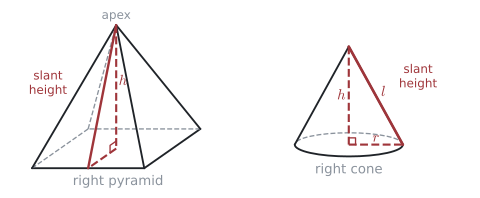
Volume of a right pyramid and a right cone; curved surface of a cone In the formula booklet
\[ V_{\text{pyramid}} = \frac{1}{3}Ah \qquad\qquad V_{\text{cone}} = \frac{1}{3}\pi r^2 h \]
Area of the curved surface of a cone: \(\;A = \pi r l\)
- \(A\): the area of the base (for the pyramid); the curved surface area (for the cone)
- \(h\): the (perpendicular) height
- \(r\): the radius of the base of the cone
- \(l\): the slant height of the cone
The slant height is not the same as the height. In Figure 3, \(h\), \(r\) and \(l\) form a right-angled triangle:
Slant height of a right cone Not in the formula booklet
\[ l^2 = r^2 + h^2 \]
The total surface area of a solid cone is \(\;\pi r l + \pi r^2\).
- \(l\): the slant height
- \(r\): the radius of the base
- \(h\): the height
Example 5 A right pyramid has a square base of side \(8\) cm and a height of \(3\) cm. Find
(a) the slant height of each triangular face,
(b) the volume of the pyramid,
(c) the total surface area of the pyramid,
(d) the length of a sloping edge, from a corner of the base to the apex.
(a) From the centre of the base to the midpoint of a side is \(4\) cm. With the height \(3\) cm, this makes a right-angled triangle:
\[ \text{slant height} = \sqrt{4^2 + 3^2} = 5 \text{ cm}. \]
(b) \(V = \dfrac{1}{3} \times 8^2 \times 3 = 64\) cm³.
(c) The base is \(64\) cm². Each triangular face has base \(8\) cm and height \(5\) cm (the slant height):
\[ A = 64 + 4 \times \frac{1}{2} \times 8 \times 5 = 64 + 80 = 144 \text{ cm}^2 . \]
(d) From the centre of the base to a corner is half a diagonal: \(\dfrac{1}{2}\sqrt{8^2 + 8^2} = 4\sqrt{2}\) cm. So
\[ \text{edge} = \sqrt{\left(4\sqrt{2}\right)^2 + 3^2} = \sqrt{32 + 9} = \sqrt{41} \approx 6.40 \text{ cm}. \]
Example 6 A solid right cone has base radius \(5\) cm and slant height \(13\) cm. Find its volume and its total surface area, in terms of \(\pi\).
Height: \(h = \sqrt{13^2 - 5^2} = \sqrt{144} = 12\) cm.
\[ V = \frac{1}{3}\pi (5^2)(12) = 100\pi \text{ cm}^3 . \]
Curved surface \(= \pi (5)(13) = 65\pi\); base \(= \pi (5^2) = 25\pi\). Total surface area \(= 90\pi\) cm².
Spheres and hemispheres
A sphere is the set of points in space at the same distance \(r\) (the radius) from the centre. A hemisphere is half a sphere, cut through the centre (Figure 4).
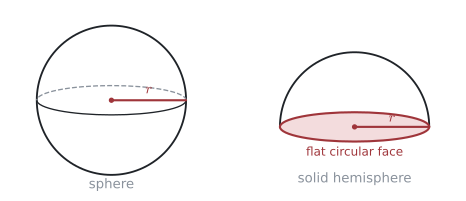
Volume and surface area of a sphere In the formula booklet
\[ V = \frac{4}{3}\pi r^3 \qquad\qquad A = 4\pi r^2 \]
- \(V\): the volume
- \(A\): the surface area
- \(r\): the radius
A solid hemisphere also has a flat circular face.
Hemisphere Not in the formula booklet
\[ V = \frac{2}{3}\pi r^3 \]
Curved surface \(= 2\pi r^2\); \(\;\) total surface of a solid hemisphere \(= 2\pi r^2 + \pi r^2 = 3\pi r^2\).
- \(V\): the volume
- \(r\): the radius
Example 7 (a) A sphere has surface area \(144\pi\) cm². Find its volume, in terms of \(\pi\).
(b) Find the volume and the total surface area of a solid hemisphere of radius \(3\) cm, in terms of \(\pi\).
(a) \(4\pi r^2 = 144\pi \;\Longrightarrow\; r^2 = 36 \;\Longrightarrow\; r = 6\) cm. Then
\[ V = \frac{4}{3}\pi (6^3) = \frac{4}{3}\pi \times 216 = 288\pi \text{ cm}^3 . \]
(b) \(V = \dfrac{2}{3}\pi (3^3) = 18\pi\) cm³. \(\;\) Total surface area \(= 3\pi (3^2) = 27\pi\) cm².
Combinations of solids
Split a combined solid into simple parts.
- For the volume, add the volumes of the parts.
- For the surface area, add only the surfaces that are on the outside. Faces where two parts are joined are hidden, so leave them out.
Example 8 A grain silo is a cylinder of radius \(3\) m and height \(10\) m with a hemisphere on top, as shown.
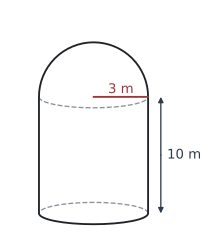
(a) Find the volume of the silo. Give your answer in terms of \(\pi\) and to 3 significant figures.
(b) The outside of the silo (not the base, which stands on the ground) is painted. Find the area to be painted.
(a)
\[ \begin{aligned} V &= \pi (3^2)(10) + \frac{2}{3}\pi (3^3) \\ &= 90\pi + 18\pi = 108\pi \approx 339 \text{ m}^3 . \end{aligned} \]
(b) The painted surface is the curved surface of the cylinder plus the curved surface of the hemisphere. The circle where they join is inside, and the base is not painted.
\[ A = 2\pi (3)(10) + 2\pi (3^2) = 60\pi + 18\pi = 78\pi \approx 245 \text{ m}^2 . \]
Example 9 A cylindrical tank of radius \(10\) cm contains some water. A solid metal sphere of radius \(6\) cm is placed in the tank and is completely under the water. By how much does the water level rise?
The water rises by a volume equal to the volume of the sphere:
\[ \frac{4}{3}\pi (6^3) = 288\pi \text{ cm}^3 . \]
This volume is a cylinder of radius \(10\) cm and unknown height \(d\):
\[ \pi (10^2)\, d = 288\pi \;\Longrightarrow\; d = \frac{288}{100} = 2.88 \text{ cm}. \]
Right-angled triangles inside solids
Many lengths in a solid can be found by spotting a right-angled triangle and using Pythagoras’ theorem. In a cuboid, the space diagonal \(AG\) goes from one corner to the opposite corner.
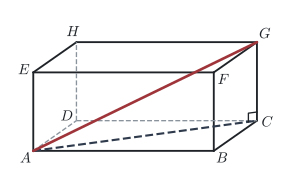
The edge \(CG\) is vertical, so it is perpendicular to the base. So triangle \(ACG\) has a right angle at \(C\):
\[ AG^2 = AC^2 + CG^2 = \left(AB^2 + BC^2\right) + CG^2 . \]
Space diagonal of a cuboid Not in the formula booklet
\[ d = \sqrt{l^2 + w^2 + h^2} \]
- \(d\): the length of the space diagonal
- \(l\), \(w\), \(h\): the length, width and height of the cuboid
This is really the 3D distance formula: put one corner at the origin and the opposite corner at \((l, w, h)\).
Example 10 In the cuboid \(ABCDEFGH\) of Figure 5, \(AB = 12\) cm, \(BC = 4\) cm and \(CG = 3\) cm.
(a) Find the exact length of the face diagonal \(AC\).
(b) Find the length of the space diagonal \(AG\).
(a) Triangle \(ABC\) has a right angle at \(B\):
\[ AC = \sqrt{12^2 + 4^2} = \sqrt{160} = 4\sqrt{10} \text{ cm}. \]
(b) Triangle \(ACG\) has a right angle at \(C\):
\[ AG = \sqrt{160 + 3^2} = \sqrt{169} = 13 \text{ cm}. \]
The angle \(GAC\) is the angle between the line \(AG\) and the base. You will learn to find it in Section 14.2.
Common errors
| ✗ Wrong | ✓ Right | Why |
|---|---|---|
| Using the slant height \(l\) in \(V = \frac{1}{3}\pi r^2 h\) | Use the perpendicular height \(h\) | Find \(h\) first from \(l^2 = r^2 + h^2\). |
| \(V_{\text{cone}} = \pi r^2 h\) | \(V_{\text{cone}} = \frac{1}{3}\pi r^2 h\) | A cone (or pyramid) is one third of the cylinder (or prism) with the same base and height. |
| Surface area of a solid hemisphere \(= 2\pi r^2\) | \(3\pi r^2\) | \(2\pi r^2\) is only the curved part; add the flat circle \(\pi r^2\). |
| Adding the joined faces in a combined solid | Leave them out | Hidden faces are not part of the outside surface. |
| Using the diameter as \(r\) | Halve the diameter first | All the formulae use the radius. |
| Midpoint \(= \left(\frac{x_2 - x_1}{2}, \ldots\right)\) | \(\left(\frac{x_1 + x_2}{2}, \ldots\right)\) | The midpoint is the mean of the coordinates. |
Exercises
1 Find the distance between \(P(-3, 2, 4)\) and \(Q(3, -1, 6)\), and the midpoint of \(PQ\).
\(PQ = \sqrt{6^2 + (-3)^2 + 2^2} = \sqrt{36 + 9 + 4} = \sqrt{49} = 7\).
Midpoint \(= \left(\dfrac{-3 + 3}{2}, \dfrac{2 - 1}{2}, \dfrac{4 + 6}{2}\right) = (0,\; 0.5,\; 5)\).
2 The midpoint of \(AB\) is \(M(4, 1, 3)\) and \(A\) is the point \((2, 5, -1)\).
(a) Find the coordinates of \(B\).
(b) Find the length \(AB\).
(a) \(B = (2 \times 4 - 2,\; 2 \times 1 - 5,\; 2 \times 3 - (-1)) = (6, -3, 7)\).
(b) \(AB = \sqrt{4^2 + (-8)^2 + 8^2} = \sqrt{16 + 64 + 64} = \sqrt{144} = 12\).
3 The point \(P(t, 2t, 2)\) is \(7\) units from the origin. Find the possible values of \(t\).
\(t^2 + (2t)^2 + 2^2 = 49 \;\Longrightarrow\; 5t^2 = 45 \;\Longrightarrow\; t^2 = 9 \;\Longrightarrow\; t = \pm 3\).
4 A closed cylinder has radius \(3\) cm and height \(8\) cm. Find its volume and its total surface area, in terms of \(\pi\).
\(V = \pi (3^2)(8) = 72\pi\) cm³.
\(A = 2\pi (3^2) + 2\pi (3)(8) = 18\pi + 48\pi = 66\pi\) cm².
5 A solid right cone has volume \(96\pi\) cm³ and base radius \(6\) cm.
(a) Find its height.
(b) Find its total surface area, in terms of \(\pi\).
(a) \(\dfrac{1}{3}\pi (6^2) h = 96\pi \;\Longrightarrow\; 12h = 96 \;\Longrightarrow\; h = 8\) cm.
(b) \(l = \sqrt{6^2 + 8^2} = 10\) cm. Total \(= \pi(6)(10) + \pi(6^2) = 60\pi + 36\pi = 96\pi\) cm².
6 A sphere has volume \(36\pi\) cm³. Find its radius and its surface area.
\(\dfrac{4}{3}\pi r^3 = 36\pi \;\Longrightarrow\; r^3 = 27 \;\Longrightarrow\; r = 3\) cm.
\(A = 4\pi (3^2) = 36\pi\) cm².
7 A right pyramid has a rectangular base measuring \(6\) cm by \(8\) cm. Its height is \(12\) cm.
(a) Find the volume of the pyramid.
(b) Find the length of a sloping edge.
(a) \(V = \dfrac{1}{3} \times (6 \times 8) \times 12 = 192\) cm³.
(b) The diagonal of the base is \(\sqrt{6^2 + 8^2} = 10\) cm, so the centre is \(5\) cm from each corner. The apex is \(12\) cm above the centre, so
\[ \text{edge} = \sqrt{5^2 + 12^2} = 13 \text{ cm}. \]
8 A solid is made of a right cone on top of a hemisphere. Both have radius \(3\) cm, and the height of the cone is \(4\) cm. Find, in terms of \(\pi\),
(a) the volume of the solid,
(b) the total surface area of the solid.
(a) \(V = \dfrac{1}{3}\pi (3^2)(4) + \dfrac{2}{3}\pi (3^3) = 12\pi + 18\pi = 30\pi\) cm³.
(b) Slant height \(l = \sqrt{3^2 + 4^2} = 5\) cm. The flat circles are joined, so they are not on the outside:
\[ A = \pi(3)(5) + 2\pi(3^2) = 15\pi + 18\pi = 33\pi \text{ cm}^2 . \]
9 (a) Find the length of the space diagonal of a cuboid measuring \(6\) cm by \(2\) cm by \(3\) cm.
(b) The space diagonal of a cube is \(6\sqrt{3}\) cm. Find the volume of the cube.
(a) \(d = \sqrt{6^2 + 2^2 + 3^2} = \sqrt{49} = 7\) cm.
(b) For a cube of side \(s\): \(d = \sqrt{s^2 + s^2 + s^2} = s\sqrt{3}\). So \(s\sqrt{3} = 6\sqrt{3}\), \(\;s = 6\) cm and \(V = 6^3 = 216\) cm³.
10 A cylindrical glass has radius \(4\) cm and contains water. Metal balls, each of radius \(1\) cm, are dropped into the glass and sink to the bottom. Find the number of balls needed to raise the water level by \(2\) cm. (Assume the water does not overflow and the balls are covered.)
Volume needed: \(\pi (4^2)(2) = 32\pi\) cm³. \(\;\) Volume of one ball: \(\dfrac{4}{3}\pi (1^3) = \dfrac{4}{3}\pi\) cm³.
\[ \text{number of balls} = \frac{32\pi}{\frac{4}{3}\pi} = 32 \times \frac{3}{4} = 24 . \]