14.3 The Sine Rule, Cosine Rule and Area of a Triangle
SL 3.2 SL 3.5
- how to label the sides and angles of any triangle
- the sine rule, to find sides and angles of triangles that are not right-angled
- the ambiguous case of the sine rule, when two different triangles fit the information
- the cosine rule, to find a side or an angle
- the formula \(\frac{1}{2}ab\sin C\) for the area of a triangle
- how to choose the right rule for a problem
Labelling a triangle
In triangle \(ABC\), the angles are called \(A\), \(B\) and \(C\). The side opposite each angle uses the same letter in lower case: side \(a\) is opposite angle \(A\), and so on.
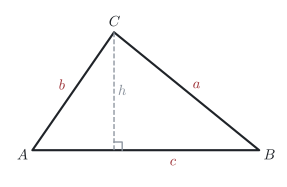
In this section all angles are in degrees. Make sure your calculator is in degree mode.
The sine rule
In Figure 1, draw the height \(h\) from \(C\) to \(AB\). This makes two right-angled triangles, so
\[ h = b\sin A \qquad \text{and} \qquad h = a\sin B . \]
So \(a\sin B = b\sin A\). Divide both sides by \(\sin A \sin B\): \(\;\dfrac{a}{\sin A} = \dfrac{b}{\sin B}\). The same argument with a height from \(A\) brings in \(c\).
The sine rule In the formula booklet
\[ \frac{a}{\sin A} = \frac{b}{\sin B} = \frac{c}{\sin C} \]
- \(a\), \(b\), \(c\): the lengths of the sides
- \(A\), \(B\), \(C\): the angles opposite the sides \(a\), \(b\), \(c\)
To find an angle, it is easier to turn the fractions upside down: \(\;\dfrac{\sin A}{a} = \dfrac{\sin B}{b} = \dfrac{\sin C}{c}\).
Use the sine rule when you know a side and the angle opposite it (a “matching pair”), plus one more side or angle. You only ever use two of the three fractions at a time.
Example 1 In triangle \(ABC\), \(A = 45^\circ\), \(B = 30^\circ\) and \(a = 10\) cm.
(a) Find the exact length of \(b\).
(b) Find the angle \(C\).
(a) \(a\) and \(A\) are a matching pair. Use \(\dfrac{b}{\sin B} = \dfrac{a}{\sin A}\):
\[ \begin{gathered} b = \frac{a \sin B}{\sin A} = \frac{10 \times \frac{1}{2}}{\frac{\sqrt{2}}{2}} \\ = \frac{10}{\sqrt{2}} = 5\sqrt{2} \text{ cm}. \end{gathered} \]
(b) The angles add up to \(180^\circ\): \(\;C = 180^\circ - 45^\circ - 30^\circ = 105^\circ\).
Example 2 In triangle \(ABC\), \(A = 52^\circ\), \(C = 71^\circ\) and \(b = 14\) cm. Find \(a\).
To use \(b\) we need the angle opposite it: \(B = 180^\circ - 52^\circ - 71^\circ = 57^\circ\).
\[ a = \frac{b \sin A}{\sin B} = \frac{14 \sin 52^\circ}{\sin 57^\circ} = 13.2 \text{ cm (3 s.f.)}. \]
Example 3 In triangle \(ABC\), \(a = 9\) cm, \(b = 6\) cm and \(A = 64^\circ\). Find \(B\), \(C\) and \(c\).
\[ \frac{\sin B}{6} = \frac{\sin 64^\circ}{9} \;\Longrightarrow\; \sin B = \frac{6 \sin 64^\circ}{9} = 0.5992\ldots \]
So \(B = 36.8^\circ\). (Could \(B\) be \(180^\circ - 36.8^\circ = 143.2^\circ\)? No: \(b < a\), so \(B < A\) and \(B\) must be acute.)
\(C = 180^\circ - 64^\circ - 36.8^\circ = 79.2^\circ\), and
\[ c = \frac{9 \sin 79.2^\circ}{\sin 64^\circ} = 9.84 \text{ cm (3 s.f.)}. \]
Use the unrounded value of \(B\) in your calculator, to avoid rounding errors.
The ambiguous case
The equation \(\sin B = k\) (with \(0 < k < 1\)) has two solutions between \(0^\circ\) and \(180^\circ\), because
Supplementary angles Not in the formula booklet
\[ \sin\theta = \sin(180^\circ - \theta) \]
- \(\theta\): any angle between \(0^\circ\) and \(180^\circ\)
(You will see why in Section 14.6.) The calculator gives only the acute answer \(\theta\). The obtuse answer \(180^\circ - \theta\) may also give a real triangle.
This can happen when you know two sides and an angle that is not between them. In Figure 2, the angle \(A\) and the sides \(b = AC\) and \(a\) are fixed. The side \(a\) can “swing” from \(C\) and meet the base line at two points, \(B_1\) and \(B_2\).
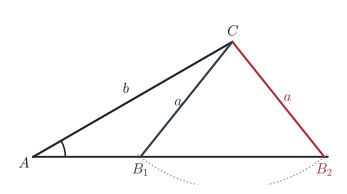
How many triangles? (given \(A\) acute, and sides \(a\) and \(b\)) Not in the formula booklet
- \(a < b\sin A\): no triangle (\(a\) is too short to reach the base line).
- \(a = b\sin A\): one right-angled triangle.
- \(b\sin A < a < b\): two triangles (the ambiguous case).
- \(a \geq b\): one triangle.
In practice: find the acute angle \(\theta\) from the sine rule, then check whether \(180^\circ - \theta\) plus the known angle is still less than \(180^\circ\). If it is, there are two triangles.
- \(A\): the known angle
- \(a\): the side opposite \(A\)
- \(b\): the other known side (next to \(A\))
Example 4 In triangle \(ABC\), \(A = 30^\circ\), \(a = 4\) cm and \(b = 4\sqrt{2}\) cm.
(a) Find the two possible values of \(B\), and the matching values of \(C\).
(b) Find the shorter possible length of \(c\).
(a)
\[ \sin B = \frac{b \sin A}{a} = \frac{4\sqrt{2} \times \frac{1}{2}}{4} = \frac{\sqrt{2}}{2} . \]
So \(B = 45^\circ\) or \(B = 180^\circ - 45^\circ = 135^\circ\). Both are possible, because \(30^\circ + 135^\circ < 180^\circ\).
- If \(B = 45^\circ\), then \(C = 180^\circ - 30^\circ - 45^\circ = 105^\circ\).
- If \(B = 135^\circ\), then \(C = 180^\circ - 30^\circ - 135^\circ = 15^\circ\).
(b) The shorter \(c\) is opposite the smaller angle \(C = 15^\circ\):
\[ \begin{gathered} c = \frac{a \sin C}{\sin A} = \frac{4 \sin 15^\circ}{\frac{1}{2}} = 8 \sin 15^\circ \\ = 2.07 \text{ cm (3 s.f.)}. \end{gathered} \]
(The other triangle has \(c = 8 \sin 105^\circ = 7.73\) cm.)
Example 5 In triangle \(ABC\), \(A = 40^\circ\), \(a = 10\) cm and \(b = 7\) cm. Find \(B\). Explain why there is only one triangle.
\[ \begin{gathered} \sin B = \frac{7 \sin 40^\circ}{10} = 0.4499\ldots \\ B = 26.7^\circ \;\text{ or }\; B = 180^\circ - 26.7^\circ = 153.3^\circ . \end{gathered} \]
But \(40^\circ + 153.3^\circ = 193.3^\circ > 180^\circ\), so \(153.3^\circ\) is impossible. The only answer is \(B = 26.7^\circ\). (This agrees with the box: \(a \geq b\), so there is one triangle.)
Example 6 In triangle \(ABC\), \(A = 30^\circ\), \(b = 10\) cm and \(a = k\) cm. Find the values of \(k\) for which there are two possible triangles.
\(b\sin A = 10 \times \dfrac{1}{2} = 5\). There are two triangles when \(b\sin A < a < b\), that is,
\[ 5 < k < 10 . \]
(If \(k = 5\) the triangle is right-angled at \(B\); if \(k \geq 10\) there is one triangle; if \(k < 5\) there is none.)
The cosine rule
If you do not know a matching pair, the sine rule cannot start. Use the cosine rule instead.
Put \(C\) at the origin and \(B\) at \((a, 0)\). Then \(A\) is the point \((b\cos C,\; b\sin C)\), and
\[ \begin{aligned} c^2 &= (a - b\cos C)^2 + (b\sin C)^2 \\ &= a^2 - 2ab\cos C + b^2\left(\cos^2 C + \sin^2 C\right) \\ &= a^2 + b^2 - 2ab\cos C , \end{aligned} \]
using \(\cos^2 C + \sin^2 C = 1\) (see Section 14.11). A vector proof is in Section 20.4.
The cosine rule In the formula booklet
\[ c^2 = a^2 + b^2 - 2ab\cos C \]
\[ \cos C = \frac{a^2 + b^2 - c^2}{2ab} \]
- \(a\), \(b\): two sides of the triangle
- \(C\): the angle between \(a\) and \(b\) (the included angle)
- \(c\): the third side, opposite \(C\)
- Use the first form to find a side when you know two sides and the angle between them.
- Use the second form to find an angle when you know all three sides.
- If \(C = 90^\circ\), then \(\cos C = 0\) and the rule becomes Pythagoras’ theorem.
- If \(\cos C < 0\), the angle \(C\) is obtuse. The cosine rule always gives the correct angle: there is no ambiguous case.
Example 7 In triangle \(ABC\), \(b = 5\) cm, \(c = 8\) cm and \(A = 60^\circ\). Find \(a\).
The angle \(A\) is between \(b\) and \(c\), so write the rule with \(a\) on the left:
\[ a^2 = b^2 + c^2 - 2bc\cos A = 25 + 64 - 2(5)(8)\left(\frac{1}{2}\right) = 89 - 40 = 49 . \]
So \(a = 7\) cm.
Example 8 A triangle has sides \(3\) cm, \(5\) cm and \(7\) cm. Find the largest angle.
The largest angle is opposite the longest side, \(7\) cm. Call this angle \(\theta\):
\[ \cos\theta = \frac{3^2 + 5^2 - 7^2}{2(3)(5)} = \frac{9 + 25 - 49}{30} = -\frac{15}{30} = -\frac{1}{2} . \]
So \(\theta = 120^\circ\). The cosine is negative, so the angle is obtuse.
When the unknown side is not opposite the known angle, the cosine rule gives a quadratic equation.
Example 9 In triangle \(ABC\), \(A = 60^\circ\), \(a = 7\) cm and \(c = 8\) cm. Find the possible values of \(b\).
Use the cosine rule with the known angle \(A\):
\[ \begin{gathered} a^2 = b^2 + c^2 - 2bc\cos A \\ 49 = b^2 + 64 - 2(b)(8)\left(\tfrac{1}{2}\right) \\ b^2 - 8b + 15 = 0 \\ (b - 3)(b - 5) = 0 . \end{gathered} \]
So \(b = 3\) cm or \(b = 5\) cm. Both are positive, so both triangles exist. This is the ambiguous case again, solved without the sine rule.
The area of a triangle
The usual formula is area \(= \frac{1}{2} \times \text{base} \times \text{height}\). In Figure 1, take base \(c\); the height is \(h = b\sin A\). So the area is \(\frac{1}{2}bc\sin A\).
Area of a triangle In the formula booklet
\[ A = \frac{1}{2}ab\sin C \]
- \(A\): the area of the triangle (do not mix this up with the angle \(A\))
- \(a\), \(b\): two sides
- \(C\): the angle between \(a\) and \(b\) (the included angle)
In words: half the product of two sides, times the sine of the angle between them.
Example 10 (a) Find the area of a triangle with sides \(6\) cm and \(10\) cm and an included angle of \(150^\circ\).
(b) Triangle \(PQR\) has \(PQ = 6\) cm, \(PR = 8\) cm and area \(12\sqrt{3}\) cm². Find the two possible sizes of angle \(P\), and the exact length \(QR\) in each case.
(a) \(\sin 150^\circ = \dfrac{1}{2}\), so the area is \(\dfrac{1}{2}(6)(10)\left(\dfrac{1}{2}\right) = 15\) cm².
(b) \(\dfrac{1}{2}(6)(8)\sin P = 12\sqrt{3} \;\Longrightarrow\; \sin P = \dfrac{12\sqrt{3}}{24} = \dfrac{\sqrt{3}}{2}\).
So \(P = 60^\circ\) or \(P = 120^\circ\). Now use the cosine rule:
\[ \begin{aligned} P = 60^\circ: \quad QR^2 &= 36 + 64 - 96\left(\tfrac{1}{2}\right) = 52 \\ QR &= 2\sqrt{13} \text{ cm} \\[4pt] P = 120^\circ: \quad QR^2 &= 36 + 64 - 96\left(-\tfrac{1}{2}\right) = 148 \\ QR &= 2\sqrt{37} \text{ cm} \end{aligned} \]
Choosing the right rule
Which rule?
| You know | You want | Use |
|---|---|---|
| a side and its opposite angle, plus one more side or angle | another side or angle | sine rule |
| two sides and the angle between them | the third side | cosine rule |
| all three sides | an angle | cosine rule (\(\cos C = \ldots\)) |
| two sides and the angle between them | the area | \(\frac{1}{2}ab\sin C\) |
| a right angle | anything | right-angled trigonometry (Section 14.2) |
If you know two angles, find the third one first: they add up to \(180^\circ\).
Example 11 In the quadrilateral \(ABCD\), \(AB = 7\) cm, \(BC = 9\) cm, \(CD = 6\) cm, \(\angle ABC = 108^\circ\) and \(\angle ACD = 47^\circ\).
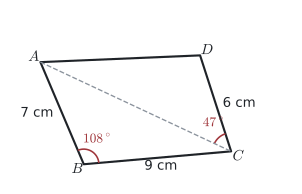
(a) Find the length \(AC\).
(b) Find the area of \(ABCD\).
(c) Find the length \(AD\).
(a) In triangle \(ABC\) we know two sides and the angle between them: cosine rule.
\[ \begin{gathered} AC^2 = 7^2 + 9^2 - 2(7)(9)\cos 108^\circ = 168.9\ldots \\ \Longrightarrow\quad AC = 13.0 \text{ cm (3 s.f.)} \end{gathered} \]
(b) Split the quadrilateral into two triangles along \(AC\).
\[ \begin{aligned} \text{Area } ABC &= \tfrac{1}{2}(7)(9)\sin 108^\circ = 29.96\ldots \\ \text{Area } ACD &= \tfrac{1}{2}(AC)(6)\sin 47^\circ = 28.52\ldots \end{aligned} \]
Total area \(= 58.5\) cm² (3 s.f.).
(c) In triangle \(ACD\) we know \(AC\), \(CD\) and the angle between them:
\[ \begin{gathered} AD^2 = AC^2 + 6^2 - 2(AC)(6)\cos 47^\circ \\ \Longrightarrow\quad AD = 9.93 \text{ cm (3 s.f.)} \end{gathered} \]
Keep the full value of \(AC\) in the calculator for parts (b) and (c).
- Check the angle mode: the top right of the screen must show DEG. If it shows RAD, click on it to switch.
- On a Calculator page, type the cosine rule in one line, for example
√(7^2+9^2-2*7*9*cos(108)). - Store the answer so that you do not need to retype it: type
→ac(press ctrl then var for the arrow, then type a name). - Use the stored value later, for example
0.5*ac*6*sin(47). - For an angle, use
sin⁻¹orcos⁻¹(press ctrl then sin or cos), for examplecos⁻¹((3^2+5^2-7^2)/(2*3*5))\(= 120\).
sin⁻¹ gives only the acute angle. In an ambiguous-case problem, also check \(180^\circ\) minus that angle yourself.
Common errors
| ✗ Wrong | ✓ Right | Why |
|---|---|---|
| Calculator in radian mode | Degree mode (DEG) | \(\sin 30\) in radians is \(-0.988\), not \(0.5\). |
| \(\sin B = 0.6 \Rightarrow B = 36.9^\circ\) only | Also test \(B = 143.1^\circ\) | \(\sin\theta = \sin(180^\circ - \theta)\); there may be two triangles. |
| Using \(\frac{1}{2}ab\sin C\) with an angle that is not between \(a\) and \(b\) | Use the included angle | The formula comes from base \(\times\) height with that angle. |
| \(c^2 = a^2 + b^2 - 2ab\cos C\) with \(C\) not opposite \(c\) | The angle must be opposite the side on the left | Label the triangle so that the angle and the side match. |
| \(a^2 = 89 - 80\cos 60^\circ = 9\cos 60^\circ\) | \(89 - 40 = 49\) | Work out \(2ab\cos C\) before subtracting. |
| Rounding \(AC\) to \(13\) and using it later | Store the full value | Early rounding changes the final 3 s.f. answer. |
Exercises
1 In triangle \(ABC\), \(A = 60^\circ\), \(B = 45^\circ\) and \(a = 3\sqrt{6}\) cm. Find the exact length of \(b\).
\[ \begin{gathered} b = \frac{a\sin B}{\sin A} = \frac{3\sqrt{6} \times \frac{\sqrt{2}}{2}}{\frac{\sqrt{3}}{2}} \\ = \frac{3\sqrt{12}}{\sqrt{3}} = 3\sqrt{4} = 6 \text{ cm}. \end{gathered} \]
2 In triangle \(PQR\), \(P = 48^\circ\), \(Q = 67^\circ\) and \(PQ = 12\) cm. Find \(QR\).
\(R = 180^\circ - 48^\circ - 67^\circ = 65^\circ\). \(QR\) is opposite \(P\) and \(PQ\) is opposite \(R\):
\[ QR = \frac{12 \sin 48^\circ}{\sin 65^\circ} = 9.84 \text{ cm (3 s.f.)}. \]
3 A triangle has sides \(7\) cm, \(8\) cm and \(13\) cm. Find the exact size of the largest angle.
\[ \cos\theta = \frac{7^2 + 8^2 - 13^2}{2(7)(8)} = \frac{49 + 64 - 169}{112} = -\frac{56}{112} = -\frac{1}{2}, \]
so \(\theta = 120^\circ\).
4 In triangle \(ABC\), \(b = 4\) cm, \(c = 6\) cm and \(A = 120^\circ\). Find the exact length of \(a\).
\[ \begin{gathered} a^2 = 16 + 36 - 2(4)(6)\left(-\frac{1}{2}\right) = 52 + 24 = 76 \\ a = \sqrt{76} = 2\sqrt{19} \text{ cm}. \end{gathered} \]
5 (a) Find the area of a triangle with sides \(8\) cm and \(5\) cm and an included angle of \(30^\circ\).
(b) Find the exact area of an equilateral triangle with side \(6\) cm.
(a) \(\dfrac{1}{2}(8)(5)\sin 30^\circ = 20 \times \dfrac{1}{2} = 10\) cm².
(b) All angles are \(60^\circ\): \(\;\dfrac{1}{2}(6)(6)\sin 60^\circ = 18 \times \dfrac{\sqrt{3}}{2} = 9\sqrt{3}\) cm².
6 In triangle \(ABC\), \(A = 35^\circ\), \(a = 6\) cm and \(b = 9\) cm.
(a) Show that there are two possible triangles.
(b) Find the two possible values of \(C\).
(a) \(b\sin A = 9\sin 35^\circ = 5.16\). Since \(5.16 < 6 < 9\), that is \(b\sin A < a < b\), there are two triangles.
(b) \(\sin B = \dfrac{9 \sin 35^\circ}{6} = 0.8603\ldots\), so \(B = 59.4^\circ\) or \(B = 120.6^\circ\).
\[ \begin{gathered} C = 180^\circ - 35^\circ - 59.4^\circ = 85.6^\circ \\ \text{or} \quad C = 180^\circ - 35^\circ - 120.6^\circ = 24.4^\circ . \end{gathered} \]
7 In triangle \(ABC\), \(B = 45^\circ\), \(AB = 10\) cm and \(AC = k\) cm.
(a) Find the value of \(k\) for which the triangle is right-angled at \(C\).
(b) Find the values of \(k\) for which there are two possible triangles.
Here the known angle is \(B\), the side next to it is \(c = AB = 10\), and the side opposite it is \(b = AC = k\).
(a) \(k = c\sin B = 10 \times \dfrac{\sqrt{2}}{2} = 5\sqrt{2}\).
(b) Two triangles when \(c\sin B < b < c\): \(\;5\sqrt{2} < k < 10\).
8 In triangle \(ABC\), \(A = 120^\circ\), \(a = 7\) cm and \(b = 3\) cm. Use the cosine rule to find \(c\).
\[ \begin{gathered} a^2 = b^2 + c^2 - 2bc\cos A \\ 49 = 9 + c^2 - 2(3)c\left(-\tfrac{1}{2}\right) = 9 + c^2 + 3c \\ c^2 + 3c - 40 = 0 \;\Longrightarrow\; (c + 8)(c - 5) = 0 . \end{gathered} \]
A length is positive, so \(c = 5\) cm. (Here only one triangle exists, because \(A\) is obtuse.)
9 A triangle has area \(18\) cm². Two of its sides are \(6\) cm and \(x\) cm, and the angle between them is \(150^\circ\). Find \(x\).
\(\dfrac{1}{2}(6)(x)\sin 150^\circ = 18 \;\Longrightarrow\; \dfrac{3x}{2} = 18 \;\Longrightarrow\; x = 12\).
10 A triangle has sides \(9\) cm, \(11\) cm and \(14\) cm.
(a) Find the largest angle.
(b) Find the area of the triangle.
(a) The largest angle \(\theta\) is opposite \(14\) cm:
\[ \begin{gathered} \cos\theta = \frac{81 + 121 - 196}{2(9)(11)} = \frac{6}{198} = \frac{1}{33} \\ \theta = 88.3^\circ \text{ (1 d.p.)}. \end{gathered} \]
(b) The angle \(\theta\) is between the sides \(9\) and \(11\):
\[ \text{Area} = \frac{1}{2}(9)(11)\sin\theta = 49.5 \text{ cm}^2 \text{ (3 s.f.)}. \]