14.4 Bearings and Applications
SL 3.3
- how to write and read three-figure bearings
- how to find a back bearing (the bearing of the return journey)
- how to find the angles inside a triangle from bearings, using parallel north lines
- how to draw a clear, labelled diagram from a written description
- how to solve navigation, height and distance problems with right-angled and non-right-angled trigonometry
Three-figure bearings
A bearing gives a direction on a map.
Three-figure bearing Not in the formula booklet
The bearing of \(B\) from \(A\) is the angle measured
- from north,
- clockwise,
- at the point \(A\) (the point you are “from”),
to the line \(AB\). It is always written with three digits, from \(000^\circ\) to \(359^\circ\) (for example \(060^\circ\), not \(60^\circ\)).
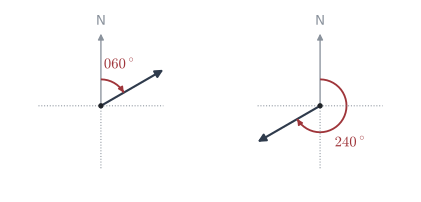
The main compass directions are:
| N | NE | E | SE | S | SW | W | NW |
|---|---|---|---|---|---|---|---|
| \(000^\circ\) | \(045^\circ\) | \(090^\circ\) | \(135^\circ\) | \(180^\circ\) | \(225^\circ\) | \(270^\circ\) | \(315^\circ\) |
Example 1 Write each direction as a three-figure bearing.
(a) due east \(\qquad\) (b) south-west
(c) \(20^\circ\) east of south \(\qquad\) (d) \(35^\circ\) west of north
(a) \(090^\circ\) \(\qquad\) (b) \(225^\circ\)
(c) Start at south (\(180^\circ\)) and turn \(20^\circ\) towards east, which is anticlockwise: \(180^\circ - 20^\circ = 160^\circ\).
(d) Start at north (\(360^\circ\)) and turn \(35^\circ\) towards west, which is anticlockwise: \(360^\circ - 35^\circ = 325^\circ\).
A quick sketch with a north arrow makes these easy to check.
Back bearings
If you go from \(A\) to \(B\) and then come straight back, you travel in the opposite direction. The north lines at \(A\) and \(B\) are parallel, so the angles marked \(70^\circ\) in Figure 2 are equal (alternate angles).
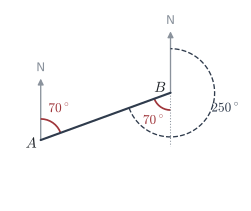
Back bearing Not in the formula booklet
If the bearing of \(B\) from \(A\) is \(\theta\), then the bearing of \(A\) from \(B\) is
\[ \begin{gathered} \theta + 180^\circ \quad \text{if } \theta < 180^\circ \\ \theta - 180^\circ \quad \text{if } \theta \geq 180^\circ \end{gathered} \]
- \(\theta\): the bearing of \(B\) from \(A\)
Example 2 (a) The bearing of \(B\) from \(A\) is \(065^\circ\). Find the bearing of \(A\) from \(B\).
(b) The bearing of \(Q\) from \(P\) is \(310^\circ\). Find the bearing of \(P\) from \(Q\).
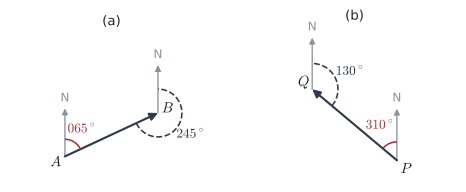
(a) \(065^\circ + 180^\circ = 245^\circ\).
(b) \(310^\circ - 180^\circ = 130^\circ\).
Check: the two bearings always differ by exactly \(180^\circ\).
Angles inside a triangle
To find an angle of a triangle at a point, draw a north line at that point. Then work out the bearings of the other two points from that point, and subtract.
Example 3 The bearing of \(B\) from \(A\) is \(040^\circ\) and the bearing of \(C\) from \(A\) is \(110^\circ\). The bearing of \(C\) from \(B\) is \(160^\circ\).
(a) Find the three angles of triangle \(ABC\).
(b) Given that \(AB = 10\) km, find \(AC\).
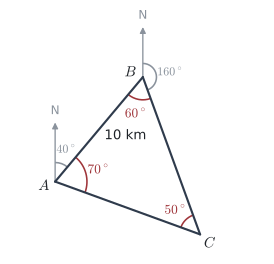
(a) At \(A\): \(\;\angle BAC = 110^\circ - 40^\circ = 70^\circ\).
At \(B\): the bearing of \(A\) from \(B\) is \(040^\circ + 180^\circ = 220^\circ\), and the bearing of \(C\) from \(B\) is \(160^\circ\). So \(\angle ABC = 220^\circ - 160^\circ = 60^\circ\).
At \(C\): \(\;\angle ACB = 180^\circ - 70^\circ - 60^\circ = 50^\circ\).
(b) \(AC\) is opposite \(\angle ABC\) and \(AB\) is opposite \(\angle ACB\). By the sine rule,
\[ AC = \frac{10 \sin 60^\circ}{\sin 50^\circ} = 11.3 \text{ km (3 s.f.)}. \]
Drawing diagrams from written statements
Most marks in a bearings question depend on a correct diagram.
Strategy for bearings and navigation problems
- Mark the starting point. Draw a north line at every point where a direction is given or changes.
- Draw each leg of the journey with its bearing measured clockwise from north. Label lengths.
- Find the angles inside the triangle, using back bearings and angles on a straight line (\(180^\circ\)) or at a point (\(360^\circ\)).
- Choose the rule: right-angled trigonometry, the sine rule or the cosine rule (Section 14.3).
- To give a final bearing, add or subtract the angle you found to a known bearing. Check that the answer fits your diagram.
Example 4 A hiker walks \(12\) km due north and then \(5\) km due east.
(a) How far is the hiker from the starting point?
(b) Find the bearing of the hiker from the starting point.
(c) Find the bearing of the starting point from the hiker.
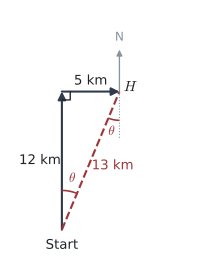
Due north then due east makes a right angle, so we can use right-angled trigonometry.
(a) \(\sqrt{12^2 + 5^2} = \sqrt{169} = 13\) km.
(b) The angle \(\theta\) at the start, measured from north, satisfies \(\tan\theta = \dfrac{5}{12}\), so \(\theta = 22.6^\circ\). The bearing is \(022.6^\circ\), or \(023^\circ\) to the nearest degree.
(c) \(22.6^\circ + 180^\circ = 202.6^\circ\), or \(203^\circ\) to the nearest degree.
Example 5 A ship leaves port \(A\) and sails \(5\) km on a bearing of \(030^\circ\) to \(B\). It then sails \(8\) km on a bearing of \(150^\circ\) to \(C\).
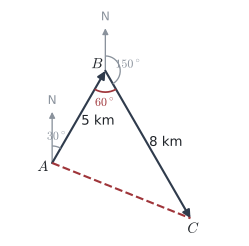
(a) Show that \(\angle ABC = 60^\circ\).
(b) Find the distance \(AC\).
(c) Find the bearing of \(C\) from \(A\).
(a) At \(B\), the bearing of \(A\) is \(030^\circ + 180^\circ = 210^\circ\), and the bearing of \(C\) is \(150^\circ\). So \(\angle ABC = 210^\circ - 150^\circ = 60^\circ\).
(b) Two sides and the angle between them, so use the cosine rule:
\[ \begin{gathered} AC^2 = 5^2 + 8^2 - 2(5)(8)\cos 60^\circ = 25 + 64 - 40 = 49 \\ AC = 7 \text{ km}. \end{gathered} \]
(c) Now we know all three sides of triangle \(ABC\):
\[ \begin{gathered} \cos \angle BAC = \frac{5^2 + 7^2 - 8^2}{2(5)(7)} = \frac{10}{70} = \frac{1}{7} \\ \angle BAC = 81.8^\circ . \end{gathered} \]
\(C\) is clockwise from \(B\) (as seen from \(A\)), so the bearing of \(C\) from \(A\) is
\[ 030^\circ + 81.8^\circ = 111.8^\circ \approx 112^\circ . \]
Angles of elevation in non-right-angled triangles
Angles of elevation and depression were introduced in Section 14.2. When two observations are made from different points, the triangle between the two points and the top of the object is usually not right-angled. Use the sine rule in that triangle first.
Example 6 Two points \(A\) and \(B\) are on level ground, in a straight line with the foot \(F\) of a vertical tower \(FT\). \(AB = 40\) m. The angle of elevation of the top \(T\) is \(30^\circ\) from \(A\) and \(60^\circ\) from \(B\).
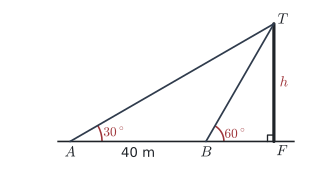
(a) Find \(\angle ATB\) and show that \(BT = 40\) m.
(b) Find the exact height \(h\) of the tower.
(a) \(\angle ABT = 180^\circ - 60^\circ = 120^\circ\) (angles on a straight line). So in triangle \(ABT\),
\[ \angle ATB = 180^\circ - 30^\circ - 120^\circ = 30^\circ . \]
The angles at \(A\) and \(T\) are both \(30^\circ\), so triangle \(ABT\) is isosceles and \(BT = AB = 40\) m. (The sine rule gives the same: \(BT = \dfrac{40 \sin 30^\circ}{\sin 30^\circ} = 40\).)
(b) Triangle \(BFT\) is right-angled at \(F\):
\[ h = BT \sin 60^\circ = 40 \times \frac{\sqrt{3}}{2} = 20\sqrt{3} \approx 34.6 \text{ m}. \]
Example 7 Two ships leave a port \(P\) at the same time. Ship \(X\) sails on a bearing of \(050^\circ\) at \(12\) km/h. Ship \(Y\) sails on a bearing of \(110^\circ\) at \(10\) km/h.
(a) Find the distance between the ships after \(2\) hours.
(b) Find the bearing of \(Y\) from \(X\) at that time.
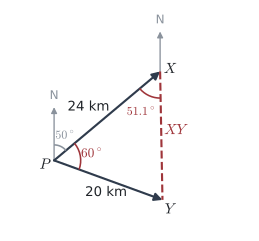
After \(2\) hours, \(PX = 24\) km and \(PY = 20\) km. The angle between the two courses is \(\angle XPY = 110^\circ - 50^\circ = 60^\circ\).
(a)
\[ XY^2 = 24^2 + 20^2 - 2(24)(20)\cos 60^\circ = 576 + 400 - 480 = 496 , \]
so \(XY = \sqrt{496} = 4\sqrt{31} = 22.3\) km (3 s.f.).
(b) Find \(\angle PXY\) with the sine rule (\(PY = 20\) is opposite it):
\[ \begin{gathered} \sin \angle PXY = \frac{20 \sin 60^\circ}{XY} = 0.7777\ldots \\ \angle PXY = 51.1^\circ . \end{gathered} \]
(\(\angle PXY\) is acute, because \(PY < PX\), so it is smaller than the angle opposite \(PX\).)
The bearing of \(P\) from \(X\) is \(050^\circ + 180^\circ = 230^\circ\). \(Y\) is closer to south than \(P\) is, so turn anticlockwise from the direction of \(P\):
\[ 230^\circ - 51.1^\circ = 178.9^\circ \approx 179^\circ . \]
Problems in three dimensions
In SL examinations, three-dimensional problems use right-angled trigonometry only. Look for right-angled triangles in a vertical plane (with the height) and in the horizontal plane (on the ground).
Example 8 A vertical tower \(FT\) has height \(h\) m. Point \(A\) is due south of the foot \(F\), and point \(B\) is due east of \(F\), on level ground. The angle of elevation of \(T\) is \(45^\circ\) from \(A\) and \(30^\circ\) from \(B\). The distance \(AB\) is \(100\) m.
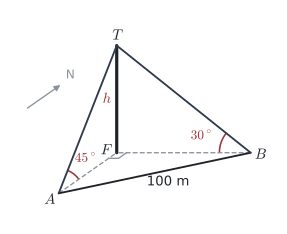
Find \(h\).
In the vertical triangle \(AFT\): \(\;\tan 45^\circ = \dfrac{h}{AF}\), so \(AF = h\).
In the vertical triangle \(BFT\): \(\;\tan 30^\circ = \dfrac{h}{BF}\), so \(BF = \dfrac{h}{\tan 30^\circ} = h\sqrt{3}\).
South and east are perpendicular, so the horizontal triangle \(AFB\) has a right angle at \(F\):
\[ \begin{gathered} AF^2 + BF^2 = AB^2 \;\Longrightarrow\; h^2 + 3h^2 = 100^2 \\ 4h^2 = 10\,000 \;\Longrightarrow\; h = 50 \text{ m}. \end{gathered} \]
Common errors
| ✗ Wrong | ✓ Right | Why |
|---|---|---|
| Bearing \(60^\circ\) | \(060^\circ\) | Bearings always have three figures. |
| Measuring anticlockwise, or from east | Clockwise from north | This is the definition of a bearing. |
| Bearing of \(B\) from \(A\) measured at \(B\) | Measure at \(A\) | “From \(A\)” means stand at \(A\). |
| Back bearing \(= 360^\circ - \theta\) | \(\theta \pm 180^\circ\) | The return direction is the opposite direction. |
| Using a bearing as an angle of the triangle | Find the angle between two lines at the point | A bearing is measured from north, not from a side of the triangle. |
| Assuming the triangle is right-angled | Check first | Only perpendicular directions (e.g. north and east) give a right angle. |
| Using \(\sin\) or \(\cos\) of the angle of elevation in the wrong triangle | Use the sine rule in the slanted triangle first | The right angle is at the foot of the tower, not at the observer. |
Exercises
1 Write as three-figure bearings:
(a) due west \(\qquad\) (b) north-east
(c) \(40^\circ\) west of south \(\qquad\) (d) \(15^\circ\) east of north
(a) \(270^\circ\) \(\qquad\) (b) \(045^\circ\)
(c) \(180^\circ + 40^\circ = 220^\circ\) \(\qquad\) (d) \(015^\circ\)
2 The bearing of \(B\) from \(A\) is given. Find the bearing of \(A\) from \(B\).
(a) \(072^\circ\) \(\qquad\) (b) \(200^\circ\) \(\qquad\) (c) \(345^\circ\)
(a) \(072^\circ + 180^\circ = 252^\circ\)
(b) \(200^\circ - 180^\circ = 020^\circ\)
(c) \(345^\circ - 180^\circ = 165^\circ\)
3 A boat sails \(9\) km due east and then \(12\) km due south. Find its distance from the start, and its bearing from the start.
Distance \(= \sqrt{9^2 + 12^2} = 15\) km.
The angle from south towards east is \(\tan^{-1}\left(\dfrac{9}{12}\right) = 36.9^\circ\), so the bearing is \(180^\circ - 36.9^\circ = 143.1^\circ \approx 143^\circ\).
4 The bearing of \(Q\) from \(P\) is \(030^\circ\) and the bearing of \(R\) from \(P\) is \(100^\circ\). The bearing of \(R\) from \(Q\) is \(140^\circ\). Show that triangle \(PQR\) is isosceles.
At \(P\): \(\angle QPR = 100^\circ - 30^\circ = 70^\circ\).
At \(Q\): the bearing of \(P\) from \(Q\) is \(210^\circ\), so \(\angle PQR = 210^\circ - 140^\circ = 70^\circ\).
Two angles are equal, so the triangle is isosceles (with \(PR = QR\)). The third angle is \(\angle PRQ = 40^\circ\).
5 A ship sails \(6\) km on a bearing of \(020^\circ\) and then \(10\) km on a bearing of \(140^\circ\). Find the exact distance of the ship from its starting point.
At the turning point \(B\), the bearing back to the start is \(200^\circ\), so the angle inside the triangle is \(200^\circ - 140^\circ = 60^\circ\).
\[ \begin{gathered} d^2 = 6^2 + 10^2 - 2(6)(10)\cos 60^\circ = 136 - 60 = 76 \\ d = 2\sqrt{19} \approx 8.72 \text{ km}. \end{gathered} \]
6 From town \(A\), town \(B\) is \(30\) km away on a bearing of \(075^\circ\) and town \(C\) is \(40\) km away on a bearing of \(135^\circ\). Find the distance \(BC\).
\(\angle BAC = 135^\circ - 75^\circ = 60^\circ\).
\[ \begin{gathered} BC^2 = 30^2 + 40^2 - 2(30)(40)\cos 60^\circ = 2500 - 1200 = 1300 \\ BC = 10\sqrt{13} \approx 36.1 \text{ km}. \end{gathered} \]
7 Points \(A\) and \(B\) are on level ground, \(50\) m apart, in a straight line with the foot of a vertical mast. \(B\) is closer to the mast. The angles of elevation of the top of the mast from \(A\) and \(B\) are \(30^\circ\) and \(45^\circ\). Find the height of the mast.
Let \(T\) be the top. \(\angle ABT = 180^\circ - 45^\circ = 135^\circ\), so \(\angle ATB = 180^\circ - 30^\circ - 135^\circ = 15^\circ\).
Sine rule in triangle \(ABT\): \(\;BT = \dfrac{50 \sin 30^\circ}{\sin 15^\circ} = 96.59\ldots\) m.
Right-angled triangle at the foot: \(\;h = BT \sin 45^\circ = 68.3\) m (3 s.f.).
8 A vertical flagpole is \(20\) m tall. Point \(A\) is due north of its foot and point \(B\) is due east of its foot, on level ground. The angles of elevation of the top from \(A\) and \(B\) are \(45^\circ\) and \(30^\circ\). Find the distance \(AB\).
From \(A\): the distance to the foot is \(\dfrac{20}{\tan 45^\circ} = 20\) m. From \(B\): it is \(\dfrac{20}{\tan 30^\circ} = 20\sqrt{3}\) m.
North and east are perpendicular, so \(AB = \sqrt{20^2 + \left(20\sqrt{3}\right)^2} = \sqrt{400 + 1200} = 40\) m.
9 Two ships leave a harbour at the same time. One sails on a bearing of \(040^\circ\) at \(15\) km/h, the other on a bearing of \(160^\circ\) at \(20\) km/h. Find the distance between them after \(2\) hours.
The distances are \(30\) km and \(40\) km, and the angle between the courses is \(160^\circ - 40^\circ = 120^\circ\).
\[ \begin{gathered} d^2 = 30^2 + 40^2 - 2(30)(40)\cos 120^\circ = 2500 + 1200 = 3700 \\ d = 10\sqrt{37} \approx 60.8 \text{ km}. \end{gathered} \]
10 From a lighthouse \(L\), ship \(S\) is \(12\) km away on a bearing of \(300^\circ\) and ship \(T\) is \(9\) km away on a bearing of \(040^\circ\).
(a) Find the distance \(ST\).
(b) Find the bearing of \(T\) from \(S\).
(a) Turning clockwise from \(300^\circ\) to \(040^\circ\) is \(100^\circ\), so \(\angle SLT = 100^\circ\).
\[ \begin{gathered} ST^2 = 12^2 + 9^2 - 2(12)(9)\cos 100^\circ = 262.5\ldots \\ ST = 16.2 \text{ km (3 s.f.)}. \end{gathered} \]
(b) Sine rule: \(\;\sin \angle LST = \dfrac{9 \sin 100^\circ}{ST}\), so \(\angle LST = 33.2^\circ\).
The bearing of \(L\) from \(S\) is \(300^\circ - 180^\circ = 120^\circ\). \(T\) is further north than \(L\), so turn anticlockwise from \(120^\circ\):
\[ 120^\circ - 33.2^\circ = 86.8^\circ \approx 087^\circ . \]