19.4 Standardising and Inverse Normal Calculations
SL 4.9 SL 4.12
- how to standardise a normal variable: \(z = \dfrac{x - \mu}{\sigma}\)
- what a \(z\)-value means: the number of standard deviations from the mean
- how to use \(z\)-values to compare results from different distributions
- how to find an unknown mean \(\mu\) or an unknown standard deviation \(\sigma\) (or both) from given probabilities
- how to solve problems that mix the normal and the binomial distributions
Standardising a normal variable
If \(X \sim \mathrm{N}(\mu, \sigma^2)\), we can change \(X\) into the standard normal variable \(Z\) in two steps:
- subtract the mean \(\mu\) (this moves the centre to \(0\));
- divide by the standard deviation \(\sigma\) (this makes the standard deviation \(1\)).
This process is called standardisation.
Standardising Partly in the formula booklet
\[ z = \frac{x - \mu}{\sigma} \]
In the booklet
This value is the \(z\)-value (or \(z\)-score) of \(x\). It tells you how many standard deviations \(x\) is above the mean (negative: below the mean).
If \(X \sim \mathrm{N}(\mu, \sigma^2)\), then
\[ Z = \frac{X - \mu}{\sigma} \sim \mathrm{N}(0, 1) \qquad\text{and}\qquad \mathrm{P}(X \leq x) = \mathrm{P}\left(Z \leq \frac{x - \mu}{\sigma}\right) . \]
- \(z\): the \(z\)-value of \(x\)
- \(x\): a value of \(X\)
- \(\mu\): the mean of \(X\)
- \(\sigma\): the standard deviation of \(X\)
- \(X\): a normal random variable, \(X \sim \mathrm{N}(\mu, \sigma^2)\)
- \(Z\): the standard normal random variable, \(Z \sim \mathrm{N}(0, 1)\)
This works because of the rules in Section 19.2: \(\mathrm{E}\left(\frac{X - \mu}{\sigma}\right) = \frac{\mu - \mu}{\sigma} = 0\) and \(\mathrm{Var}\left(\frac{X - \mu}{\sigma}\right) = \frac{\sigma^2}{\sigma^2} = 1\).
For example, if \(X \sim \mathrm{N}(60, 8^2)\), then \(x = 72\) has \(z = \dfrac{72 - 60}{8} = 1.5\): it is \(1.5\) standard deviations above the mean.
Comparing results with \(z\)-values
A \(z\)-value measures position relative to the group, so it lets us compare results from distributions with different means and spreads.
Example 1 Aiko scored \(78\) in a Biology test, where the class mean was \(70\) and the standard deviation was \(6.4\). In a Chemistry test she scored \(71\), where the class mean was \(64\) and the standard deviation was \(5.0\). Both sets of marks are normally distributed. In which subject did Aiko do better compared with the rest of her class?
\[ \text{Biology: } z = \frac{78 - 70}{6.4} = 1.25 \qquad\qquad \text{Chemistry: } z = \frac{71 - 64}{5.0} = 1.4 \]
Her Chemistry mark is \(1.4\) standard deviations above the mean, which is further above the mean than in Biology. So she did better in Chemistry, even though the Biology mark is higher.
Finding an unknown mean or standard deviation
The syllabus (SL 4.12) uses \(z\)-values to find an unknown \(\mu\) or \(\sigma\). The method:
Unknown \(\mu\) or \(\sigma\)
- Write the given probability as an area to the left: \(\mathrm{P}(X < x) = p\).
- Find \(z = \mathtt{invNorm}(p, 0, 1)\) on the GDC (the standard normal).
- Use \(\dfrac{x - \mu}{\sigma} = z\) and solve for the unknown.
- With two unknowns, you need two facts. This gives two simultaneous equations.
- \(X\): a normal random variable, \(X \sim \mathrm{N}(\mu, \sigma^2)\)
- \(x\): a given value of \(X\)
- \(p\): the given probability (area to the left of \(x\))
- \(z\): the \(z\)-value of \(x\)
- \(\mu\): the mean of \(X\)
- \(\sigma\): the standard deviation of \(X\)
You cannot use invNorm(p, μ, σ) directly when \(\mu\) or \(\sigma\) is unknown. That is why we change to \(Z\).
Example 2 (a) The masses of melons from one farm are normally distributed with mean \(\mu\) kg and standard deviation \(0.15\) kg. \(70\%\) of the melons have a mass less than \(1.40\) kg. Find \(\mu\).
(b) At another farm the masses are normally distributed with mean \(1.25\) kg and standard deviation \(\sigma\) kg. \(10\%\) of the melons are heavier than \(1.50\) kg. Find \(\sigma\).
(a) \(\mathrm{P}(M < 1.40) = 0.7\), so \(\mathrm{P}\left(Z < \dfrac{1.40 - \mu}{0.15}\right) = 0.7\).
\(z = \mathtt{invNorm}(0.7, 0, 1) = 0.52440\ldots\)
\[ \frac{1.40 - \mu}{0.15} = 0.52440\ldots \;\Longrightarrow\; \mu = 1.40 - 0.15 \times 0.52440\ldots = 1.32 \text{ kg (3 s.f.)} . \]
(Sensible: more than half of the melons are below \(1.40\), so the mean is below \(1.40\).)
(b) \(\mathrm{P}(M > 1.50) = 0.1\), so \(\mathrm{P}(M < 1.50) = 0.9\) and \(z = \mathtt{invNorm}(0.9, 0, 1) = 1.28155\ldots\)
\[ \frac{1.50 - 1.25}{\sigma} = 1.28155\ldots \;\Longrightarrow\; \sigma = \frac{0.25}{1.28155\ldots} = 0.195 \text{ kg (3 s.f.)} . \]
Example 3 The marks in an examination are normally distributed with mean \(\mu\) and standard deviation \(\sigma\). \(15\%\) of the candidates scored less than \(35\) marks, and \(8\%\) scored more than \(80\) marks. Find \(\mu\) and \(\sigma\).
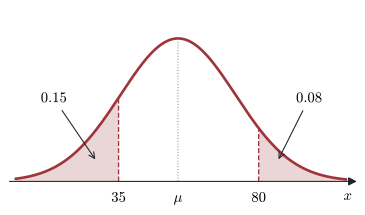
\(\mathrm{P}(X < 35) = 0.15\): \(\quad z_1 = \mathtt{invNorm}(0.15) = -1.03643\ldots\), so \(\dfrac{35 - \mu}{\sigma} = -1.03643\ldots\)
\(\mathrm{P}(X > 80) = 0.08 \Rightarrow \mathrm{P}(X < 80) = 0.92\): \(\quad z_2 = \mathtt{invNorm}(0.92) = 1.40507\ldots\), so \(\dfrac{80 - \mu}{\sigma} = 1.40507\ldots\)
Multiply out:
\[ \mu - 1.03643\sigma = 35 \qquad (1) \qquad\qquad \mu + 1.40507\sigma = 80 \qquad (2) \]
\((2) - (1)\): \(\;2.44150\sigma = 45\), so \(\sigma = 18.4\) (3 s.f.). Then \(\mu = 35 + 1.03643 \times 18.431 = 54.1\) (3 s.f.).
Store the \(z\)-values first: a:=invNorm(0.15) and b:=invNorm(0.92). Then Menu → Algebra → Solve System of Linear Equations, 2 equations, variables m, s:
m+a·s=35 and m+b·s=80
This gives \(m = 54.10\ldots\) and \(s = 18.43\ldots\) with no rounding errors.
Example 4 A machine fills bottles with water. The volumes are normally distributed with mean \(\mu\) ml and standard deviation \(4\) ml. Bottles that contain less than \(500\) ml are rejected. The mean can be adjusted.
(a) Find the percentage of bottles rejected if the mean is set at \(508\) ml.
(b) Find, to the nearest \(0.1\) ml, the smallest value of the mean for which not more than \(1\%\) of bottles are rejected.
(a) \(\mathrm{P}(V < 500) = \mathtt{normCdf}(-\infty, 500, 508, 4) = 0.02275\ldots\), so \(2.28\%\) of bottles are rejected.
(b) We need \(\mathrm{P}(V < 500) \leq 0.01\). At the boundary, \(z = \mathtt{invNorm}(0.01) = -2.32634\ldots\)
\[ \frac{500 - \mu}{4} = -2.32634\ldots \;\Longrightarrow\; \mu = 500 + 4 \times 2.32634\ldots = 509.305\ldots \]
A larger mean moves the curve to the right, so fewer bottles are rejected. We need \(\mu \geq 509.305\ldots\) Rounding to \(509.3\) would make the mean slightly too small (then \(1.004\%\) are rejected), so round up: the smallest mean is \(509.4\) ml.
Mixed problems
A normal probability can become the \(p\) of a binomial distribution (see Unit 18): if each of \(n\) independent items has the same probability \(p\) of “success”, the number of successes is \(\mathrm{B}(n, p)\).
Example 5 The times taken for a food delivery are normally distributed with mean \(28\) minutes and standard deviation \(6\) minutes.
(a) Find the probability that a delivery takes less than \(20\) minutes or more than \(40\) minutes.
(b) \(85\%\) of deliveries take less than \(t\) minutes. Find \(t\).
(c) \(12\) deliveries are chosen at random. Find the probability that exactly \(8\) of them take less than \(30\) minutes.
Let \(T \sim \mathrm{N}(28, 6^2)\).
(a) \(\mathrm{P}(T < 20 \text{ or } T > 40) = 1 - \mathrm{P}(20 < T < 40) = 1 - 0.88603\ldots = 0.114\) (3 s.f.).
(b) \(t = \mathtt{invNorm}(0.85, 28, 6) = 34.2\) minutes (3 s.f.).
(c) For one delivery, \(p = \mathrm{P}(T < 30) = 0.63055\ldots\)
Let \(Y\) be the number (out of \(12\)) that take less than \(30\) minutes. Then \(Y \sim \mathrm{B}(12, 0.63055\ldots)\) and
\[ \mathrm{P}(Y = 8) = \mathtt{binomPdf}(12, 0.63055\ldots, 8) = 0.230 \text{ (3 s.f.)} . \]
(Store \(p\) in the calculator so that you do not round it.)
Using your GDC
Calculator page → Menu → Probability → Distributions:
| Task | Command |
|---|---|
| a probability, \(\mu\) and \(\sigma\) known | Normal Cdf: normCdf(lower, upper, μ, σ) |
| a value of \(x\), \(\mu\) and \(\sigma\) known | Inverse Normal: invNorm(area to the left, μ, σ) |
| a \(z\)-value (for unknown \(\mu\) or \(\sigma\)) | Inverse Normal with \(\mu = 0\), \(\sigma = 1\): invNorm(area to the left) |
| a binomial probability | Binomial Pdf / Binomial Cdf |
For two unknowns, use Menu → Algebra → Solve System of Linear Equations. Give final answers to 3 s.f., but keep full accuracy (stored values) in all working.
Common errors
| ✗ Wrong | ✓ Right | Why |
|---|---|---|
| \(z = \dfrac{x - \mu}{\sigma^2}\) | \(z = \dfrac{x - \mu}{\sigma}\) | Divide by the standard deviation, not the variance. |
| \(\mathrm{P}(X > 80) = 0.08 \Rightarrow z = \mathtt{invNorm}(0.08)\) | \(z = \mathtt{invNorm}(0.92)\) | Convert to the area on the left first. |
| A positive \(z\) for a value below the mean | \(z < 0\) when \(x < \mu\) | Check the sign with a sketch. |
Unknown \(\mu\): invNorm(0.7, μ, 0.15) |
Use \(Z\): invNorm(0.7), then solve |
The GDC cannot work with an unknown \(\mu\). |
| Rounding \(509.305\) to \(509.3\) | \(509.4\) | The answer must still satisfy “not more than \(1\%\)”. |
| Rounding \(z\)-values to 2 d.p. before solving | Keep at least 5 s.f. (or store them) | Early rounding changes \(\mu\) and \(\sigma\). |
Exercises
1 \(X \sim \mathrm{N}(60, 8^2)\).
(a) Find the \(z\)-values of \(x = 72\) and \(x = 50\).
(b) Find the value of \(x\) whose \(z\)-value is \(-0.75\).
(a) \(\dfrac{72 - 60}{8} = 1.5\) and \(\dfrac{50 - 60}{8} = -1.25\).
(b) \(x = \mu + z\sigma = 60 - 0.75 \times 8 = 54\).
2 Ravi scored \(64\) in French (mean \(55\), standard deviation \(6\)) and \(81\) in Physics (mean \(72\), standard deviation \(8\)). Both sets of marks are normally distributed. In which subject did he do better compared with his class?
French: \(z = \dfrac{64 - 55}{6} = 1.5\). Physics: \(z = \dfrac{81 - 72}{8} = 1.125\). French has the larger \(z\)-value, so he did better in French.
3 \(X \sim \mathrm{N}(\mu, 5^2)\) and \(\mathrm{P}(X < 40) = 0.9\). Find \(\mu\).
\(z = \mathtt{invNorm}(0.9) = 1.28155\ldots\), so \(\dfrac{40 - \mu}{5} = 1.28155\ldots\) and \(\mu = 40 - 6.4078 = 33.6\) (3 s.f.).
4 \(X \sim \mathrm{N}(25, \sigma^2)\) and \(\mathrm{P}(X > 30) = 0.12\). Find \(\sigma\).
\(\mathrm{P}(X < 30) = 0.88\), so \(z = \mathtt{invNorm}(0.88) = 1.17498\ldots\)
\(\dfrac{30 - 25}{\sigma} = 1.17498\ldots \Rightarrow \sigma = 4.26\) (3 s.f.).
5 \(X \sim \mathrm{N}(\mu, \sigma^2)\), with \(\mathrm{P}(X < 12) = 0.3\) and \(\mathrm{P}(X > 20) = 0.1\). Find \(\mu\) and \(\sigma\).
\(\mathtt{invNorm}(0.3) = -0.52440\ldots\) and \(\mathtt{invNorm}(0.9) = 1.28155\ldots\)
\(\mu - 0.52440\sigma = 12\) and \(\mu + 1.28155\sigma = 20\). Subtracting: \(1.80595\sigma = 8\), so \(\sigma = 4.43\) and \(\mu = 14.3\) (3 s.f.).
6 Bags of rice have masses that are normally distributed with mean \(\mu\) g and standard deviation \(2.5\) g. At most \(3\%\) of bags may have a mass less than \(250\) g. Find, to the nearest \(0.1\) g, the smallest possible value of \(\mu\).
\(\mathtt{invNorm}(0.03) = -1.88079\ldots\), so \(\dfrac{250 - \mu}{2.5} = -1.88079\ldots\) and \(\mu = 254.70198\ldots\)
We need \(\mu \geq 254.70198\ldots\), so round up: \(\mu = 254.8\) g. (With \(\mu = 254.7\), \(\mathrm{P}(X < 250) = 0.03005 > 0.03\).)
7 The volumes of cups of coffee from a machine are \(\mathrm{N}(250, \sigma^2)\) ml. No more than \(2\%\) of cups may contain less than \(245\) ml. Find the largest possible value of \(\sigma\).
\(\mathtt{invNorm}(0.02) = -2.05374\ldots\), so \(\dfrac{245 - 250}{\sigma} = -2.05374\ldots\) and \(\sigma = 2.43457\ldots\)
A smaller \(\sigma\) gives fewer small cups, so we need \(\sigma \leq 2.43457\ldots\) The largest value is \(\sigma = 2.43\) ml (3 s.f., rounded down).
8 The lifetimes of a type of light bulb are normally distributed with mean \(1200\) hours and standard deviation \(150\) hours.
(a) Find the probability that a bulb lasts more than \(1400\) hours.
(b) \(10\) bulbs are chosen at random. Find the probability that at least \(2\) of them last more than \(1400\) hours.
(a) \(p = \mathtt{normCdf}(1400, 10^{99}, 1200, 150) = 0.0912\) (3 s.f.).
(b) \(Y \sim \mathrm{B}(10, 0.09121\ldots)\). \(\;\mathrm{P}(Y \geq 2) = 1 - \mathrm{P}(Y \leq 1) = 1 - \mathtt{binomCdf}(10, 0.09121\ldots, 0, 1) = 0.230\) (3 s.f.).
9 \(X \sim \mathrm{N}(50, 10^2)\). Find \(\mathrm{P}(X > 65 \mid X > 55)\).
“\(X > 65\) and \(X > 55\)” is just \(X > 65\).
\(\mathrm{P}(X > 65 \mid X > 55) = \dfrac{\mathrm{P}(X > 65)}{\mathrm{P}(X > 55)} = \dfrac{0.066807\ldots}{0.308537\ldots} = 0.217\) (3 s.f.).
10 \(X \sim \mathrm{N}(\mu, \sigma^2)\) and \(\mathrm{P}(X < \mu + 2.5) = 0.8\). Find \(\sigma\).
\(\dfrac{(\mu + 2.5) - \mu}{\sigma} = \dfrac{2.5}{\sigma} = \mathtt{invNorm}(0.8) = 0.84162\ldots\), so \(\sigma = 2.97\) (3 s.f.). (\(\mu\) cancels, so we do not need it.)