22.5 Two Planes
AHL 3.18
- how to tell from the normals whether two planes are parallel or perpendicular
- how to find the line of intersection of two planes, by two methods
- how to find the angle between two planes
- how to find the distance between two parallel planes
Let the two planes be \(\Pi_1: \boldsymbol{r}\cdot\boldsymbol{n}_1 = d_1\) and \(\Pi_2: \boldsymbol{r}\cdot\boldsymbol{n}_2 = d_2\). Everything in this section is decided by the two normals.
Parallel planes
Parallel planes Not in the formula booklet
\(\Pi_1\) and \(\Pi_2\) are parallel if their normals are parallel: \(\;\boldsymbol{n}_1 = k\boldsymbol{n}_2\) for some scalar \(k\).
If, in addition, the equations are multiples of each other (including the right-hand side), the planes are the same plane.
- \(\Pi_1, \Pi_2\): the two planes
- \(\boldsymbol{n}_1, \boldsymbol{n}_2\): normal vectors of \(\Pi_1\) and \(\Pi_2\)
Example 1 Show that the planes \(\Pi_1: \boldsymbol{r}\cdot\begin{pmatrix} 2 \\ -1 \\ 3 \end{pmatrix} = 4\) and \(\Pi_2: \boldsymbol{r}\cdot\begin{pmatrix} -4 \\ 2 \\ -6 \end{pmatrix} = 5\) are parallel and are not the same plane.
\(\begin{pmatrix} -4 \\ 2 \\ -6 \end{pmatrix} = -2\begin{pmatrix} 2 \\ -1 \\ 3 \end{pmatrix}\), so the normals are parallel and so are the planes.
Divide the equation of \(\Pi_2\) by \(-2\): \(\;\boldsymbol{r}\cdot\begin{pmatrix} 2 \\ -1 \\ 3 \end{pmatrix} = -\dfrac{5}{2}\). Since \(-\dfrac{5}{2} \neq 4\), the planes are different.
Perpendicular planes
Perpendicular planes Not in the formula booklet
\(\Pi_1\) and \(\Pi_2\) are perpendicular if their normals are perpendicular: \(\;\boldsymbol{n}_1\cdot\boldsymbol{n}_2 = 0\).
- \(\Pi_1, \Pi_2\): the two planes
- \(\boldsymbol{n}_1, \boldsymbol{n}_2\): normal vectors of \(\Pi_1\) and \(\Pi_2\)
Example 2 Show that the planes \(\Pi_1: \boldsymbol{r}\cdot\begin{pmatrix} 1 \\ 2 \\ -1 \end{pmatrix} = 3\) and \(\Pi_2: \boldsymbol{r}\cdot\begin{pmatrix} 3 \\ 1 \\ 5 \end{pmatrix} = 0\) are perpendicular.
\(\boldsymbol{n}_1\cdot\boldsymbol{n}_2 = (1)(3) + (2)(1) + (-1)(5) = 0\), so the planes are perpendicular.
The line of intersection
Two planes that are not parallel meet in a straight line, the line of intersection.
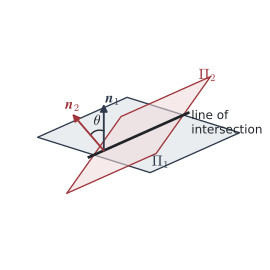
The line lies in both planes, so its direction is perpendicular to both normals.
Line of intersection of two planes
Method 1. Direction: \(\boldsymbol{d} = \boldsymbol{n}_1\times\boldsymbol{n}_2\). A point: choose a value for one variable (often \(z = 0\)) and solve the two equations for the other two.
Method 2. Let one variable be the parameter (for example \(z = \lambda\)), and solve for the other two in terms of \(\lambda\).
If \(z = 0\) gives no solution, the line never meets the plane \(z = 0\); choose \(x = 0\) or \(y = 0\) instead.
Example 3 Find a vector equation of the line of intersection of the planes \(x + 2y - z = 4\) and \(2x - y + 3z = 3\).
Method 1.
\[ \boldsymbol{d} = \begin{pmatrix} 1 \\ 2 \\ -1 \end{pmatrix}\times\begin{pmatrix} 2 \\ -1 \\ 3 \end{pmatrix} = \begin{pmatrix} (2)(3) - (-1)(-1) \\ (-1)(2) - (1)(3) \\ (1)(-1) - (2)(2) \end{pmatrix} = \begin{pmatrix} 5 \\ -5 \\ -5 \end{pmatrix} = 5\begin{pmatrix} 1 \\ -1 \\ -1 \end{pmatrix}. \]
Put \(z = 0\): \(\;x + 2y = 4\) and \(2x - y = 3\). Then \(x = 2\), \(y = 1\). So
\[ \boldsymbol{r} = \begin{pmatrix} 2 \\ 1 \\ 0 \end{pmatrix} + \lambda\begin{pmatrix} 1 \\ -1 \\ -1 \end{pmatrix}. \]
Method 2. Let \(z = \lambda\):
\[ x + 2y = 4 + \lambda, \qquad 2x - y = 3 - 3\lambda . \]
Double the second and add: \(5x = 10 - 5\lambda\), so \(x = 2 - \lambda\). Then \(y = 2x - 3 + 3\lambda = 1 + \lambda\).
\[ \boldsymbol{r} = \begin{pmatrix} 2 \\ 1 \\ 0 \end{pmatrix} + \lambda\begin{pmatrix} -1 \\ 1 \\ 1 \end{pmatrix}, \]
the same line (the direction is just reversed).
The angle between two planes
The angle between two planes is the angle between their normals (see Figure 1). We take the acute angle, so we use the modulus.
Angle between two planes Not in the formula booklet
\[ \cos\theta = \frac{|\boldsymbol{n}_1\cdot\boldsymbol{n}_2|}{|\boldsymbol{n}_1|\,|\boldsymbol{n}_2|} \]
- If \(\boldsymbol{n}_1\cdot\boldsymbol{n}_2 < 0\), the angle between the normals is obtuse. The modulus gives the acute angle.
- If \(\boldsymbol{n}_1\cdot\boldsymbol{n}_2 = 0\), the planes are perpendicular.
- \(\theta\): the acute angle between the two planes
- \(\boldsymbol{n}_1, \boldsymbol{n}_2\): normal vectors of the two planes
The HL booklet gives \(\cos\theta = \frac{\boldsymbol{v}\cdot\boldsymbol{w}}{|\boldsymbol{v}||\boldsymbol{w}|}\) for two vectors (3.13); the modulus for the acute angle is not printed.
Example 4 Find the acute angle between the planes \(\Pi_1: \boldsymbol{r}\cdot(\boldsymbol{i} - 2\boldsymbol{j} + 2\boldsymbol{k}) = 1\) and \(\Pi_2: \boldsymbol{r}\cdot(2\boldsymbol{i} + 2\boldsymbol{j} - \boldsymbol{k}) = 4\).
\(\boldsymbol{n}_1\cdot\boldsymbol{n}_2 = 2 - 4 - 2 = -4\), \(\;|\boldsymbol{n}_1| = 3\), \(\;|\boldsymbol{n}_2| = 3\).
\[ \cos\theta = \frac{|-4|}{3 \times 3} = \frac{4}{9} \quad\Longrightarrow\quad \theta = 63.6^\circ \text{ (3 s.f.)}. \]
Without the modulus we would get \(116.4^\circ\), the obtuse angle between the normals.
The distance between two parallel planes
Choose any point on one plane. Its distance to the other plane is the distance between the planes (use a method from Section 22.4).
Distance between parallel planes Not in the formula booklet
If the planes are written with the same normal, \(\boldsymbol{r}\cdot\boldsymbol{n} = d_1\) and \(\boldsymbol{r}\cdot\boldsymbol{n} = d_2\), then
\[ \text{distance} = \frac{|d_1 - d_2|}{|\boldsymbol{n}|} . \]
If \(d_1\) and \(d_2\) have opposite signs, the origin lies between the planes.
- \(\boldsymbol{r}\): the position vector of a general point on a plane
- \(\boldsymbol{n}\): the common normal vector of the two planes
- \(d_1, d_2\): the constants on the right-hand sides of the two equations
Example 5 Find the distance between the planes \(\Pi_1: \boldsymbol{r}\cdot(2\boldsymbol{i} - 2\boldsymbol{j} + \boldsymbol{k}) = 5\) and \(\Pi_2: \boldsymbol{r}\cdot(2\boldsymbol{i} - 2\boldsymbol{j} + \boldsymbol{k}) = -7\).
The point \(A(0, 0, 5)\) lies on \(\Pi_1\). Its distance to \(\Pi_2\) is
\[ \frac{|2(0) - 2(0) + 5 - (-7)|}{\sqrt{4 + 4 + 1}} = \frac{12}{3} = 4 . \]
(Or directly: \(\dfrac{|5 - (-7)|}{3} = 4\).) Since \(5 > 0 > -7\), the origin is between the two planes.
Common errors
| ✗ Wrong | ✓ Right | Why |
|---|---|---|
| Angle between planes uses \(\sin\) | \(\cos\theta = \dfrac{\lvert\boldsymbol{n}_1\cdot\boldsymbol{n}_2\rvert}{\lvert\boldsymbol{n}_1\rvert\lvert\boldsymbol{n}_2\rvert}\) | The angle between the planes equals the angle between the normals. (\(\sin\) is for a line and a plane.) |
| Giving \(116.4^\circ\) | \(63.6^\circ\) | Use the modulus to get the acute angle. |
| Distance \(= \dfrac{\lvert 5 - 7\rvert}{\lvert\boldsymbol{n}\rvert}\) when \(\Pi_2\) is \(\boldsymbol{r}\cdot 2\boldsymbol{n} = 7\) | First write \(\Pi_2\) as \(\boldsymbol{r}\cdot\boldsymbol{n} = \frac{7}{2}\) | The formula needs the same normal in both equations. |
| Direction of the line of intersection \(= \boldsymbol{n}_1 + \boldsymbol{n}_2\) | \(\boldsymbol{n}_1\times\boldsymbol{n}_2\) | The line must be perpendicular to both normals. |
| A point on the line that satisfies only one plane | Check the point in both equations | The line lies in both planes. |
Exercises
1 Decide whether each pair of planes is parallel, perpendicular, or neither.
(a) \(2x - y + z = 3\) and \(-6x + 3y - 3z = 1\)
(b) \(x + 2y - z = 0\) and \(3x - y + z = 4\)
(c) \(x + y + z = 1\) and \(x - y + 2z = 5\)
(a) \(\begin{pmatrix} -6 \\ 3 \\ -3 \end{pmatrix} = -3\begin{pmatrix} 2 \\ -1 \\ 1 \end{pmatrix}\): parallel (and different, since \(-\frac{1}{3} \neq 3\)).
(b) \(3 - 2 - 1 = 0\): perpendicular.
(c) The normals are not parallel, and \(1 - 1 + 2 = 2 \neq 0\): neither.
2 The plane \(\Pi_1\) is \(\boldsymbol{r}\cdot\begin{pmatrix} 2 \\ k \\ -1 \end{pmatrix} = 3\). Find \(k\) if \(\Pi_1\) is
(a) perpendicular to \(\boldsymbol{r}\cdot\begin{pmatrix} 1 \\ 3 \\ 4 \end{pmatrix} = 0\);
(b) parallel to \(\boldsymbol{r}\cdot\begin{pmatrix} 4 \\ -6 \\ -2 \end{pmatrix} = 1\).
(a) \(2 + 3k - 4 = 0\), so \(k = \dfrac{2}{3}\).
(b) \(\begin{pmatrix} 4 \\ -6 \\ -2 \end{pmatrix} = 2\begin{pmatrix} 2 \\ -3 \\ -1 \end{pmatrix}\), so \(k = -3\).
3 Find the acute angle between the planes \(x + y - z = 2\) and \(2x - y + 2z = 5\).
\(\boldsymbol{n}_1\cdot\boldsymbol{n}_2 = 2 - 1 - 2 = -1\), \(|\boldsymbol{n}_1| = \sqrt{3}\), \(|\boldsymbol{n}_2| = 3\).
\(\cos\theta = \dfrac{1}{3\sqrt{3}}\), so \(\theta = 78.9^\circ\) (3 s.f.).
4 Find the acute angle between the plane \(2x + y + 2z = 7\) and the \(xy\)-plane.
The \(xy\)-plane has normal \(\boldsymbol{k}\). \(\;\cos\theta = \dfrac{|2|}{3 \times 1} = \dfrac{2}{3}\), so \(\theta = 48.2^\circ\) (3 s.f.).
5 Find a vector equation of the line of intersection of \(x + y + z = 2\) and \(x - y + 3z = 6\).
\(\boldsymbol{n}_1\times\boldsymbol{n}_2 = \begin{pmatrix} (1)(3) - (1)(-1) \\ (1)(1) - (1)(3) \\ (1)(-1) - (1)(1) \end{pmatrix} = \begin{pmatrix} 4 \\ -2 \\ -2 \end{pmatrix} = 2\begin{pmatrix} 2 \\ -1 \\ -1 \end{pmatrix}\).
\(z = 0\): \(x + y = 2\), \(x - y = 6\), so \(x = 4\), \(y = -2\).
\[ \boldsymbol{r} = \begin{pmatrix} 4 \\ -2 \\ 0 \end{pmatrix} + \lambda\begin{pmatrix} 2 \\ -1 \\ -1 \end{pmatrix} \]
6 Find a vector equation of the line of intersection of \(2x - y + z = 1\) and \(x + y - 2z = 5\).
\(\boldsymbol{n}_1\times\boldsymbol{n}_2 = \begin{pmatrix} (-1)(-2) - (1)(1) \\ (1)(1) - (2)(-2) \\ (2)(1) - (-1)(1) \end{pmatrix} = \begin{pmatrix} 1 \\ 5 \\ 3 \end{pmatrix}\).
\(z = 0\): \(2x - y = 1\), \(x + y = 5\), so \(x = 2\), \(y = 3\).
\[ \boldsymbol{r} = \begin{pmatrix} 2 \\ 3 \\ 0 \end{pmatrix} + \lambda\begin{pmatrix} 1 \\ 5 \\ 3 \end{pmatrix} \]
7 Find the distance between the planes \(x - 2y + 2z = 4\) and \(2x - 4y + 4z = -10\). Is the origin between them?
Divide the second equation by \(2\): \(x - 2y + 2z = -5\). Distance \(= \dfrac{|4 - (-5)|}{\sqrt{1 + 4 + 4}} = \dfrac{9}{3} = 3\).
The right-hand sides \(4\) and \(-5\) have opposite signs, so yes, the origin is between the planes.
8 Find the Cartesian equation of the plane through \((1, 1, 1)\) that is perpendicular to both of the planes \(x + y - z = 3\) and \(2x - y + z = 0\).
The normal \(\boldsymbol{n}\) must be perpendicular to both normals, so \(\boldsymbol{n} = \begin{pmatrix} 1 \\ 1 \\ -1 \end{pmatrix}\times\begin{pmatrix} 2 \\ -1 \\ 1 \end{pmatrix} = \begin{pmatrix} (1)(1) - (-1)(-1) \\ (-1)(2) - (1)(1) \\ (1)(-1) - (1)(2) \end{pmatrix} = \begin{pmatrix} 0 \\ -3 \\ -3 \end{pmatrix}\).
Use \(\begin{pmatrix} 0 \\ 1 \\ 1 \end{pmatrix}\): \(\;y + z = 1 + 1 = 2\). The plane is \(\;y + z = 2\).
9 The plane \(\Pi_1\) is \(x + 2y + 2z = 3\). Find the equations of the two planes that are parallel to \(\Pi_1\) and at a distance of \(2\) from it.
They have the form \(x + 2y + 2z = d\) with \(\dfrac{|d - 3|}{3} = 2\), so \(d - 3 = \pm 6\).
\(x + 2y + 2z = 9\) and \(x + 2y + 2z = -3\).
10 The planes are \(\Pi_1: 2x - y + 2z = 1\) and \(\Pi_2: x + y + kz = 5\).
(a) Find \(k\) if the planes are perpendicular.
Now let \(k = 1\).
(b) Find the acute angle between the planes.
(c) Find a vector equation of their line of intersection.
(a) \(2 - 1 + 2k = 0\), so \(k = -\dfrac{1}{2}\).
(b) \(\boldsymbol{n}_1\cdot\boldsymbol{n}_2 = 2 - 1 + 2 = 3\), \(|\boldsymbol{n}_1| = 3\), \(|\boldsymbol{n}_2| = \sqrt{3}\). \(\cos\theta = \dfrac{3}{3\sqrt{3}} = \dfrac{1}{\sqrt{3}}\), so \(\theta = 54.7^\circ\) (3 s.f.).
(c) \(\boldsymbol{n}_1\times\boldsymbol{n}_2 = \begin{pmatrix} (-1)(1) - (2)(1) \\ (2)(1) - (2)(1) \\ (2)(1) - (-1)(1) \end{pmatrix} = \begin{pmatrix} -3 \\ 0 \\ 3 \end{pmatrix} = -3\begin{pmatrix} 1 \\ 0 \\ -1 \end{pmatrix}\).
\(z = 0\): \(2x - y = 1\), \(x + y = 5\), so \(x = 2\), \(y = 3\).
\[ \boldsymbol{r} = \begin{pmatrix} 2 \\ 3 \\ 0 \end{pmatrix} + \lambda\begin{pmatrix} 1 \\ 0 \\ -1 \end{pmatrix} \]