23.7 Geometric Interpretation
AHL 1.13
- how addition and subtraction of complex numbers match addition and subtraction of vectors
- that \(|z_2 - z_1|\) is the distance between the points \(Z_1\) and \(Z_2\)
- what the conjugate, the negative and a real multiple of \(z\) look like in the Argand diagram
- why multiplying by \(i\), or by \(\mathrm{e}^{i\theta}\), is a rotation about the origin
- how to use rotations to find the vertices of squares and equilateral triangles
Addition and subtraction in the Argand diagram
Think of \(z_1 = a + bi\) and \(z_2 = c + di\) as the position vectors \(\overrightarrow{OZ_1} = \begin{pmatrix} a \\ b \end{pmatrix}\) and \(\overrightarrow{OZ_2} = \begin{pmatrix} c \\ d \end{pmatrix}\) (see Unit 20 for vectors). Then
\[ z_1 + z_2 = (a + c) + (b + d)i \qquad\text{matches}\qquad \begin{pmatrix} a \\ b \end{pmatrix} + \begin{pmatrix} c \\ d \end{pmatrix} = \begin{pmatrix} a + c \\ b + d \end{pmatrix} . \]
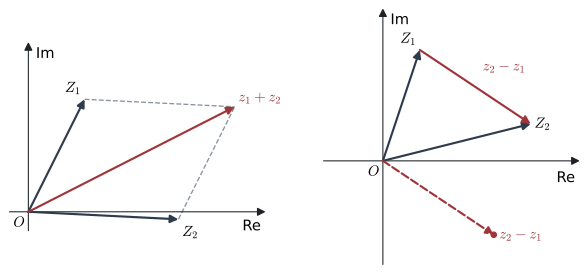
So \(z_1 + z_2\) is the fourth vertex of the parallelogram with sides \(OZ_1\) and \(OZ_2\) (Figure 1, left).
In the same way, \(z_2 - z_1 = (c - a) + (d - b)i\) matches \(\overrightarrow{OZ_2} - \overrightarrow{OZ_1} = \overrightarrow{Z_1Z_2}\): the number \(z_2 - z_1\) is the vector from \(Z_1\) to \(Z_2\) (Figure 1, right).
Sums and differences Not in the formula booklet
- \(z_1 + z_2\) is the fourth vertex of the parallelogram \(OZ_1PZ_2\).
- \(z_2 - z_1\) represents the vector \(\overrightarrow{Z_1Z_2}\).
- \(|z_2 - z_1|\) is the distance between \(Z_1\) and \(Z_2\).
- \(z_1, z_2\): two complex numbers
- \(O\): the origin
- \(Z_1, Z_2\): the points that represent \(z_1\) and \(z_2\)
- \(P\): the point that represents \(z_1 + z_2\)
Example 1 (a) In an Argand diagram, the points \(A\) and \(B\) represent \(3 + 4i\) and \(7 + i\). \(OABC\) is a rhombus, where \(O\) is the origin. Find the complex number represented by \(C\), and check that the four sides are equal.
(b) The points \(Z\) and \(W\) represent \(2 + 5i\) and \(4 - 2i\). The point \(P\) is such that \(OZPW\) (in this order) is a parallelogram. Find the complex number \(p\) represented by \(P\).
(a) In a rhombus (a parallelogram) \(\overrightarrow{OC} = \overrightarrow{AB}\), so
\[ c = b - a = (7 + i) - (3 + 4i) = 4 - 3i . \]
Sides: \(|a| = |3 + 4i| = 5\), \(\;|b - a| = |4 - 3i| = 5\), \(\;|c| = 5\), \(\;|b - c| = |3 + 4i| = 5\) ✓.
(b) \(OZPW\) is a parallelogram, so \(\overrightarrow{OP} = \overrightarrow{OZ} + \overrightarrow{OW}\):
\[ p = (2 + 5i) + (4 - 2i) = 6 + 3i . \]
Geometric effects of operations
The conjugate and the negative
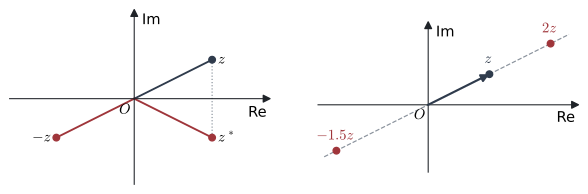
For \(z = x + iy\) at the point \(Z(x, y)\) (Figure 2, left):
- \(z^* = x - iy\) is at \((x, -y)\): the reflection of \(Z\) in the real axis.
- \(-z = -x - iy\) is at \((-x, -y)\): the rotation of \(Z\) by \(\pi\) about \(O\) (a half-turn).
Multiplying by a real number
For a real number \(k\), the point \(kz\) is on the line through \(O\) and \(Z\) (Figure 2, right):
- if \(k > 0\), \(kz\) is \(k\) times as far from \(O\) as \(Z\), in the same direction;
- if \(k < 0\), \(kz\) is \(|k|\) times as far from \(O\), in the opposite direction.
This is an enlargement with centre \(O\) and scale factor \(k\).
Multiplying by \(\mathrm{e}^{i\theta}\): a rotation
Let \(z = \mathrm{e}^{i\theta}w\). Since \(|\mathrm{e}^{i\theta}| = 1\),
\[ |z| = |w| \qquad\text{and}\qquad \arg z = \arg w + \theta . \]
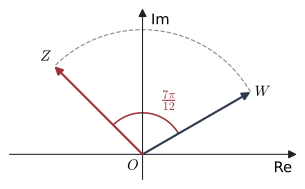
The point \(Z\) is the same distance from \(O\) as \(W\), but turned through the angle \(\theta\). So multiplying by \(\mathrm{e}^{i\theta}\) rotates the point anticlockwise through \(\theta\) about the origin (clockwise if \(\theta < 0\)).
For example, let \(w = 3\mathrm{e}^{i\frac{\pi}{6}}\) and \(z = 3\mathrm{e}^{i\frac{3\pi}{4}}\). Since \(\dfrac{\pi}{6} + \dfrac{7\pi}{12} = \dfrac{3\pi}{4}\),
\[ z = 3\mathrm{e}^{i\frac{3\pi}{4}} = 3\mathrm{e}^{i\frac{\pi}{6}}\,\mathrm{e}^{i\frac{7\pi}{12}} = w\,\mathrm{e}^{i\frac{7\pi}{12}} . \]
The modulus stays the same and the argument increases by \(\dfrac{7\pi}{12}\). This is a rotation through \(\dfrac{7\pi}{12}\) anticlockwise about the origin (Figure 3).
Since \(i = \mathrm{e}^{i\frac{\pi}{2}}\), multiplying by \(i\) is a rotation of \(\dfrac{\pi}{2}\) anticlockwise. For example, \(i(3 + i) = -1 + 3i\): the point \((3, 1)\) moves to \((-1, 3)\).
More generally, \(r\mathrm{e}^{i\theta}\) has modulus \(r\) and argument \(\theta\), so multiplying by \(r\mathrm{e}^{i\theta}\) is a rotation through \(\theta\) together with an enlargement of scale factor \(r\), both about \(O\).
Summary of geometric effects (centre \(O\)) Not in the formula booklet
| Operation | Effect on the point \(Z\) |
|---|---|
| \(z \mapsto z^*\) | reflection in the real axis |
| \(z \mapsto -z\) | rotation through \(\pi\) |
| \(z \mapsto kz\), \(k \in \mathbb{R}\) | enlargement, scale factor \(k\) |
| \(z \mapsto iz\) | rotation through \(\dfrac{\pi}{2}\) anticlockwise |
| \(z \mapsto \mathrm{e}^{i\theta}z\) | rotation through \(\theta\) anticlockwise |
| \(z \mapsto r\mathrm{e}^{i\theta}z\) | rotation through \(\theta\) and enlargement, scale factor \(r\) |
| \(z \mapsto z + w\) | translation by the vector \(w\) |
- \(O\): the origin (the centre of the rotation or enlargement)
- \(Z\): the point that represents \(z\)
- \(z\): a complex number
- \(k\): a real number (the scale factor)
- \(\theta\): the angle of rotation
- \(r\): a positive real number (the scale factor)
- \(w\): a complex number (the translation vector)
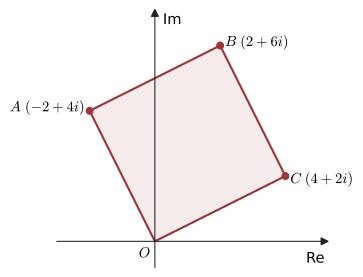
Example 2 Points \(A\), \(B\) and \(C\) in an Argand diagram represent the complex numbers \(a\), \(b\) and \(c = 4 + 2i\), and \(O\) is the origin. \(OCBA\) is a square, with the vertices in anticlockwise order. Find \(a\), and show that \(b = a + c\). Sketch the square and label \(O\), \(A\), \(B\) and \(C\).
Going anticlockwise \(O \to C \to B \to A\), the side \(OA\) is the side \(OC\) turned through \(\dfrac{\pi}{2}\) anticlockwise about \(O\). So
\[ a = ic = i(4 + 2i) = -2 + 4i . \]
\(OCBA\) is a square, so it is a parallelogram and \(\overrightarrow{OB} = \overrightarrow{OC} + \overrightarrow{OA}\):
\[ b = a + c = (-2 + 4i) + (4 + 2i) = 2 + 6i . \]
Example 3 In an Argand diagram, the points \(W\) and \(Z\) represent \(w = 2 + i\) and \(z = a + ib\), where \(a, b \in \mathbb{R}\), and \(O\) is the origin. \(OWZ\) is an equilateral triangle, with \(O\), \(W\), \(Z\) in anticlockwise order. Find the exact values of \(a\) and \(b\).
In an equilateral triangle, \(OZ = OW\) and angle \(WOZ = \dfrac{\pi}{3}\). So \(Z\) is \(W\) rotated through \(\dfrac{\pi}{3}\) anticlockwise about \(O\):
\[ z = \mathrm{e}^{i\frac{\pi}{3}}w = \left(\frac{1}{2} + \frac{\sqrt{3}}{2}i\right)(2 + i) = 1 + \frac{1}{2}i + \sqrt{3}\,i + \frac{\sqrt{3}}{2}i^2 . \]
\[ z = \left(1 - \frac{\sqrt{3}}{2}\right) + \left(\frac{1}{2} + \sqrt{3}\right)i, \qquad a = \frac{2 - \sqrt{3}}{2}, \quad b = \frac{1 + 2\sqrt{3}}{2} . \]
Common errors
| ✗ Wrong | ✓ Right | Why |
|---|---|---|
| \(z_2 - z_1\) is the vector from \(Z_2\) to \(Z_1\) | from \(Z_1\) to \(Z_2\) | Like vectors: \(\overrightarrow{Z_1Z_2} = z_2 - z_1\) (“end minus start”). |
| \(-z\) is the reflection of \(Z\) in the imaginary axis | rotation by \(\pi\) about \(O\) | Both coordinates change sign. Reflection in the imaginary axis is \(-z^*\). |
| Multiplying by \(i\) turns clockwise | anticlockwise through \(\dfrac{\pi}{2}\) | \(\arg i = +\dfrac{\pi}{2}\). Use \(-i\) for clockwise. |
| In Example 2, \(a = -ic\) | \(a = ic\) | Draw the order of the vertices first to see the direction of turn. |
| Rotation by \(\theta\): \(z = w + \mathrm{e}^{i\theta}\) | \(z = \mathrm{e}^{i\theta}w\) | A rotation is a multiplication; adding is a translation. |
Exercises
1 Let \(z_1 = 1 + 3i\) and \(z_2 = 4 - i\). Find \(z_1 + z_2\) and \(z_2 - z_1\), and find the distance between the points \(Z_1\) and \(Z_2\).
\(z_1 + z_2 = 5 + 2i\). \(\;z_2 - z_1 = 3 - 4i\). Distance \(= |z_2 - z_1| = \sqrt{9 + 16} = 5\).
2 \(OPQR\) (in this order) is a parallelogram, where \(P\) and \(R\) represent \(5 + i\) and \(2 + 4i\). Find the complex number represented by \(Q\), and the complex number at the point where the diagonals meet.
\(q = p + r = 7 + 5i\). The diagonals bisect each other, so they meet at \(\dfrac{q}{2} = \dfrac{7}{2} + \dfrac{5}{2}i\).
3 Describe the single transformation that maps the point \(Z\) onto the point representing
(a) \(z^*\)
(b) \(-z\)
(c) \(3z\)
(d) \(iz\)
(e) \(-iz\)
(a) Reflection in the real axis.
(b) Rotation through \(\pi\) about \(O\).
(c) Enlargement, centre \(O\), scale factor \(3\).
(d) Rotation through \(\dfrac{\pi}{2}\) anticlockwise about \(O\).
(e) Rotation through \(\dfrac{\pi}{2}\) clockwise about \(O\) (since \(-i = \mathrm{e}^{-i\frac{\pi}{2}}\)).
4 The point \(Z\) represents \(4 - 2i\). Find the complex number for the image of \(Z\) after a rotation about \(O\) of
(a) \(\dfrac{\pi}{2}\) anticlockwise,
(b) \(\pi\),
(c) \(\dfrac{\pi}{2}\) clockwise.
(a) \(i(4 - 2i) = 2 + 4i\)
(b) \(-(4 - 2i) = -4 + 2i\)
(c) \(-i(4 - 2i) = -2 - 4i\)
5 The point \(Z\) represents \(2\sqrt{3} + 2i\). It is rotated anticlockwise about \(O\) through \(\dfrac{\pi}{3}\). Find the complex number for the image.
\(2\sqrt{3} + 2i = 4\mathrm{e}^{i\frac{\pi}{6}}\). The image is \(\mathrm{e}^{i\frac{\pi}{3}} \times 4\mathrm{e}^{i\frac{\pi}{6}} = 4\mathrm{e}^{i\frac{\pi}{2}} = 4i\).
6 Let \(w = 1 + i\). Describe the geometric effect of multiplying \(w\) by \(2\mathrm{e}^{i\frac{\pi}{4}}\), and find the result in Cartesian form.
It is a rotation through \(\dfrac{\pi}{4}\) anticlockwise and an enlargement with scale factor \(2\), both about \(O\).
\(w = \sqrt{2}\,\mathrm{e}^{i\frac{\pi}{4}}\), so the result is \(2\sqrt{2}\,\mathrm{e}^{i\frac{\pi}{2}} = 2\sqrt{2}\,i\).
7 \(A\) and \(B\) represent \(1 + 2i\) and \(5 + 4i\). \(ABCD\) is a square with the vertices in anticlockwise order. Find the complex numbers for \(C\) and \(D\).
\(\overrightarrow{AB} = b - a = 4 + 2i\). Turning anticlockwise, \(\overrightarrow{BC} = i(4 + 2i) = -2 + 4i\).
\(c = b + (-2 + 4i) = 3 + 8i\) and \(d = a + (-2 + 4i) = -1 + 6i\).
8 \(OWZ\) is an equilateral triangle, with \(O\), \(W\), \(Z\) in clockwise order. \(W\) represents \(4\). Find \(z\) in the form \(x + iy\).
Clockwise, so rotate through \(-\dfrac{\pi}{3}\): \(\;z = 4\mathrm{e}^{-i\frac{\pi}{3}} = 4\left(\dfrac{1}{2} - \dfrac{\sqrt{3}}{2}i\right) = 2 - 2\sqrt{3}\,i\).
9 Let \(z = 1 + 2i\) and \(z' = (1 + i)z\).
(a) Find \(z'\). Describe the transformation \(z \mapsto (1 + i)z\).
(b) Show that \(z' - z = iz\). Hence show that the triangle \(OZZ'\) is right-angled and isosceles.
(a) \(z' = (1 + i)(1 + 2i) = 1 + 2i + i - 2 = -1 + 3i\). \(1 + i = \sqrt{2}\,\mathrm{e}^{i\frac{\pi}{4}}\), so it is a rotation through \(\dfrac{\pi}{4}\) anticlockwise and an enlargement with scale factor \(\sqrt{2}\), about \(O\).
(b) \(z' - z = (1 + i)z - z = iz\). So \(\overrightarrow{ZZ'}\) is \(\overrightarrow{OZ}\) turned through \(\dfrac{\pi}{2}\): the angle at \(Z\) is a right angle, and \(ZZ' = |iz| = |z| = OZ\). So the triangle is right-angled and isosceles.
10 A regular hexagon has its centre at \(O\), and one vertex at \(2 + 2i\).
(a) Find the complex number for the next vertex in the anticlockwise direction.
(b) Find the exact area of the hexagon.
(a) The vertices are \(\dfrac{2\pi}{6} = \dfrac{\pi}{3}\) apart, so multiply by \(\mathrm{e}^{i\frac{\pi}{3}}\):
\[ (2 + 2i)\left(\frac{1}{2} + \frac{\sqrt{3}}{2}i\right) = 1 + \sqrt{3}\,i + i - \sqrt{3} = (1 - \sqrt{3}) + (1 + \sqrt{3})i . \]
(b) The hexagon is six equilateral triangles with side \(|2 + 2i| = 2\sqrt{2}\).
\[ \text{Area} = 6 \times \frac{\sqrt{3}}{4}(2\sqrt{2})^2 = 6 \times \frac{\sqrt{3}}{4} \times 8 = 12\sqrt{3} . \]