24.1 The Concept of a Limit
SL 5.1
- what \(\displaystyle\lim_{x \to a} f(x) = L\) means
- how to estimate a limit from a table or a graph
- when a limit does not exist
The idea of a limit
Look at the function
\[ f(x) = \frac{x^2 - 9}{x - 3}. \]
We cannot put \(x = 3\) into \(f(x)\), because this gives \(\frac{0}{0}\). So \(f(3)\) is undefined. But we can look at the values of \(f(x)\) when \(x\) is close to 3, from the left and from the right.
| \(x\) | \(2.9\) | \(2.99\) | \(2.999\) | \(3\) | \(3.001\) | \(3.01\) | \(3.1\) |
|---|---|---|---|---|---|---|---|
| \(f(x)\) | \(5.9\) | \(5.99\) | \(5.999\) | undefined | \(6.001\) | \(6.01\) | \(6.1\) |
From both sides, the values of \(f(x)\) get closer and closer to \(6\). The graph of \(y = f(x)\) is the line \(y = x + 3\) with one point missing: a hole at \((3, 6)\).
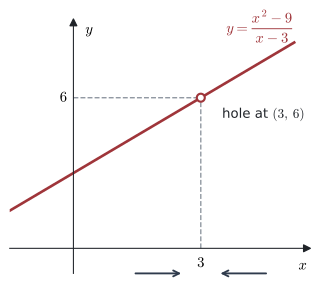
We say “the limit of \(f(x)\) as \(x\) approaches 3 is 6”, and we write
\[ \lim_{x \to 3} f(x) = 6 \qquad \text{or} \qquad \lim_{x \to 3} \frac{x^2 - 9}{x - 3} = 6. \]
The limit of a function Not in the formula booklet
If \(f(x)\) gets closer and closer to a fixed number \(L\) when \(x\) gets closer and closer to \(a\) (from both sides, with \(x \neq a\)), then
\[ \lim_{x \to a} f(x) = L. \]
The value \(f(a)\) itself does not matter. \(f(a)\) may be different from \(L\), or it may not exist at all.
When a limit does not exist. If \(f(x)\) does not approach one fixed value as \(x \to a\), we say that \(\displaystyle\lim_{x \to a} f(x)\) does not exist. Two common cases are shown below:
- a jump: \(f(x)\) approaches different values from the left and from the right;
- \(f(x)\) becomes infinitely large near \(x = a\) (a vertical asymptote).
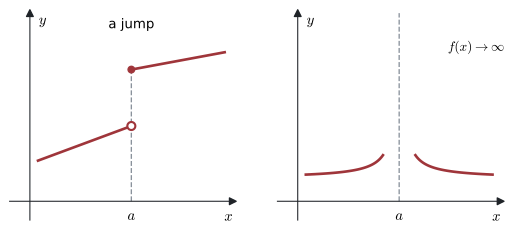
Example 1 Use each graph of \(y = f(x)\) below to find \(\displaystyle\lim_{x \to a} f(x)\), if it exists.
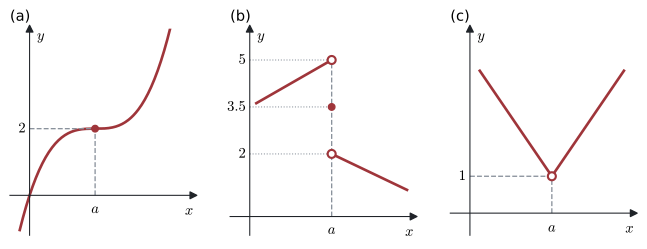
(a) The curve has no break at \(x = a\). From both sides, \(f(x) \to 2\). So \(\displaystyle\lim_{x \to a} f(x) = 2\).
(b) From the left, \(f(x) \to 5\). From the right, \(f(x) \to 2\). These are different, so \(\displaystyle\lim_{x \to a} f(x)\) does not exist. (The value \(f(a) = 3.5\) does not change this.)
(c) From both sides, \(f(x) \to 1\), so \(\displaystyle\lim_{x \to a} f(x) = 1\), even though \(f(a)\) is not defined (there is a hole).
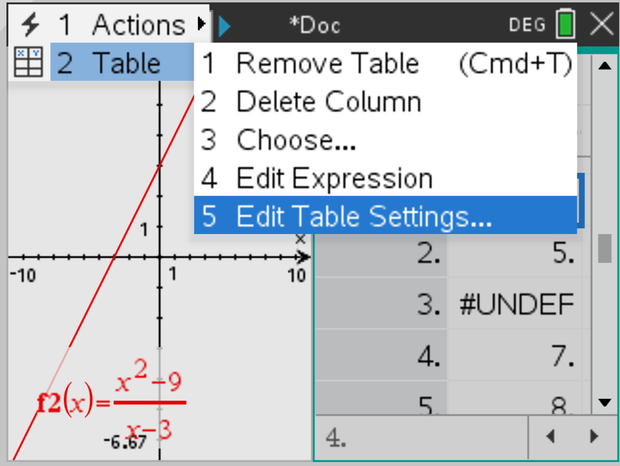
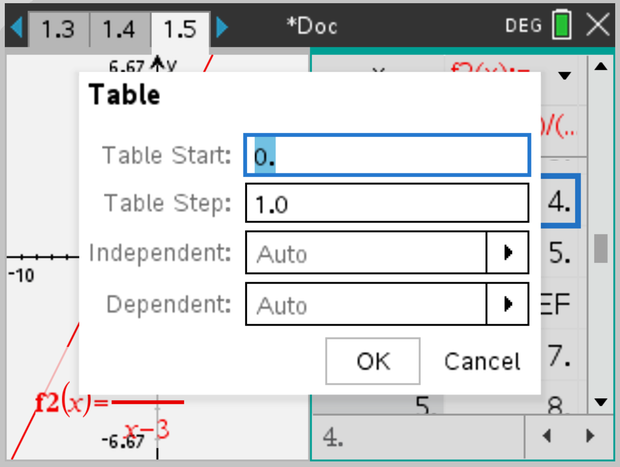
- Open a Graphs page and enter \(f_1(x) = \dfrac{x^2 - 9}{x - 3}\).
- Press ctrl + T: a table appears next to the graph (split screen).
- Click in the table, then Menu → Table → Edit Table Settings.
- In the Table box, set Table Start \(= 2.9\) and Table Step \(= 0.01\), then OK.
- Look at the values on both sides of \(x = 3\). At \(x = 3\) itself the table shows #UNDEF.
Common errors
| ✗ Wrong | ✓ Right | Why |
|---|---|---|
| \(\displaystyle\lim_{x \to a} f(x) = f(a)\) for every graph | Only when there is no hole or jump at \(a\) | At a hole or a jump, \(f(a)\) can be different from the limit. |
| The limit exists because the left-hand side approaches a value | Both sides must approach the same value | In Example 1 (b) the two sides give 5 and 2. |
Exercises
1 Let \(f(x) = \dfrac{x^2 + x - 6}{x - 2}\).
(a) Copy and complete the table.
| \(x\) | \(1.9\) | \(1.99\) | \(2.01\) | \(2.1\) |
|---|---|---|---|---|
| \(f(x)\) |
(b) Hence estimate \(\displaystyle\lim_{x \to 2} f(x)\).
(a) \(f(x) = \dfrac{(x + 3)(x - 2)}{x - 2} = x + 3\) for \(x \neq 2\), so the values are \(4.9,\ 4.99,\ 5.01,\ 5.1\).
(b) \(\displaystyle\lim_{x \to 2} f(x) = 5\).
2 The function \(f\) is defined by \(f(x) = 2x + 1\) for \(x < 1\), \(f(1) = 4\), and \(f(x) = 5 - x\) for \(x > 1\). Find the value that \(f(x)\) approaches from the left of \(x = 1\), and from the right. Does \(\displaystyle\lim_{x \to 1} f(x)\) exist?
From the left: \(2(1) + 1 = 3\). From the right: \(5 - 1 = 4\). The two values are different, so \(\displaystyle\lim_{x \to 1} f(x)\) does not exist (even though \(f(1) = 4\)).
3 Paper 2 Use a table of values on your GDC to estimate \(\displaystyle\lim_{x \to 0} \frac{\mathrm{e}^x - 1}{x}\).
| \(x\) | \(-0.1\) | \(-0.01\) | \(0.01\) | \(0.1\) |
|---|---|---|---|---|
| \(f(x)\) | \(0.9516\) | \(0.9950\) | \(1.0050\) | \(1.0517\) |
From both sides the values approach \(1\), so the limit is \(1\).
4 Let \(f(x) = \dfrac{x^2 - 1}{x - 1}\).
(a) Explain why \(f(1)\) is not defined.
(b) Find \(\displaystyle\lim_{x \to 1} f(x)\), and describe the graph of \(y = f(x)\).
(a) \(x = 1\) gives \(\dfrac{0}{0}\), which has no value.
(b) For \(x \neq 1\), \(f(x) = \dfrac{(x + 1)(x - 1)}{x - 1} = x + 1\). As \(x \to 1\), \(f(x) \to 2\), so the limit is \(2\). The graph is the line \(y = x + 1\) with a hole at \((1, 2)\).
5 Does \(\displaystyle\lim_{x \to 2} \frac{1}{(x - 2)^2}\) exist? Give a reason.
No. As \(x \to 2\) from either side, \((x - 2)^2 \to 0\) and is positive, so \(\dfrac{1}{(x - 2)^2}\) becomes infinitely large. It does not approach a fixed number (\(x = 2\) is a vertical asymptote).