26.2 Trigonometric Limits and Limits at Infinity
AHL 5.12
- the important limit \(\displaystyle\lim_{x \to 0} \frac{\sin x}{x} = 1\), and how to use it for other trigonometric limits
- how to use the double angle and compound angle formulae inside a limit
- what \(\displaystyle\lim_{x \to \infty} f(x) = L\) means
- how to find limits at infinity by dividing by the highest power, and by using the conjugate
Limits of trigonometric functions
The function \(\dfrac{\sin x}{x}\) is not defined at \(x = 0\) (it gives \(\frac{0}{0}\)), and we cannot factorise it. So we start with a table.
Example 1 Investigation. With your calculator in radian mode, find \(\dfrac{\sin x}{x}\) to 5 decimal places for \(x = \pm 0.5,\ \pm 0.1,\ \pm 0.01,\ \pm 0.001\). Hence estimate \(\displaystyle\lim_{x \to 0} \frac{\sin x}{x}\).
| \(x\) | \(\pm 0.5\) | \(\pm 0.1\) | \(\pm 0.01\) | \(\pm 0.001\) |
|---|---|---|---|---|
| \(\dfrac{\sin x}{x}\) | \(0.95885\) | \(0.99833\) | \(0.99998\) | \(1.00000\) |
The values are the same for \(x\) and \(-x\), because \(\dfrac{\sin(-x)}{-x} = \dfrac{-\sin x}{-x} = \dfrac{\sin x}{x}\). They get closer and closer to \(1\), so \(\displaystyle\lim_{x \to 0} \frac{\sin x}{x} = 1\).
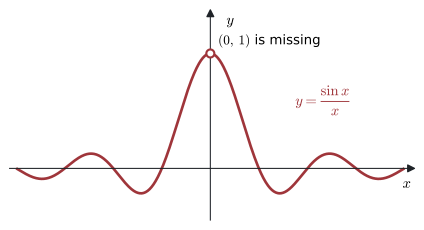
The fundamental trigonometric limit Not in the formula booklet
\[ \lim_{x \to 0} \frac{\sin x}{x} = 1 \qquad (x \text{ in radians}). \]
It follows that, for a constant \(k \neq 0\),
\[ \lim_{x \to 0} \frac{x}{\sin x} = 1, \qquad \lim_{x \to 0} \frac{\tan x}{x} = 1, \qquad \lim_{x \to 0} \frac{\sin kx}{kx} = 1. \]
The syllabus gives \(\lim_{\theta \to 0} \frac{\sin\theta}{\theta} = 1\) as an example of a limit you should know.
Why is \(\displaystyle\lim_{x \to 0} \frac{\tan x}{x} = 1\)? Because \(\dfrac{\tan x}{x} = \dfrac{\sin x}{x} \times \dfrac{1}{\cos x} \to 1 \times 1 = 1\).
Method. Make the angle inside \(\sin\) (or \(\tan\)) appear underneath it, then use the key result.
Example 2 Find
(a) \(\displaystyle\lim_{x \to 0} \frac{\sin 5x}{x}\)
(b) \(\displaystyle\lim_{x \to 0} \frac{\tan 2x}{x}\)
(c) \(\displaystyle\lim_{x \to 0} \frac{\tan 3x}{\sin 5x}\)
(a) \(\dfrac{\sin 5x}{x} = 5 \times \dfrac{\sin 5x}{5x}\). As \(x \to 0\), also \(5x \to 0\), so the limit is \(5 \times 1 = 5\).
(b) \(\dfrac{\tan 2x}{x} = 2 \times \dfrac{\tan 2x}{2x} \to 2 \times 1 = 2\).
(c) Divide the top and bottom by \(x\), and make each angle appear underneath:
\[ \frac{\tan 3x}{\sin 5x} = \frac{3 \times \dfrac{\tan 3x}{3x}}{5 \times \dfrac{\sin 5x}{5x}} \to \frac{3 \times 1}{5 \times 1} = \frac{3}{5}. \]
Sometimes we first use a trigonometric identity, such as a double angle or compound angle formula (see Unit 14).
Example 3 Find
(a) \(\displaystyle\lim_{x \to 0} \frac{1 - \cos 4x}{x^2}\)
(b) \(\displaystyle\lim_{x \to 0} \frac{\cos\left(\frac{\pi}{6} + x\right) - \cos\left(\frac{\pi}{6} - x\right)}{x}\)
(a) Use \(\cos 2A = 1 - 2\sin^2 A\) with \(A = 2x\): \(\;1 - \cos 4x = 2\sin^2 2x\). So
\[ \frac{1 - \cos 4x}{x^2} = 2\left(\frac{\sin 2x}{x}\right)^2 = 2\left(2 \times \frac{\sin 2x}{2x}\right)^2 \to 2 \times 2^2 = 8. \]
(b) Expand both terms with \(\cos(A \pm B) = \cos A \cos B \mp \sin A \sin B\):
\[ \cos\left(\tfrac{\pi}{6} + x\right) - \cos\left(\tfrac{\pi}{6} - x\right) = -2\sin\tfrac{\pi}{6}\,\sin x = -2 \times \tfrac{1}{2} \sin x = -\sin x. \]
So the limit is \(\displaystyle\lim_{x \to 0} \frac{-\sin x}{x} = -1\).
Limits at infinity
Look at \(f(x) = \dfrac{2x + 7}{x + 4}\) for large values of \(x\).
| \(x\) | \(10\) | \(100\) | \(1000\) | \(10\,000\) |
|---|---|---|---|---|
| \(f(x)\) | \(1.9286\) | \(1.9904\) | \(1.9990\) | \(1.9999\) |
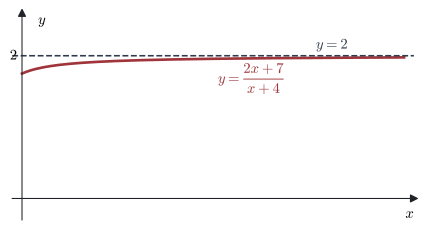
As \(x\) increases without limit (we write \(x \to \infty\)), \(f(x)\) gets closer and closer to \(2\). We write
\[ \lim_{x \to \infty} \frac{2x + 7}{x + 4} = 2. \]
Limits at infinity Not in the formula booklet
If \(f(x)\) gets closer and closer to a fixed number \(L\) as \(x\) increases without limit, then \(\displaystyle\lim_{x \to \infty} f(x) = L\).
In the same way, \(\displaystyle\lim_{x \to -\infty} f(x) = M\) means \(f(x) \to M\) as \(x\) decreases without limit.
Notes.
- \(L\) must be a fixed number. For example, \(x^2\) grows without limit as \(x \to \infty\), so \(\displaystyle\lim_{x \to \infty} x^2\) does not exist. We often write \(\displaystyle\lim_{x \to \infty} x^2 = \infty\) to say how it fails to exist.
- If \(\displaystyle\lim_{x \to \infty} f(x) = L\), then the line \(y = L\) is a horizontal asymptote of the graph (see Section 10.1).
Now look at \(y = \dfrac{1}{x^2 + 4}\). As \(x \to \infty\), the denominator \(x^2 + 4 \to \infty\), so the fraction \(\to 0\). The same happens as \(x \to -\infty\). In general:
Reciprocals of large numbers Not in the formula booklet
If \(f(x) \to \pm\infty\) as \(x \to \infty\), then \(\displaystyle\lim_{x \to \infty} \frac{1}{f(x)} = 0\).
In particular, \(\displaystyle\lim_{x \to \infty} \frac{1}{x^n} = 0\) for every \(n > 0\). The properties of limits from Section 26.1 also hold for limits at infinity.
Method for rational functions. Divide the top and the bottom by the highest power of \(x\) in the denominator. Then every term \(\dfrac{c}{x^n}\) tends to \(0\).
Example 4 Find
(a) \(\displaystyle\lim_{x \to \infty} \frac{x - 3}{x + 5}\)
(b) \(\displaystyle\lim_{x \to \infty} \frac{4x^2 - x + 2}{2x^2 + 3x - 1}\)
(c) \(\displaystyle\lim_{x \to \infty} \frac{3x + 2}{x^2 - 4x + 1}\)
(d) \(\displaystyle\lim_{x \to \infty} \frac{x^3 + 1}{4x^2 - x}\)
(a) Divide by \(x\): \(\;\dfrac{1 - \frac{3}{x}}{1 + \frac{5}{x}} \to \dfrac{1 - 0}{1 + 0} = 1\).
(b) Divide by \(x^2\): \(\;\dfrac{4 - \frac{1}{x} + \frac{2}{x^2}}{2 + \frac{3}{x} - \frac{1}{x^2}} \to \dfrac{4}{2} = 2\).
(c) Divide by \(x^2\): \(\;\dfrac{\frac{3}{x} + \frac{2}{x^2}}{1 - \frac{4}{x} + \frac{1}{x^2}} \to \dfrac{0}{1} = 0\).
(d) Divide by \(x^2\): \(\;\dfrac{x + \frac{1}{x^2}}{4 - \frac{1}{x}}\). The top grows without limit and the bottom \(\to 4\), so the fraction \(\to \infty\). The limit does not exist (\(\displaystyle\lim_{x \to \infty} \frac{x^3 + 1}{4x^2 - x} = \infty\)).
For a rational function, compare the degrees: top degree < bottom degree gives \(0\); equal degrees give the ratio of the leading coefficients; top degree > bottom degree gives no finite limit.
Example 5 Find
(a) \(\displaystyle\lim_{x \to -\infty} \frac{\sqrt{4^x + 25}}{3^x - 2}\)
(b) \(\displaystyle\lim_{x \to \infty} \frac{\sqrt{9x^4 - x^2 + 3}}{2x^2 + 5}\)
(a) As \(x \to -\infty\), \(4^x \to 0\) and \(3^x \to 0\). So the limit is \(\dfrac{\sqrt{0 + 25}}{0 - 2} = -\dfrac{5}{2}\).
(b) Divide the top and bottom by \(x^2\). For \(x > 0\), \(x^2 = \sqrt{x^4}\), so
\[ \frac{\sqrt{9x^4 - x^2 + 3}}{2x^2 + 5} = \frac{\sqrt{9 - \frac{1}{x^2} + \frac{3}{x^4}}}{2 + \frac{5}{x^2}} \to \frac{\sqrt{9}}{2} = \frac{3}{2}. \]
Example 6 (a) Find \(\displaystyle\lim_{x \to \infty} \frac{\sqrt{x^2 + 6x + 1}}{x}\).
(b) Hence find \(\displaystyle\lim_{x \to \infty} \left(\sqrt{x^2 + 6x + 1} - x\right)\).
(a) For \(x > 0\), \(x = \sqrt{x^2}\), so \(\;\dfrac{\sqrt{x^2 + 6x + 1}}{x} = \sqrt{1 + \dfrac{6}{x} + \dfrac{1}{x^2}} \to \sqrt{1} = 1\).
(b) This is “\(\infty - \infty\)”, so multiply by the conjugate:
\[ \left(\sqrt{x^2 + 6x + 1} - x\right) \times \frac{\sqrt{x^2 + 6x + 1} + x}{\sqrt{x^2 + 6x + 1} + x} = \frac{(x^2 + 6x + 1) - x^2}{\sqrt{x^2 + 6x + 1} + x} = \frac{6x + 1}{\sqrt{x^2 + 6x + 1} + x}. \]
Divide the top and bottom by \(x\) and use part (a):
\[ \frac{6 + \frac{1}{x}}{\frac{\sqrt{x^2 + 6x + 1}}{x} + 1} \to \frac{6}{1 + 1} = 3. \]
Example 7 Find \(\displaystyle\lim_{x \to \infty} \sin\left(\frac{\pi x + 5}{6x - 1}\right)\).
Inside: divide by \(x\): \(\;\dfrac{\pi + \frac{5}{x}}{6 - \frac{1}{x}} \to \dfrac{\pi}{6}\).
\(\sin\) is continuous, so the limit is \(\sin\dfrac{\pi}{6} = \dfrac{1}{2}\).
Common errors
| ✗ Wrong | ✓ Right | Why |
|---|---|---|
| \(\displaystyle\lim_{x \to 0} \frac{\sin 5x}{x} = 1\) | \(= 5\) | The angle (\(5x\)) must appear underneath: \(5 \times \frac{\sin 5x}{5x}\). |
| Using degrees | Use radians | \(\frac{\sin x}{x} \to 1\) is true only in radians. |
| “Cancel” \(\sin\): \(\dfrac{\sin 3x}{\sin 5x} = \dfrac{3x}{5x}\) | Write each as \(k \times \frac{\sin kx}{kx}\) | \(\sin\) is a function, not a factor. The answer \(\frac{3}{5}\) is right, but the step is not. |
| \(\infty - \infty = 0\) | Use the conjugate | In Example 6 the answer is 3, not 0. |
| \(\sqrt{9x^4 + \dots} \div x^2\) gives \(\sqrt{9x^2 + \dots}\) | \(x^2 = \sqrt{x^4}\) | Divide inside the root by \(x^4\). |
Exercises
1 Find \(\displaystyle\lim_{x \to 0} \frac{\sin 7x}{x}\).
\(7 \times \dfrac{\sin 7x}{7x} \to 7\).
2 Find \(\displaystyle\lim_{x \to 0} \frac{\tan 3x}{\sin 9x}\).
\(\dfrac{3 \times \frac{\tan 3x}{3x}}{9 \times \frac{\sin 9x}{9x}} \to \dfrac{3}{9} = \dfrac{1}{3}\).
3 Find \(\displaystyle\lim_{x \to 0} \frac{1 - \cos 6x}{x^2}\).
\(1 - \cos 6x = 2\sin^2 3x\), so the fraction is \(2\left(3 \times \dfrac{\sin 3x}{3x}\right)^2 \to 2 \times 9 = 18\).
4 Find \(\displaystyle\lim_{x \to 0} \frac{\sin\left(\frac{\pi}{4} + x\right) - \sin\left(\frac{\pi}{4} - x\right)}{x}\).
\(\sin(A + x) - \sin(A - x) = 2\cos A \sin x\) with \(A = \frac{\pi}{4}\): the top is \(2 \times \dfrac{\sqrt{2}}{2}\sin x = \sqrt{2}\sin x\).
The limit is \(\sqrt{2} \times 1 = \sqrt{2}\).
5 Find \(\displaystyle\lim_{x \to \infty} \frac{5x^2 - 3}{2x^2 + x}\).
Divide by \(x^2\): \(\dfrac{5 - \frac{3}{x^2}}{2 + \frac{1}{x}} \to \dfrac{5}{2}\).
6 Find \(\displaystyle\lim_{x \to \infty} \frac{2x + 1}{x^3 + 4}\).
Divide by \(x^3\): \(\dfrac{\frac{2}{x^2} + \frac{1}{x^3}}{1 + \frac{4}{x^3}} \to \dfrac{0}{1} = 0\).
7 Find \(\displaystyle\lim_{x \to \infty} \frac{\sqrt{16x^2 + 3x}}{2x - 7}\).
Divide by \(x = \sqrt{x^2}\): \(\dfrac{\sqrt{16 + \frac{3}{x}}}{2 - \frac{7}{x}} \to \dfrac{4}{2} = 2\).
8 Find \(\displaystyle\lim_{x \to \infty} \left(\sqrt{x^2 + 10x} - x\right)\).
Conjugate: \(\dfrac{10x}{\sqrt{x^2 + 10x} + x} = \dfrac{10}{\sqrt{1 + \frac{10}{x}} + 1} \to \dfrac{10}{2} = 5\).
9 Find \(\displaystyle\lim_{x \to -\infty} \frac{3 \times 2^x + 1}{2^x - 4}\).
As \(x \to -\infty\), \(2^x \to 0\), so the limit is \(\dfrac{0 + 1}{0 - 4} = -\dfrac{1}{4}\).
10 Find \(\displaystyle\lim_{x \to \infty} \cos\left(\frac{2\pi x + 1}{3x}\right)\).
Inside: \(\dfrac{2\pi + \frac{1}{x}}{3} \to \dfrac{2\pi}{3}\). So the limit is \(\cos\dfrac{2\pi}{3} = -\dfrac{1}{2}\).