27.1 Anti-Derivatives and Indefinite Integrals
SL 5.5
- what an anti-derivative is, and why every indefinite integral has a constant \(+\,C\)
- the power rule for integration, and the rules for constant multiples, sums and differences
- how to integrate \((ax + b)^n\), a power of a linear expression
- how to find the constant \(C\) from a boundary condition, such as a point on a curve
Integration is the reverse of differentiation. Before you start, make sure you can differentiate powers of \(x\) quickly (see Unit 24).
Anti-derivatives and the constant of integration
Suppose two functions \(f\) and \(F\) are linked by
\[ \frac{\mathrm{d}}{\mathrm{d}x}F(x) = f(x). \]
Then \(f\) is the derivative of \(F\), and \(F\) is an anti-derivative of \(f\).
For example, if \(f(x) = 3x^2\), we can take \(F(x) = x^3\), because \(\dfrac{\mathrm{d}}{\mathrm{d}x}\left(x^3\right) = 3x^2\). Finding \(F\) when we know \(f\) is called anti-differentiation.
But \(x^3\) is not the only answer. The functions \(x^3 + 1\), \(x^3 - 7\) and \(x^3 + \pi\) also have derivative \(3x^2\), because the derivative of a constant is \(0\):
\[ \frac{\mathrm{d}}{\mathrm{d}x}\big[F(x) + C\big] = F'(x) + 0 = f(x). \]
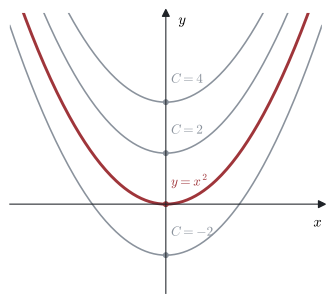
So \(f\) has a whole family of anti-derivatives \(F(x) + C\), where \(C\) is any constant. On a graph, these are copies of one curve, translated vertically (Figure 1).
The indefinite integral Not in the formula booklet
If \(\dfrac{\mathrm{d}}{\mathrm{d}x}F(x) = f(x)\), then the indefinite integral of \(f(x)\) with respect to \(x\) is
\[ \int f(x)\,\mathrm{d}x = F(x) + C. \]
- \(\int\) is the integral sign, and \(\mathrm{d}x\) says that \(x\) is the variable.
- \(f(x)\) is the integrand.
- \(C\) is an arbitrary constant, the constant of integration. Always write it.
Finding an integral is called integration. You can always check an answer by differentiating it.
Example 1 (a) Given that \(y = x(x^2 + 9)\), show that \(\dfrac{\mathrm{d}y}{\mathrm{d}x}\) can be written as \(a(x^2 + 3)\), and state the value of \(a\).
(b) Hence find \(\displaystyle\int (6x^2 + 18)\,\mathrm{d}x\).
(a) \(y = x^3 + 9x\), so \(\dfrac{\mathrm{d}y}{\mathrm{d}x} = 3x^2 + 9 = 3(x^2 + 3)\). So \(a = 3\).
(b) \(6x^2 + 18 = 6(x^2 + 3) = 2 \times 3(x^2 + 3)\), which is twice the derivative in (a). So
\[ \int (6x^2 + 18)\,\mathrm{d}x = 2x(x^2 + 9) + C. \]
Check: \(\dfrac{\mathrm{d}}{\mathrm{d}x}\left(2x^3 + 18x\right) = 6x^2 + 18\) ✓
The power rule
If \(n \neq -1\), then
\[ \frac{\mathrm{d}}{\mathrm{d}x}\left(\frac{x^{n+1}}{n + 1}\right) = \frac{(n + 1)x^n}{n + 1} = x^n. \]
Reversing this gives the most important rule of integration.
Power rule In the formula booklet
\[ \int x^n\,\mathrm{d}x = \frac{x^{n+1}}{n + 1} + C, \quad n \neq -1 \]
Here \(n\) may be any rational number. In words: add one to the power, then divide by the new power.
- \(n\): the power (\(n\) may be any rational number, but \(n \neq -1\))
- \(C\): the constant of integration
The rule fails for \(n = -1\) because we would divide by \(0\). The integral of \(x^{-1} = \dfrac{1}{x}\) is a logarithm (see Section 27.2).
Example 2 Integrate with respect to \(x\):
(a) \(x^7\) \(\qquad\) (b) \(\dfrac{1}{x^5}\) \(\qquad\) (c) \(\sqrt[3]{x^2}\)
First write each integrand as a power of \(x\).
(a) \(\displaystyle\int x^7\,\mathrm{d}x = \frac{x^8}{8} + C\)
(b) \(\displaystyle\int x^{-5}\,\mathrm{d}x = \frac{x^{-4}}{-4} + C = -\frac{1}{4x^4} + C\)
(c) \(\displaystyle\int x^{\frac{2}{3}}\,\mathrm{d}x = \frac{x^{\frac{5}{3}}}{\frac{5}{3}} + C = \frac{3}{5}x^{\frac{5}{3}} + C\)
Properties of indefinite integrals
For differentiation, \(\dfrac{\mathrm{d}}{\mathrm{d}x}\big[kf(x)\big] = k\dfrac{\mathrm{d}}{\mathrm{d}x}\big[f(x)\big]\), and the derivative of a sum is the sum of the derivatives. Integration has the same two rules.
Constant multiples, sums and differences Not in the formula booklet
If \(k\) is a constant,
\[ \int k f(x)\,\mathrm{d}x = k\int f(x)\,\mathrm{d}x, \qquad \int \big[f(x) \pm g(x)\big]\,\mathrm{d}x = \int f(x)\,\mathrm{d}x \pm \int g(x)\,\mathrm{d}x. \]
There is no product rule or quotient rule for integration. Multiply out products and split quotients first.
Example 3 Find these indefinite integrals.
(a) \(\displaystyle\int (4x^3 - 6x)\,\mathrm{d}x\)
(b) \(\displaystyle\int x^2(3 - x)\,\mathrm{d}x\)
(c) \(\displaystyle\int \frac{x^4 + 2}{x^2}\,\mathrm{d}x\)
(d) \(\displaystyle\int \frac{3x - x^2}{\sqrt{x}}\,\mathrm{d}x\)
(a) \(\displaystyle\int (4x^3 - 6x)\,\mathrm{d}x = x^4 - 3x^2 + C\)
(b) Expand first: \(\displaystyle\int (3x^2 - x^3)\,\mathrm{d}x = x^3 - \frac{x^4}{4} + C\)
(c) Split the fraction: \(\dfrac{x^4 + 2}{x^2} = x^2 + 2x^{-2}\).
\[ \int (x^2 + 2x^{-2})\,\mathrm{d}x = \frac{x^3}{3} - 2x^{-1} + C = \frac{x^3}{3} - \frac{2}{x} + C \]
(d) \(\dfrac{3x - x^2}{x^{\frac{1}{2}}} = 3x^{\frac{1}{2}} - x^{\frac{3}{2}}\).
\[ \int \left(3x^{\frac{1}{2}} - x^{\frac{3}{2}}\right)\mathrm{d}x = 3 \cdot \frac{2}{3}x^{\frac{3}{2}} - \frac{2}{5}x^{\frac{5}{2}} + C = 2x^{\frac{3}{2}} - \frac{2}{5}x^{\frac{5}{2}} + C \]
Example 4 (a) Find \(\dfrac{\mathrm{d}}{\mathrm{d}x}\left(\sqrt{3x + 2}\right)\).
(b) Hence find \(\displaystyle\int \frac{1}{\sqrt{3x + 2}}\,\mathrm{d}x\).
(a) By the chain rule, \(\dfrac{\mathrm{d}}{\mathrm{d}x}(3x + 2)^{\frac{1}{2}} = \dfrac{1}{2}(3x + 2)^{-\frac{1}{2}} \times 3 = \dfrac{3}{2\sqrt{3x + 2}}\).
(b) The integrand is \(\dfrac{2}{3}\) of the derivative in (a), so
\[ \int \frac{1}{\sqrt{3x + 2}}\,\mathrm{d}x = \frac{2}{3}\sqrt{3x + 2} + C. \]
Powers of a linear expression
What is \(\displaystyle\int (ax + b)^n\,\mathrm{d}x\), where \(a \neq 0\) and \(n \neq -1\)? By the chain rule,
\[ \frac{\mathrm{d}}{\mathrm{d}x}(ax + b)^{n+1} = (n + 1)(ax + b)^n \times a, \qquad\text{so}\qquad \frac{\mathrm{d}}{\mathrm{d}x}\left[\frac{(ax + b)^{n+1}}{a(n + 1)}\right] = (ax + b)^n. \]
Power of a linear expression Not in the formula booklet
\[ \int (ax + b)^n\,\mathrm{d}x = \frac{(ax + b)^{n+1}}{a(n + 1)} + C, \qquad a \neq 0,\ n \neq -1. \]
Use the power rule on the bracket, then divide by \(a\), the coefficient of \(x\).
- \(a\): the coefficient of \(x\) (\(a \neq 0\))
- \(b\): the constant term
- \(n\): the power of the bracket (\(n \neq -1\))
- \(C\): the constant of integration
Example 5 Find
(a) \(\displaystyle\int (5 - 2x)^6\,\mathrm{d}x\)
(b) \(\displaystyle\int \frac{1}{(2x + 3)^5}\,\mathrm{d}x\)
(c) \(\displaystyle\int \frac{1}{\sqrt{9 - 4x}}\,\mathrm{d}x\)
(a) \(a = -2\), \(n = 6\): \(\displaystyle\int (5 - 2x)^6\,\mathrm{d}x = \frac{(5 - 2x)^7}{(-2)(7)} + C = -\frac{(5 - 2x)^7}{14} + C\)
(b) \(\displaystyle\int (2x + 3)^{-5}\,\mathrm{d}x = \frac{(2x + 3)^{-4}}{2 \times (-4)} + C = -\frac{1}{8(2x + 3)^4} + C\)
(c) \(\displaystyle\int (9 - 4x)^{-\frac{1}{2}}\,\mathrm{d}x = \frac{(9 - 4x)^{\frac{1}{2}}}{(-4)\left(\frac{1}{2}\right)} + C = -\frac{1}{2}\sqrt{9 - 4x} + C\)
Finding the constant: boundary conditions
An indefinite integral gives a family of curves. If we also know one point on the curve (a boundary condition), we can find \(C\) and choose one member of the family.
Example 6 The gradient of a curve at any point \((x, y)\) is given by \(\dfrac{\mathrm{d}y}{\mathrm{d}x} = x^2(4x - 3)\). The curve passes through the point \((2, -3)\). Find the equation of the curve.
\(\dfrac{\mathrm{d}y}{\mathrm{d}x} = 4x^3 - 3x^2\), so
\[ y = \int (4x^3 - 3x^2)\,\mathrm{d}x = x^4 - x^3 + C. \]
At \((2, -3)\): \(\;-3 = 16 - 8 + C\), so \(C = -11\).
The curve is \(y = x^4 - x^3 - 11\).
Example 7 A curve has \(\dfrac{\mathrm{d}^2y}{\mathrm{d}x^2} = 12x - 4\). The points \((0, 5)\) and \((2, 3)\) lie on the curve. Find the equation of the curve.
Integrate twice. Each integration gives a new constant.
\[ \frac{\mathrm{d}y}{\mathrm{d}x} = 6x^2 - 4x + A, \qquad y = 2x^3 - 2x^2 + Ax + B. \]
At \((0, 5)\): \(5 = B\).
At \((2, 3)\): \(3 = 16 - 8 + 2A + 5\), so \(2A = -10\) and \(A = -5\).
The curve is \(y = 2x^3 - 2x^2 - 5x + 5\).
You can check an answer such as \(F(x) = 2x^3 - 2x^2 - 5x + 5\) from Example 7 by comparing \(F'(a)\) with the given derivative at one value of \(x\).
- Calculator → Menu → Calculus → Numerical Derivative at a Point.
- In the dialog box enter the variable \(x\), the value (for example \(1.5\)) and choose 2nd Derivative (for \(\dfrac{\mathrm{d}^2y}{\mathrm{d}x^2}\)).
- Type the expression \(2x^3 - 2x^2 - 5x + 5\) and press enter. You should get \(14\), which equals \(12(1.5) - 4\) ✓.
This is only a check at one point; on Paper 1 check by differentiating by hand.
Common errors
| ✗ Wrong | ✓ Right | Why |
|---|---|---|
| \(\int x^3\,\mathrm{d}x = \dfrac{x^4}{4}\) | \(\dfrac{x^4}{4} + C\) | An indefinite integral is a whole family; the constant is part of the answer. |
| \(\int x^{-1}\,\mathrm{d}x = \dfrac{x^0}{0}\) | \(\ln\lvert x\rvert + C\) | The power rule needs \(n \neq -1\). |
| \(\int x(x + 1)\,\mathrm{d}x = \dfrac{x^2}{2}\cdot\dfrac{(x + 1)^2}{2}\) | Expand first: \(\int (x^2 + x)\,\mathrm{d}x\) | There is no product rule for integration. |
| \(\int (3x + 1)^4\,\mathrm{d}x = \dfrac{(3x + 1)^5}{5}\) | \(\dfrac{(3x + 1)^5}{15} + C\) | Divide by \(a = 3\) as well. |
| \(\int \dfrac{1}{x^3}\,\mathrm{d}x = \dfrac{1}{4x^4}\) | \(-\dfrac{1}{2x^2} + C\) | Write \(x^{-3}\); the new power is \(-2\). |
Exercises
1 Find \(\displaystyle\int (6x^2 - 4x + 5)\,\mathrm{d}x\).
\(2x^3 - 2x^2 + 5x + C\).
2 Find \(\displaystyle\int \left(\frac{3}{x^4} - 4\sqrt{x}\right)\mathrm{d}x\).
\(\displaystyle\int \left(3x^{-4} - 4x^{\frac{1}{2}}\right)\mathrm{d}x = \frac{3x^{-3}}{-3} - 4 \cdot \frac{2}{3}x^{\frac{3}{2}} + C = -\frac{1}{x^3} - \frac{8}{3}x^{\frac{3}{2}} + C\).
3 Find \(\displaystyle\int (x + 3)(2x - 1)\,\mathrm{d}x\).
\((x + 3)(2x - 1) = 2x^2 + 5x - 3\), so the integral is \(\dfrac{2}{3}x^3 + \dfrac{5}{2}x^2 - 3x + C\).
4 Find \(\displaystyle\int \frac{(x + 1)^2}{\sqrt{x}}\,\mathrm{d}x\).
\(\dfrac{x^2 + 2x + 1}{x^{\frac{1}{2}}} = x^{\frac{3}{2}} + 2x^{\frac{1}{2}} + x^{-\frac{1}{2}}\).
\[ \int \left(x^{\frac{3}{2}} + 2x^{\frac{1}{2}} + x^{-\frac{1}{2}}\right)\mathrm{d}x = \frac{2}{5}x^{\frac{5}{2}} + \frac{4}{3}x^{\frac{3}{2}} + 2x^{\frac{1}{2}} + C. \]
5 Find \(\displaystyle\int (4x - 7)^3\,\mathrm{d}x\).
\(\dfrac{(4x - 7)^4}{4 \times 4} + C = \dfrac{(4x - 7)^4}{16} + C\).
6 Find \(\displaystyle\int \frac{6}{(1 - 3x)^3}\,\mathrm{d}x\).
\(\displaystyle 6\int (1 - 3x)^{-3}\,\mathrm{d}x = 6 \cdot \frac{(1 - 3x)^{-2}}{(-3)(-2)} + C = \frac{1}{(1 - 3x)^2} + C\).
7 Find \(\displaystyle\int 2\sqrt{5x + 2}\,\mathrm{d}x\).
\(\displaystyle 2 \cdot \frac{(5x + 2)^{\frac{3}{2}}}{5 \times \frac{3}{2}} + C = \frac{4}{15}(5x + 2)^{\frac{3}{2}} + C\).
8 A curve has gradient \(\dfrac{\mathrm{d}y}{\mathrm{d}x} = 3x^2 - 4x + 1\), and \(y = 6\) when \(x = 2\). Find \(y\) in terms of \(x\).
\(y = x^3 - 2x^2 + x + C\). At \(x = 2\): \(6 = 8 - 8 + 2 + C\), so \(C = 4\).
\(y = x^3 - 2x^2 + x + 4\).
9 A function has \(f''(x) = 6x + 2\), \(f'(1) = 4\) and \(f(0) = -1\). Find \(f(x)\).
\(f'(x) = 3x^2 + 2x + A\). \(\;f'(1) = 5 + A = 4\), so \(A = -1\).
\(f(x) = x^3 + x^2 - x + B\). \(\;f(0) = B = -1\).
\(f(x) = x^3 + x^2 - x - 1\).
10
(a) Find \(\dfrac{\mathrm{d}}{\mathrm{d}x}\left[(x^2 + 4)^{\frac{3}{2}}\right]\).
(b) Hence find \(\displaystyle\int x\sqrt{x^2 + 4}\,\mathrm{d}x\).
(a) \(\dfrac{3}{2}(x^2 + 4)^{\frac{1}{2}} \times 2x = 3x\sqrt{x^2 + 4}\).
(b) The integrand is \(\dfrac{1}{3}\) of this, so \(\displaystyle\int x\sqrt{x^2 + 4}\,\mathrm{d}x = \frac{1}{3}(x^2 + 4)^{\frac{3}{2}} + C\).