28.2 The Definite Integral as a Limit of a Sum
SL 5.5
- how the area under a curve can be approximated by the sum of the areas of rectangles
- lower and upper sums, and why the true area lies between them
- why the area is the limit of this sum as the strips become thinner: \(\;A = \displaystyle\lim_{\delta x \to 0}\sum y\,\delta x = \int_a^b y\,\mathrm{d}x\)
- how to use sigma notation to find the limit of a sum of rectangles
Strips and rectangles
Let \(A\) be the area of the region \(R\) under the curve \(y = f(x)\) (with \(f(x) \geq 0\)), between \(x = a\) and \(x = b\). Cut \(R\) into thin vertical strips. Let one strip have width \(\delta x\) and area \(\delta A\).
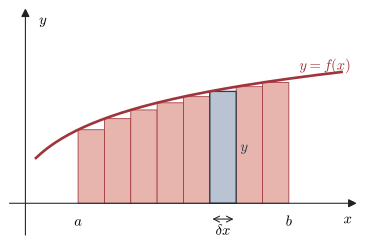
If we treat each strip as a rectangle of height \(y\), a small piece of area near the curve is missed (or added). So the area of one strip is only approximately
\[ \delta A \approx y\,\delta x . \qquad (1) \]
Adding all the strips from \(x = a\) to \(x = b\):
\[ A = \sum_{x = a}^{b} \delta A \approx \sum_{x = a}^{b} y\,\delta x . \]
When the strips become thinner, there are more of them, and the rectangles fill the region better. So the approximation gets better as \(\delta x \to 0\):
\[ A = \lim_{\delta x \to 0}\sum_{x = a}^{b} y\,\delta x . \qquad (2) \]
Now divide (1) by \(\delta x\): \(\;\dfrac{\delta A}{\delta x} \approx y\). As \(\delta x \to 0\), \(\dfrac{\delta A}{\delta x} \to \dfrac{\mathrm{d}A}{\mathrm{d}x}\), so
\[ \frac{\mathrm{d}A}{\mathrm{d}x} = y . \]
So the area \(A\) is an antiderivative of \(y\), and by Section 28.1,
\[ A = \int_a^b y\,\mathrm{d}x = F(b) - F(a). \qquad (3) \]
The definite integral as a limit of a sum Partly in the formula booklet
\[ A = \int_a^b y\,\mathrm{d}x \]
In the booklet
\[ \int_a^b y\,\mathrm{d}x = \lim_{\delta x \to 0}\sum_{x = a}^{b} y\,\delta x \]
The symbol \(\displaystyle\int\) is a long letter S, for “sum”. The \(\mathrm{d}x\) comes from the width \(\delta x\).
- \(A\): the area under the curve
- \(a\): the lower limit (the left end)
- \(b\): the upper limit (the right end)
- \(y\): the height of the curve, \(y = f(x)\)
- \(\delta x\): the width of each thin strip
The booklet gives \(A = \int_a^b y\,\mathrm{d}x\) for \(f(x) > 0\).
Lower and upper sums
If \(f\) is increasing on \([a, b]\):
- rectangles that use the height at the left end of each strip lie under the curve. Their total is a lower sum;
- rectangles that use the height at the right end of each strip go above the curve. Their total is an upper sum.
For a decreasing function, left and right swap. In every case
\[ \text{lower sum} < A < \text{upper sum}, \]
and both sums get closer to \(A\) as the number of strips increases.
Example 1 The region under \(y = x^2 + 1\) from \(x = 0\) to \(x = 2\) is divided into 4 strips of width \(0.5\).
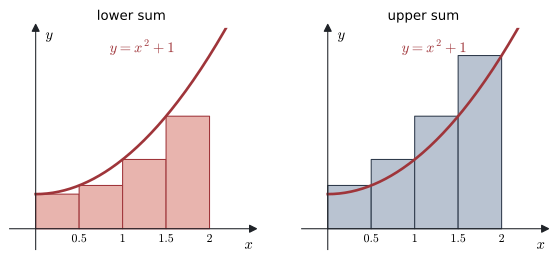
(a) Find the lower sum and the upper sum.
(b) Find the exact area, and check that it lies between the two sums.
Heights: \(f(0) = 1\), \(f(0.5) = 1.25\), \(f(1) = 2\), \(f(1.5) = 3.25\), \(f(2) = 5\).
(a) The function is increasing, so the lower sum uses the left ends:
\[ \text{lower} = 0.5\,(1 + 1.25 + 2 + 3.25) = 0.5 \times 7.5 = 3.75 . \]
The upper sum uses the right ends:
\[ \text{upper} = 0.5\,(1.25 + 2 + 3.25 + 5) = 0.5 \times 11.5 = 5.75 . \]
(b) \[ A = \int_0^2 (x^2 + 1)\,\mathrm{d}x = \Big[\tfrac{x^3}{3} + x\Big]_0^2 = \tfrac{8}{3} + 2 = \tfrac{14}{3} \approx 4.67 . \]
Indeed \(3.75 < 4.67 < 5.75\).
Finding the limit with sigma notation
With \(n\) strips, the sum of the rectangles can often be written with sigma notation (see Section 2.6). Then we can let \(n \to \infty\). You need these standard results, which will be given in a question:
\[ \sum_{r=1}^{n} r = \frac{n(n + 1)}{2}, \qquad \sum_{r=1}^{n} r^2 = \frac{n(n + 1)(2n + 1)}{6}, \qquad \sum_{r=1}^{n} r^3 = \frac{n^2(n + 1)^2}{4}. \]
Example 2 The diagram shows part of the graph of \(y = x^3\), with four rectangles under the curve between \(x = 0\) and \(x = 1\). Each rectangle has width \(\dfrac{1}{5}\).
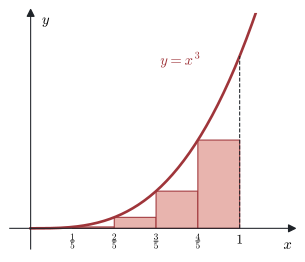
(a) Show that the total area of the four rectangles is \(\dfrac{1}{5^4}\displaystyle\sum_{r=1}^{4} r^3\), and find its value.
In general, the interval from \(x = 0\) to \(x = 1\) is divided into \(n\) equal strips, and \((n - 1)\) rectangles of width \(\dfrac{1}{n}\) are drawn under the curve in the same way. Let \(S\) be their total area.
(b) Given that \(\displaystyle\sum_{r=1}^{n} r^3 = \frac{n^2(n + 1)^2}{4}\), show that \(S = \dfrac{(n - 1)^2}{4n^2}\).
(c) Explain how the exact value of \(\displaystyle\int_0^1 x^3\,\mathrm{d}x\) can be found from this expression.
(a) The rectangles stand on \(\left[\frac{1}{5}, \frac{2}{5}\right]\), \(\left[\frac{2}{5}, \frac{3}{5}\right]\), \(\left[\frac{3}{5}, \frac{4}{5}\right]\), \(\left[\frac{4}{5}, 1\right]\). Their heights are the values of \(x^3\) at the left ends: \(\left(\frac{1}{5}\right)^3, \left(\frac{2}{5}\right)^3, \left(\frac{3}{5}\right)^3, \left(\frac{4}{5}\right)^3\).
\[ \text{Total} = \frac{1}{5}\left(\frac{1^3}{5^3} + \frac{2^3}{5^3} + \frac{3^3}{5^3} + \frac{4^3}{5^3}\right) = \frac{1}{5^4}\sum_{r=1}^{4} r^3 = \frac{100}{625} = \frac{4}{25} = 0.16 . \]
(b) Now the rectangles have width \(\frac{1}{n}\) and heights \(\left(\frac{r}{n}\right)^3\) for \(r = 1, 2, \ldots, n - 1\).
\[ S = \sum_{r=1}^{n-1} \frac{1}{n}\left(\frac{r}{n}\right)^3 = \frac{1}{n^4}\sum_{r=1}^{n-1} r^3 = \frac{1}{n^4} \cdot \frac{(n - 1)^2 n^2}{4} = \frac{(n - 1)^2}{4n^2}, \]
using the given formula with \(n - 1\) in place of \(n\).
(c) As \(n \to \infty\) the rectangles fill the region, so the area is the limit of \(S\):
\[ \int_0^1 x^3\,\mathrm{d}x = \lim_{n \to \infty} \frac{(n - 1)^2}{4n^2} = \lim_{n \to \infty} \frac{1}{4}\left(1 - \frac{1}{n}\right)^2 = \frac{1}{4}. \]
(Check: \(\Big[\tfrac{x^4}{4}\Big]_0^1 = \tfrac{1}{4}\).)
Common errors
| ✗ Wrong | ✓ Right | Why |
|---|---|---|
| Using right-end heights for a lower sum of an increasing function | Left-end heights | Right ends give rectangles above the curve. |
| Forgetting to multiply the heights by the width | Area $= $ width \(\times\) height for every strip | The sum is \(\sum y\,\delta x\), not \(\sum y\). |
| Using the formula for \(\sum_{r=1}^{n}\) when the sum stops at \(n - 1\) | Replace \(n\) by \(n - 1\) in the formula | The last term is different. |
| Counting \(n + 1\) heights for \(n\) strips | \(n\) strips use \(n\) heights | Choose the left or the right end of each strip. |
| Thinking more rectangles always gives the exact area | The exact area is the limit | Any finite sum is still an approximation. |
Exercises
1 The region under \(y = x\) from \(x = 0\) to \(x = 4\) is divided into 4 strips of width 1. Find the lower sum and the upper sum, and the exact area.
Lower: \(1 \times (0 + 1 + 2 + 3) = 6\). Upper: \(1 \times (1 + 2 + 3 + 4) = 10\). Exact: \(\dfrac{1}{2} \times 4 \times 4 = 8\) (or \(\Big[\tfrac{x^2}{2}\Big]_0^4 = 8\)).
2 Write \(\displaystyle\lim_{\delta x \to 0}\sum_{x=0}^{2} (3x^2 + 1)\,\delta x\) as a definite integral, and find its value.
\(\displaystyle\int_0^2 (3x^2 + 1)\,\mathrm{d}x = \Big[x^3 + x\Big]_0^2 = 8 + 2 = 10\).
3 The region under \(y = 4 - x^2\) from \(x = 0\) to \(x = 2\) is divided into 4 strips of width \(0.5\).
(a) Find the upper sum and the lower sum.
(b) Find the exact area.
Heights: \(f(0) = 4\), \(f(0.5) = 3.75\), \(f(1) = 3\), \(f(1.5) = 1.75\), \(f(2) = 0\).
(a) The function is decreasing, so the upper sum uses the left ends: \(0.5\,(4 + 3.75 + 3 + 1.75) = 6.25\). Lower sum (right ends): \(0.5\,(3.75 + 3 + 1.75 + 0) = 4.25\).
(b) \(\Big[4x - \tfrac{x^3}{3}\Big]_0^2 = 8 - \tfrac{8}{3} = \tfrac{16}{3} \approx 5.33\).
4 Paper 2 The region under \(y = 2^x\) from \(x = 0\) to \(x = 3\) is divided into 3 strips of width 1.
(a) Find the lower and upper sums.
(b) Use your GDC to find the area, to 3 significant figures.
(a) Lower: \(1 + 2 + 4 = 7\). Upper: \(2 + 4 + 8 = 14\).
(b) \(\displaystyle\int_0^3 2^x\,\mathrm{d}x = 10.0988\ldots \approx 10.1\) (exactly \(\dfrac{7}{\ln 2}\)). It lies between 7 and 14.
5 The region under \(y = x\) from \(x = 0\) to \(x = 1\) is divided into \(n\) equal strips. Using \(\displaystyle\sum_{r=1}^{n} r = \frac{n(n + 1)}{2}\), show that the lower sum is \(\dfrac{n - 1}{2n}\), and find its limit as \(n \to \infty\).
Width \(\frac{1}{n}\), left-end heights \(\frac{r}{n}\) for \(r = 0, 1, \ldots, n - 1\).
Lower sum \(= \dfrac{1}{n^2}\displaystyle\sum_{r=1}^{n-1} r = \dfrac{1}{n^2} \cdot \dfrac{(n - 1)n}{2} = \dfrac{n - 1}{2n}\).
As \(n \to \infty\), \(\dfrac{n - 1}{2n} = \dfrac{1}{2} - \dfrac{1}{2n} \to \dfrac{1}{2} = \displaystyle\int_0^1 x\,\mathrm{d}x\).
6 The region under \(y = x^2\) from \(x = 0\) to \(x = 2\) is divided into \(n\) equal strips, and the upper sum \(U_n\) is formed.
(a) Show that \(U_n = \dfrac{4(n + 1)(2n + 1)}{3n^2}\). (Use \(\sum_{r=1}^{n} r^2 = \frac{n(n + 1)(2n + 1)}{6}\).)
(b) Find \(U_4\).
(c) Find \(\displaystyle\lim_{n \to \infty} U_n\).
(a) Width \(\frac{2}{n}\); right-end heights \(\left(\frac{2r}{n}\right)^2\), \(r = 1, \ldots, n\).
\(U_n = \displaystyle\sum_{r=1}^{n} \frac{2}{n} \cdot \frac{4r^2}{n^2} = \frac{8}{n^3} \cdot \frac{n(n + 1)(2n + 1)}{6} = \frac{4(n + 1)(2n + 1)}{3n^2}\).
(b) \(U_4 = \dfrac{4 \times 5 \times 9}{48} = \dfrac{15}{4} = 3.75\).
(c) \(U_n = \dfrac{4}{3}\left(1 + \frac{1}{n}\right)\left(2 + \frac{1}{n}\right) \to \dfrac{8}{3}\). (This is \(\int_0^2 x^2\,\mathrm{d}x\).)
7 For an increasing function \(f\), a lower sum is \(12.4\) and an upper sum is \(13.0\), both for the same strips on \([a, b]\). Write down an inequality for \(A = \displaystyle\int_a^b f(x)\,\mathrm{d}x\). If \(A\) is estimated by the mean of the two sums, what is the largest possible error?
\(12.4 < A < 13.0\). The mean is \(12.7\). \(A\) is less than \(0.3\) away from \(12.7\), so the error is less than \(0.3\).
8 Paper 2 The region under \(y = \dfrac{1}{x}\) from \(x = 1\) to \(x = 2\) is divided into 4 strips of width \(0.25\). Find the upper and lower sums to 3 significant figures, and compare them with the exact area \(\ln 2\).
Heights: \(f(1) = 1\), \(f(1.25) = 0.8\), \(f(1.5) = \frac{2}{3}\), \(f(1.75) = \frac{4}{7}\), \(f(2) = 0.5\). The function is decreasing.
Upper (left ends): \(0.25\left(1 + 0.8 + \frac{2}{3} + \frac{4}{7}\right) = \dfrac{319}{420} \approx 0.760\).
Lower (right ends): \(0.25\left(0.8 + \frac{2}{3} + \frac{4}{7} + 0.5\right) = \dfrac{533}{840} \approx 0.635\).
\(\ln 2 \approx 0.693\) lies between them.
9 The region under \(y = 3x^2\) from \(x = 0\) to \(x = 1\) is divided into \(n\) equal strips. Show that the upper sum is \(\dfrac{(n + 1)(2n + 1)}{2n^2}\), and hence find \(\displaystyle\int_0^1 3x^2\,\mathrm{d}x\).
Upper sum \(= \displaystyle\sum_{r=1}^{n} \frac{1}{n} \cdot 3\left(\frac{r}{n}\right)^2 = \frac{3}{n^3} \cdot \frac{n(n + 1)(2n + 1)}{6} = \frac{(n + 1)(2n + 1)}{2n^2}\).
As \(n \to \infty\): \(\dfrac{1}{2}\left(1 + \frac{1}{n}\right)\left(2 + \frac{1}{n}\right) \to 1\). So \(\displaystyle\int_0^1 3x^2\,\mathrm{d}x = 1\).
10 For \(y = x\) on \([0, 1]\) with \(n\) equal strips, the upper sum is \(\dfrac{n + 1}{2n}\). Find the smallest \(n\) for which the upper sum is less than \(0.01\) away from the exact area.
Exact area \(= \frac{1}{2}\). Upper sum \(-\ \frac{1}{2} = \dfrac{n + 1}{2n} - \dfrac{n}{2n} = \dfrac{1}{2n}\).
\(\dfrac{1}{2n} < 0.01 \Rightarrow n > 50\). The smallest such \(n\) is \(51\).