28.4 Area between Curves
SL 5.11
- how to find the area between a curve and a line
- how to find the area of a region made from a curve, a tangent and an axis
- how to find the area between two curves, using \(\displaystyle\int_a^b \big[f(x) - g(x)\big]\,\mathrm{d}x\) with \(f\) the upper curve
- how to split a region when the curves cross more than once, and how to use a GDC for intersections
Area between a curve and a line
Suppose the curve \(y = f(x)\) and the line \(y = g(x)\) meet at \(x = a\) and \(x = b\), and \(f(x) \geq g(x)\) between them. The area under \(f\) minus the area under \(g\) is the area between them:
\[ A = \int_a^b f(x)\,\mathrm{d}x - \int_a^b g(x)\,\mathrm{d}x = \int_a^b \big[f(x) - g(x)\big]\,\mathrm{d}x . \]
If the line is above the curve, swap them: \(A = \displaystyle\int_a^b \big[g(x) - f(x)\big]\,\mathrm{d}x\). In words: (upper) \(-\) (lower).
Example 1 Find the area of the region enclosed by the curve \(y = 10 - x^2\) and the line \(y = x + 4\).
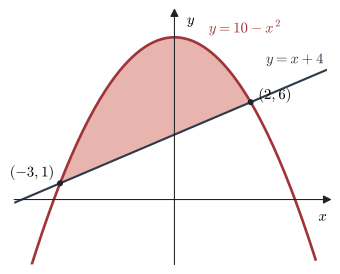
Intersections: \(10 - x^2 = x + 4 \Rightarrow x^2 + x - 6 = 0 \Rightarrow (x + 3)(x - 2) = 0\), so \(x = -3\) and \(x = 2\).
Between them the curve is above the line (at \(x = 0\): \(10 > 4\)).
\[ A = \int_{-3}^{2} \big[(10 - x^2) - (x + 4)\big]\,\mathrm{d}x = \int_{-3}^{2} (6 - x - x^2)\,\mathrm{d}x = \Big[6x - \tfrac{x^2}{2} - \tfrac{x^3}{3}\Big]_{-3}^{2} . \]
\[ = \left(12 - 2 - \tfrac{8}{3}\right) - \left(-18 - \tfrac{9}{2} + 9\right) = \tfrac{22}{3} + \tfrac{27}{2} = \tfrac{125}{6}. \]
Sometimes the region is bounded by a curve, a line and an axis. Then it is often easiest to find a larger area and subtract a triangle.
Example 2 The diagram shows part of the curve \(y = x^2 - 4x + 3\), which meets the \(x\)-axis at \(Q(3, 0)\). The tangent to the curve at \(P\), where \(x = 5\), meets the \(x\)-axis at \(R\). \(PS\) is a vertical line, with \(S\) on the \(x\)-axis. Find
(a) the equation of the tangent at \(P\),
(b) the coordinates of \(R\),
(c) the area of the shaded region \(PQR\).
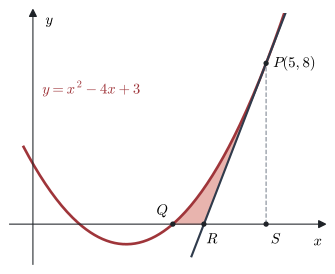
(a) At \(x = 5\): \(y = 25 - 20 + 3 = 8\), so \(P = (5, 8)\). \(\;\dfrac{\mathrm{d}y}{\mathrm{d}x} = 2x - 4 = 6\) at \(x = 5\). (For tangents see Unit 25.)
Tangent: \(y - 8 = 6(x - 5)\), so \(y = 6x - 22\).
(b) \(y = 0\): \(6x = 22\), \(x = \dfrac{11}{3}\). So \(R = \left(\dfrac{11}{3}, 0\right)\).
(c) The region under the curve from \(Q\) to \(S\) is made of the shaded region and the triangle \(RSP\).
\[ \int_3^5 (x^2 - 4x + 3)\,\mathrm{d}x = \Big[\tfrac{x^3}{3} - 2x^2 + 3x\Big]_3^5 = \left(\tfrac{125}{3} - 35\right) - (9 - 18 + 9) = \tfrac{20}{3}. \]
Triangle \(RSP\): base \(5 - \dfrac{11}{3} = \dfrac{4}{3}\), height \(8\), area \(\dfrac{1}{2} \times \dfrac{4}{3} \times 8 = \dfrac{16}{3}\).
Shaded area \(= \dfrac{20}{3} - \dfrac{16}{3} = \dfrac{4}{3}\).
Area bounded by two curves
The same rule works for any two curves, and it does not matter whether the region is above or below the \(x\)-axis.
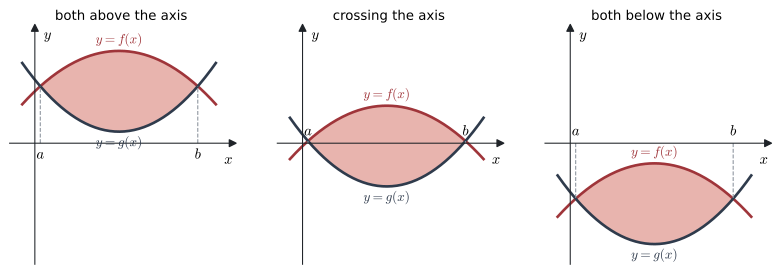
Area between two curves Not in the formula booklet
If \(f(x) \geq g(x)\) for \(a \leq x \leq b\), the area between \(y = f(x)\) and \(y = g(x)\) from \(x = a\) to \(x = b\) is
\[ A = \int_a^b \big[f(x) - g(x)\big]\,\mathrm{d}x \qquad \text{(upper curve minus lower curve).} \]
If the curves cross between \(a\) and \(b\), split the interval at each crossing point and add the areas.
- \(A\): the area between the two curves
- \(a\): the lower limit (left end)
- \(b\): the upper limit (right end)
- \(f(x)\): the upper curve
- \(g(x)\): the lower curve
Why does it work below the axis? Each strip has height \(f(x) - g(x)\), which is positive, wherever the strip is. (You can also think of moving both curves up by the same amount: the area between them does not change.)
Example 3 Without a calculator, find the total area of the finite regions enclosed by the line \(y = 3x\) and the curve \(y = x^3 - 2x^2\).
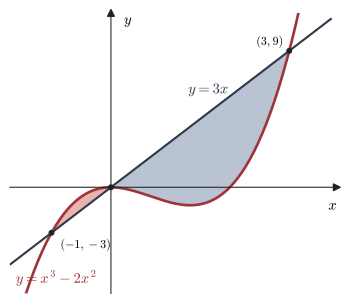
Intersections: \(x^3 - 2x^2 = 3x \Rightarrow x^3 - 2x^2 - 3x = 0 \Rightarrow x(x - 3)(x + 1) = 0\), so \(x = -1, 0, 3\).
The curves cross at \(x = 0\), so there are two regions. Test a point in each:
- at \(x = -\frac{1}{2}\): curve \(-\frac{5}{8}\), line \(-\frac{3}{2}\), so the curve is above on \([-1, 0]\);
- at \(x = 1\): curve \(-1\), line \(3\), so the line is above on \([0, 3]\).
\[ A_1 = \int_{-1}^{0} \big[(x^3 - 2x^2) - 3x\big]\,\mathrm{d}x = \Big[\tfrac{x^4}{4} - \tfrac{2x^3}{3} - \tfrac{3x^2}{2}\Big]_{-1}^{0} = 0 - \left(\tfrac{1}{4} + \tfrac{2}{3} - \tfrac{3}{2}\right) = \frac{7}{12}. \]
\[ A_2 = \int_{0}^{3} \big[3x - (x^3 - 2x^2)\big]\,\mathrm{d}x = \Big[\tfrac{3x^2}{2} - \tfrac{x^4}{4} + \tfrac{2x^3}{3}\Big]_{0}^{3} = \tfrac{27}{2} - \tfrac{81}{4} + 18 = \frac{45}{4}. \]
Total area \(= \dfrac{7}{12} + \dfrac{45}{4} = \dfrac{7}{12} + \dfrac{135}{12} = \dfrac{142}{12} = \dfrac{71}{6}\).
When the intersections cannot be found by hand, use a GDC (Paper 2). Store the \(x\)-coordinates in the calculator, so that you do not lose accuracy by rounding too early.
Example 4 Paper 2 The shaded region is bounded by the curves \(y = \mathrm{e}^x\), \(y = 2 - x\) and \(y = x^2 - 3\).
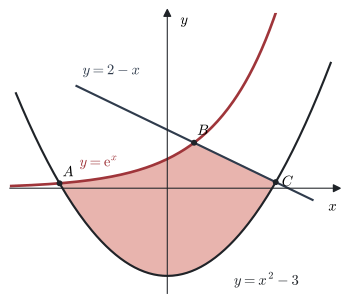
(a) Use your GDC to find the \(x\)-coordinates of \(A\), \(B\) and \(C\).
(b) Hence find the area of the shaded region, correct to 2 significant figures.
(a) \(A\): \(\mathrm{e}^x = x^2 - 3 \Rightarrow x_A = -1.7800\ldots\)
\(B\): \(\mathrm{e}^x = 2 - x \Rightarrow x_B = 0.44285\ldots\)
\(C\): \(2 - x = x^2 - 3 \Rightarrow x_C = 1.7912\ldots\) (exactly \(\frac{-1 + \sqrt{21}}{2}\)).
(b) The lower boundary is always \(y = x^2 - 3\). The upper boundary is \(y = \mathrm{e}^x\) from \(A\) to \(B\), then \(y = 2 - x\) from \(B\) to \(C\).
\[ A = \int_{x_A}^{x_B} \big[\mathrm{e}^x - (x^2 - 3)\big]\,\mathrm{d}x + \int_{x_B}^{x_C} \big[(2 - x) - (x^2 - 3)\big]\,\mathrm{d}x = 9.497\ldots \approx 9.5 . \]
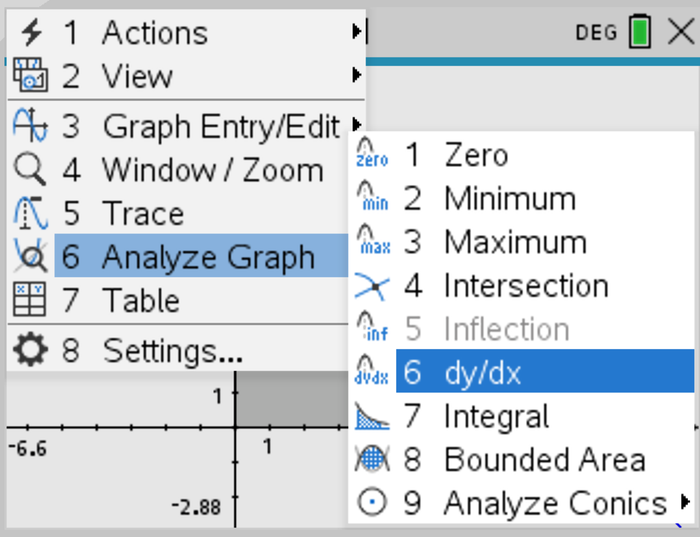
Graphs page: enter \(f_1(x) = \mathrm{e}^x\), \(f_2(x) = 2 - x\), \(f_3(x) = x^2 - 3\). Menu → Analyze Graph → Intersection: choose two graphs, then a lower and an upper bound around the point. Repeat for each point. To keep full accuracy, store each answer (click on the coordinate, then ctrl + var (store, sto→), for example as a, b, c).
Calculator page: Menu → Calculus → Numerical Integral, and type for example \(\displaystyle\int_a^b \big(f_1(x) - f_3(x)\big)\,\mathrm{d}x + \int_b^c \big(f_2(x) - f_3(x)\big)\,\mathrm{d}x\).
Graphs page (another way): Menu → Analyze Graph → Bounded Area shades the area between two graphs between two bounds and shows its value.
Common errors
| ✗ Wrong | ✓ Right | Why |
|---|---|---|
| \(\displaystyle\int_a^b \big[g(x) - f(x)\big]\,\mathrm{d}x\) with \(g\) the lower curve, giving a negative answer | (upper) \(-\) (lower) | Test a point to see which curve is on top. |
| One integral across a crossing point | Split at every intersection | The regions would cancel. |
| Adding \(\int f\) and \(\int g\) | Subtract: \(\int (f - g)\) | The area between is a difference. |
| Thinking the rule fails below the \(x\)-axis | \(\int (f - g)\) works anywhere | Each strip has height \(f(x) - g(x) > 0\). |
| Rounding the intersections to 3 s.f. before integrating | Store the full values | Early rounding changes the final answer. |
| Forgetting a bracket: \(f(x) - x^2 - 3\) for \(f(x) - (x^2 - 3)\) | \(f(x) - x^2 + 3\) | Subtract the whole lower function. |
Exercises
1 Find the area enclosed by \(y = x^2\) and \(y = 2x\).
\(x^2 = 2x \Rightarrow x = 0, 2\). The line is above. \(\displaystyle\int_0^2 (2x - x^2)\,\mathrm{d}x = \Big[x^2 - \tfrac{x^3}{3}\Big]_0^2 = 4 - \tfrac{8}{3} = \tfrac{4}{3}\).
2 Find the area enclosed by \(y = 10 - x^2\) and \(y = 1\).
\(10 - x^2 = 1 \Rightarrow x = \pm 3\). \(\displaystyle\int_{-3}^{3} (9 - x^2)\,\mathrm{d}x = \Big[9x - \tfrac{x^3}{3}\Big]_{-3}^{3} = 18 - (-18) = 36\).
3 Find the area enclosed by \(y = x^2 - 2x\) and \(y = 2x\).
\(x^2 - 2x = 2x \Rightarrow x(x - 4) = 0\), \(x = 0, 4\). The line is above. \(\displaystyle\int_0^4 (4x - x^2)\,\mathrm{d}x = 32 - \tfrac{64}{3} = \tfrac{32}{3}\). (Part of this region is below the \(x\)-axis, but the rule still works.)
4 Find the area enclosed by \(y = \sqrt{x}\) and \(y = \dfrac{x}{3}\).
\(\sqrt{x} = \dfrac{x}{3} \Rightarrow x = 0\) or \(\sqrt{x} = 3\), \(x = 9\). The curve is above (at \(x = 1\): \(1 > \frac{1}{3}\)).
\(\displaystyle\int_0^9 \left(x^{1/2} - \frac{x}{3}\right)\mathrm{d}x = \Big[\tfrac{2}{3}x^{3/2} - \tfrac{x^2}{6}\Big]_0^9 = 18 - \tfrac{27}{2} = \tfrac{9}{2}\).
5 Find the area enclosed by \(y = x^2\) and \(y = 8 - x^2\).
\(x^2 = 8 - x^2 \Rightarrow x = \pm 2\). \(\displaystyle\int_{-2}^{2} (8 - 2x^2)\,\mathrm{d}x = \Big[8x - \tfrac{2x^3}{3}\Big]_{-2}^{2} = \left(16 - \tfrac{16}{3}\right) \times 2 = \tfrac{64}{3}\).
6 The curves \(y = \sin x\) and \(y = \cos x\) meet at \(x = \dfrac{\pi}{4}\) and \(x = \dfrac{5\pi}{4}\). Find the area enclosed between them for \(\dfrac{\pi}{4} \leq x \leq \dfrac{5\pi}{4}\).
\(\sin x \geq \cos x\) on this interval (at \(x = \frac{\pi}{2}\): \(1 > 0\)).
\(\displaystyle\int_{\frac{\pi}{4}}^{\frac{5\pi}{4}} (\sin x - \cos x)\,\mathrm{d}x = \Big[-\cos x - \sin x\Big]_{\frac{\pi}{4}}^{\frac{5\pi}{4}} = \left(\tfrac{\sqrt{2}}{2} + \tfrac{\sqrt{2}}{2}\right) - \left(-\tfrac{\sqrt{2}}{2} - \tfrac{\sqrt{2}}{2}\right) = 2\sqrt{2}\).
7 Find the total area of the regions enclosed by \(y = x^3\) and \(y = 4x\).
\(x^3 = 4x \Rightarrow x = -2, 0, 2\). On \([-2, 0]\) the cubic is above; on \([0, 2]\) the line is above.
\(\displaystyle\int_{-2}^{0} (x^3 - 4x)\,\mathrm{d}x = 0 - (4 - 8) = 4\); \(\quad\displaystyle\int_0^2 (4x - x^3)\,\mathrm{d}x = 8 - 4 = 4\). Total \(= 8\).
8 Find the area of the region bounded by \(y = \mathrm{e}^x\), the line \(y = \mathrm{e}\) and the \(y\)-axis.
\(\mathrm{e}^x = \mathrm{e}\) at \(x = 1\). The line is above. \(\displaystyle\int_0^1 (\mathrm{e} - \mathrm{e}^x)\,\mathrm{d}x = \Big[\mathrm{e}x - \mathrm{e}^x\Big]_0^1 = (\mathrm{e} - \mathrm{e}) - (0 - 1) = 1\).
9 The tangent to \(y = x^2\) at the point \((2, 4)\) meets the \(x\)-axis at \(T\). Find the area of the region bounded by the curve, the tangent and the \(x\)-axis.
\(\dfrac{\mathrm{d}y}{\mathrm{d}x} = 2x = 4\). Tangent: \(y = 4x - 4\), so \(T = (1, 0)\).
Area under the curve from \(0\) to \(2\): \(\dfrac{8}{3}\). Triangle under the tangent from \(x = 1\) to \(x = 2\): \(\dfrac{1}{2} \times 1 \times 4 = 2\).
Region \(= \dfrac{8}{3} - 2 = \dfrac{2}{3}\).
10 Paper 2 The curves \(y = 2\cos x\) and \(y = x^2\) enclose a finite region. Find the \(x\)-coordinates of the intersection points and the area of the region.
GDC: \(2\cos x = x^2\) at \(x = \pm 1.0216\ldots \approx \pm 1.02\).
Area \(= \displaystyle\int_{-1.0216\ldots}^{1.0216\ldots} (2\cos x - x^2)\,\mathrm{d}x = 2.7009\ldots \approx 2.70\).