Unit 7 Exam Practice
Linear Functions
These questions are written in the style of IB examination questions, and they are harder than the review exercises. The marks for each part are shown in square brackets on the right, for example [3]. Paper 1 means no calculator; Paper 2 means a graphic display calculator (GDC) is allowed. Try each question under exam conditions first, then open the markscheme.
| Mark | Meaning |
|---|---|
| M | Method mark: a correct method is used, even with a small slip |
| A | Accuracy mark: a correct answer or line of working (usually needs the M mark before it) |
| R | Reasoning mark: a clear reason or justification is given |
| N | Mark for a correct final answer with no working shown |
| AG | “Answer given” in the question, so no extra mark is awarded for writing it |
The number after the letter is the number of marks, so A2 is worth 2 marks. In the exam, give answers exactly or correct to 3 significant figures (s.f.) unless the question says otherwise.
SL questions
SL 1 Paper 1
The points \(A(1, 2)\) and \(B(7, 5)\) are given. The point \(C\) lies on the line \(x + y = 10\), and the angle \(BAC\) is a right angle.
(a) Find the coordinates of \(C\). [5]
(b) Find the area of triangle \(ABC\). [3]
Total 8 marks
(a)
\(m_{AB} = \dfrac{5 - 2}{7 - 1} = \dfrac{1}{2}\) A1
\(m_{AC} = -2\), so \(AC\): \(y - 2 = -2(x - 1)\), that is \(y = -2x + 4\) M1 A1
substituting into \(x + y = 10\): \(x + (-2x + 4) = 10\) M1
\(x = -6\), \(y = 16\), so \(C\) is \((-6, 16)\) A1
[5 marks]
(b)
\(AB = \sqrt{6^{2} + 3^{2}} = 3\sqrt{5}\) and \(AC = \sqrt{7^{2} + 14^{2}} = 7\sqrt{5}\) M1 A1
the right angle is at \(A\), so area \(= \dfrac{1}{2} \times 3\sqrt{5} \times 7\sqrt{5} = \dfrac{105}{2}\) A1
[3 marks]
SL 2 Paper 1
A straight line \(L\) has gradient \(m\), where \(m < 0\), and passes through the point \((2, 6)\). \(L\) meets the \(x\)-axis at \(A\) and the \(y\)-axis at \(B\). Let \(O\) be the origin.
(a) Find, in terms of \(m\), the coordinates of \(A\) and of \(B\). [2]
The area of triangle \(OAB\) is \(25\) units².
(b) Show that \(2m^{2} + 13m + 18 = 0\). [3]
(c) Hence find the two possible equations of \(L\), in the form \(y = mx + c\). [3]
Total 8 marks
(a)
\(L\): \(y - 6 = m(x - 2)\), then put \(y = 0\) and \(x = 0\) M1
\(A\left(2 - \dfrac{6}{m},\ 0\right)\) and \(B(0,\ 6 - 2m)\) A1
[2 marks]
(b)
\(m < 0\), so both intercepts are positive, and \(\dfrac{1}{2}\left(2 - \dfrac{6}{m}\right)(6 - 2m) = 25\) M1
multiplying by \(2m\): \((2m - 6)(6 - 2m) = 50m\) A1
\(-4m^{2} + 24m - 36 = 50m\), so \(4m^{2} + 26m + 36 = 0\)
\(2m^{2} + 13m + 18 = 0\) A1 AG
[3 marks]
(c)
\((2m + 9)(m + 2) = 0\) M1
\(m = -2\) or \(m = -\dfrac{9}{2}\) (both negative, so both are valid) A1
\(y = -2x + 10\) and \(y = -\dfrac{9}{2}x + 15\) A1
[3 marks]
See 7.2.
SL 3 Paper 2
On a map, the coordinates are measured in kilometres. A straight gas pipeline runs from \(A(-2, 1)\) to \(B(10, 6)\). A farmhouse is at the point \(H(4, 9)\).
(a) Find the gradient of the pipeline and its angle of inclination. [2]
(b) Find the equation of the line through \(H\) that is perpendicular to the pipeline. [2]
The farmhouse is to be connected to the pipeline by the shortest possible straight pipe.
(c) Find the length of this pipe. [4]
Total 8 marks
(a)
\(m = \dfrac{6 - 1}{10 - (-2)} = \dfrac{5}{12}\) A1
\(\theta = \tan^{-1}\left(\dfrac{5}{12}\right) = 22.6^\circ\) \((22.619\ldots^\circ)\) A1
[2 marks]
(b)
perpendicular gradient \(-\dfrac{12}{5}\), so \(y - 9 = -\dfrac{12}{5}(x - 4)\) M1 A1
Accept \(12x + 5y - 93 = 0\) or \(y = -2.4x + 18.6\).
[2 marks]
(c)
pipeline: \(y - 1 = \dfrac{5}{12}(x + 2)\) (or \(5x - 12y + 22 = 0\)) A1
solving the two equations together (for example, the intersection of the two graphs on a GDC) M1
foot of the perpendicular \(F(5.95,\ 4.31)\) \((5.9526\ldots,\ 4.3136\ldots)\) A1
\(HF = 5.08\) km \((5.0769\ldots)\) A1
\(F\) lies between \(A\) and \(B\), so the shortest pipe meets the pipeline itself.
[4 marks]
SL 4 Paper 1
\(ABCD\) is a rhombus. The vertices \(A\) and \(C\) are the points \((3, 2)\) and \((-5, -2)\). \(M\) is the midpoint of \(AC\).
(a) Find the coordinates of \(M\). [1]
(b) Show that the equation of the diagonal \(BD\) is \(y = -2x - 2\). [4]
The vertex \(B\) lies on the \(y\)-axis.
(c) Find the coordinates of \(B\) and of \(D\). [3]
(d) Find the area of the rhombus \(ABCD\). [3]
(e) Find the length of \(AB\). Hence find the perpendicular distance between the parallel sides \(AB\) and \(DC\). [3]
Total 14 marks
(a)
\(M = \left(\dfrac{3 + (-5)}{2},\ \dfrac{2 + (-2)}{2}\right) = (-1, 0)\) A1
[1 mark]
(b)
\(m_{AC} = \dfrac{-2 - 2}{-5 - 3} = \dfrac{1}{2}\) A1
the diagonals of a rhombus bisect each other at right angles, so \(BD\) passes through \(M\) and \(BD \perp AC\) R1
\(m_{BD} = -2\) M1
\(y - 0 = -2(x + 1)\), so \(y = -2x - 2\) A1 AG
[4 marks]
(c)
\(x = 0\) gives \(y = -2\), so \(B\) is \((0, -2)\) A1
\(M\) is the midpoint of \(BD\): \(D = \big(2 \times (-1) - 0,\ 2 \times 0 - (-2)\big)\) M1
\(D\) is \((-2, 2)\) A1
[3 marks]
(d)
area \(= 2 \times\) area of triangle \(ABC = 2 \times \dfrac{1}{2} \times AC \times BM\) M1
\(AC = \sqrt{8^{2} + 4^{2}} = 4\sqrt{5}\) and \(BM = \sqrt{1^{2} + 2^{2}} = \sqrt{5}\) A1
area \(= 4\sqrt{5} \times \sqrt{5} = 20\) A1
Accept area \(= \dfrac{1}{2} \times AC \times BD = \dfrac{1}{2} \times 4\sqrt{5} \times 2\sqrt{5}\).
[3 marks]
(e)
\(AB = \sqrt{3^{2} + 4^{2}} = 5\) A1
a rhombus is a parallelogram, so area \(=\) base \(\times\) height: \(5h = 20\) M1
\(h = 4\) A1
[3 marks]
SL 5 Paper 1
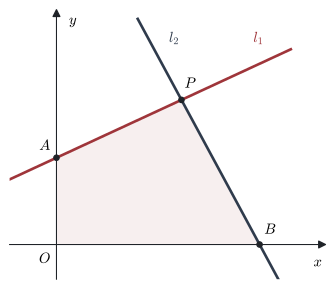
The diagram shows the lines \(l_1\): \(x - 2y + 6 = 0\) and \(l_2\): \(2x + y - 13 = 0\), which meet at the point \(P\). The line \(l_1\) meets the \(y\)-axis at \(A\), and the line \(l_2\) meets the \(x\)-axis at \(B\). \(O\) is the origin. The diagram is not to scale.
(a) Show that \(l_1\) and \(l_2\) are perpendicular. [2]
(b) Find the coordinates of \(P\). [3]
(c) Write down the coordinates of \(A\), and find the coordinates of \(B\). [2]
(d) Find the area of triangle \(APB\). [3]
(e) Hence find the area of the quadrilateral \(OAPB\). [2]
\(N\) is the midpoint of \(AB\).
(f) Show that \(N\) is the same distance from each of the points \(O\), \(A\), \(P\) and \(B\). [4]
Total 16 marks
(a)
\(l_1\): \(y = \dfrac{1}{2}x + 3\) and \(l_2\): \(y = -2x + 13\), so the gradients are \(\dfrac{1}{2}\) and \(-2\) A1
\(\dfrac{1}{2} \times (-2) = -1\), so \(l_1 \perp l_2\) R1
[2 marks]
(b)
\(x - 2(13 - 2x) + 6 = 0\) M1
\(5x - 20 = 0\), so \(x = 4\) A1
\(y = 5\), so \(P\) is \((4, 5)\) A1
[3 marks]
(c)
\(A(0, 3)\) A1
\(B\left(\dfrac{13}{2},\ 0\right)\) A1
[2 marks]
(d)
the right angle is at \(P\), so area \(= \dfrac{1}{2} \times AP \times PB\) M1
\(AP = \sqrt{4^{2} + 2^{2}} = 2\sqrt{5}\)
\(PB = \sqrt{\left(\dfrac{5}{2}\right)^{2} + 5^{2}} = \dfrac{5\sqrt{5}}{2}\) A1
\(= \dfrac{1}{2} \times 2\sqrt{5} \times \dfrac{5\sqrt{5}}{2} = \dfrac{25}{2}\) A1
[3 marks]
(e)
area of triangle \(OAB = \dfrac{1}{2} \times 3 \times \dfrac{13}{2} = \dfrac{39}{4}\) M1
area of \(OAPB = \dfrac{39}{4} + \dfrac{25}{2} = \dfrac{89}{4}\) A1
[2 marks]
(f)
\(N = \left(\dfrac{13}{4},\ \dfrac{3}{2}\right)\)
\(NO = \sqrt{\dfrac{169}{16} + \dfrac{36}{16}} = \dfrac{\sqrt{205}}{4}\) M1 A1
\(NP = \sqrt{\dfrac{9}{16} + \dfrac{196}{16}} = \dfrac{\sqrt{205}}{4}\) A1
\(NA = NB = \dfrac{1}{2}AB = \dfrac{1}{2}\sqrt{\dfrac{169}{4} + 9} = \dfrac{\sqrt{205}}{4}\) A1
so \(NO = NA = NP = NB\) AG
[4 marks]
HL questions
This unit has no AHL content, so the HL questions test the same syllabus content as SL, but they are longer and need more algebra and coordinate-geometry reasoning.
HL 1 Paper 1
For each real number \(k\), the line \(L_k\) has equation \[ (2k + 1)x + (k - 3)y + 1 - 5k = 0 . \]
(a) Show that every line \(L_k\) passes through the point \((2, 1)\). [2]
(b) Find the value of \(k\) for which \(L_k\) is perpendicular to \(L_0\). [3]
(c) Show that no line \(L_k\) is parallel to the line \(2x + y = 0\). [3]
Total 8 marks
(a)
substituting \(x = 2\), \(y = 1\): \(2(2k + 1) + (k - 3) + 1 - 5k\) M1
\(= 4k + 2 + k - 3 + 1 - 5k = 0\) for every \(k\), so \((2, 1)\) is on every \(L_k\) A1 AG
[2 marks]
(b)
for \(k \neq 3\), the gradient of \(L_k\) is \(-\dfrac{2k + 1}{k - 3}\); \(L_0\): \(x - 3y + 1 = 0\) has gradient \(\dfrac{1}{3}\) A1
so we need \(-\dfrac{2k + 1}{k - 3} = -3\) M1
\(2k + 1 = 3k - 9\), so \(k = 10\) A1
[3 marks]
(c)
for \(k \neq 3\): \(-\dfrac{2k + 1}{k - 3} = -2\) M1
\(2k + 1 = 2k - 6\), so \(1 = -6\), which is impossible A1
for \(k = 3\), \(L_3\) is \(7x - 14 = 0\), that is \(x = 2\), a vertical line, so it is not parallel to \(2x + y = 0\) either R1
[3 marks]
See 7.2.
HL 2 Paper 1
\(ABCD\) is a square. The opposite vertices \(A\) and \(C\) are the points \((1, -2)\) and \((7, 6)\).
(a) Find the equation of the diagonal \(BD\), in the form \(ax + by + d = 0\), where \(a, b, d \in \mathbb{Z}\). [3]
(b) Find the coordinates of the other two vertices of the square. [4]
(c) Find the area of the square. [1]
Total 8 marks
(a)
midpoint of \(AC\): \(M(4, 2)\); \(m_{AC} = \dfrac{8}{6} = \dfrac{4}{3}\) A1
the diagonals of a square bisect each other at right angles, so \(m_{BD} = -\dfrac{3}{4}\) and \(BD\) passes through \(M\) M1
\(y - 2 = -\dfrac{3}{4}(x - 4)\), so \(3x + 4y - 20 = 0\) A1
[3 marks]
(b)
the diagonals of a square are equal, so \(MB = MD = MA = \sqrt{3^{2} + 4^{2}} = 5\) R1
with \(y - 2 = -\dfrac{3}{4}(x - 4)\): \((x - 4)^{2} + \dfrac{9}{16}(x - 4)^{2} = 25\) M1
\((x - 4)^{2} = 16\), so \(x = 8\) or \(x = 0\) A1
the other vertices are \((8, -1)\) and \((0, 5)\) A1
[4 marks]
(c)
\(AC = 10\), so area \(= \dfrac{1}{2} \times 10 \times 10 = 50\) A1
[1 mark]
HL 3 Paper 2
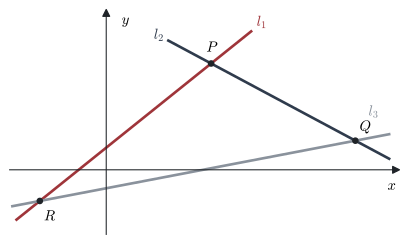
The diagram shows the triangle \(PQR\) formed by the lines \[ l_1:\ 3x - 5y + 6 = 0, \qquad l_2:\ 2x + 5y - 44 = 0, \qquad l_3:\ x - 7y - 7 = 0 . \] \(P\) is the intersection of \(l_1\) and \(l_2\), \(Q\) is the intersection of \(l_2\) and \(l_3\), and \(R\) is the intersection of \(l_3\) and \(l_1\). The diagram is not to scale.
(a) Find the coordinates of \(P\), \(Q\) and \(R\). [3]
(b) Find the size of the angle \(QPR\). [2]
(c) Find the area of triangle \(PQR\). [3]
Total 8 marks
(a)
\(P(7.6,\ 5.76)\) A1
\(Q(18.1,\ 1.58)\) \((18.052\ldots,\ 1.5789\ldots)\) A1
\(R(-4.81,\ -1.69)\) \((-4.8125,\ -1.6875)\) A1
[3 marks]
(b)
angles of inclination: \(l_1\): \(\tan^{-1} 0.6 = 30.96^\circ\); \(l_2\): \(\tan^{-1}(-0.4) + 180^\circ = 158.20^\circ\) M1
angle \(QPR = 158.20^\circ - 30.96^\circ = 127^\circ\) \((127.23\ldots^\circ)\) A1
From \(P\), \(Q\) is down and to the right along \(l_2\) and \(R\) is down and to the left along \(l_1\), so the angle \(QPR\) is obtuse. Do not award the final A1 for the acute angle \(52.8^\circ\) between the lines.
[2 marks]
(c)
height from \(P\): the line through \(P\) with gradient \(-7\) meets \(l_3\) at \((8.39,\ 0.199)\) M1
height \(= 5.62\) \((5.6172\ldots)\) and base \(QR = 23.1\) \((23.097\ldots)\) A1
area \(= \dfrac{1}{2} \times 23.097 \times 5.6172 = 64.9\) A1
Accept any correct base with its perpendicular height.
[3 marks]
HL 4 Paper 1
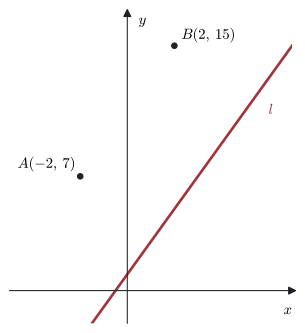
The line \(l\) has equation \(y = 2x + 1\). The points \(A(-2, 7)\) and \(B(2, 15)\) lie on the same side of \(l\), as shown in the diagram (not to scale).
(a) Find the equation of the line through \(A\) that is perpendicular to \(l\). [2]
(b) Find the coordinates of \(F\), the foot of the perpendicular from \(A\) to \(l\). [3]
The point \(A'\) is the reflection of \(A\) in the line \(l\).
(c) Find the coordinates of \(A'\). [2]
(d) Explain why \(AP = A'P\) for every point \(P\) on \(l\). [2]
(e) Hence find the coordinates of the point \(P\) on \(l\) for which \(AP + PB\) is as small as possible, and find this smallest value. [5]
Total 14 marks
(a)
the perpendicular gradient is \(-\dfrac{1}{2}\) M1
\(y - 7 = -\dfrac{1}{2}(x + 2)\), that is \(x + 2y - 12 = 0\) A1
[2 marks]
(b)
\(x + 2(2x + 1) - 12 = 0\) M1
\(5x - 10 = 0\), so \(x = 2\) A1
\(F\) is \((2, 5)\) A1
[3 marks]
(c)
\(F\) is the midpoint of \(AA'\) M1
\(A' = \big(2 \times 2 - (-2),\ 2 \times 5 - 7\big) = (6, 3)\) A1
[2 marks]
(d)
\(l\) passes through \(F\), the midpoint of \(AA'\), and is perpendicular to \(AA'\), so \(l\) is the perpendicular bisector of \(AA'\) R1
every point on the perpendicular bisector of \(AA'\) is the same distance from \(A\) and from \(A'\) R1
[2 marks]
(e)
\(AP + PB = A'P + PB\) M1
\(A'P + PB \geq A'B\), with equality when \(P\) is on the segment \(A'B\); \(A'\) and \(B\) are on opposite sides of \(l\), so this segment meets \(l\) R1
\(m_{A'B} = \dfrac{15 - 3}{2 - 6} = -3\), so \(A'B\): \(y = -3x + 21\) A1
\(2x + 1 = -3x + 21\), so \(x = 4\), and \(P\) is \((4, 9)\) A1
smallest value \(= A'B = \sqrt{4^{2} + 12^{2}} = \sqrt{160} = 4\sqrt{10}\) A1
[5 marks]
HL 5 Paper 1
The triangle \(ABC\) has vertices \(A(-3, 1)\), \(B(2, 6)\) and \(C(5, -3)\).
(a) Find the equation of the perpendicular bisector of \(AB\). [3]
The perpendicular bisector of \(BC\) has equation \(x - 3y + 1 = 0\).
(b) Find the coordinates of the point \(K\) that is the same distance from \(A\), \(B\) and \(C\). [2]
An altitude of a triangle is the line through a vertex perpendicular to the opposite side.
(c) Find the equation of the altitude through \(C\). [2]
(d) The altitude through \(A\) has equation \(x - 3y + 6 = 0\). Find the coordinates of \(H\), the point where the altitudes through \(A\) and \(C\) meet. [2]
A median of a triangle is the line from a vertex to the midpoint of the opposite side. The three medians meet at the point \(G\left(\dfrac{4}{3}, \dfrac{4}{3}\right)\).
(e) Verify that \(G\) lies on the median through \(B\). [3]
(f) Show that \(K\), \(G\) and \(H\) are collinear, and that \(HG = 2GK\). [4]
Total 16 marks
(a)
midpoint of \(AB\): \(\left(-\dfrac{1}{2},\ \dfrac{7}{2}\right)\); \(m_{AB} = \dfrac{6 - 1}{2 - (-3)} = 1\) A1
perpendicular gradient \(-1\): \(y - \dfrac{7}{2} = -\left(x + \dfrac{1}{2}\right)\) M1
\(y = -x + 3\) A1
[3 marks]
(b)
\(K\) lies on both perpendicular bisectors: \(x - 3(-x + 3) + 1 = 0\) M1
\(4x - 8 = 0\), so \(K\) is \((2, 1)\) A1
[2 marks]
(c)
the altitude through \(C\) is perpendicular to \(AB\), so its gradient is \(-1\) M1
\(y + 3 = -(x - 5)\), that is \(y = -x + 2\) A1
[2 marks]
(d)
\(x - 3(-x + 2) + 6 = 0\) M1
\(4x = 0\), so \(H\) is \((0, 2)\) A1
[2 marks]
(e)
midpoint of \(CA\): \(N(1, -1)\) A1
\(m_{BN} = \dfrac{6 - (-1)}{2 - 1} = 7\), so \(BN\): \(y - 6 = 7(x - 2)\), that is \(y = 7x - 8\) M1
at \(x = \dfrac{4}{3}\): \(y = \dfrac{28}{3} - 8 = \dfrac{4}{3}\), so \(G\) lies on \(BN\) A1
[3 marks]
(f)
\(m_{HG} = \dfrac{\frac{4}{3} - 2}{\frac{4}{3} - 0} = -\dfrac{1}{2}\) M1
\(m_{GK} = \dfrac{1 - \frac{4}{3}}{2 - \frac{4}{3}} = -\dfrac{1}{2}\) A1
equal gradients and the common point \(G\), so \(K\), \(G\) and \(H\) are collinear R1
\(HG = \sqrt{\dfrac{16}{9} + \dfrac{4}{9}} = \dfrac{2\sqrt{5}}{3}\)
\(GK = \sqrt{\dfrac{4}{9} + \dfrac{1}{9}} = \dfrac{\sqrt{5}}{3}\), so \(HG = 2GK\) A1
[4 marks]