Unit 29 Exam Practice
Kinematics
These questions are written in the style of IB examination questions, and they are harder than the review exercises. The marks for each part are shown in square brackets on the right, for example [3]. Paper 1 means no calculator; Paper 2 means a graphic display calculator (GDC) is allowed. Try each question under exam conditions first, then open the markscheme.
| Mark | Meaning |
|---|---|
| M | Method mark: a correct method is used, even with a small slip |
| A | Accuracy mark: a correct answer or line of working (usually needs the M mark before it) |
| R | Reasoning mark: a clear reason or justification is given |
| N | Mark for a correct final answer with no working shown |
| AG | “Answer given” in the question, so no extra mark is awarded for writing it |
The number after the letter is the number of marks, so A2 is worth 2 marks. In the exam, give answers exactly or correct to 3 significant figures (s.f.) unless the question says otherwise.
SL questions
SL 1 Paper 1
A particle P moves in a straight line. Its displacement from a fixed point \(O\) after \(t\) seconds is \(s = 2t^{3} - 21t^{2} + 60t\) metres, for \(t \ge 0\).
(a) Find expressions for the velocity \(v\) and the acceleration \(a\) of P. [2]
(b) Find the values of \(t\) for which P is speeding up. [5]
Total 7 marks
(a)
\(v = \dfrac{\mathrm{d}s}{\mathrm{d}t} = 6t^{2} - 42t + 60\) A1
\(a = \dfrac{\mathrm{d}v}{\mathrm{d}t} = 12t - 42\) A1
[2 marks]
(b)
P speeds up when \(v\) and \(a\) have the same sign M1
\(v = 6(t - 2)(t - 5)\): \(v > 0\) for \(0 \le t < 2\) or \(t > 5\), and \(v < 0\) for \(2 < t < 5\) A1
\(a > 0\) for \(t > 3.5\), and \(a < 0\) for \(t < 3.5\) A1
both negative: \(2 < t < 3.5\) A1
both positive: \(t > 5\) A1
Award at most A1 for the last two marks if the answer is given as “\(a > 0\), so \(t > 3.5\)”.
[5 marks]
See 29.1.
SL 2 Paper 1
A particle moves in a straight line. Its velocity after \(t\) seconds is \(v = \mathrm{e}^{2t} - 5\mathrm{e}^{t} + 6\ \mathrm{m\,s^{-1}}\), for \(t \ge 0\).
(a) Find the values of \(t\) when the particle is at instantaneous rest. [3]
(b) Find the total distance travelled by the particle for \(0 \le t \le \ln 3\). Give your answer in the form \(p\ln q + r\), where \(p, r \in \mathbb{Z}\) and \(q \in \mathbb{Q}\). [5]
Total 8 marks
(a)
\(v = \left(\mathrm{e}^{t}\right)^{2} - 5\mathrm{e}^{t} + 6 = \left(\mathrm{e}^{t} - 2\right)\left(\mathrm{e}^{t} - 3\right) = 0\) M1
\(\mathrm{e}^{t} = 2\) or \(\mathrm{e}^{t} = 3\) A1
\(t = \ln 2\) or \(t = \ln 3\) A1
[3 marks]
(b)
\(v > 0\) on \((0, \ln 2)\) and \(v < 0\) on \((\ln 2, \ln 3)\), so split the integral at \(t = \ln 2\) M1
\(F(t) = \displaystyle\int v\,\mathrm{d}t = \dfrac{1}{2}\mathrm{e}^{2t} - 5\mathrm{e}^{t} + 6t\) A1
\(F(0) = -\dfrac{9}{2}\), \(\;F(\ln 2) = -8 + 6\ln 2\), \(\;F(\ln 3) = -\dfrac{21}{2} + 6\ln 3\) A1
\(\displaystyle\int_0^{\ln 2} v\,\mathrm{d}t = 6\ln 2 - \dfrac{7}{2}\), \(\;\displaystyle\int_{\ln 2}^{\ln 3} v\,\mathrm{d}t = 6\ln\dfrac{3}{2} - \dfrac{5}{2}\) A1
distance \(= 6\ln 2 - \dfrac{7}{2} - 6\ln\dfrac{3}{2} + \dfrac{5}{2} = 6\ln\dfrac{4}{3} - 1\) \((0.726)\) A1
The second integral is negative, so its absolute value is \(\dfrac{5}{2} - 6\ln\dfrac{3}{2}\). Accept equivalent forms, for example \(3\ln\dfrac{16}{9} - 1\). Do not award the final A1 for \(6\ln 3 - 6\) (this is the displacement).
[5 marks]
See 29.2.
SL 3 Paper 1
A particle P starts at a fixed point \(O\) when \(t = 0\) and moves in a straight line. The diagram shows the velocity–time graph of P for \(0 \le t \le 10\), where \(v\) is in \(\mathrm{m\,s^{-1}}\) and \(t\) is in seconds. The graph is made of straight line segments.
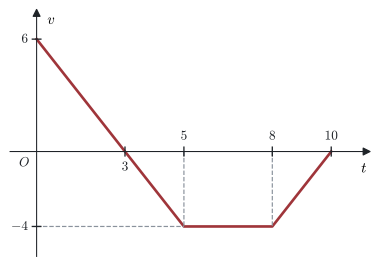
(a) Write down the value of \(t\) at which P changes direction. [1]
(b) Find the total distance travelled by P for \(0 \le t \le 10\). [2]
(c) Find the value of \(t\) at which P returns to \(O\). [3]
(d) Find the greatest distance of P from \(O\) for \(0 \le t \le 10\). [2]
Total 8 marks
(a)
\(t = 3\) (\(v\) changes from positive to negative) A1
[1 mark]
(b)
areas: \(\dfrac{1}{2}(3)(6) = 9\), \(\;\dfrac{1}{2}(2)(4) = 4\), \(\;3 \times 4 = 12\), \(\;\dfrac{1}{2}(2)(4) = 4\) M1
distance \(= 9 + 4 + 12 + 4 = 29\) m A1
[2 marks]
(c)
\(s(3) = 9\) and \(s(5) = 9 - 4 = 5\), so P is not yet back at \(O\) when \(t = 5\) M1
for \(5 \le t \le 8\): \(s = 5 - 4(t - 5)\) A1
\(5 - 4(t - 5) = 0 \;\Rightarrow\; t = 6.25\) A1
[3 marks]
(d)
greatest \(s\) is \(s(3) = 9\); at the end \(s(10) = 9 - 20 = -11\) M1
greatest distance from \(O\) is \(11\) m (when \(t = 10\)) A1
Do not award A1 for \(9\) m.
[2 marks]
SL 4 Paper 1
A particle P starts at a fixed point \(O\) with velocity \(2\ \mathrm{m\,s^{-1}}\) and moves in a straight line. Its acceleration after \(t\) seconds is \(a = -8\sin 2t\ \mathrm{m\,s^{-2}}\), for \(0 \le t \le \pi\).
(a) Show that the velocity of P is \(v = 4\cos 2t - 2\). [3]
(b) Find the values of \(t\) at which P is at instantaneous rest. [3]
(c) Find an expression for the displacement \(s\) of P from \(O\) in terms of \(t\). [2]
(d) Find the total distance travelled by P for \(0 \le t \le \pi\). Give your answer in the form \(p\sqrt{3} + q\pi\), where \(p, q \in \mathbb{Q}\). [5]
(e) Find the greatest speed of P. Justify your answer. [2]
Total 15 marks
(a)
\(v = \displaystyle\int -8\sin 2t\,\mathrm{d}t = 4\cos 2t + c\) M1 A1
\(t = 0\), \(v = 2\): \(\;2 = 4 + c\), so \(c = -2\) A1
\(v = 4\cos 2t - 2\) AG
[3 marks]
(b)
\(4\cos 2t - 2 = 0 \;\Rightarrow\; \cos 2t = \dfrac{1}{2}\) M1
\(2t = \dfrac{\pi}{3}\) or \(2t = \dfrac{5\pi}{3}\) (since \(0 \le 2t \le 2\pi\)) A1
\(t = \dfrac{\pi}{6}\) or \(t = \dfrac{5\pi}{6}\) A1
[3 marks]
(c)
\(s = \displaystyle\int (4\cos 2t - 2)\,\mathrm{d}t = 2\sin 2t - 2t + k\) A1
\(s = 0\) when \(t = 0\), so \(k = 0\) and \(s = 2\sin 2t - 2t\) A1
[2 marks]
(d)
P changes direction at \(\dfrac{\pi}{6}\) and \(\dfrac{5\pi}{6}\), so add the distances on the three intervals M1
\(s\left(\dfrac{\pi}{6}\right) = 2\sin\dfrac{\pi}{3} - \dfrac{\pi}{3} = \sqrt{3} - \dfrac{\pi}{3}\) A1
\(s\left(\dfrac{5\pi}{6}\right) = 2\sin\dfrac{5\pi}{3} - \dfrac{5\pi}{3} = -\sqrt{3} - \dfrac{5\pi}{3}\), \(\;s(\pi) = -2\pi\) A1
distance \(= \left(\sqrt{3} - \dfrac{\pi}{3}\right) + \left(2\sqrt{3} + \dfrac{4\pi}{3}\right) + \left(\sqrt{3} - \dfrac{\pi}{3}\right)\) A1
\(= 4\sqrt{3} + \dfrac{2\pi}{3}\) m \((9.02)\) A1
[5 marks]
(e)
\(-1 \le \cos 2t \le 1\), so \(-6 \le v \le 2\) R1
greatest speed \(= \lvert -6 \rvert = 6\ \mathrm{m\,s^{-1}}\) (when \(t = \dfrac{\pi}{2}\)) A1
Do not award A1 for \(2\ \mathrm{m\,s^{-1}}\) (the greatest velocity).
[2 marks]
SL 5 Paper 2
A particle P starts at a fixed point \(O\) when \(t = 0\) and moves in a straight line. Its velocity after \(t\) seconds is \[ v(t) = 8t\mathrm{e}^{-0.5t} - 3\ \mathrm{m\,s^{-1}}, \qquad 0 \le t \le 10 . \]
(a) Show that the acceleration of P is \(a = 4(2 - t)\mathrm{e}^{-0.5t}\). [2]
(b) Hence find the exact maximum velocity of P. Justify that it is a maximum. [3]
(c) Find the greatest speed of P for \(0 \le t \le 10\). Justify your answer. [2]
(d) Find the values of \(t\) at which P changes direction. [2]
(e) Find the total distance travelled by P for \(0 \le t \le 10\). [2]
(f) Find the greatest distance of P from \(O\) for \(0 \le t \le 10\). [3]
Total 14 marks
(a)
\(a = 8\mathrm{e}^{-0.5t} + 8t\left(-0.5\mathrm{e}^{-0.5t}\right)\) M1 A1
\(= 8\mathrm{e}^{-0.5t} - 4t\mathrm{e}^{-0.5t} = 4(2 - t)\mathrm{e}^{-0.5t}\) AG
[2 marks]
(b)
\(a = 0 \;\Rightarrow\; t = 2\) (since \(\mathrm{e}^{-0.5t} > 0\)) M1
\(a > 0\) for \(t < 2\) and \(a < 0\) for \(t > 2\), so \(v\) has a maximum at \(t = 2\) R1
\(v_{\max} = 16\mathrm{e}^{-1} - 3\) \((2.89)\) A1
[3 marks]
(c)
\(v\) increases on \([0, 2]\) and decreases on \([2, 10]\), so the least \(v\) is \(v(0) = -3\) or \(v(10) = -2.46\) M1
greatest speed \(= 3\ \mathrm{m\,s^{-1}}\) (when \(t = 0\)), since \(3 > 16\mathrm{e}^{-1} - 3\) A1
Do not award A1 for \(2.89\).
[2 marks]
(d)
\(v(t) = 0\) (for example, using Analyze Graph → Zero on a GDC) M1
\(t = 0.476\) and \(t = 5.30\) \((0.475692\ldots,\ 5.29529\ldots)\) A1
[2 marks]
(e)
\(\displaystyle\int_0^{10} \lvert 8t\mathrm{e}^{-0.5t} - 3 \rvert\,\mathrm{d}t\) (using Numerical Integral on a GDC) M1
\(= 16.3\) m \((16.2964\ldots)\) A1
[2 marks]
(f)
\(s(T) = \displaystyle\int_0^{T} v\,\mathrm{d}t\); check the times of rest and the end point M1
\(s(0.476) = -0.653\), \(\;s(10) = 0.706\) A1
\(s(5.30) = 7.85\), so the greatest distance is \(7.85\) m \((7.84794\ldots)\) A1
[3 marks]
HL questions
This unit has no AHL content. HL questions test the same syllabus content as SL, but they need longer chains of reasoning, and some use the HL integration techniques of Unit 27 (substitution and integration by parts).
HL 1 Paper 1
A particle P starts at a fixed point \(O\) when \(t = 0\) and moves in a straight line. Its velocity after \(t\) seconds is \(v = \ln(t + 1) - 1\ \mathrm{m\,s^{-1}}\), for \(t \ge 0\).
(a) Find the value of \(t\) at which P changes direction. Justify your answer. [2]
(b) Find the total distance travelled by P in the first \(\left(\mathrm{e}^{2} - 1\right)\) seconds. [6]
Total 8 marks
(a)
\(\ln(t + 1) = 1 \;\Rightarrow\; t = \mathrm{e} - 1\) A1
\(v\) is increasing, so \(v < 0\) before \(t = \mathrm{e} - 1\) and \(v > 0\) after it: \(v\) changes sign R1
[2 marks]
(b)
by parts with \(u = \ln(t + 1)\), \(\dfrac{\mathrm{d}w}{\mathrm{d}t} = 1\), \(w = t + 1\) M1
\(\displaystyle\int \ln(t + 1)\,\mathrm{d}t = (t + 1)\ln(t + 1) - t\), so \(F(t) = (t + 1)\ln(t + 1) - 2t\) A1
\(F(0) = 0\), \(\;F(\mathrm{e} - 1) = \mathrm{e} - 2(\mathrm{e} - 1) = 2 - \mathrm{e}\) A1
\(F\left(\mathrm{e}^{2} - 1\right) = 2\mathrm{e}^{2} - 2\left(\mathrm{e}^{2} - 1\right) = 2\) A1
distance \(= \lvert F(\mathrm{e} - 1) - F(0) \rvert + F\left(\mathrm{e}^{2} - 1\right) - F(\mathrm{e} - 1)\) M1
\(= (\mathrm{e} - 2) + \mathrm{e} = 2\mathrm{e} - 2\) m \((3.44)\) A1
Accept \(w = t\), which gives \(t\ln(t + 1) - t + \ln(t + 1)\). Do not award the final A1 for \(2\) (the displacement).
[6 marks]
See 29.2.
HL 2 Paper 1
A particle P starts at a fixed point \(O\) when \(t = 0\) and moves in a straight line. Its velocity after \(t\) seconds is \(v = 6(t - 2)(t - k)\ \mathrm{m\,s^{-1}}\), where \(k > 2\) is a constant and \(t \ge 0\).
(a) Show that the displacement of P from \(O\) is \(s = 2t^{3} - 3(k + 2)t^{2} + 12kt\). [2]
P is at \(O\) at the moment when it is at instantaneous rest for the second time.
(b) Find the value of \(k\). [3]
(c) Find the total distance travelled by P from \(t = 0\) to \(t = k\). [3]
Total 8 marks
(a)
\(v = 6t^{2} - 6(k + 2)t + 12k\) A1
\(s = 2t^{3} - 3(k + 2)t^{2} + 12kt + c\) A1
\(s = 0\) when \(t = 0\), so \(c = 0\) and \(s = 2t^{3} - 3(k + 2)t^{2} + 12kt\) AG
[2 marks]
(b)
P is at rest when \(t = 2\) and \(t = k\); the second time is \(t = k\) (as \(k > 2\)) R1
\(s(k) = 2k^{3} - 3k^{3} - 6k^{2} + 12k^{2} = 6k^{2} - k^{3} = 0\) M1
\(k^{2}(6 - k) = 0\) and \(k > 2\), so \(k = 6\) A1
[3 marks]
(c)
\(v > 0\) on \((0, 2)\) and \(v < 0\) on \((2, 6)\), so distance \(= \big(s(2) - s(0)\big) + \big(s(2) - s(6)\big)\) M1
\(s = 2t^{3} - 24t^{2} + 72t\), so \(s(2) = 16 - 96 + 144 = 64\) A1
distance \(= 64 + 64 = 128\) m A1
[3 marks]
HL 3 Paper 2
A particle moves in a straight line. Its velocity after \(t\) seconds is \[ v(t) = \frac{6\sin t}{t + 1}\ \mathrm{m\,s^{-1}}, \qquad 0 \le t \le 8 . \]
(a) Find the acceleration of the particle when \(t = 2\). [2]
(b) Find the total distance travelled by the particle for \(0 \le t \le 8\). [2]
(c) Find the time taken for the particle to travel a total distance of \(6\) m. [3]
Total 7 marks
(a)
\(a = \dfrac{6(t + 1)\cos t - 6\sin t}{(t + 1)^{2}}\), or Numerical Derivative at a Point on a GDC M1
\(a(2) = -1.44\ \mathrm{m\,s^{-2}}\) \((-1.43849\ldots)\) A1
[2 marks]
(b)
\(\displaystyle\int_0^{8} \left\lvert \dfrac{6\sin t}{t + 1} \right\rvert\,\mathrm{d}t\) (using Numerical Integral on a GDC) M1
\(= 8.02\) m \((8.01832\ldots)\) A1
[2 marks]
(c)
\(\displaystyle\int_0^{\pi} v\,\mathrm{d}t = 5.06 < 6\), so the time \(T\) is greater than \(\pi\) R1
\(\displaystyle\int_0^{T} \lvert v \rvert\,\mathrm{d}t = 6\) or \(5.06286\ldots - \displaystyle\int_{\pi}^{T} v\,\mathrm{d}t = 6\) M1
\(T = 4.49\) s \((4.48993\ldots)\) A1
For example, graph \(y = \displaystyle\int_0^{x} \lvert v(t) \rvert\,\mathrm{d}t\) and \(y = 6\) on a GDC and use Intersection.
[3 marks]
HL 4 Paper 1
A particle P starts at a fixed point \(O\) when \(t = 0\) and moves in a straight line. Its velocity after \(t\) seconds is \(v = \sin\sqrt{t}\ \mathrm{m\,s^{-1}}\), for \(t \ge 0\).
(a) Find an expression for the acceleration \(a\) of P, for \(t > 0\). [2]
(b) Find the first two positive values of \(t\) at which P is at instantaneous rest. [2]
(c) Determine whether P is speeding up or slowing down when \(t = \dfrac{16\pi^{2}}{9}\). Justify your answer. [3]
(d) Use the substitution \(u = \sqrt{t}\) to show that \[ \int \sin\sqrt{t}\,\mathrm{d}t = 2\sin\sqrt{t} - 2\sqrt{t}\cos\sqrt{t} + c . \] [5]
(e) Hence find the total distance travelled by P for \(0 \le t \le 4\pi^{2}\). [4]
Total 16 marks
(a)
\(a = \cos\sqrt{t} \times \dfrac{\mathrm{d}}{\mathrm{d}t}\left(\sqrt{t}\right)\) M1
\(= \dfrac{\cos\sqrt{t}}{2\sqrt{t}}\) A1
[2 marks]
(b)
\(\sin\sqrt{t} = 0 \;\Rightarrow\; \sqrt{t} = \pi\) or \(2\pi\) M1
\(t = \pi^{2}\) and \(t = 4\pi^{2}\) A1
[2 marks]
(c)
\(\sqrt{t} = \dfrac{4\pi}{3}\), so \(v = \sin\dfrac{4\pi}{3} = -\dfrac{\sqrt{3}}{2}\) A1
\(a = \dfrac{\cos\frac{4\pi}{3}}{2 \times \frac{4\pi}{3}} = -\dfrac{3}{16\pi}\) A1
\(v\) and \(a\) are both negative (same sign), so P is speeding up R1
Award R1 only if both signs are correct.
[3 marks]
(d)
\(t = u^{2}\), so \(\mathrm{d}t = 2u\,\mathrm{d}u\) M1
\(\displaystyle\int \sin\sqrt{t}\,\mathrm{d}t = \displaystyle\int 2u\sin u\,\mathrm{d}u\) A1
by parts: \(= -2u\cos u + \displaystyle\int 2\cos u\,\mathrm{d}u\) M1 A1
\(= -2u\cos u + 2\sin u + c\) A1
\(= 2\sin\sqrt{t} - 2\sqrt{t}\cos\sqrt{t} + c\) AG
[5 marks]
(e)
\(s = 0\) when \(t = 0\), so \(c = 0\) and \(s = 2\sin\sqrt{t} - 2\sqrt{t}\cos\sqrt{t}\) A1
P changes direction at \(t = \pi^{2}\), so distance \(= s\left(\pi^{2}\right) + \big(s\left(\pi^{2}\right) - s\left(4\pi^{2}\right)\big)\) M1
\(s\left(\pi^{2}\right) = -2\pi\cos\pi = 2\pi\), \(\;s\left(4\pi^{2}\right) = -4\pi\cos 2\pi = -4\pi\) A1
distance \(= 2\pi + 6\pi = 8\pi\) m \((25.1)\) A1
Do not award the final A1 for \(4\pi\) (the size of the displacement).
[4 marks]
HL 5 Paper 2
A particle P starts at a fixed point \(O\) when \(t = 0\) and moves in a straight line. Its velocity after \(t\) seconds is \[ v(t) = 6\mathrm{e}^{-0.2t}\sin t\ \mathrm{m\,s^{-1}}, \qquad t \ge 0 . \] The diagram shows the graph of \(v\) for \(0 \le t \le 12\).
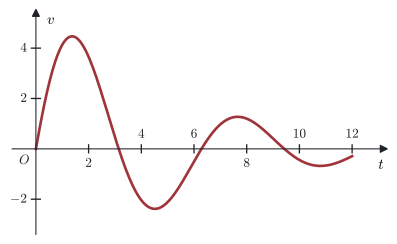
(a) Find the values of \(t\), for \(0 < t < 12\), at which P changes direction. Justify your answer. [2]
(b) Find the greatest speed of P for \(0 \le t \le 12\). [2]
(c) Find the total distance travelled by P for \(0 \le t \le 12\). [2]
(d) Use integration by parts to show that \[ \int \mathrm{e}^{-0.2t}\sin t\,\mathrm{d}t = -\frac{5}{26}\,\mathrm{e}^{-0.2t}(\sin t + 5\cos t) + c . \] [4]
(e) Hence show that the distance travelled by P between \(t = n\pi\) and \(t = (n + 1)\pi\), where \(n \in \mathbb{N}\), is \[ \frac{75}{13}\left(1 + \mathrm{e}^{-0.2\pi}\right)\mathrm{e}^{-0.2n\pi} . \] [3]
(f) Hence find the total distance travelled by P for \(t \ge 0\). [3]
Total 16 marks
(a)
\(t = \pi,\ 2\pi,\ 3\pi\) \((3.14,\ 6.28,\ 9.42)\) A1
\(\mathrm{e}^{-0.2t} > 0\) and \(\sin t\) changes sign at each of these values, so \(v\) changes sign R1
[2 marks]
(b)
greatest value of \(\lvert v \rvert\) (for example, using Analyze Graph → Maximum on a GDC) M1
\(4.47\ \mathrm{m\,s^{-1}}\) \((4.47036\ldots\), when \(t = 1.37)\) A1
The minimum of \(v\) is only \(-2.38\), so the greatest speed is at the first maximum.
[2 marks]
(c)
\(\displaystyle\int_0^{12} \lvert 6\mathrm{e}^{-0.2t}\sin t \rvert\,\mathrm{d}t\) (using Numerical Integral on a GDC) M1
\(= 17.3\) m \((17.3462\ldots)\) A1
[2 marks]
(d)
\(I = -\mathrm{e}^{-0.2t}\cos t - 0.2\displaystyle\int \mathrm{e}^{-0.2t}\cos t\,\mathrm{d}t\) M1
\(\displaystyle\int \mathrm{e}^{-0.2t}\cos t\,\mathrm{d}t = \mathrm{e}^{-0.2t}\sin t + 0.2I\) M1
\(I = -\mathrm{e}^{-0.2t}\cos t - 0.2\mathrm{e}^{-0.2t}\sin t - 0.04I\) A1
\(1.04I = -\mathrm{e}^{-0.2t}(\cos t + 0.2\sin t)\) A1
\(I = -\dfrac{\mathrm{e}^{-0.2t}(5\cos t + \sin t)}{5.2} = -\dfrac{5}{26}\,\mathrm{e}^{-0.2t}(\sin t + 5\cos t) + c\) AG
[4 marks]
(e)
\(\displaystyle\int_{n\pi}^{(n+1)\pi} v\,\mathrm{d}t = -\dfrac{15}{13}\Big[\mathrm{e}^{-0.2t}(\sin t + 5\cos t)\Big]_{n\pi}^{(n+1)\pi}\) M1
\(\sin n\pi = 0\) and \(\cos n\pi = (-1)^{n}\) A1
\(= -\dfrac{75}{13}\left((-1)^{n+1}\mathrm{e}^{-0.2(n+1)\pi} - (-1)^{n}\mathrm{e}^{-0.2n\pi}\right)\) A1
\(= (-1)^{n}\,\dfrac{75}{13}\left(1 + \mathrm{e}^{-0.2\pi}\right)\mathrm{e}^{-0.2n\pi}\); \(v\) has one sign on this interval, so take the absolute value AG
[3 marks]
(f)
total distance \(= \displaystyle\sum_{n=0}^{\infty}\) (distances in (e)): geometric, \(u_1 = \dfrac{75}{13}\left(1 + \mathrm{e}^{-0.2\pi}\right)\), \(r = \mathrm{e}^{-0.2\pi}\), \(\lvert r \rvert < 1\) M1
\(S_\infty = \dfrac{75\left(1 + \mathrm{e}^{-0.2\pi}\right)}{13\left(1 - \mathrm{e}^{-0.2\pi}\right)}\) A1
\(= 19.0\) m \((18.9642\ldots)\) A1
[3 marks]