Unit 25 Exam Practice
Applications of Differentiation
These questions are written in the style of IB examination questions, and they are harder than the review exercises. The marks for each part are shown in square brackets on the right, for example [3]. Paper 1 means no calculator; Paper 2 means a graphic display calculator (GDC) is allowed. Try each question under exam conditions first, then open the markscheme.
| Mark | Meaning |
|---|---|
| M | Method mark: a correct method is used, even with a small slip |
| A | Accuracy mark: a correct answer or line of working (usually needs the M mark before it) |
| R | Reasoning mark: a clear reason or justification is given |
| N | Mark for a correct final answer with no working shown |
| AG | “Answer given” in the question, so no extra mark is awarded for writing it |
The number after the letter is the number of marks, so A2 is worth 2 marks. In the exam, give answers exactly or correct to 3 significant figures (s.f.) unless the question says otherwise.
SL questions
SL 1 Paper 1
The line \(y = x - 4\) is a tangent to the curve \(y = ax^{3} + bx\) at the point where \(x = 1\).
(a) Find the value of \(a\) and the value of \(b\). [4]
(b) The tangent meets the curve again at the point \(Q\). Find the coordinates of \(Q\). [3]
Total 7 marks
(a)
\(\dfrac{dy}{dx} = 3ax^{2} + b\), and the gradient of the line is \(1\), so \(3a + b = 1\) M1 A1
at \(x = 1\) the line gives \(y = -3\), so \(a + b = -3\) A1
\(a = 2\), \(b = -5\) A1
[4 marks]
(b)
\(2x^{3} - 5x = x - 4 \;\Rightarrow\; 2x^{3} - 6x + 4 = 0\) M1
\(x = 1\) is a repeated root (tangent), so \(2(x - 1)^{2}(x + 2) = 0\) M1
\(x = -2\), so \(Q(-2, -6)\) A1
[3 marks]
See 25.1.
SL 2 Paper 1
A function \(f\) is defined for \(-1 \le x \le 3\). The diagram shows the graph of its derivative, \(y = f'(x)\). The graph of \(f'\) has a local minimum at \((0, -2)\) and a local maximum at \((2, 2)\). It meets the \(x\)-axis at \(x = p\), \(x = 1\) and \(x = q\), where \(-1 < p < 0\) and \(2 < q < 3\).
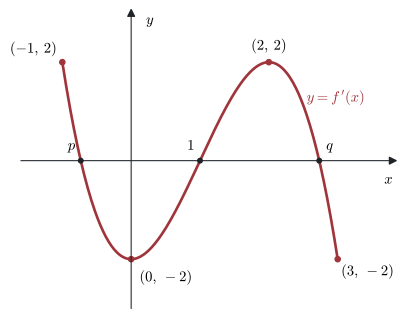
(a) Find the \(x\)-coordinates of the points where \(f\) has a local maximum. Justify your answer. [2]
(b) Find the set of values of \(x\) for which the graph of \(f\) is concave down. Justify your answer. [2]
It is given that \(f(2) = 5\).
(c) Find the equation of the normal to the graph of \(f\) at the point \((2, 5)\). [3]
(d) Explain why \((2, 5)\) is a point of inflexion of the graph of \(f\), and state whether it is a stationary or a non-stationary point of inflexion. [2]
Total 9 marks
(a)
\(x = p\) and \(x = q\) A1
\(f'(x)\) changes from positive to negative at these points R1
Do not award the A1 if \(x = 1\) is also given.
[2 marks]
(b)
concave down where \(f'\) is decreasing (so \(f''(x) < 0\)) R1
\(-1 < x < 0\) or \(2 < x < 3\) A1
Accept \(-1 \le x < 0\) or \(2 < x \le 3\).
[2 marks]
(c)
\(f'(2) = 2\), so the gradient of the normal is \(-\dfrac{1}{2}\) M1 A1
\(y - 5 = -\dfrac{1}{2}(x - 2)\), so \(y = -\dfrac{1}{2}x + 6\) A1
[3 marks]
(d)
\(f'\) has a local maximum at \(x = 2\), so \(f''\) changes sign there R1
\(f'(2) = 2 \neq 0\), so it is a non-stationary point of inflexion A1
[2 marks]
SL 3 Paper 2
The concentration of a drug in a patient’s blood, \(C\) mg per litre, \(t\) hours after the drug is taken, is modelled by \[ C(t) = 15t\,\mathrm{e}^{-0.5t}, \qquad 0 \le t \le 12 . \]
(a) Find the maximum concentration. [2]
The drug is effective while the concentration is at least \(6\) mg per litre.
(b) Find the length of time for which the drug is effective. [3]
(c) Find the value of \(t\) at which the concentration is decreasing most rapidly. Justify your answer. [3]
Total 8 marks
(a)
\(C'(t) = 15\mathrm{e}^{-0.5t} - 7.5t\,\mathrm{e}^{-0.5t} = 0\), or using Analyze Graph → Maximum on a GDC M1
\(11.0\) mg per litre \((11.0363\ldots)\), at \(t = 2\) A1
[2 marks]
(b)
\(15t\,\mathrm{e}^{-0.5t} = 6\) (for example, using the intersection of the graphs of \(C\) and \(y = 6\) on a GDC) M1
\(t = 0.518342\ldots\) and \(t = 5.08528\ldots\) A1
\(5.08528\ldots - 0.518342\ldots = 4.57\) hours \((4.56694\ldots)\) A1
[3 marks]
(c)
decreasing most rapidly where \(C'(t)\) is least, so consider \(C''(t) = 0\) M1
\(C''(t) = 3.75\,\mathrm{e}^{-0.5t}(t - 4) = 0 \;\Rightarrow\; t = 4\) A1
\(C''\) changes from negative to positive at \(t = 4\), so \(C'\) has a minimum there R1
Accept the minimum of the graph of \(C'\) on a GDC: \((4, -2.03)\). At the end point, \(C'(12) = -0.186\), which is greater than \(-2.03\).
[3 marks]
SL 4 Paper 1
Let \(f(x) = 2\sin x + \sin 2x\), for \(0 \le x \le 2\pi\).
(a) Show that \(f'(x) = 2(2\cos x - 1)(\cos x + 1)\). [3]
(b) Find the coordinates of the stationary points of the graph of \(f\). [5]
(c) Show that the stationary point at \(x = \pi\) is neither a maximum nor a minimum. [2]
(d) Show that \(f''(x) = -2\sin x\,(1 + 4\cos x)\). [2]
(e) Hence find the number of points of inflexion of the graph of \(f\) for \(0 < x < 2\pi\). Justify your answer. [4]
Total 16 marks
(a)
\(f'(x) = 2\cos x + 2\cos 2x\) A1
\(= 2\cos x + 2\left(2\cos^{2} x - 1\right)\) M1
\(= 4\cos^{2} x + 2\cos x - 2 = 2\left(2\cos^{2} x + \cos x - 1\right)\) A1
\(= 2(2\cos x - 1)(\cos x + 1)\) AG
[3 marks]
(b)
\(f'(x) = 0 \;\Rightarrow\; \cos x = \dfrac{1}{2}\) or \(\cos x = -1\) M1
\(x = \dfrac{\pi}{3}\), \(x = \dfrac{5\pi}{3}\) A1
\(x = \pi\) A1
\(f\left(\dfrac{\pi}{3}\right) = \sqrt{3} + \dfrac{\sqrt{3}}{2}\): points \(\left(\dfrac{\pi}{3}, \dfrac{3\sqrt{3}}{2}\right)\) and \(\left(\dfrac{5\pi}{3}, -\dfrac{3\sqrt{3}}{2}\right)\) A1
\(f(\pi) = 0\): point \((\pi, 0)\) A1
[5 marks]
(c)
near \(x = \pi\): \(2\cos x - 1 < 0\), and \(\cos x + 1 > 0\) for \(x \neq \pi\) M1
so \(f'(x) < 0\) on both sides of \(x = \pi\): \(f'\) does not change sign R1
\((\pi, 0)\) is a stationary point of inflexion, not a maximum or minimum AG
[2 marks]
(d)
\(f''(x) = -2\sin x - 4\sin 2x\) A1
\(= -2\sin x - 8\sin x\cos x\) M1
\(= -2\sin x\,(1 + 4\cos x)\) AG
[2 marks]
(e)
\(f''(x) = 0 \;\Rightarrow\; \sin x = 0\) or \(\cos x = -\dfrac{1}{4}\) M1
\(\sin x = 0\) gives \(x = \pi\) only (as \(0 < x < 2\pi\)) A1
\(\cos x = -\dfrac{1}{4}\) gives two values, one in \(\left(\dfrac{\pi}{2}, \pi\right)\) and one in \(\left(\pi, \dfrac{3\pi}{2}\right)\) A1
at each value one factor changes sign and the other is not \(0\), so \(f''\) changes sign: \(3\) points of inflexion R1
[4 marks]
SL 5 Paper 1
The point \(P\left(p, 9 - p^{2}\right)\), where \(0 < p < 3\), lies on the curve \(y = 9 - x^{2}\). The tangent to the curve at \(P\) meets the \(x\)-axis at \(A\) and the \(y\)-axis at \(B\). Let \(O\) be the origin.
(a) Show that the equation of the tangent at \(P\) is \(y = -2px + p^{2} + 9\). [3]
(b) Show that the area of triangle \(OAB\) is \(A(p) = \dfrac{\left(p^{2} + 9\right)^{2}}{4p}\). [3]
(c) Show that \(A'(p) = \dfrac{3\left(p^{2} + 9\right)\left(p^{2} - 3\right)}{4p^{2}}\). [4]
(d) Find the exact minimum area of triangle \(OAB\). Justify that your answer is a minimum. [5]
Total 15 marks
(a)
\(\dfrac{dy}{dx} = -2x\), so the gradient at \(P\) is \(-2p\) A1
\(y - \left(9 - p^{2}\right) = -2p(x - p)\) M1
\(y = -2px + 2p^{2} + 9 - p^{2} = -2px + p^{2} + 9\) A1 AG
[3 marks]
(b)
\(y = 0\): \(x = \dfrac{p^{2} + 9}{2p}\), so \(OA = \dfrac{p^{2} + 9}{2p}\) A1
\(x = 0\): \(y = p^{2} + 9\), so \(OB = p^{2} + 9\) A1
area \(= \dfrac{1}{2} \times \dfrac{p^{2} + 9}{2p} \times \left(p^{2} + 9\right)\) M1
\(= \dfrac{\left(p^{2} + 9\right)^{2}}{4p}\) AG
[3 marks]
(c)
\(A(p) = \dfrac{p^{4} + 18p^{2} + 81}{4p} = \dfrac{1}{4}\left(p^{3} + 18p + 81p^{-1}\right)\) M1 A1
\(A'(p) = \dfrac{1}{4}\left(3p^{2} + 18 - 81p^{-2}\right)\) A1
\(= \dfrac{3p^{4} + 18p^{2} - 81}{4p^{2}} = \dfrac{3\left(p^{4} + 6p^{2} - 27\right)}{4p^{2}}\) A1
\(= \dfrac{3\left(p^{2} + 9\right)\left(p^{2} - 3\right)}{4p^{2}}\) AG
Accept the quotient rule or the chain rule used on \(\dfrac{\left(p^{2} + 9\right)^{2}}{4p}\).
[4 marks]
(d)
\(A'(p) = 0 \;\Rightarrow\; p^{2} = 3\) (since \(p^{2} + 9 > 0\)) M1
\(p = \sqrt{3}\) (since \(p > 0\)) A1
\(A'(p) < 0\) for \(0 < p < \sqrt{3}\) and \(A'(p) > 0\) for \(\sqrt{3} < p < 3\), so it is a minimum R1
\(A\left(\sqrt{3}\right) = \dfrac{(3 + 9)^{2}}{4\sqrt{3}} = \dfrac{144}{4\sqrt{3}}\) M1
\(= 12\sqrt{3}\) A1
[5 marks]
HL questions
HL questions on this unit also use the AHL content: tangents to curves given implicitly, related rates of change and optimisation (including optimum values at end points), with the AHL derivatives from Unit 24.
HL 1 Paper 1
The curve \(C\) has equation \(y\,\mathrm{e}^{x} - x\,\mathrm{e}^{y} = 1\).
(a) Show that \(\dfrac{dy}{dx} = \dfrac{\mathrm{e}^{y} - y\,\mathrm{e}^{x}}{\mathrm{e}^{x} - x\,\mathrm{e}^{y}}\). [3]
The point \(P(0, 1)\) lies on \(C\). The normal to \(C\) at \(P\) meets the \(x\)-axis at \(Q\).
(b) Find the \(x\)-coordinate of \(Q\). [4]
Total 7 marks
(a)
\(\dfrac{dy}{dx}\mathrm{e}^{x} + y\,\mathrm{e}^{x} - \mathrm{e}^{y} - x\,\mathrm{e}^{y}\dfrac{dy}{dx} = 0\) M1 A1 A1
\(\dfrac{dy}{dx}\left(\mathrm{e}^{x} - x\,\mathrm{e}^{y}\right) = \mathrm{e}^{y} - y\,\mathrm{e}^{x}\), so the result follows AG
M1 for implicit differentiation with the product rule; A1 for each product differentiated correctly.
[3 marks]
(b)
at \(P\): \(\dfrac{dy}{dx} = \dfrac{\mathrm{e}^{1} - 1 \times \mathrm{e}^{0}}{\mathrm{e}^{0} - 0} = \mathrm{e} - 1\) M1 A1
normal: \(y - 1 = -\dfrac{1}{\mathrm{e} - 1}\,x\) A1
\(y = 0\): \(x = \mathrm{e} - 1\) A1
[4 marks]
See 25.1.
HL 2 Paper 1
Sand is poured onto horizontal ground at a constant rate of \(0.5\) m\(^{3}\) per minute. It forms a pile in the shape of a right circular cone. The height of the cone is always \(\dfrac{3}{4}\) of its base radius. At time \(t\) minutes the base radius is \(r\) m and the volume of sand is \(V\) m\(^{3}\).
(a) Show that \(V = \dfrac{\pi r^{3}}{4}\). [1]
(b) Show that the area \(A\) m\(^{2}\) of the base of the pile increases at the rate \(\dfrac{dA}{dt} = \dfrac{4}{3r}\) m\(^{2}\) per minute. [5]
(c) Find the rate of increase of the area of the base when the height of the pile is \(1.5\) m. [2]
Total 8 marks
(a)
\(V = \dfrac{1}{3}\pi r^{2} \times \dfrac{3r}{4}\) M1
\(= \dfrac{\pi r^{3}}{4}\) AG
[1 mark]
(b)
\(\dfrac{dV}{dt} = \dfrac{3\pi r^{2}}{4} \times \dfrac{dr}{dt}\) M1 A1
\(0.5 = \dfrac{3\pi r^{2}}{4}\dfrac{dr}{dt}\), so \(\dfrac{dr}{dt} = \dfrac{2}{3\pi r^{2}}\) A1
\(A = \pi r^{2}\), so \(\dfrac{dA}{dt} = 2\pi r\,\dfrac{dr}{dt}\) M1
\(= 2\pi r \times \dfrac{2}{3\pi r^{2}} = \dfrac{4}{3r}\) A1 AG
[5 marks]
(c)
\(h = 1.5\) gives \(r = \dfrac{4}{3} \times 1.5 = 2\) A1
\(\dfrac{dA}{dt} = \dfrac{4}{6} = \dfrac{2}{3}\) m\(^{2}\) per minute A1
[2 marks]
See 25.5.
HL 3 Paper 1
Let \(f(x) = kx - \ln\left(x^{2} + 4\right)\), for \(x \in \mathbb{R}\), where \(k\) is a constant.
(a) Find the set of values of \(k\) for which \(f\) is increasing for all \(x \in \mathbb{R}\). [4]
(b) For the least value of \(k\) found in part (a), show that the graph of \(f\) has exactly one stationary point. Find its coordinates and determine its nature. [4]
Total 8 marks
(a)
\(f'(x) = k - \dfrac{2x}{x^{2} + 4}\) A1
\(x^{2} + 4 > 0\), so we need \(kx^{2} - 2x + 4k \ge 0\) for all \(x\) M1
\(k > 0\) and discriminant \(4 - 16k^{2} \le 0\) M1
\(k \ge \dfrac{1}{2}\) A1
[4 marks]
(b)
\(k = \dfrac{1}{2}\): \(f'(x) = \dfrac{x^{2} - 4x + 4}{2\left(x^{2} + 4\right)} = \dfrac{(x - 2)^{2}}{2\left(x^{2} + 4\right)}\) A1
\(f'(x) = 0\) only when \(x = 2\), so there is exactly one stationary point A1
\(f(2) = 1 - \ln 8\), so the point is \((2, 1 - \ln 8)\) A1
\(f'(x) > 0\) on both sides of \(x = 2\), so it is a stationary point of inflexion R1
Accept \(1 - 3\ln 2\).
[4 marks]
HL 4 Paper 2
The point \(P\left(x, \mathrm{e}^{\frac{x}{2}}\right)\) lies on the curve \(y = \mathrm{e}^{\frac{x}{2}}\). The point \(A\) has coordinates \((3, 0)\).
(a) Show that \(AP^{2} = (x - 3)^{2} + \mathrm{e}^{x}\). [1]
(b) Find the minimum distance \(AP\). [3]
(c) For the position of \(P\) found in part (b), show that the line \(AP\) is a normal to the curve. [4]
Total 8 marks
(a)
\(AP^{2} = (x - 3)^{2} + \left(\mathrm{e}^{\frac{x}{2}} - 0\right)^{2} = (x - 3)^{2} + \mathrm{e}^{x}\) A1 AG
[1 mark]
(b)
minimum of \(AP\) (or of \(AP^{2}\)), using Analyze Graph → Minimum on a GDC M1
\(x = 1.25175\ldots\) A1
\(AP = 2.56\) \((2.55985\ldots)\) A1
[3 marks]
(c)
at the minimum, \(\dfrac{d}{dx}\left(AP^{2}\right) = 2(x - 3) + \mathrm{e}^{x} = 0\) M1
so \(\mathrm{e}^{x} = 6 - 2x\) A1
gradient of the curve \(\dfrac{1}{2}\mathrm{e}^{\frac{x}{2}}\); gradient of \(AP\) is \(\dfrac{\mathrm{e}^{\frac{x}{2}}}{x - 3}\) A1
product \(= \dfrac{\mathrm{e}^{x}}{2(x - 3)} = \dfrac{6 - 2x}{2(x - 3)} = -1\), so \(AP\) is perpendicular to the tangent R1
Accept a numerical check of the product with values to at least 3 s.f.: \(0.934944 \times (-1.06959) = -1.000\).
[4 marks]
HL 5 Paper 1
A point \(P\) moves along the curve \(x^{3} + y^{3} = 9\). At the instant when \(P\) is at \((1, 2)\), its \(x\)-coordinate is decreasing at \(2\) units per second.
(a) Find the rate of change of the \(y\)-coordinate of \(P\) at this instant. [3]
Let \(\theta\) be the angle between the line \(OP\) and the positive \(x\)-axis, where \(O\) is the origin.
(b) Find the rate of change of \(\theta\) at this instant. [4]
Total 7 marks
(a)
\(3x^{2}\dfrac{dx}{dt} + 3y^{2}\dfrac{dy}{dt} = 0\) M1 A1
\(3(1)(-2) + 3(4)\dfrac{dy}{dt} = 0\), so \(\dfrac{dy}{dt} = \dfrac{1}{2}\) unit per second A1
[3 marks]
(b)
\(\tan\theta = \dfrac{y}{x}\), so \(\sec^{2}\theta\,\dfrac{d\theta}{dt} = \dfrac{x\frac{dy}{dt} - y\frac{dx}{dt}}{x^{2}}\) M1 A1
\(\sec^{2}\theta = 1 + 2^{2} = 5\), and the right-hand side is \(\dfrac{\frac{1}{2} + 4}{1} = \dfrac{9}{2}\) A1
\(\dfrac{d\theta}{dt} = \dfrac{9}{10}\) radians per second A1
Accept \(\theta = \arctan\dfrac{y}{x}\) differentiated with respect to \(t\).
[4 marks]
See 25.5.
HL 6 Paper 1
Let \(f(x) = x - 2\arctan x\), for \(x \in \mathbb{R}\).
(a) Show that \(f'(x) = \dfrac{x^{2} - 1}{x^{2} + 1}\). [2]
(b) Find the exact coordinates of the stationary points of the graph of \(f\), and determine their nature. [5]
(c) Find \(f''(x)\). Hence show that the graph of \(f\) has exactly one point of inflexion, and write down its coordinates. [4]
(d) Show that the line \(y = x - \pi\) is an asymptote to the graph of \(f\) as \(x \to \infty\), and write down the equation of the asymptote as \(x \to -\infty\). [2]
(e) Find the set of values of \(k\) for which the equation \(f(x) = k\) has exactly three real solutions. [2]
Total 15 marks
(a)
\(f'(x) = 1 - \dfrac{2}{1 + x^{2}}\) A1 A1
\(= \dfrac{x^{2} + 1 - 2}{x^{2} + 1} = \dfrac{x^{2} - 1}{x^{2} + 1}\) AG
[2 marks]
(b)
\(f'(x) = 0 \;\Rightarrow\; x^{2} = 1 \;\Rightarrow\; x = \pm 1\) A1
\(f(1) = 1 - 2 \times \dfrac{\pi}{4} = 1 - \dfrac{\pi}{2}\) A1
\(f(-1) = -1 + \dfrac{\pi}{2}\) A1
\(x^{2} + 1 > 0\), so \(f'\) has the sign of \(x^{2} - 1\): positive, negative, positive R1
\(\left(-1, \dfrac{\pi}{2} - 1\right)\) is a local maximum and \(\left(1, 1 - \dfrac{\pi}{2}\right)\) is a local minimum A1
Accept the second derivative test with \(f''(-1) = -1\) and \(f''(1) = 1\).
[5 marks]
(c)
\(f''(x) = \dfrac{2x\left(x^{2} + 1\right) - \left(x^{2} - 1\right)2x}{\left(x^{2} + 1\right)^{2}}\) M1
\(= \dfrac{4x}{\left(x^{2} + 1\right)^{2}}\) A1
\(f''(x) = 0\) only at \(x = 0\), and \(f''\) changes from negative to positive there R1
exactly one point of inflexion, at \((0, 0)\) A1
[4 marks]
(d)
as \(x \to \infty\), \(\arctan x \to \dfrac{\pi}{2}\), so \(f(x) - (x - \pi) = \pi - 2\arctan x \to 0\) M1
as \(x \to -\infty\), the asymptote is \(y = x + \pi\) A1
[2 marks]
(e)
\(f\) increases to the local maximum, decreases to the local minimum, then increases, and \(f(x) \to \pm\infty\) as \(x \to \pm\infty\), so \(k\) must lie between the two stationary values M1
\(1 - \dfrac{\pi}{2} < k < \dfrac{\pi}{2} - 1\) A1
[2 marks]
HL 7 Paper 1
A running track is a circle with centre \(O\) and radius \(50\) m. A camera is fixed at the point \(C\), where \(OC = 120\) m. The line segment \(OC\) meets the track at \(A\). A runner \(R\) starts at \(A\) and runs anticlockwise around the track at a constant speed of \(5\) m s\(^{-1}\). Let \(\theta\) be the angle \(AOR\) in radians, and let \(D\) m be the distance \(CR\), as shown in the diagram.
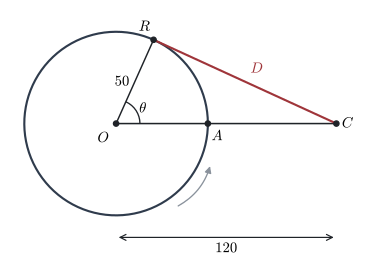
(a) Show that \(D^{2} = 16\,900 - 12\,000\cos\theta\). [2]
(b) Show that \(\dfrac{d\theta}{dt} = 0.1\) radians per second. Hence find the rate at which \(D\) is changing when \(\theta = \dfrac{\pi}{2}\). [5]
It can be shown that, at any time, \(D\) is changing at the rate \(v\) m s\(^{-1}\), where \[ v = \frac{600\sin\theta}{\sqrt{16\,900 - 12\,000\cos\theta}} . \]
(c) Show that \(\dfrac{dv}{d\theta} = 0\) when \(60\cos^{2}\theta - 169\cos\theta + 60 = 0\). [4]
(d) Hence find the greatest rate at which the distance \(CR\) increases. Justify that your answer is a maximum. [5]
Total 16 marks
(a)
cosine rule in triangle \(OCR\): \(D^{2} = 50^{2} + 120^{2} - 2(50)(120)\cos\theta\) M1
\(= 2500 + 14\,400 - 12\,000\cos\theta\) A1
\(= 16\,900 - 12\,000\cos\theta\) AG
[2 marks]
(b)
arc \(AR = 50\theta\), so \(50\dfrac{d\theta}{dt} = 5\) and \(\dfrac{d\theta}{dt} = 0.1\) M1
\(2D\dfrac{dD}{dt} = 12\,000\sin\theta\,\dfrac{d\theta}{dt}\) M1 A1
\(\theta = \dfrac{\pi}{2}\): \(D^{2} = 16\,900\), so \(D = 130\) A1
\(\dfrac{dD}{dt} = \dfrac{1200 \times 1}{2 \times 130} = \dfrac{60}{13}\) m s\(^{-1}\) \((4.62)\) A1
[5 marks]
(c)
let \(w = 16\,900 - 12\,000\cos\theta\), so \(v = 600\sin\theta\,w^{-\frac{1}{2}}\) and \(\dfrac{dw}{d\theta} = 12\,000\sin\theta\) M1
\(\dfrac{dv}{d\theta} = 600\cos\theta\,w^{-\frac{1}{2}} - 300\sin\theta\,w^{-\frac{3}{2}} \times 12\,000\sin\theta\) A1
\(= 600\,w^{-\frac{3}{2}}\left(w\cos\theta - 6000\sin^{2}\theta\right)\) A1
\(= 0\) when \(\cos\theta\,(16\,900 - 12\,000\cos\theta) - 6000\left(1 - \cos^{2}\theta\right) = 0\) M1
\(-6000\cos^{2}\theta + 16\,900\cos\theta - 6000 = 0\), so \(60\cos^{2}\theta - 169\cos\theta + 60 = 0\) AG
[4 marks]
(d)
\((12\cos\theta - 5)(5\cos\theta - 12) = 0\) M1
\(\cos\theta = \dfrac{5}{12}\) (as \(\cos\theta = \dfrac{12}{5} > 1\) is impossible) A1
\(D^{2} = 16\,900 - 5000 = 11\,900\) and \(\sin\theta = \dfrac{\sqrt{119}}{12}\) A1
\(v = \dfrac{600 \times \frac{\sqrt{119}}{12}}{\sqrt{11\,900}} = \dfrac{50\sqrt{119}}{10\sqrt{119}} = 5\) m s\(^{-1}\) A1
\(v > 0\) only for \(0 < \theta < \pi\), \(v = 0\) at \(\theta = 0\) and \(\theta = \pi\), and there is one stationary point between, so it is the maximum R1
At this instant \(\cos\theta = \dfrac{50}{120}\), so angle \(ORC\) is a right angle: the runner is moving directly away from \(C\), so \(D\) increases at the runner’s full speed.
[5 marks]
HL 8 Paper 1
An offshore wind turbine \(T\) is \(3\) km from a straight coastline. The point on the coast nearest to \(T\) is \(N\). A substation \(S\) is on the coast, \(L\) km from \(N\). A cable is laid in a straight line under the sea from \(T\) to a point \(Q\) on the coast between \(N\) and \(S\), and then along the coast from \(Q\) to \(S\). The cable costs \(5\) units per km to lay under the sea and \(3\) units per km to lay along the coast. Let \(\theta\) be the angle \(NTQ\), where \(0 \le \theta \le \arctan\dfrac{L}{3}\).
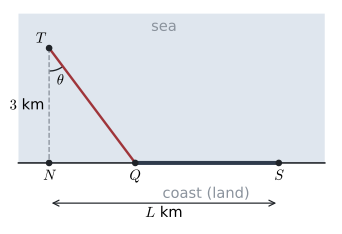
(a) Show that the total cost is \(C = 15\sec\theta - 9\tan\theta + 3L\) units. [3]
(b) Show that \(\dfrac{dC}{d\theta} = 3\sec^{2}\theta\,(5\sin\theta - 3)\). [3]
(c) In this part, \(L = 6\). Find the minimum cost, and the distance \(NQ\) for which it occurs. Justify that your answer is a minimum. [5]
(d) Find the set of values of \(L\) for which the cheapest cable includes a part laid along the coast. [2]
(e) In this part, \(L = 1.5\). Find the minimum cost, and explain why it does not occur at a stationary point of \(C\). [3]
Total 16 marks
(a)
\(C = 5 \times TQ + 3 \times QS\) M1
\(\cos\theta = \dfrac{3}{TQ}\), so \(TQ = 3\sec\theta\) A1
\(NQ = 3\tan\theta\), so \(QS = L - 3\tan\theta\) A1
\(C = 5(3\sec\theta) + 3(L - 3\tan\theta) = 15\sec\theta - 9\tan\theta + 3L\) AG
[3 marks]
(b)
\(\dfrac{dC}{d\theta} = 15\sec\theta\tan\theta - 9\sec^{2}\theta\) A1 A1
\(= 3\sec^{2}\theta\left(\dfrac{5\tan\theta}{\sec\theta} - 3\right)\) M1
\(= 3\sec^{2}\theta\,(5\sin\theta - 3)\), since \(\dfrac{\tan\theta}{\sec\theta} = \sin\theta\) AG
[3 marks]
(c)
\(\sec^{2}\theta \neq 0\), so \(\dfrac{dC}{d\theta} = 0 \;\Rightarrow\; \sin\theta = \dfrac{3}{5}\) M1
\(\tan\theta = \dfrac{3}{4}\), so \(NQ = \dfrac{9}{4}\) km (less than \(6\), so \(Q\) is between \(N\) and \(S\)) A1
\(\dfrac{dC}{d\theta} < 0\) when \(\sin\theta < \dfrac{3}{5}\) and \(\dfrac{dC}{d\theta} > 0\) when \(\sin\theta > \dfrac{3}{5}\), so it is a minimum R1
\(\sec\theta = \dfrac{5}{4}\): \(C = 15 \times \dfrac{5}{4} - 9 \times \dfrac{3}{4} + 18\) M1
\(= 30\) units A1
[5 marks]
(d)
the stationary point needs \(NQ = \dfrac{9}{4}\) to be less than \(NS = L\) M1
\(L > \dfrac{9}{4}\) A1
Do not accept \(L \ge \dfrac{9}{4}\): for \(L \le \dfrac{9}{4}\), \(\dfrac{dC}{d\theta} \le 0\) on the whole domain, so the cheapest cable goes straight to \(S\) (\(Q = S\)).
[2 marks]
(e)
the greatest \(\theta\) has \(\tan\theta = \dfrac{1}{2}\), so \(\sin\theta \le \dfrac{1}{\sqrt{5}} < \dfrac{3}{5}\) for all \(\theta\) in the domain M1
so \(\dfrac{dC}{d\theta} < 0\): \(C\) is decreasing, and the minimum is at the end point \(\theta = \arctan\dfrac{1}{2}\) (\(Q = S\)) R1
\(C = 5\sqrt{3^{2} + 1.5^{2}} = \dfrac{15\sqrt{5}}{2}\) units \((16.8)\) A1
[3 marks]
See 25.6.