Unit 28 Exam Practice
Applications of Integration
These questions are written in the style of IB examination questions, and they are harder than the review exercises. The marks for each part are shown in square brackets on the right, for example [3]. Paper 1 means no calculator; Paper 2 means a graphic display calculator (GDC) is allowed. Try each question under exam conditions first, then open the markscheme.
| Mark | Meaning |
|---|---|
| M | Method mark: a correct method is used, even with a small slip |
| A | Accuracy mark: a correct answer or line of working (usually needs the M mark before it) |
| R | Reasoning mark: a clear reason or justification is given |
| N | Mark for a correct final answer with no working shown |
| AG | “Answer given” in the question, so no extra mark is awarded for writing it |
The number after the letter is the number of marks, so A2 is worth 2 marks. In the exam, give answers exactly or correct to 3 significant figures (s.f.) unless the question says otherwise.
SL questions
SL 1 Paper 1
A continuous function \(f\) is such that \[ \int_{-1}^{4} f(x)\,\mathrm{d}x = 10 \qquad \text{and} \qquad \int_{2}^{4} f(x)\,\mathrm{d}x = 7 . \]
(a) Find \(\displaystyle\int_{-1}^{2} f(x)\,\mathrm{d}x\). [2]
(b) Find \(\displaystyle\int_{2}^{-1} \big(3f(x) - 2x\big)\,\mathrm{d}x\). [3]
(c) Given that \(\displaystyle\int_{-1}^{4} \big(f(x) + kx\big)\,\mathrm{d}x = 25\), find the value of the constant \(k\). [3]
Total 8 marks
(a)
\(\displaystyle\int_{-1}^{2} f(x)\,\mathrm{d}x + \int_{2}^{4} f(x)\,\mathrm{d}x = \int_{-1}^{4} f(x)\,\mathrm{d}x\) M1
\(\displaystyle\int_{-1}^{2} f(x)\,\mathrm{d}x = 10 - 7 = 3\) A1
[2 marks]
(b)
\(\displaystyle\int_{2}^{-1} \big(3f(x) - 2x\big)\,\mathrm{d}x = -\left(3\int_{-1}^{2} f(x)\,\mathrm{d}x - \int_{-1}^{2} 2x\,\mathrm{d}x\right)\) M1
\(\displaystyle\int_{-1}^{2} 2x\,\mathrm{d}x = \Big[x^{2}\Big]_{-1}^{2} = 4 - 1 = 3\) A1
\(-(3 \times 3 - 3) = -6\) A1
Award M1 for either swapping the limits with a change of sign or splitting the integral.
[3 marks]
(c)
\(\displaystyle 10 + k\int_{-1}^{4} x\,\mathrm{d}x = 25\) M1
\(\displaystyle\int_{-1}^{4} x\,\mathrm{d}x = \Big[\tfrac{x^{2}}{2}\Big]_{-1}^{4} = 8 - \dfrac{1}{2} = \dfrac{15}{2}\) A1
\(\dfrac{15k}{2} = 15\), so \(k = 2\) A1
[3 marks]
See 28.1.
SL 2 Paper 1
Let \(f(x) = 3x^{2} - 2kx\), where \(k > 0\).
(a) Show that the area of the region enclosed by the graph of \(f\) and the \(x\)-axis is \(\dfrac{4k^{3}}{27}\). [4]
(b) Given that this area is \(4\), find the value of \(k\). [2]
(c) Using your value of \(k\), find the value of \(b\), where \(b > 0\), such that \(\displaystyle\int_{0}^{b} f(x)\,\mathrm{d}x = 0\). [2]
Total 8 marks
(a)
\(x(3x - 2k) = 0\), so the graph meets the \(x\)-axis at \(x = 0\) and \(x = \dfrac{2k}{3}\) A1
the region is below the axis, so area \(= \displaystyle\int_{0}^{\frac{2k}{3}} \left(2kx - 3x^{2}\right)\mathrm{d}x\) M1
\(= \Big[kx^{2} - x^{3}\Big]_{0}^{\frac{2k}{3}}\) A1
\(= \dfrac{4k^{3}}{9} - \dfrac{8k^{3}}{27}\) A1
\(= \dfrac{4k^{3}}{27}\) AG
Accept \(-\displaystyle\int_{0}^{\frac{2k}{3}} f(x)\,\mathrm{d}x\) or \(\left|\displaystyle\int_{0}^{\frac{2k}{3}} f(x)\,\mathrm{d}x\right|\) for the M1.
[4 marks]
(b)
\(\dfrac{4k^{3}}{27} = 4 \;\Rightarrow\; k^{3} = 27\) M1
\(k = 3\) A1
[2 marks]
(c)
\(\displaystyle\int_{0}^{b} \left(3x^{2} - 6x\right)\mathrm{d}x = b^{3} - 3b^{2} = 0\) M1
\(b^{2}(b - 3) = 0\) and \(b > 0\), so \(b = 3\) A1
[2 marks]
SL 3 Paper 2
Let \(f(x) = 6x\mathrm{e}^{-x}\) and \(g(x) = \dfrac{x^{2}}{2}\), for \(x \geq 0\). The graphs of \(f\) and \(g\) meet at the origin \(O\) and at the point \(P\). The shaded region \(R\) is enclosed by the two graphs.
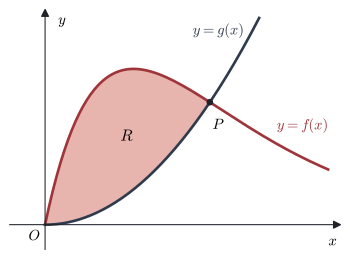
(a) Find \(p\), the \(x\)-coordinate of \(P\). [2]
(b) Find the area of \(R\). [3]
(c) A vertical line \(x = k\), where \(0 < k < p\), meets the graph of \(f\) at \(M\) and the graph of \(g\) at \(N\). Find the maximum length of \(MN\) as \(k\) varies. [3]
Total 8 marks
(a)
\(6x\mathrm{e}^{-x} = \dfrac{x^{2}}{2}\) (for example, the intersection of the two graphs on a GDC) M1
\(p = 1.86\) \((1.86281\ldots)\) A1
[2 marks]
(b)
area \(= \displaystyle\int_{0}^{1.86281\ldots} \left(6x\mathrm{e}^{-x} - \dfrac{x^{2}}{2}\right)\mathrm{d}x\) M1 A1
\(= 2.26\) \((2.25619\ldots)\) (using the Integral feature on a GDC) A1
Award M1 for the integral of (upper \(-\) lower) and A1 for the correct limits.
[3 marks]
(c)
\(MN = f(k) - g(k) = 6k\mathrm{e}^{-k} - \dfrac{k^{2}}{2}\) M1
maximum at \(k = 0.741\) \((0.740933\ldots)\) (using Analyze Graph → Maximum on a GDC) A1
maximum length \(= 1.84\) \((1.84458\ldots)\) A1
[3 marks]
See 28.4.
SL 4 Paper 1
Let \(f(x) = x^{3} - 6x^{2} + 9x\). The diagram shows part of the graph of \(f\). The graph has a local maximum at \(A\) and a local minimum at \(B\), where \(B\) lies on the \(x\)-axis. The tangent to the graph at \(A\) meets the graph again at \(C\). The region \(R_1\) is bounded by the graph and the \(x\)-axis between \(O\) and \(B\). The region \(R_2\) is enclosed by the graph and the line \(AC\).
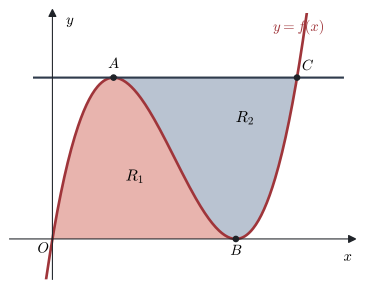
(a) Find the coordinates of \(A\) and of \(B\), and justify that \(A\) is a local maximum. [4]
(b) Show that the \(x\)-coordinate of \(C\) is \(4\). [3]
(c) Find the area of \(R_1\). [3]
(d) Find the area of \(R_2\). [3]
(e) Find \(\displaystyle\int_{-1}^{3} f(x)\,\mathrm{d}x\). Hence find the total area between the graph of \(f\) and the \(x\)-axis for \(-1 \leq x \leq 3\). [3]
Total 16 marks
(a)
\(f'(x) = 3x^{2} - 12x + 9 = 3(x - 1)(x - 3)\) M1
\(f'(x) = 0\) at \(x = 1\) and \(x = 3\) A1
\(A(1, 4)\) and \(B(3, 0)\) A1
\(f''(x) = 6x - 12\), and \(f''(1) = -6 < 0\), so \(A\) is a local maximum R1
Accept a sign diagram for \(f'\) (positive for \(x < 1\), negative for \(1 < x < 3\)) for the R1.
[4 marks]
(b)
the tangent at \(A\) is horizontal: \(y = 4\), so \(x^{3} - 6x^{2} + 9x = 4\) M1
\(x^{3} - 6x^{2} + 9x - 4 = 0\) has the double root \(x = 1\) (the tangent point) A1
\((x - 1)^{2}(x - 4) = 0\) A1
so \(C\) has \(x = 4\) AG
[3 marks]
(c)
area of \(R_1 = \displaystyle\int_{0}^{3} \left(x^{3} - 6x^{2} + 9x\right)\mathrm{d}x\) M1
\(= \Big[\tfrac{x^{4}}{4} - 2x^{3} + \tfrac{9x^{2}}{2}\Big]_{0}^{3}\) A1
\(= \dfrac{81}{4} - 54 + \dfrac{81}{2} = \dfrac{27}{4}\) A1
[3 marks]
(d)
area of \(R_2 = \displaystyle\int_{1}^{4} \left(4 - x^{3} + 6x^{2} - 9x\right)\mathrm{d}x\) M1
\(= \Big[4x - \tfrac{x^{4}}{4} + 2x^{3} - \tfrac{9x^{2}}{2}\Big]_{1}^{4} = 8 - \dfrac{5}{4}\) A1
\(= \dfrac{27}{4}\) A1
[3 marks]
(e)
with \(F(x) = \dfrac{x^{4}}{4} - 2x^{3} + \dfrac{9x^{2}}{2}\): \(\;F(3) - F(-1) = \dfrac{27}{4} - \dfrac{27}{4}\) M1
\(\displaystyle\int_{-1}^{3} f(x)\,\mathrm{d}x = 0\) A1
so \(\displaystyle\int_{-1}^{0} f(x)\,\mathrm{d}x = -\int_{0}^{3} f(x)\,\mathrm{d}x = -\dfrac{27}{4}\) (this part is below the axis)
total area \(= \dfrac{27}{4} + \dfrac{27}{4} = \dfrac{27}{2}\) A1
Do not award the final A1 for an answer of \(0\).
[3 marks]
SL 5 Paper 1
Let \(f(x) = 9 - x^{2}\), for \(0 \leq x \leq 3\). The region \(R\) is bounded by the graph of \(f\) and the coordinate axes. The diagram shows \(R\) and three rectangles of width \(1\).
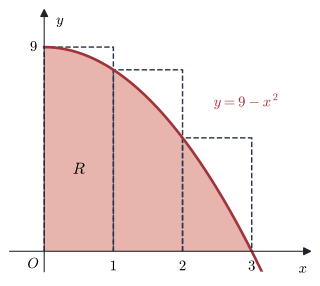
(a) The interval \(0 \leq x \leq 3\) is divided into \(3\) strips of width \(1\). Find the upper sum \(U_3\) and the lower sum \(L_3\) for the area of \(R\). [3]
The interval \(0 \leq x \leq 3\) is now divided into \(n\) strips, each of width \(\dfrac{3}{n}\). Let \(L_n\) and \(U_n\) be the lower and upper sums.
(b) Given that \(\displaystyle\sum_{r=1}^{n} r^{2} = \dfrac{n(n + 1)(2n + 1)}{6}\), show that \[ L_n = 27 - \frac{9(n + 1)(2n + 1)}{2n^{2}} . \] [4]
(c) Show that \(U_n - L_n = \dfrac{27}{n}\). [2]
(d) Find the least value of \(n\) for which \(U_n - L_n < 0.1\). [2]
(e) Find \(\displaystyle\lim_{n \to \infty} L_n\), and hence write down the exact area of \(R\). [2]
(f) Find the area of the region enclosed by the graph of \(f\) and the straight line through \((0, 9)\) and \((3, 0)\). [3]
Total 16 marks
(a)
heights \(f(0) = 9\), \(f(1) = 8\), \(f(2) = 5\), \(f(3) = 0\); \(f\) is decreasing, so \(U_3\) uses the left ends M1
\(U_3 = 1 \times (9 + 8 + 5) = 22\) A1
\(L_3 = 1 \times (8 + 5 + 0) = 13\) A1
[3 marks]
(b)
\(f\) is decreasing, so \(L_n\) uses the right ends \(x = \dfrac{3r}{n}\), \(r = 1, 2, \ldots, n\) M1
\(L_n = \displaystyle\sum_{r=1}^{n} \dfrac{3}{n}\left(9 - \dfrac{9r^{2}}{n^{2}}\right)\) A1
\(= 27 - \dfrac{27}{n^{3}}\displaystyle\sum_{r=1}^{n} r^{2}\) A1
\(= 27 - \dfrac{27}{n^{3}} \times \dfrac{n(n + 1)(2n + 1)}{6}\) M1
\(= 27 - \dfrac{9(n + 1)(2n + 1)}{2n^{2}}\) AG
[4 marks]
(c)
\(U_n\) uses \(r = 0, 1, \ldots, n - 1\) and \(L_n\) uses \(r = 1, 2, \ldots, n\), so all terms cancel except two M1
\(U_n - L_n = \dfrac{3}{n}\big(f(0) - f(3)\big) = \dfrac{3}{n}(9 - 0)\) A1
\(= \dfrac{27}{n}\) AG
[2 marks]
(d)
\(\dfrac{27}{n} < 0.1 \;\Rightarrow\; n > 270\) M1
\(n = 271\) A1
[2 marks]
(e)
\(\dfrac{9(n + 1)(2n + 1)}{2n^{2}} = \dfrac{9}{2}\left(1 + \dfrac{1}{n}\right)\left(2 + \dfrac{1}{n}\right) \to 9\) M1
\(\displaystyle\lim_{n \to \infty} L_n = 18\), so the area of \(R\) is \(18\) A1
[2 marks]
(f)
line: \(y = 9 - 3x\); area \(= \displaystyle\int_{0}^{3} \big((9 - x^{2}) - (9 - 3x)\big)\,\mathrm{d}x\) M1
\(= \Big[\tfrac{3x^{2}}{2} - \tfrac{x^{3}}{3}\Big]_{0}^{3}\) A1
\(= \dfrac{27}{2} - 9 = \dfrac{9}{2}\) A1
Accept \(18 - \frac{1}{2} \times 3 \times 9 = \frac{9}{2}\) (area of \(R\) minus the triangle).
[3 marks]
HL questions
HL questions on this unit also use the AHL content: areas with respect to the \(y\)-axis and volumes of revolution about both axes, together with the HL integration techniques of Unit 27.
HL 1 Paper 1
The diagram shows the parabola \(y^{2} = x + 3\) and the line \(x = 2y\). They meet at the points \(P\) and \(Q\). The shaded region \(R\) is enclosed by the parabola and the line.
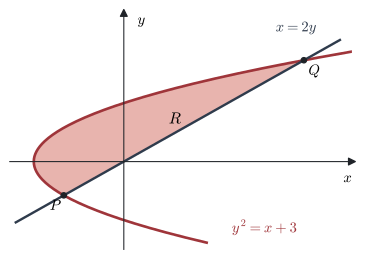
(a) Find the coordinates of \(P\) and \(Q\). [3]
(b) By integrating with respect to \(y\), find the area of \(R\). [4]
Total 7 marks
(a)
\(y^{2} = 2y + 3 \;\Rightarrow\; y^{2} - 2y - 3 = 0\) M1
\((y - 3)(y + 1) = 0\), so \(y = -1\) or \(y = 3\) A1
\(P(-2, -1)\) and \(Q(6, 3)\) A1
[3 marks]
(b)
for \(-1 \leq y \leq 3\) the line \(x = 2y\) is on the right and the parabola \(x = y^{2} - 3\) is on the left M1
area \(= \displaystyle\int_{-1}^{3} \left(2y - y^{2} + 3\right)\mathrm{d}y\) A1
\(= \Big[y^{2} - \tfrac{y^{3}}{3} + 3y\Big]_{-1}^{3} = 9 - \left(-\dfrac{5}{3}\right)\) A1
\(= \dfrac{32}{3}\) A1
[4 marks]
See 28.3.
HL 2 Paper 1
The region bounded by the curve \(y = \dfrac{4}{\sqrt{(x + 1)(x + 3)}}\), the coordinate axes and the line \(x = 3\) is rotated through \(2\pi\) about the \(x\)-axis. Find the exact volume of the solid formed. Give your answer in the form \(a\pi\ln b\), where \(a \in \mathbb{Z}^{+}\) and \(b\) is a prime number. [6]
Total 6 marks
\(V = \pi\displaystyle\int_{0}^{3} \dfrac{16}{(x + 1)(x + 3)}\,\mathrm{d}x\) M1
\(\dfrac{16}{(x + 1)(x + 3)} = \dfrac{A}{x + 1} + \dfrac{B}{x + 3}\), so \(16 = A(x + 3) + B(x + 1)\) M1
\(A = 8\), \(B = -8\) A1
\(\displaystyle\int \left(\dfrac{8}{x + 1} - \dfrac{8}{x + 3}\right)\mathrm{d}x = 8\ln(x + 1) - 8\ln(x + 3)\) A1
\(V = 8\pi\Big[\ln\dfrac{x + 1}{x + 3}\Big]_{0}^{3} = 8\pi\left(\ln\dfrac{2}{3} - \ln\dfrac{1}{3}\right)\) M1
\(V = 8\pi\ln 2\) A1
[6 marks]
See 28.5.
HL 3 Paper 1
The region bounded by the curve \(y = \sqrt{x}\,\sin x\) and the \(x\)-axis, for \(0 \leq x \leq \pi\), is rotated through \(2\pi\) about the \(x\)-axis. Find the exact volume of the solid formed. [7]
Total 7 marks
\(V = \pi\displaystyle\int_{0}^{\pi} x\sin^{2} x\,\mathrm{d}x\) M1
\(\sin^{2} x = \dfrac{1 - \cos 2x}{2}\), so \(V = \dfrac{\pi}{2}\displaystyle\int_{0}^{\pi} \left(x - x\cos 2x\right)\mathrm{d}x\) M1
\(\dfrac{\pi}{2}\displaystyle\int_{0}^{\pi} x\,\mathrm{d}x = \dfrac{\pi}{2}\Big[\tfrac{x^{2}}{2}\Big]_{0}^{\pi} = \dfrac{\pi^{3}}{4}\) A1
by parts: \(\displaystyle\int x\cos 2x\,\mathrm{d}x = \dfrac{x\sin 2x}{2} - \int \dfrac{\sin 2x}{2}\,\mathrm{d}x\) M1
\(= \dfrac{x\sin 2x}{2} + \dfrac{\cos 2x}{4}\) A1
\(\Big[\tfrac{x\sin 2x}{2} + \tfrac{\cos 2x}{4}\Big]_{0}^{\pi} = \dfrac{1}{4} - \dfrac{1}{4} = 0\) A1
\(V = \dfrac{\pi^{3}}{4}\) A1
[7 marks]
HL 4 Paper 1
(a) Let \(f\) be a continuous function and let \(a > 0\). Use the substitution \(u = a - x\) to show that \[ \int_{0}^{a} f(a - x)\,\mathrm{d}x = \int_{0}^{a} f(x)\,\mathrm{d}x . \] [2]
Let \(g(x) = \dfrac{x^{2}}{x^{2} + (2 - x)^{2}}\), for \(0 \leq x \leq 2\).
(b) Show that \(g(x) + g(2 - x) = 1\). [2]
(c) Hence find the area of the region bounded by the graph of \(g\), the \(x\)-axis and the line \(x = 2\). [4]
Total 8 marks
(a)
\(u = a - x\), \(\mathrm{d}x = -\mathrm{d}u\); \(\;x = 0 \Rightarrow u = a\), \(\;x = a \Rightarrow u = 0\) M1
\(\displaystyle\int_{0}^{a} f(a - x)\,\mathrm{d}x = \int_{a}^{0} f(u)\,(-\mathrm{d}u) = \int_{0}^{a} f(u)\,\mathrm{d}u\) A1
\(= \displaystyle\int_{0}^{a} f(x)\,\mathrm{d}x\) (the letter used for the variable does not matter) AG
[2 marks]
(b)
\(g(2 - x) = \dfrac{(2 - x)^{2}}{(2 - x)^{2} + \big(2 - (2 - x)\big)^{2}} = \dfrac{(2 - x)^{2}}{(2 - x)^{2} + x^{2}}\) M1 A1
same denominator, so \(g(x) + g(2 - x) = \dfrac{x^{2} + (2 - x)^{2}}{x^{2} + (2 - x)^{2}} = 1\) AG
[2 marks]
(c)
\(g(x) \geq 0\), so the area is \(A = \displaystyle\int_{0}^{2} g(x)\,\mathrm{d}x = \int_{0}^{2} g(2 - x)\,\mathrm{d}x\), by (a) with \(a = 2\) M1
\(2A = \displaystyle\int_{0}^{2} \big(g(x) + g(2 - x)\big)\,\mathrm{d}x\) M1
\(= \displaystyle\int_{0}^{2} 1\,\mathrm{d}x = 2\) A1
\(A = 1\) A1
[4 marks]
HL 5 Paper 2
The curves \(y = 2\sin x\) and \(y = x^{2}\) meet at the origin \(O\) and at the point \(P\), where \(x > 0\). The shaded region \(R\) is enclosed by the two curves.
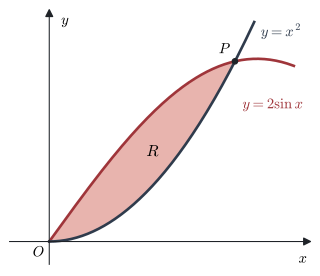
(a) Write down the \(x\)-coordinate of \(P\). [1]
(b) The region \(R\) is rotated through \(2\pi\) about the \(x\)-axis. Find the volume of the solid formed. [3]
(c) The region \(R\) is rotated through \(2\pi\) about the \(y\)-axis. Find the volume of the solid formed. [4]
Total 8 marks
(a)
\(x = 1.40\) \((1.40441\ldots)\) A1
[1 mark]
(b)
\(V = \pi\displaystyle\int_{0}^{1.40441\ldots} \left((2\sin x)^{2} - (x^{2})^{2}\right)\mathrm{d}x\) M1 A1
\(= 4.37\) \((4.36511\ldots)\) (using the Integral feature on a GDC) A1
Award M1 for outer radius squared minus inner radius squared, A1 for the correct limits. Do not award the M1 for \(\pi\int (2\sin x - x^{2})^{2}\,\mathrm{d}x\).
[3 marks]
(c)
in terms of \(y\): \(x = \arcsin\dfrac{y}{2}\) (inner boundary) and \(x = \sqrt{y}\) (outer boundary) M1
\(y\) goes from \(0\) to \(y_P = 1.40441\ldots^{2} = 1.97\) \((1.97238\ldots)\) A1
\(V = \pi\displaystyle\int_{0}^{1.97238\ldots} \left(y - \left(\arcsin\dfrac{y}{2}\right)^{2}\right)\mathrm{d}y\) M1
\(= 3.36\) \((3.35914\ldots)\) (using the Integral feature on a GDC) A1
[4 marks]
See 28.5.
HL 6 Paper 1
Let \(f(x) = \dfrac{\ln x}{\sqrt{x}}\), for \(x > 0\). The diagram shows part of the graph of \(f\), which has a maximum point at \(M\). The shaded region \(R\) is bounded by the graph of \(f\), the \(x\)-axis and the vertical line through \(M\).
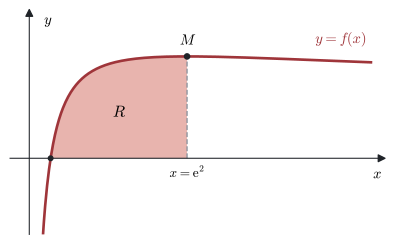
(a) Show that \(f'(x) = \dfrac{2 - \ln x}{2x\sqrt{x}}\). [3]
(b) Find the exact coordinates of \(M\), and justify that \(M\) is a maximum. [4]
(c) Use integration by parts to show that the area of \(R\) is \(4\). [5]
(d) The region \(R\) is rotated through \(2\pi\) about the \(x\)-axis. Find the exact volume of the solid formed. [3]
Total 15 marks
(a)
quotient rule: \(f'(x) = \dfrac{\sqrt{x} \times \frac{1}{x} - \ln x \times \frac{1}{2\sqrt{x}}}{x}\) M1 A1
multiply the numerator and the denominator by \(2\sqrt{x}\): \(f'(x) = \dfrac{2 - \ln x}{2x\sqrt{x}}\) A1 AG
Accept the product rule on \(x^{-\frac{1}{2}}\ln x\).
[3 marks]
(b)
\(f'(x) = 0 \;\Rightarrow\; \ln x = 2\) M1
\(x = \mathrm{e}^{2}\) A1
\(f\left(\mathrm{e}^{2}\right) = \dfrac{2}{\mathrm{e}}\), so \(M\left(\mathrm{e}^{2}, \dfrac{2}{\mathrm{e}}\right)\) A1
\(2x\sqrt{x} > 0\); for \(x < \mathrm{e}^{2}\), \(\ln x < 2\) so \(f'(x) > 0\), and for \(x > \mathrm{e}^{2}\), \(f'(x) < 0\), so \(M\) is a maximum R1
[4 marks]
(c)
the graph meets the \(x\)-axis where \(\ln x = 0\), at \(x = 1\) A1
\(u = \ln x\), \(\dfrac{\mathrm{d}v}{\mathrm{d}x} = x^{-\frac{1}{2}}\), so \(\dfrac{\mathrm{d}u}{\mathrm{d}x} = \dfrac{1}{x}\), \(v = 2\sqrt{x}\) M1
\(\displaystyle\int \dfrac{\ln x}{\sqrt{x}}\,\mathrm{d}x = 2\sqrt{x}\ln x - \int \dfrac{2\sqrt{x}}{x}\,\mathrm{d}x\) A1
\(= 2\sqrt{x}\ln x - 4\sqrt{x}\) A1
\(\Big[2\sqrt{x}\ln x - 4\sqrt{x}\Big]_{1}^{\mathrm{e}^{2}} = (4\mathrm{e} - 4\mathrm{e}) - (0 - 4)\) M1
\(= 4\) AG
[5 marks]
(d)
\(V = \pi\displaystyle\int_{1}^{\mathrm{e}^{2}} \dfrac{(\ln x)^{2}}{x}\,\mathrm{d}x\) M1
\(= \pi\Big[\tfrac{(\ln x)^{3}}{3}\Big]_{1}^{\mathrm{e}^{2}}\) (by inspection, or with \(u = \ln x\)) A1
\(= \dfrac{8\pi}{3}\) A1
[3 marks]
HL 7 Paper 1
The diagram shows part of the curve \(y = \arctan 2x\). The region \(R\) is bounded by the curve, the \(x\)-axis and the line \(x = \dfrac{1}{2}\). The region \(S\) is bounded by the curve, the \(y\)-axis and the line \(y = \dfrac{\pi}{4}\).
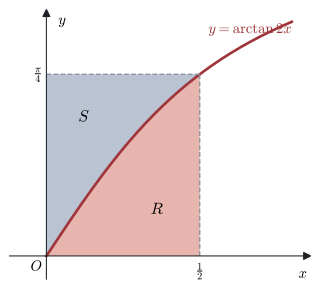
(a) Use integration by parts to show that \(\displaystyle\int_{0}^{\frac{1}{2}} \arctan 2x\,\mathrm{d}x = \frac{\pi}{8} - \frac{1}{4}\ln 2\). [5]
(b) Write \(x\) in terms of \(y\) for points on the curve. [1]
(c) By integrating with respect to \(y\), find the exact area of \(S\). Hence verify the result of part (a). [4]
(d) The region \(R\) is rotated through \(2\pi\) about the \(y\)-axis. Show that the volume of the solid formed is \(\dfrac{\pi}{4}\left(\dfrac{\pi}{2} - 1\right)\). [4]
(e) Hence find the exact volume of the solid formed when \(S\) is rotated through \(2\pi\) about the \(y\)-axis. [2]
Total 16 marks
(a)
\(u = \arctan 2x\), \(\dfrac{\mathrm{d}v}{\mathrm{d}x} = 1\), so \(v = x\) M1
\(\dfrac{\mathrm{d}u}{\mathrm{d}x} = \dfrac{2}{1 + 4x^{2}}\) A1
\(\displaystyle\int \arctan 2x\,\mathrm{d}x = x\arctan 2x - \int \dfrac{2x}{1 + 4x^{2}}\,\mathrm{d}x\) A1
\(\displaystyle\int \dfrac{2x}{1 + 4x^{2}}\,\mathrm{d}x = \dfrac{1}{4}\ln\left(1 + 4x^{2}\right)\) A1
\(\Big[x\arctan 2x - \tfrac{1}{4}\ln\left(1 + 4x^{2}\right)\Big]_{0}^{\frac{1}{2}} = \dfrac{1}{2} \times \dfrac{\pi}{4} - \dfrac{1}{4}\ln 2 - 0\) M1
\(= \dfrac{\pi}{8} - \dfrac{1}{4}\ln 2\) AG
[5 marks]
(b)
\(x = \dfrac{1}{2}\tan y\) A1
[1 mark]
(c)
area of \(S = \displaystyle\int_{0}^{\frac{\pi}{4}} \dfrac{1}{2}\tan y\,\mathrm{d}y\) M1
\(= \dfrac{1}{2}\Big[-\ln(\cos y)\Big]_{0}^{\frac{\pi}{4}} = -\dfrac{1}{2}\ln\dfrac{1}{\sqrt{2}}\) A1
\(= \dfrac{1}{4}\ln 2\) A1
\(R\) and \(S\) form a rectangle of area \(\dfrac{1}{2} \times \dfrac{\pi}{4} = \dfrac{\pi}{8}\), so area of \(R = \dfrac{\pi}{8} - \dfrac{1}{4}\ln 2\), the same as (a) R1
[4 marks]
(d)
\(V = \pi\displaystyle\int_{0}^{\frac{\pi}{4}} \left(\left(\dfrac{1}{2}\right)^{2} - \left(\dfrac{1}{2}\tan y\right)^{2}\right)\mathrm{d}y\) M1 A1
\(\tan^{2} y = \sec^{2} y - 1\), so \(V = \dfrac{\pi}{4}\displaystyle\int_{0}^{\frac{\pi}{4}} \left(2 - \sec^{2} y\right)\mathrm{d}y\) M1
\(= \dfrac{\pi}{4}\Big[2y - \tan y\Big]_{0}^{\frac{\pi}{4}} = \dfrac{\pi}{4}\left(\dfrac{\pi}{2} - 1\right)\) A1 AG
Award M1 for outer radius \(\frac{1}{2}\) and inner radius \(\frac{1}{2}\tan y\), A1 for the correct limits.
[4 marks]
(e)
\(R\) and \(S\) together form a cylinder of radius \(\dfrac{1}{2}\) and height \(\dfrac{\pi}{4}\), with volume \(\pi \times \dfrac{1}{4} \times \dfrac{\pi}{4} = \dfrac{\pi^{2}}{16}\) M1
\(V_S = \dfrac{\pi^{2}}{16} - \dfrac{\pi^{2}}{8} + \dfrac{\pi}{4} = \dfrac{\pi}{4} - \dfrac{\pi^{2}}{16}\) A1
Accept \(\pi\displaystyle\int_{0}^{\frac{\pi}{4}} \dfrac{1}{4}\tan^{2} y\,\mathrm{d}y\) evaluated directly.
[2 marks]
HL 8 Paper 2
The inside of a vase is formed by rotating the part of the curve \[ y = \frac{8x^{2}}{1 + x^{2}}, \qquad 0 \leq x \leq \sqrt{3}, \] through \(2\pi\) about the \(y\)-axis, where \(x\) and \(y\) are measured in decimetres (dm). The lowest point of the inside of the vase is at the origin \(O\), and the rim is at \(y = 6\). The vase contains water to a depth of \(h\) dm.
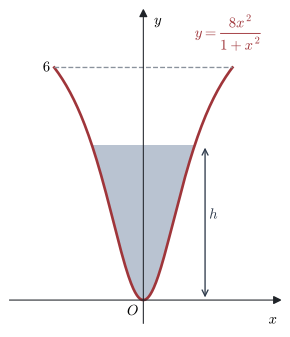
(a) Show that \(x^{2} = \dfrac{y}{8 - y}\). [2]
(b) Show that the volume of water, \(V\) dm³, is given by \[ V = \pi\left(8\ln\left(\frac{8}{8 - h}\right) - h\right) . \] [5]
(c) Find the volume of the vase. Give your answer in exact form and correct to 3 significant figures. [2]
Water is poured into the vase at a constant rate of \(0.2\) dm³ per second.
(d) Find the rate at which the depth of the water is increasing when \(h = 4\). [4]
(e) Find the depth of the water when the vase is half full (by volume). [2]
Total 15 marks
(a)
\(y\left(1 + x^{2}\right) = 8x^{2} \;\Rightarrow\; y = 8x^{2} - yx^{2} = x^{2}(8 - y)\) M1
\(x^{2} = \dfrac{y}{8 - y}\) A1 AG
[2 marks]
(b)
\(V = \pi\displaystyle\int_{0}^{h} x^{2}\,\mathrm{d}y = \pi\int_{0}^{h} \dfrac{y}{8 - y}\,\mathrm{d}y\) M1
\(\dfrac{y}{8 - y} = \dfrac{8 - (8 - y)}{8 - y} = \dfrac{8}{8 - y} - 1\) M1 A1
\(\displaystyle\int \left(\dfrac{8}{8 - y} - 1\right)\mathrm{d}y = -8\ln(8 - y) - y\) A1
\(V = \pi\Big[-8\ln(8 - y) - y\Big]_{0}^{h} = \pi\big(-8\ln(8 - h) - h + 8\ln 8\big)\) A1
\(= \pi\left(8\ln\left(\dfrac{8}{8 - h}\right) - h\right)\) AG
No modulus is needed in \(\ln(8 - y)\), since \(0 \leq y \leq 6\).
[5 marks]
(c)
\(V(6) = \pi(8\ln 4 - 6) = \pi(16\ln 2 - 6)\) A1
\(= 16.0\) dm³ \((15.9918\ldots)\) A1
[2 marks]
(d)
\(\dfrac{\mathrm{d}V}{\mathrm{d}h} = \pi x^{2} = \dfrac{\pi h}{8 - h}\) (or differentiate \(V\)) M1
at \(h = 4\): \(\dfrac{\mathrm{d}V}{\mathrm{d}h} = \pi\) A1
\(\dfrac{\mathrm{d}h}{\mathrm{d}t} = \dfrac{\mathrm{d}V}{\mathrm{d}t} \div \dfrac{\mathrm{d}V}{\mathrm{d}h} = \dfrac{0.2}{\pi}\) M1
\(= 0.0637\) dm per second \((0.0636619\ldots)\) A1
[4 marks]
(e)
\(\pi\left(8\ln\left(\dfrac{8}{8 - h}\right) - h\right) = \dfrac{15.9918\ldots}{2}\) (for example, the intersection of two graphs on a GDC) M1
\(h = 4.81\) dm \((4.80987\ldots)\) A1
[2 marks]
See 28.5.