Unit 12 Exam Practice
Graph Transformations
These questions are written in the style of IB examination questions, and they are harder than the review exercises. The marks for each part are shown in square brackets on the right, for example [3]. Paper 1 means no calculator; Paper 2 means a graphic display calculator (GDC) is allowed. Try each question under exam conditions first, then open the markscheme.
| Mark | Meaning |
|---|---|
| M | Method mark: a correct method is used, even with a small slip |
| A | Accuracy mark: a correct answer or line of working (usually needs the M mark before it) |
| R | Reasoning mark: a clear reason or justification is given |
| N | Mark for a correct final answer with no working shown |
| AG | “Answer given” in the question, so no extra mark is awarded for writing it |
The number after the letter is the number of marks, so A2 is worth 2 marks. In the exam, give answers exactly or correct to 3 significant figures (s.f.) unless the question says otherwise.
SL questions
SL 1 Paper 1
The graph of \(y = f(x)\) has a maximum point \(A(-3, 5)\), passes through the point \(B(4, -1)\) and has the horizontal asymptote \(y = 2\).
Let \(g(x) = 4 - 2f\left(\frac{1}{2}x\right)\).
(a) Find the coordinates of the image of \(A\) on the graph of \(y = g(x)\), and state whether it is a maximum point or a minimum point. [3]
(b) Find the coordinates of the image of \(B\). [1]
(c) Write down the equation of the horizontal asymptote of the graph of \(y = g(x)\). [1]
(d) The point \(C(6, 10)\) lies on the graph of \(y = g(x)\). Find the coordinates of the point on the graph of \(y = f(x)\) that is mapped onto \(C\). [2]
Total 7 marks
(a)
\((x, y) \longmapsto (2x,\ 4 - 2y)\) M1
\(A(-3, 5) \longmapsto (-6, -6)\) A1
it is a minimum point (the factor \(-2\) includes a reflection in the \(x\)-axis) A1
[3 marks]
(b)
\((8, 6)\) A1
[1 mark]
(c)
\(y = 4 - 2 \times 2\), so \(y = 0\) A1
[1 mark]
(d)
\(2x = 6\) and \(4 - 2y = 10\) M1
\((3, -3)\) A1
[2 marks]
See 12.2.
SL 2 Paper 2
Let \(f(x) = 2^{x}\). The graph of \(y = f(x)\) is transformed onto the graph of \(y = g(x)\) by the following sequence of transformations:
- a translation by the vector \(\begin{pmatrix} 3 \\ 0 \end{pmatrix}\), followed by
- a stretch parallel to the \(y\)-axis with scale factor \(4\), followed by
- a reflection in the \(x\)-axis, followed by
- a translation by the vector \(\begin{pmatrix} 0 \\ 8 \end{pmatrix}\).
(a) Show that \(g(x) = 8 - 2^{x - 1}\). [3]
(b) Write down the equation of the horizontal asymptote of the graph of \(y = g(x)\), and find the \(x\)-intercept of the graph. [2]
(c) The graph of \(y = g(x)\) can also be obtained from the graph of \(y = f(x)\) by a reflection in the \(x\)-axis followed by a single translation. Find the translation vector. [2]
(d) Find the \(x\)-coordinates of the points where the graph of \(y = g(x)\) meets the graph of \(y = x^{2}\). [2]
Total 9 marks
(a)
\(y = 2^{x - 3}\) A1
\(y = 4 \times 2^{x - 3} = 2^{2} \times 2^{x - 3}\) M1
\(= 2^{x - 1}\) A1
\(y = -2^{x - 1}\), then \(y = 8 - 2^{x - 1}\) AG
[3 marks]
(b)
\(y = 8\) A1
\(2^{x - 1} = 8 = 2^{3}\), so \((4, 0)\) A1
[2 marks]
(c)
\(y = -2^{x}\), and \(g(x) = -2^{x - 1} + 8\) is this graph moved \(1\) right and \(8\) up M1
\(\begin{pmatrix} 1 \\ 8 \end{pmatrix}\) A1
[2 marks]
(d)
\(8 - 2^{x - 1} = x^{2}\) (for example, the intersection of the two graphs on a GDC)
\(x = -2.82\) \((-2.8158\ldots)\) A1
\(x = 2.34\) \((2.3388\ldots)\) A1
[2 marks]
SL 3 Paper 1
Let \(g(x) = \dfrac{4x - 5}{2x - 4}\), for \(x \neq 2\).
(a) Write \(g(x)\) in the form \(p + \dfrac{q}{x - 2}\), where \(p, q \in \mathbb{Q}\). [2]
(b) Hence describe a sequence of transformations that maps the graph of \(y = \dfrac{1}{x}\) onto the graph of \(y = g(x)\). [3]
(c) The point \((a, b)\) on the graph of \(y = \dfrac{1}{x}\) is mapped onto the point \(\left(5, \dfrac{5}{2}\right)\) by this sequence of transformations. Find \(a\) and \(b\). [2]
Total 7 marks
(a)
\(g(x) = \dfrac{(4x - 8) + 3}{2x - 4} = 2 + \dfrac{3}{2x - 4}\) M1
\(= 2 + \dfrac{\frac{3}{2}}{x - 2}\), so \(p = 2\), \(q = \dfrac{3}{2}\) A1
[2 marks]
(b)
a stretch parallel to the \(y\)-axis with scale factor \(\dfrac{3}{2}\) A1
then a translation of \(2\) units in the positive \(x\)-direction A1
and \(2\) units in the positive \(y\)-direction (after the stretch) A1
The horizontal translation may be done at any stage. Accept a vertical translation of \(\frac{4}{3}\) units before the stretch.
[3 marks]
(c)
\((a, b) \longmapsto \left(a + 2,\ \dfrac{3}{2}b + 2\right)\), so \(a + 2 = 5\) and \(\dfrac{3}{2}b + 2 = \dfrac{5}{2}\) M1
\(a = 3\), \(b = \dfrac{1}{3}\) A1
[2 marks]
See 12.2.
SL 4 Paper 1
The diagram shows the graph of \(y = f(x)\), for \(-4 \le x \le 6\). The graph consists of three line segments, joining the points \(A(-4, 2)\), \(B(-1, -4)\), \(C(3, 4)\) and \(D(6, 1)\).
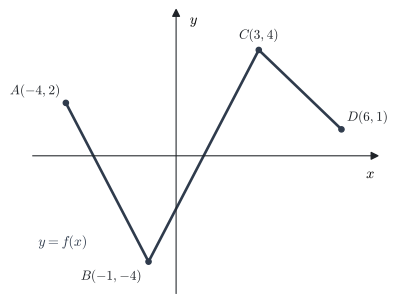
(a) Find the \(x\)-intercepts of the graph of \(y = f(x)\). [2]
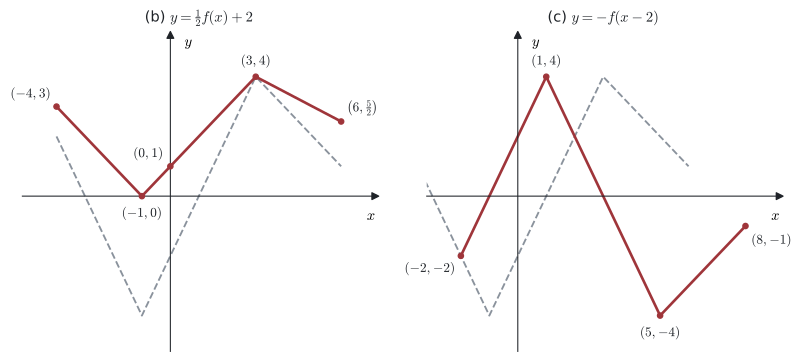
(b) Sketch the graph of \(y = \frac{1}{2}f(x) + 2\). Give the coordinates of the end points, of the images of \(B\) and \(C\), and of the \(y\)-intercept. [4]
(c) Sketch the graph of \(y = -f(x - 2)\). Give the coordinates of the end points and of the images of \(B\) and \(C\). [3]
Let \(h(x) = f(-2x)\).
(d) Find the domain of \(h\), and solve the equation \(h(x) = 0\). [3]
The graph of \(y = f(x)\) is mapped onto the graph of \(y = p\,f(x - a) + b\), where \(p > 0\). The new graph has a minimum point \((1, -5)\) and a maximum point \((5, 11)\).
(e) Find the values of \(a\), \(p\) and \(b\). [4]
Total 16 marks
(a)
\(AB\): \(y = -2x - 6\) and \(BC\): \(y = 2x - 2\) (or use similar triangles) M1
\((-3, 0)\) and \((1, 0)\) A1
[2 marks]
(b)
three line segments, with \((x, y) \longmapsto \left(x,\ \frac{1}{2}y + 2\right)\) applied to the vertices A1
end points \((-4, 3)\) and \(\left(6, \frac{5}{2}\right)\) A1
minimum \((-1, 0)\) on the \(x\)-axis, and maximum \((3, 4)\) (invariant) A1
\(y\)-intercept \((0, 1)\), since \(f(0) = -2\) A1
[4 marks]
(c)
\((x, y) \longmapsto (x + 2,\ -y)\); three segments on \(-2 \le x \le 8\), end points \((-2, -2)\) and \((8, -1)\) A1
maximum \((1, 4)\) A1
minimum \((5, -4)\) A1
[3 marks]
(d)
\(-4 \le -2x \le 6\) M1
domain: \(-3 \le x \le 2\) A1
\(-2x = -3\) or \(-2x = 1\), so \(x = \dfrac{3}{2}\) or \(x = -\dfrac{1}{2}\) A1
[3 marks]
(e)
\(p > 0\), so \(B\) maps to the minimum: \(-1 + a = 1\), so \(a = 2\) (check: \(3 + 2 = 5\)) A1
\(-4p + b = -5\) and \(4p + b = 11\) M1 A1
\(p = 2\), \(b = 3\) A1
[4 marks]
SL 5 Paper 1
Let \(f(x) = 3x^{2} + 12x + 7\).
(a) Write \(f(x)\) in the form \(a(x - h)^{2} + k\). [2]
(b) Hence describe a sequence of transformations that maps the graph of \(y = x^{2}\) onto the graph of \(y = f(x)\). [3]
The graph of \(y = f(x)\) is transformed onto the graph of \(y = g(x)\) by a stretch parallel to the \(x\)-axis with scale factor \(\frac{1}{2}\), followed by a reflection in the \(x\)-axis, followed by a translation by the vector \(\begin{pmatrix} 0 \\ 7 \end{pmatrix}\).
(c) Show that \(g(x) = -12x^{2} - 24x\). [3]
(d) Find the \(x\)-intercepts of the graph of \(y = g(x)\), and use the vertex of the graph of \(f\) to find the vertex of the graph of \(g\). [3]
(e) The same three transformations are now applied to the graph of \(y = f(x)\) in the reverse order. Find the equation of the new graph in the form \(y = px^{2} + qx + r\). [3]
Total 14 marks
(a)
\(3\left(x^{2} + 4x\right) + 7 = 3\big((x + 2)^{2} - 4\big) + 7\) M1
\(f(x) = 3(x + 2)^{2} - 5\) A1
[2 marks]
(b)
a stretch parallel to the \(y\)-axis with scale factor \(3\) A1
followed by a translation by the vector \(\begin{pmatrix} -2 \\ -5 \end{pmatrix}\) A1 A1
Award A1 for each component. Accept the translation \(\begin{pmatrix} -2 \\ -\frac{5}{3} \end{pmatrix}\) before the stretch.
[3 marks]
(c)
\(f(2x) = 3(2x)^{2} + 12(2x) + 7 = 12x^{2} + 24x + 7\) M1
reflection: \(y = -12x^{2} - 24x - 7\) A1
translation: \(y = -12x^{2} - 24x - 7 + 7\) A1
\(g(x) = -12x^{2} - 24x\) AG
[3 marks]
(d)
\(-12x(x + 2) = 0\), so \(x = 0\) and \(x = -2\) A1
\((-2, -5) \longmapsto (-1, -5) \longmapsto (-1, 5) \longmapsto (-1, 12)\) M1
vertex \((-1, 12)\) (a maximum) A1
[3 marks]
(e)
translation first: \(y = f(x) + 7 = 3x^{2} + 12x + 14\) M1
reflection: \(y = -3x^{2} - 12x - 14\) A1
stretch (replace \(x\) by \(2x\)): \(y = -12x^{2} - 24x - 14\) A1
[3 marks]
See 12.2.
HL questions
HL questions on this unit use the AHL graphs \(y = f(ax + b)\), \(y = |f(x)|\), \(y = f(|x|)\), \(y = \dfrac{1}{f(x)}\) and \(y = [f(x)]^{2}\), together with the SL transformations.
HL 1 Paper 1
The graph of \(y = f(x)\) has a vertical asymptote \(x = -2\) and a maximum point \(P(4, 6)\). The line \(x = -2\) is the only vertical asymptote of the graph, and \(P\) is its only turning point.
The graph of \(y = f(ax + b)\), where \(a, b \in \mathbb{R}\) and \(a \neq 0\), has a vertical asymptote \(x = 3\) and a maximum point \((1, 6)\).
(a) Find the value of \(a\) and the value of \(b\). [4]
(b) Hence describe a sequence of transformations that maps the graph of \(y = f(x)\) onto the graph of \(y = f(ax + b)\). [3]
(c) The point \((k, 0)\) lies on the graph of \(y = f(x)\). Write down, in terms of \(k\), the coordinates of the corresponding point on the graph of \(y = f(ax + b)\). [1]
Total 8 marks
(a)
the point with \(x\)-coordinate \(x\) on the new graph comes from \(ax + b\) on \(y = f(x)\) M1
asymptote: \(3a + b = -2\) A1
maximum: \(a + b = 4\) A1
\(a = -3\), \(b = 7\) A1
[4 marks]
(b)
\(f(7 - 3x) = f\left(-3\left(x - \frac{7}{3}\right)\right)\): a stretch parallel to the \(x\)-axis with scale factor \(\dfrac{1}{3}\) A1
and a reflection in the \(y\)-axis A1
then a translation of \(\dfrac{7}{3}\) units in the positive \(x\)-direction A1
Accept a translation of \(7\) units in the negative \(x\)-direction first, followed by the stretch and the reflection.
[3 marks]
(c)
\(\left(\dfrac{7 - k}{3},\ 0\right)\) A1
[1 mark]
See 12.3.
HL 2 Paper 1
Let \(f(x) = x^{2} - 2x - 15\).
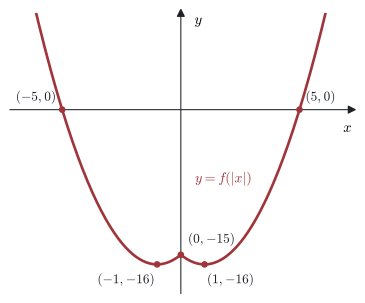
(a) Sketch the graph of \(y = f(|x|)\). Give the coordinates of the axis intercepts and of the minimum points. [3]
(b) Solve the equation \(\big|f(|x|)\big| = 15\). [5]
Total 8 marks
(a)
for \(x \ge 0\), \(f(x) = (x + 3)(x - 5) = (x - 1)^{2} - 16\); this part reflected in the \(y\)-axis (symmetric W shape) A1
intercepts \((-5, 0)\), \((5, 0)\) and \((0, -15)\) A1
minimum points \((-1, -16)\) and \((1, -16)\) A1
[3 marks]
(b)
\(f(|x|) = 15\) or \(f(|x|) = -15\) M1
\(|x|^{2} - 2|x| - 30 = 0\), so \(|x| = 1 + \sqrt{31}\) (as \(|x| \ge 0\)) A1
\(x = \pm\left(1 + \sqrt{31}\right)\) A1
\(|x|^{2} - 2|x| = 0\), so \(|x| = 0\) or \(|x| = 2\) A1
\(x = 0\), \(x = \pm 2\) A1
The line \(y = -15\) passes through the local maximum \((0, -15)\) of \(y = f(|x|)\), which is why there are five solutions.
[5 marks]
See 12.4.
HL 3 Paper 1
Let \(f(x) = 3 - 2\mathrm{e}^{x}\), for \(x \in \mathbb{R}\).
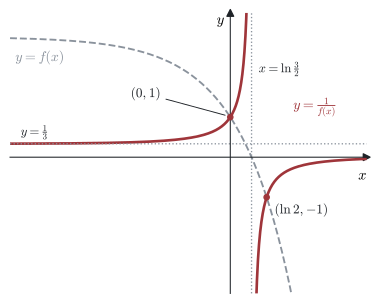
(a) Write down the equations of all the asymptotes of the graph of \(y = \dfrac{1}{f(x)}\). [3]
(b) Find the coordinates of the points where the graph of \(y = f(x)\) meets the graph of \(y = \dfrac{1}{f(x)}\). [3]
(c) Find the range of the function \(\dfrac{1}{f}\). [2]
Total 8 marks
(a)
\(f(x) = 0 \Rightarrow \mathrm{e}^{x} = \dfrac{3}{2}\), so \(x = \ln \dfrac{3}{2}\) A1
as \(x \to -\infty\), \(f(x) \to 3\), so \(y = \dfrac{1}{3}\) A1
as \(x \to \infty\), \(f(x) \to -\infty\), so \(y = 0\) A1
[3 marks]
(b)
\(f(x) = \dfrac{1}{f(x)} \iff [f(x)]^{2} = 1 \iff f(x) = \pm 1\) M1
\(f(x) = 1\): \(\mathrm{e}^{x} = 1\), so \((0, 1)\) A1
\(f(x) = -1\): \(\mathrm{e}^{x} = 2\), so \((\ln 2, -1)\) A1
[3 marks]
(c)
for \(x < \ln \frac{3}{2}\), \(0 < f(x) < 3\), so \(\dfrac{1}{f(x)} > \dfrac{1}{3}\) A1
for \(x > \ln \frac{3}{2}\), \(f(x)\) takes all negative values, so \(\dfrac{1}{f(x)} < 0\); range: \(y < 0\) or \(y > \dfrac{1}{3}\) A1
[2 marks]
See 12.5.
HL 4 Paper 1
The diagram shows the graph of \(y = f(x)\). The graph crosses the \(x\)-axis at \((-3, 0)\), \((1, 0)\) and \((5, 0)\). It has a local maximum point \((-1, 2)\) and a local minimum point \((3, -4)\), and no other turning points. As \(x \to -\infty\), \(f(x) \to -\infty\), and as \(x \to \infty\), \(f(x) \to \infty\).
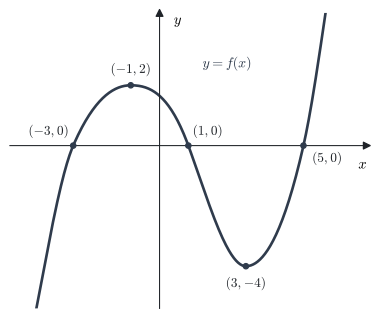
(a) Sketch the graph of \(y = |f(x)|\). Give the coordinates of the \(x\)-intercepts and of the local maximum points. [3]
(b) Sketch the graph of \(y = \dfrac{1}{f(x)}\). Give the equations of the asymptotes and the coordinates of the turning points. [5]
(c) Sketch the graph of \(y = [f(x)]^{2}\). Give the coordinates of the turning points. [3]
Let \(g(x) = -2f(2x + 1)\).
(d) Find the \(x\)-intercepts of the graph of \(y = g(x)\), and the coordinates of its turning points. State whether each turning point is a maximum or a minimum. [4]
Total 15 marks
(a)
parts below the \(x\)-axis (\(x < -3\) and \(1 < x < 5\)) reflected; sharp points at \((-3, 0)\), \((1, 0)\), \((5, 0)\) A1
local maximum \((-1, 2)\) unchanged A1
local maximum \((3, 4)\) A1
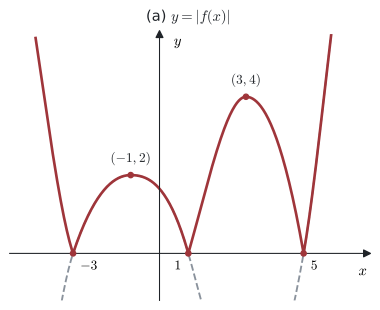
[3 marks]
(b)
vertical asymptotes \(x = -3\), \(x = 1\), \(x = 5\) A1
horizontal asymptote \(y = 0\) (because \(|f(x)| \to \infty\)) A1
local minimum \(\left(-1, \dfrac{1}{2}\right)\) A1
local maximum \(\left(3, -\dfrac{1}{4}\right)\) A1
correct shape: below the axis for \(x < -3\) and \(1 < x < 5\), above for \(-3 < x < 1\) and \(x > 5\) A1
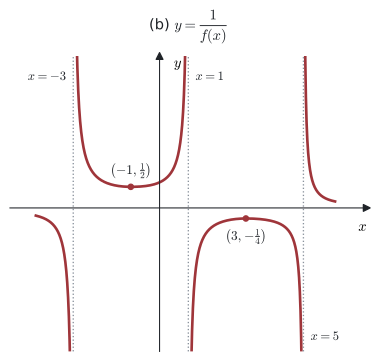
[5 marks]
(c)
graph on or above the \(x\)-axis, touching it (smooth minima) at \((-3, 0)\), \((1, 0)\), \((5, 0)\) A1
local maximum \((-1, 4)\) A1
local maximum \((3, 16)\) A1
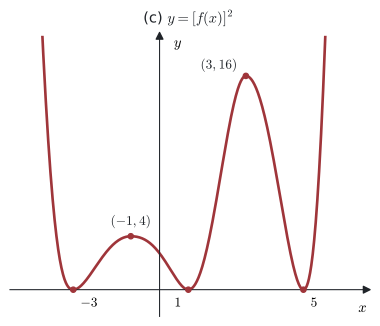
[3 marks]
(d)
\((x, y) \longmapsto \left(\dfrac{x - 1}{2},\ -2y\right)\) M1
\(x\)-intercepts: \(x = -2\), \(x = 0\), \(x = 2\) A1
\((-1, 2) \longmapsto (-1, -4)\), a minimum A1
\((3, -4) \longmapsto (1, 8)\), a maximum A1
[4 marks]
HL 5 Paper 2
Let \(f(x) = 2\ln(x + 3) - 1\), for \(x > -3\).
(a) Describe a sequence of transformations that maps the graph of \(y = \ln x\) onto the graph of \(y = f(x)\). [3]
(b) Write down the equation of the vertical asymptote of the graph of \(y = f(x)\), and find the exact \(x\)-intercept. [2]
(c) Show that \(f(2x - 1) = f(x - 2) + \ln 4\). Hence describe the single transformation that maps the graph of \(y = f(x - 2)\) onto the graph of \(y = f(2x - 1)\). [4]
(d) Find the exact coordinates of the points where the graph of \(y = f(x)\) meets the graph of \(y = \dfrac{1}{f(x)}\). [3]
(e) Solve the inequality \(\dfrac{1}{f(x)} > x + 3\). [3]
Total 15 marks
(a)
a translation of \(3\) units in the negative \(x\)-direction A1
a stretch parallel to the \(y\)-axis with scale factor \(2\) A1
then a translation of \(1\) unit in the negative \(y\)-direction (after the stretch) A1
Accept a translation by \(\begin{pmatrix} -3 \\ -1 \end{pmatrix}\) after the stretch, or a translation of \(\frac{1}{2}\) unit down before the stretch.
[3 marks]
(b)
\(x = -3\) A1
\(\ln(x + 3) = \dfrac{1}{2}\), so \(x = \mathrm{e}^{\frac{1}{2}} - 3\) A1
[2 marks]
(c)
\(f(2x - 1) = 2\ln(2x + 2) - 1\) M1
\(= 2\ln 2 + 2\ln(x + 1) - 1\) A1
\(f(x - 2) = 2\ln(x + 1) - 1\) and \(2\ln 2 = \ln 4\) A1
so \(f(2x - 1) = f(x - 2) + \ln 4\) AG
a translation by the vector \(\begin{pmatrix} 0 \\ \ln 4 \end{pmatrix}\) A1
[4 marks]
(d)
\(f(x) = \dfrac{1}{f(x)} \iff f(x) = \pm 1\) M1
\(f(x) = 1\): \(\ln(x + 3) = 1\), so \((\mathrm{e} - 3,\ 1)\) A1
\(f(x) = -1\): \(\ln(x + 3) = 0\), so \((-2,\ -1)\) A1
[3 marks]
(e)
for \(-3 < x < \mathrm{e}^{\frac{1}{2}} - 3\), \(f(x) < 0\), so \(\dfrac{1}{f(x)} < 0 < x + 3\): no solutions there R1
\(\dfrac{1}{f(x)} = x + 3\) at \(x = -0.907\) \((-0.90650\ldots)\) (for example, the intersection of the two graphs on a GDC) A1
\(\mathrm{e}^{\frac{1}{2}} - 3 < x < -0.907\) (that is, \(-1.35 < x < -0.907\)) A1
[3 marks]