Unit 14 Exam Practice
Trigonometric Functions
These questions are written in the style of IB examination questions, and they are harder than the review exercises. The marks for each part are shown in square brackets on the right, for example [3]. Paper 1 means no calculator; Paper 2 means a graphic display calculator (GDC) is allowed. Try each question under exam conditions first, then open the markscheme.
| Mark | Meaning |
|---|---|
| M | Method mark: a correct method is used, even with a small slip |
| A | Accuracy mark: a correct answer or line of working (usually needs the M mark before it) |
| R | Reasoning mark: a clear reason or justification is given |
| N | Mark for a correct final answer with no working shown |
| AG | “Answer given” in the question, so no extra mark is awarded for writing it |
The number after the letter is the number of marks, so A2 is worth 2 marks. In the exam, give answers exactly or correct to 3 significant figures (s.f.) unless the question says otherwise.
SL questions
SL 1 Paper 1
A vertical mast \(FT\) of height \(h\) metres stands on horizontal ground, with its foot at \(F\). Two points \(A\) and \(B\) lie on the ground. \(A\) is due north of \(F\), and \(B\) is on a bearing of \(060^\circ\) from \(F\). The angle of elevation of \(T\) from \(A\) is \(60^\circ\), and the angle of elevation of \(T\) from \(B\) is \(30^\circ\). The distance \(AB\) is \(10\sqrt{21}\) metres.
(a) Find expressions for \(AF\) and \(BF\) in terms of \(h\). [2]
(b) Find the value of \(h\). [4]
(c) Find the exact area of triangle \(AFB\). [2]
Total 8 marks
(a)
\(\tan 60^\circ = \dfrac{h}{AF}\), so \(AF = \dfrac{h}{\sqrt{3}}\) \(\left(= \dfrac{\sqrt{3}}{3}h\right)\) A1
\(\tan 30^\circ = \dfrac{h}{BF}\), so \(BF = \sqrt{3}\,h\) A1
[2 marks]
(b)
cosine rule in triangle \(AFB\): \(AB^{2} = AF^{2} + BF^{2} - 2(AF)(BF)\cos\angle AFB\) M1
\(\angle AFB = 60^\circ\) (from north to a bearing of \(060^\circ\)) A1
\(2100 = \dfrac{h^{2}}{3} + 3h^{2} - h^{2} = \dfrac{7h^{2}}{3}\) A1
\(h^{2} = 900\), so \(h = 30\) A1
[4 marks]
(c)
\(AF = 10\sqrt{3}\), \(BF = 30\sqrt{3}\); area \(= \dfrac{1}{2}(10\sqrt{3})(30\sqrt{3})\sin 60^\circ\) M1
\(= 450 \times \dfrac{\sqrt{3}}{2} = 225\sqrt{3}\) m² A1
[2 marks]
SL 2 Paper 2
In triangle \(ABC\), \(AB = 12\) cm, \(AC = 9\) cm and \(\angle ABC = 35^\circ\).
(a) Find the two possible values of \(\angle ACB\). [4]
(b) Find the difference between the areas of the two possible triangles. [4]
Total 8 marks
(a)
\(\dfrac{\sin\angle ACB}{12} = \dfrac{\sin 35^\circ}{9}\) M1
\(\sin\angle ACB = 0.764768\ldots\) A1
\(\angle ACB = 49.9^\circ\) \((49.8864\ldots)\) A1
or \(\angle ACB = 180^\circ - 49.89^\circ = 130^\circ\) \((130.113\ldots)\) A1
Both are valid, because \(35^\circ + 130.1^\circ < 180^\circ\).
[4 marks]
(b)
let \(BC = x\); \(9^{2} = 12^{2} + x^{2} - 2(12)x\cos 35^\circ\) M1
\(x^{2} - 19.659\ldots x + 63 = 0\), so \(x = 15.628\ldots\) or \(x = 4.031\ldots\) A1
areas \(= \dfrac{1}{2}(12)x\sin 35^\circ = 53.785\ldots\) and \(13.872\ldots\) M1
difference \(= 39.9\) cm² \((39.9122\ldots)\) A1
Accept the sine rule in each triangle: \(\angle BAC = 95.11^\circ\) or \(14.89^\circ\), then area \(= \dfrac{1}{2}(12)(9)\sin A\).
[4 marks]
See 14.3.
SL 3 Paper 2
A boat leaves a harbour \(H\) and sails \(13\) km on a bearing of \(052^\circ\) to a point \(P\). It then sails in a straight line on a bearing of \(160^\circ\) until it reaches a point \(Q\), which is due east of \(H\).
(a) Find \(\angle PHQ\) and \(\angle HPQ\). [3]
(b) Find the distance \(PQ\). [3]
(c) Find the shortest distance between the boat and \(H\) while the boat sails from \(P\) to \(Q\). [2]
Total 8 marks
(a)
\(\angle PHQ = 90^\circ - 52^\circ = 38^\circ\) A1
bearing of \(H\) from \(P\) \(= 052^\circ + 180^\circ = 232^\circ\) M1
\(\angle HPQ = 232^\circ - 160^\circ = 72^\circ\) A1
[3 marks]
(b)
\(\angle HQP = 180^\circ - 38^\circ - 72^\circ = 70^\circ\) A1
\(\dfrac{PQ}{\sin 38^\circ} = \dfrac{13}{\sin 70^\circ}\) M1
\(PQ = 8.52\) km \((8.51725\ldots)\) A1
[3 marks]
(c)
the angles at \(P\) and \(Q\) are acute, so the shortest distance is the perpendicular from \(H\) to \([PQ]\) M1
\(13\sin 72^\circ = 12.4\) km \((12.3637\ldots)\) A1
Accept \(HQ\sin 70^\circ\) with \(HQ = 13.157\ldots\) km.
[2 marks]
SL 4 Paper 1
The diagram shows a circle with centre \(O\) and radius \(r\) cm. The points \(A\) and \(B\) lie on the circle and \(\angle AOB = \dfrac{5\pi}{6}\). The shaded region is the minor segment cut off by the chord \([AB]\).
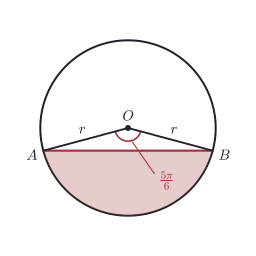
(a) Show that \(AB^{2} = \left(2 + \sqrt{3}\right)r^{2}\). [2]
The area of the shaded segment is \(\left(15\pi - 9\right)\) cm².
(b) Find the value of \(r\). [3]
(c) Find the exact perimeter of the shaded segment. [2]
Total 7 marks
(a)
\(AB^{2} = r^{2} + r^{2} - 2r^{2}\cos\dfrac{5\pi}{6}\) M1
\(= 2r^{2} + \sqrt{3}\,r^{2} = \left(2 + \sqrt{3}\right)r^{2}\) A1 AG
[2 marks]
(b)
segment \(= \dfrac{1}{2}r^{2}\left(\dfrac{5\pi}{6}\right) - \dfrac{1}{2}r^{2}\sin\dfrac{5\pi}{6}\) M1
\(= \dfrac{5\pi r^{2}}{12} - \dfrac{r^{2}}{4} = \dfrac{r^{2}}{12}\left(5\pi - 3\right)\) A1
\(15\pi - 9 = 3\left(5\pi - 3\right)\), so \(r^{2} = 36\) and \(r = 6\) A1
[3 marks]
(c)
arc \(AB = 6 \times \dfrac{5\pi}{6} = 5\pi\) A1
perimeter \(= 5\pi + 6\sqrt{2 + \sqrt{3}}\) cm A1
Accept \(5\pi + 3\left(\sqrt{6} + \sqrt{2}\right)\).
[2 marks]
SL 5 Paper 1
It is given that \(\tan\theta = -\dfrac{\sqrt{21}}{2}\), where \(\dfrac{\pi}{2} < \theta < \pi\).
(a) Find the exact value of \(\cos\theta\) and the exact value of \(\sin\theta\). [3]
(b) Find the exact value of \(\sin 2\theta\) and the exact value of \(\cos 2\theta\). [3]
(c) Hence state in which quadrant the angle \(2\theta\) lies. Justify your answer. [2]
Total 8 marks
(a)
\(\sin\theta = \tan\theta\cos\theta = -\dfrac{\sqrt{21}}{2}\cos\theta\)
\(\sin^{2}\theta + \cos^{2}\theta = 1\) gives \(\dfrac{21}{4}\cos^{2}\theta + \cos^{2}\theta = 1\) M1
\(\cos^{2}\theta = \dfrac{4}{25}\); \(\theta\) is obtuse, so \(\cos\theta = -\dfrac{2}{5}\) A1
\(\sin\theta = \dfrac{\sqrt{21}}{5}\) A1
Accept a right-angled triangle with sides \(2\), \(\sqrt{21}\), \(5\) and signs from the second quadrant.
[3 marks]
(b)
\(\sin 2\theta = 2\left(\dfrac{\sqrt{21}}{5}\right)\left(-\dfrac{2}{5}\right)\) M1
\(= -\dfrac{4\sqrt{21}}{25}\) A1
\(\cos 2\theta = 2\left(\dfrac{4}{25}\right) - 1 = -\dfrac{17}{25}\) A1
[3 marks]
(c)
\(\pi < 2\theta < 2\pi\), and \(\cos 2\theta < 0\) (also \(\sin 2\theta < 0\)) R1
\(2\theta\) lies in the third quadrant A1
[2 marks]
SL 6 Paper 1
(a) Solve the equation \(\cos 2x + 1 = \cos x\), for \(0 \leq x \leq 2\pi\), giving your answers in exact form. [6]
(b) Hence find the number of solutions of the equation \(\cos 4x + 1 = \cos 2x\), for \(0 \leq x \leq 2\pi\). [2]
Total 8 marks
(a)
\(\cos 2x = 2\cos^{2} x - 1\) M1
\(2\cos^{2} x - \cos x = 0\) A1
\(\cos x\,(2\cos x - 1) = 0\), so \(\cos x = 0\) or \(\cos x = \dfrac{1}{2}\) A1
\(\cos x = 0\): \(x = \dfrac{\pi}{2}\) or \(x = \dfrac{3\pi}{2}\) A1
\(\cos x = \dfrac{1}{2}\): \(x = \dfrac{\pi}{3}\) A1
or \(x = \dfrac{5\pi}{3}\) A1
Dividing by \(\cos x\) loses the solutions \(\dfrac{\pi}{2}\) and \(\dfrac{3\pi}{2}\): do not award the A1 for them in that case.
[6 marks]
(b)
let \(u = 2x\): \(\cos 2u + 1 = \cos u\) with \(0 \leq u \leq 4\pi\) (two full cycles) M1
each of the \(4\) solutions \(u\) in \([0, 2\pi]\) from (a) also gives \(u + 2\pi\), so \(8\) values of \(u\) and \(8\) solutions \(x = \dfrac{u}{2}\) A1
[2 marks]
SL 7 Paper 2
The diagram shows a right pyramid \(VABCD\) with a rectangular base \(ABCD\), where \(AB = 12\) cm and \(BC = 6\) cm. Each sloping edge has length \(9\) cm. The point \(M\) is the centre of the base. The diagram is not to scale.
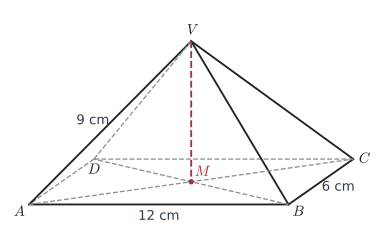
(a) Show that the height \(VM\) of the pyramid is \(6\) cm. [3]
(b) Find the volume of the pyramid. [2]
(c) Find the angle between the edge \([VA]\) and the base \(ABCD\). [2]
(d) Find the total surface area of the pyramid. [4]
The pyramid is placed in a coordinate system, with units in centimetres, so that \(A\) is \((0, 0, 0)\), \(B\) is \((12, 0, 0)\), \(D\) is \((0, 6, 0)\) and \(V\) lies above the base.
(e) Write down the coordinates of \(V\). [1]
The point \(N\) is the midpoint of \([VC]\).
(f) Find the length \(BN\). [2]
(g) Find the angle between the line \((BN)\) and the base \(ABCD\). [2]
Total 16 marks
(a)
\(AC = \sqrt{12^{2} + 6^{2}} = \sqrt{180}\), so \(AM = \dfrac{\sqrt{180}}{2} = \sqrt{45}\) M1 A1
\(VM^{2} = 9^{2} - 45 = 36\) A1
\(VM = 6\) cm AG
[3 marks]
(b)
volume \(= \dfrac{1}{3}(12 \times 6)(6)\) M1
\(= 144\) cm³ A1
[2 marks]
(c)
the angle is \(\angle VAM\): \(\tan\angle VAM = \dfrac{6}{\sqrt{45}}\) M1
\(\angle VAM = 41.8^\circ\) \((41.8103\ldots)\) A1
[2 marks]
(d)
heights of the faces: \(\sqrt{9^{2} - 6^{2}} = \sqrt{45}\) and \(\sqrt{9^{2} - 3^{2}} = \sqrt{72}\) M1 A1
area \(= 72 + 2 \times \dfrac{1}{2}(12)\sqrt{45} + 2 \times \dfrac{1}{2}(6)\sqrt{72}\) M1
\(= 203\) cm² \((203.410\ldots)\) A1
Award the second M1 for the sum of the areas of five faces, including the base.
[4 marks]
(e)
\(V(6, 3, 6)\) A1
[1 mark]
(f)
\(C(12, 6, 0)\), so \(N(9, 4.5, 3)\) A1
\(BN = \sqrt{(-3)^{2} + 4.5^{2} + 3^{2}} = \sqrt{38.25} = 6.18\) cm \((6.18465\ldots)\) A1
[2 marks]
(g)
let \(\theta\) be the angle; \(N\) is \(3\) cm above the base, so \(\sin\theta = \dfrac{3}{6.184\ldots}\) M1
\(\theta = 29.0^\circ\) \((29.0171\ldots)\) A1
[2 marks]
SL 8 Paper 1
In triangle \(ABC\), \(AB = x\) cm, \(AC = (x + 1)\) cm, \(BC = \sqrt{91}\) cm and \(\angle BAC = 120^\circ\).
(a) Show that \(x^{2} + x - 30 = 0\). [3]
(b) Find the value of \(x\). [2]
(c) Find the exact area of triangle \(ABC\). [2]
(d) Find the exact value of \(\sin \angle ABC\). [3]
The point \(D\) lies on \([BC]\) so that \([AD]\) bisects \(\angle BAC\).
(e) By considering the areas of triangles \(ABD\) and \(ACD\):
(i) show that \(\dfrac{BD}{DC} = \dfrac{5}{6}\) [3]
(ii) find the exact length of \([AD]\). [3]
Total 16 marks
(a)
\(91 = x^{2} + (x + 1)^{2} - 2x(x + 1)\cos 120^\circ\) M1
\(91 = x^{2} + (x + 1)^{2} + x(x + 1)\) A1
\(91 = 3x^{2} + 3x + 1\) A1
\(3x^{2} + 3x - 90 = 0\), so \(x^{2} + x - 30 = 0\) AG
[3 marks]
(b)
\((x + 6)(x - 5) = 0\) M1
\(x > 0\), so \(x = 5\) A1
[2 marks]
(c)
area \(= \dfrac{1}{2}(5)(6)\sin 120^\circ\) M1
\(= \dfrac{15\sqrt{3}}{2}\) cm² A1
[2 marks]
(d)
\(\dfrac{\sin \angle ABC}{6} = \dfrac{\sin 120^\circ}{\sqrt{91}}\) M1
\(\sin \angle ABC = \dfrac{6}{\sqrt{91}} \times \dfrac{\sqrt{3}}{2}\) A1
\(= \dfrac{3\sqrt{3}}{\sqrt{91}}\) \(\left(= \dfrac{3\sqrt{273}}{91}\right)\) A1
[3 marks]
(e)
(i)
\(\angle BAD = \angle DAC = 60^\circ\)
area \(ABD = \dfrac{1}{2}(5)(AD)\sin 60^\circ\), area \(ACD = \dfrac{1}{2}(6)(AD)\sin 60^\circ\) M1
\(\dfrac{\text{area } ABD}{\text{area } ACD} = \dfrac{5}{6}\) A1
the two triangles have the same height from \(A\) to \([BC]\), so the ratio of the areas is \(\dfrac{BD}{DC}\) R1
\(\dfrac{BD}{DC} = \dfrac{5}{6}\) AG
[3 marks]
(ii)
area \(ABD\) + area \(ACD\) = area \(ABC\) M1
\(\dfrac{5\sqrt{3}}{4}AD + \dfrac{6\sqrt{3}}{4}AD = \dfrac{15\sqrt{3}}{2}\) A1
\(AD = \dfrac{30}{11}\) cm A1
[3 marks]
SL 9 Paper 1
Let \(f(x) = a\cos\big(b(x - c)\big) + d\), for \(0 \leq x \leq \pi\), where \(a > 0\), \(b > 0\) and \(0 < c < \dfrac{\pi}{2}\). The diagram shows the graph of \(y = f(x)\). It has a maximum point at \(\left(\dfrac{\pi}{3}, 5\right)\) and a minimum point at \(\left(\dfrac{5\pi}{6}, -1\right)\).
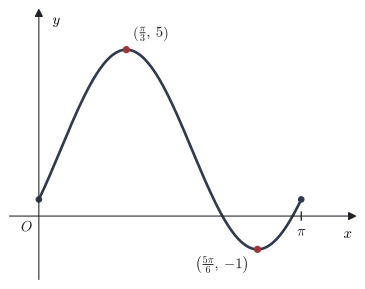
(a) Write down the value of \(a\) and the value of \(d\). [2]
(b) Find the value of \(b\). [2]
(c) Write down the value of \(c\). [1]
(d) Find the \(y\)-intercept of the graph of \(f\). [2]
(e) Solve the equation \(f(x) = \dfrac{7}{2}\). [4]
(f) Find the set of values of \(k\) for which the equation \(f(x) = k\) has exactly two solutions. [3]
Total 14 marks
(a)
\(a = \dfrac{5 - (-1)}{2} = 3\) A1
\(d = \dfrac{5 + (-1)}{2} = 2\) A1
[2 marks]
(b)
period \(= 2\left(\dfrac{5\pi}{6} - \dfrac{\pi}{3}\right) = \pi\) M1
\(b = \dfrac{2\pi}{\pi} = 2\) A1
[2 marks]
(c)
\(c = \dfrac{\pi}{3}\) (a maximum of \(a\cos\) with \(a > 0\)) A1
[1 mark]
(d)
\(f(0) = 3\cos\left(-\dfrac{2\pi}{3}\right) + 2\) M1
\(= -\dfrac{3}{2} + 2 = \dfrac{1}{2}\) A1
[2 marks]
(e)
\(3\cos\left(2x - \dfrac{2\pi}{3}\right) + 2 = \dfrac{7}{2}\), so \(\cos\left(2x - \dfrac{2\pi}{3}\right) = \dfrac{1}{2}\) M1
\(0 \leq x \leq \pi\) gives \(-\dfrac{2\pi}{3} \leq 2x - \dfrac{2\pi}{3} \leq \dfrac{4\pi}{3}\)
\(2x - \dfrac{2\pi}{3} = -\dfrac{\pi}{3}\) or \(\dfrac{\pi}{3}\) M1
\(x = \dfrac{\pi}{6}\) A1
\(x = \dfrac{\pi}{2}\) A1
Award A0 for each extra solution outside \(0 \leq x \leq \pi\).
[4 marks]
(f)
\(f(0) = f(\pi) = \dfrac{1}{2}\): the graph rises to \(5\), falls to \(-1\), then rises to \(\dfrac{1}{2}\) M1
\(-1 < k < \dfrac{1}{2}\) A1
\(\dfrac{1}{2} < k < 5\) A1
For \(k = \dfrac{1}{2}\) there are three solutions (\(x = 0\), \(x = \pi\) and one between them).
[3 marks]
SL 10 Paper 2
On one day, the temperature in city A, \(T\) °C, \(t\) hours after midnight, is modelled by \[ T(t) = a\sin\big(b(t - c)\big) + d, \qquad 0 \leq t \leq 24, \] where \(a > 0\), \(b > 0\) and \(0 < c < 24\). The minimum temperature, \(25\) °C, is at 02:00, and the maximum temperature, \(31\) °C, is at 14:00.
(a) Write down the value of \(a\) and the value of \(d\). [2]
(b) Show that \(b = \dfrac{\pi}{12}\). [2]
(c) Find the value of \(c\). [2]
(d) Find the temperature at 09:30. [2]
An air conditioner in city A is switched on whenever the temperature is above \(30\) °C.
(e) Find the length of time for which the air conditioner is switched on during this day. [3]
On the same day, the temperature in city B, \(S\) °C, is modelled by \(S(t) = 27 + 5\cos\left(\dfrac{\pi}{12}(t - 15)\right)\), for \(0 \leq t \leq 24\).
(f) Find the length of time during this day for which city B is warmer than city A. [3]
(g) Give one reason why the model for city A should not be used to predict the temperature on every day of the year. [1]
Total 15 marks
(a)
\(a = \dfrac{31 - 25}{2} = 3\) A1
\(d = \dfrac{31 + 25}{2} = 28\) A1
[2 marks]
(b)
from the minimum to the maximum is half a period, so the period is \(2 \times 12 = 24\) hours M1
\(b = \dfrac{2\pi}{24} = \dfrac{\pi}{12}\) A1 AG
[2 marks]
(c)
the maximum is a quarter of a period after \(t = c\): \(c = 14 - \dfrac{24}{4}\) M1
\(c = 8\) A1
Accept \(c = 2 + 6 = 8\) (a quarter of a period after the minimum).
[2 marks]
(d)
\(T(9.5) = 3\sin\left(\dfrac{\pi}{12}(1.5)\right) + 28\) M1
\(= 29.1\) °C \((29.1480\ldots)\) A1
[2 marks]
(e)
\(T(t) = 30\) (for example, the intersection of the two graphs on a GDC) M1
\(t = 10.787\ldots\) and \(t = 17.212\ldots\) A1
time \(= 6.43\) hours \((6.42529\ldots)\) A1
[3 marks]
(f)
\(S(t) = T(t)\) (for example, the intersection of the two graphs on a GDC) M1
\(t = 12.118\ldots\) and \(t = 20.584\ldots\) A1
time \(= 8.47\) hours \((8.46645\ldots)\) A1
[3 marks]
(g)
for example: the daily maximum and minimum temperatures change with the weather and the seasons, so \(a\), \(c\) and \(d\) will not be the same every day R1
[1 mark]
See 14.10.
HL questions
HL questions on this unit also use the AHL content: the reciprocal functions \(\sec\) and \(\cot\), the identity \(1 + \tan^{2}\theta = \sec^{2}\theta\), the inverse functions \(\arccos\) and \(\arctan\), and the compound and double angle formulae for \(\tan\); they also combine trigonometry with induction (Unit 6), quadratics (Unit 8) and the roots of polynomials (Unit 11).
HL 1 Paper 1
(a) Show that \(\cos(2\arctan x) = \dfrac{1 - x^{2}}{1 + x^{2}}\) for all \(x \in \mathbb{R}\). [3]
(b) Hence show that \(\arccos\left(\dfrac{1 - x^{2}}{1 + x^{2}}\right) = 2\arctan x\) for \(x \geq 0\). [2]
(c) Find an expression for \(\arccos\left(\dfrac{1 - x^{2}}{1 + x^{2}}\right)\) in terms of \(\arctan x\) when \(x < 0\). Justify your answer. [2]
Total 7 marks
(a)
let \(\theta = \arctan x\), so \(\tan\theta = x\); \(\;\cos 2\theta = 2\cos^{2}\theta - 1\) M1
\(\sec^{2}\theta = 1 + \tan^{2}\theta = 1 + x^{2}\), so \(\cos^{2}\theta = \dfrac{1}{1 + x^{2}}\) M1
\(\cos 2\theta = \dfrac{2}{1 + x^{2}} - 1 = \dfrac{1 - x^{2}}{1 + x^{2}}\) A1 AG
[3 marks]
(b)
\(x \geq 0\): \(\;0 \leq \arctan x < \dfrac{\pi}{2}\), so \(0 \leq 2\arctan x < \pi\) A1
this is in the range \([0, \pi]\) of \(\arccos\), and its cosine is \(\dfrac{1 - x^{2}}{1 + x^{2}}\) by (a), so the result follows R1 AG
[2 marks]
(c)
\(\arccos\left(\dfrac{1 - x^{2}}{1 + x^{2}}\right) = -2\arctan x\) A1
\(-\pi < 2\arctan x < 0\), so \(0 < -2\arctan x < \pi\) (in the range of \(\arccos\)), and \(\cos(-2\arctan x) = \cos(2\arctan x)\) R1
Do not award the R1 without a reference to the range \([0, \pi]\) of \(\arccos\).
[2 marks]
HL 2 Paper 1
(a) Show that \(\sec 2x + \tan 2x \equiv \dfrac{\cos x + \sin x}{\cos x - \sin x}\), where \(\cos 2x \neq 0\). [3]
(b) Hence show that \(\sec 2x + \tan 2x \equiv \tan\left(x + \dfrac{\pi}{4}\right)\). [2]
(c) Hence solve the equation \(\sec 2x + \tan 2x = \cot x\) for \(0 < x < \pi\). [3]
Total 8 marks
(a)
\(\sec 2x + \tan 2x = \dfrac{1}{\cos 2x} + \dfrac{\sin 2x}{\cos 2x} = \dfrac{1 + \sin 2x}{\cos 2x}\) M1
\(1 + \sin 2x = \cos^{2}x + \sin^{2}x + 2\sin x\cos x = (\cos x + \sin x)^{2}\) A1
\(\cos 2x = \cos^{2}x - \sin^{2}x = (\cos x - \sin x)(\cos x + \sin x)\) A1
cancelling \(\cos x + \sin x\) \((\neq 0)\) gives \(\dfrac{\cos x + \sin x}{\cos x - \sin x}\) AG
[3 marks]
(b)
dividing the numerator and the denominator by \(\cos x\): \(\;\dfrac{1 + \tan x}{1 - \tan x}\) M1
\(= \dfrac{\tan\frac{\pi}{4} + \tan x}{1 - \tan\frac{\pi}{4}\tan x} = \tan\left(x + \dfrac{\pi}{4}\right)\) A1 AG
Accept expanding \(\dfrac{\sin\left(x + \frac{\pi}{4}\right)}{\cos\left(x + \frac{\pi}{4}\right)}\) with the compound angle formulae.
[2 marks]
(c)
\(\cot x = \tan\left(\dfrac{\pi}{2} - x\right)\), so \(\tan\left(x + \dfrac{\pi}{4}\right) = \tan\left(\dfrac{\pi}{2} - x\right)\) M1
\(x + \dfrac{\pi}{4} = \dfrac{\pi}{2} - x + k\pi\), so \(x = \dfrac{\pi}{8} + \dfrac{k\pi}{2}\), \(\;k \in \mathbb{Z}\) A1
\(x = \dfrac{\pi}{8}, \; \dfrac{5\pi}{8}\) A1
Accept \(t = \tan x\): \(\dfrac{1 + t}{1 - t} = \dfrac{1}{t}\) gives \(t^{2} + 2t - 1 = 0\), \(t = -1 \pm \sqrt{2}\), with \(\tan\dfrac{\pi}{8} = \sqrt{2} - 1\) shown (for example from \(\tan\dfrac{\pi}{4} = \dfrac{2t}{1 - t^{2}}\)).
[3 marks]
HL 3 Paper 1
Let \(f(x) = a\arctan(x - h) + k\), for \(x \in \mathbb{R}\), where \(a > 0\) and \(h > 0\). The diagram shows the graph of \(y = f(x)\). It has the horizontal asymptotes \(y = -\dfrac{\pi}{2}\) and \(y = \dfrac{3\pi}{2}\), and it passes through the origin \(O\).
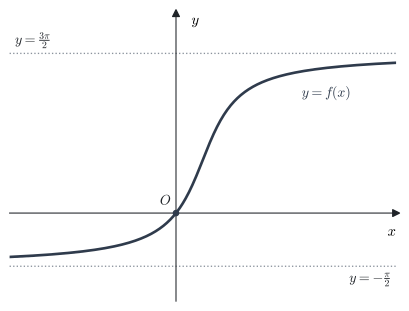
(a) Find the value of \(a\) and the value of \(k\). [2]
(b) Find the value of \(h\). [2]
(c) Solve the equation \(f(x) = \dfrac{\pi}{3}\), giving your answer in the form \(\sqrt{p} + q\), where \(p, q \in \mathbb{Z}\). [4]
Total 8 marks
(a)
\(\arctan(x - h) \to \pm\dfrac{\pi}{2}\), so \(k + \dfrac{a\pi}{2} = \dfrac{3\pi}{2}\) and \(k - \dfrac{a\pi}{2} = -\dfrac{\pi}{2}\) M1
\(a = 2\), \(\;k = \dfrac{\pi}{2}\) A1
[2 marks]
(b)
\(f(0) = 0\): \(\;2\arctan(-h) + \dfrac{\pi}{2} = 0\) M1
\(\arctan h = \dfrac{\pi}{4}\), so \(h = 1\) A1
[2 marks]
(c)
\(2\arctan(x - 1) = \dfrac{\pi}{3} - \dfrac{\pi}{2}\), so \(x - 1 = \tan\left(-\dfrac{\pi}{12}\right) = -\tan\dfrac{\pi}{12}\) M1
\(\tan\dfrac{\pi}{12} = \tan\left(\dfrac{\pi}{4} - \dfrac{\pi}{6}\right) = \dfrac{1 - \frac{\sqrt{3}}{3}}{1 + \frac{\sqrt{3}}{3}}\) M1
\(= \dfrac{3 - \sqrt{3}}{3 + \sqrt{3}} = \dfrac{(3 - \sqrt{3})^{2}}{6} = 2 - \sqrt{3}\) A1
\(x = 1 - (2 - \sqrt{3}) = \sqrt{3} - 1\) A1
[4 marks]
HL 4 Paper 1
(a) Show that \(\sin(A + B)\sin(A - B) = \sin^{2}A - \sin^{2}B\). [2]
(b) Prove by mathematical induction that, for all \(n \in \mathbb{Z}^{+}\) and all \(x\) with \(\sin x \neq 0\), \[ \sum_{r=1}^{n} \sin\big((2r - 1)x\big) = \frac{\sin^{2}(nx)}{\sin x} . \] [6]
Total 8 marks
(a)
\(\sin(A + B)\sin(A - B) = (\sin A\cos B + \cos A\sin B)(\sin A\cos B - \cos A\sin B)\)
\(= \sin^{2}A\cos^{2}B - \cos^{2}A\sin^{2}B\) M1
\(= \sin^{2}A\,(1 - \sin^{2}B) - (1 - \sin^{2}A)\sin^{2}B\) A1
\(= \sin^{2}A - \sin^{2}B\) AG
[2 marks]
(b)
\(n = 1\): \(\;\text{LHS} = \sin x\) and \(\text{RHS} = \dfrac{\sin^{2}x}{\sin x} = \sin x\), so \(P(1)\) is true A1
assume \(P(k)\) is true for some \(k \in \mathbb{Z}^{+}\): \(\displaystyle\sum_{r=1}^{k} \sin\big((2r - 1)x\big) = \frac{\sin^{2}(kx)}{\sin x}\) M1
\(\displaystyle\sum_{r=1}^{k+1} \sin\big((2r - 1)x\big) = \frac{\sin^{2}(kx)}{\sin x} + \sin\big((2k + 1)x\big)\) (by the assumption) M1
\(= \dfrac{\sin^{2}(kx) + \sin\big((2k + 1)x\big)\sin x}{\sin x}\)
by (a) with \(A = (k + 1)x\), \(B = kx\): \(\;\sin\big((2k + 1)x\big)\sin x = \sin^{2}\big((k + 1)x\big) - \sin^{2}(kx)\) M1
so the sum is \(\dfrac{\sin^{2}\big((k + 1)x\big)}{\sin x}\), and \(P(k + 1)\) is true A1
since \(P(1)\) is true, and \(P(k)\) true implies \(P(k + 1)\) true, by the principle of mathematical induction \(P(n)\) is true for all \(n \in \mathbb{Z}^{+}\) R1
[6 marks]
HL 5 Paper 1
(a) Show that \(\cos 3\theta = 4\cos^{3}\theta - 3\cos\theta\). [4]
(b) By letting \(x = \cos\theta\), where \(0 \leq \theta \leq \pi\), show that the roots of the equation \[ 8x^{3} - 6x - 1 = 0 \] are \(\cos\dfrac{\pi}{9}\), \(\;\cos\dfrac{5\pi}{9}\) and \(\cos\dfrac{7\pi}{9}\). [5]
(c) Hence find the exact value of \(\cos\dfrac{\pi}{9}\cos\dfrac{5\pi}{9}\cos\dfrac{7\pi}{9}\). [2]
(d) Show that \(\sec\dfrac{\pi}{9} + \sec\dfrac{5\pi}{9} + \sec\dfrac{7\pi}{9} = -6\). [3]
Total 14 marks
(a)
\(\cos 3\theta = \cos(2\theta + \theta) = \cos 2\theta\cos\theta - \sin 2\theta\sin\theta\) M1
\(= (2\cos^{2}\theta - 1)\cos\theta - 2\sin^{2}\theta\cos\theta\) A1
\(= 2\cos^{3}\theta - \cos\theta - 2(1 - \cos^{2}\theta)\cos\theta\) M1
\(= 4\cos^{3}\theta - 3\cos\theta\) A1 AG
[4 marks]
(b)
\(8x^{3} - 6x = 2(4\cos^{3}\theta - 3\cos\theta) = 2\cos 3\theta\) M1
so the equation becomes \(\cos 3\theta = \dfrac{1}{2}\) A1
\(0 \leq 3\theta \leq 3\pi\): \(\;3\theta = \dfrac{\pi}{3}, \; \dfrac{5\pi}{3}, \; \dfrac{7\pi}{3}\) A1
\(\theta = \dfrac{\pi}{9}, \; \dfrac{5\pi}{9}, \; \dfrac{7\pi}{9}\) A1
\(\cos\) is one-to-one on \([0, \pi]\), so these give three different roots; a cubic has at most three roots, so these are all the roots R1
[5 marks]
(c)
product of the roots \(= -\dfrac{-1}{8}\) M1
\(= \dfrac{1}{8}\) A1
[2 marks]
(d)
\(\dfrac{1}{\alpha} + \dfrac{1}{\beta} + \dfrac{1}{\gamma} = \dfrac{\alpha\beta + \beta\gamma + \gamma\alpha}{\alpha\beta\gamma}\), where \(\alpha, \beta, \gamma\) are the roots M1
\(\alpha\beta + \beta\gamma + \gamma\alpha = \dfrac{-6}{8} = -\dfrac{3}{4}\) A1
\(\sec\dfrac{\pi}{9} + \sec\dfrac{5\pi}{9} + \sec\dfrac{7\pi}{9} = -\dfrac{3}{4} \div \dfrac{1}{8} = -6\) A1 AG
[3 marks]
HL 6 Paper 2
A painting hangs on a vertical wall. Its lower edge \(B\) is \(1\) m above eye level, and its upper edge \(T\) is \(3\) m above eye level. A visitor’s eye is at the point \(P\), a horizontal distance \(x\) m from the wall, where \(x > 0\). The point \(E\) on the wall is at eye level, so \(PE\) is horizontal. The angle \(\theta = \angle TPB\) is the angle that the painting subtends at the visitor’s eye.
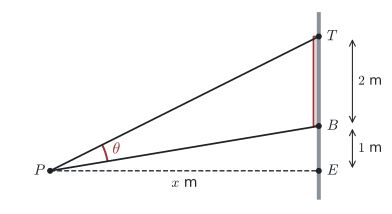
(a) Show that \(\tan\theta = \dfrac{2x}{x^{2} + 3}\). [4]
(b) Find the exact value of \(x\) for which \(\angle TPE = 2\angle BPE\). [3]
(c) Find the set of values of \(x\) for which \(\theta \geq 0.4\). [3]
(d)
(i) By considering \(\tan\theta = k\) as a quadratic equation in \(x\), show that \(\tan\theta \leq \dfrac{\sqrt{3}}{3}\) for all \(x > 0\). [3]
(ii) Hence find the maximum value of \(\theta\), and the value of \(x\) at which it occurs. [3]
Total 16 marks
(a)
\(\tan\angle TPE = \dfrac{3}{x}\) and \(\tan\angle BPE = \dfrac{1}{x}\) A1
\(\theta = \angle TPE - \angle BPE\) M1
\(\tan\theta = \dfrac{\frac{3}{x} - \frac{1}{x}}{1 + \frac{3}{x} \cdot \frac{1}{x}} = \dfrac{\frac{2}{x}}{\frac{x^{2} + 3}{x^{2}}}\) A1
\(= \dfrac{2x}{x^{2} + 3}\) A1 AG
[4 marks]
(b)
let \(\beta = \angle BPE\), so \(\tan\beta = \dfrac{1}{x}\) and \(\tan 2\beta = \dfrac{3}{x}\)
\(\tan 2\beta = \dfrac{2\cdot\frac{1}{x}}{1 - \frac{1}{x^{2}}} = \dfrac{2x}{x^{2} - 1}\) M1
\(\dfrac{2x}{x^{2} - 1} = \dfrac{3}{x} \;\Rightarrow\; 2x^{2} = 3x^{2} - 3\) A1
\(x^{2} = 3\), and \(x > 0\), so \(x = \sqrt{3}\) A1
[3 marks]
(c)
\(\theta = \arctan\dfrac{3}{x} - \arctan\dfrac{1}{x} \geq 0.4\) (for example, using the intersection of the two graphs on a GDC) M1
\(x = 0.755\) \((0.754546\ldots)\) or \(x = 3.98\) \((3.97589\ldots)\) A1
\(0.755 \leq x \leq 3.98\) A1
Accept the method \(\dfrac{2x}{x^{2} + 3} \geq \tan 0.4\), solved as a quadratic inequality.
[3 marks]
(d)
(i)
\(0 < \theta < \dfrac{\pi}{2}\), so \(k > 0\); \(\;kx^{2} - 2x + 3k = 0\) must have a real root \(x\) M1
discriminant: \(4 - 12k^{2} \geq 0\) A1
\(k^{2} \leq \dfrac{1}{3}\) and \(k > 0\), so \(k \leq \dfrac{1}{\sqrt{3}} = \dfrac{\sqrt{3}}{3}\) A1 AG
[3 marks]
(ii)
\(\theta\) is acute and \(\tan\) is increasing on \(\left(0, \dfrac{\pi}{2}\right)\), so \(\theta \leq \dfrac{\pi}{6}\) R1
maximum \(\theta = \dfrac{\pi}{6}\) A1
\(k = \dfrac{\sqrt{3}}{3}\): \(\;x^{2} - 2\sqrt{3}\,x + 3 = (x - \sqrt{3})^{2} = 0\), so \(x = \sqrt{3}\) A1
This is the same position as in (b).
[3 marks]