Unit 16 Exam Practice
Probability
These questions are written in the style of IB examination questions, and they are harder than the review exercises. The marks for each part are shown in square brackets on the right, for example [3]. Paper 1 means no calculator; Paper 2 means a graphic display calculator (GDC) is allowed. Try each question under exam conditions first, then open the markscheme.
| Mark | Meaning |
|---|---|
| M | Method mark: a correct method is used, even with a small slip |
| A | Accuracy mark: a correct answer or line of working (usually needs the M mark before it) |
| R | Reasoning mark: a clear reason or justification is given |
| N | Mark for a correct final answer with no working shown |
| AG | “Answer given” in the question, so no extra mark is awarded for writing it |
The number after the letter is the number of marks, so A2 is worth 2 marks. In the exam, give answers exactly or correct to 3 significant figures (s.f.) unless the question says otherwise.
SL questions
SL 1 Paper 1
A fair four-sided die, numbered \(1\), \(2\), \(3\), \(4\), and a fair six-sided die, numbered \(1\) to \(6\), are rolled together. Let \(T\) be the sum of the two scores. The events \(A\), \(B\) and \(C\) are
- \(A\): \(T = 7\),
- \(B\): the six-sided die shows an even number,
- \(C\): both dice show an odd number.
(a) Find \(\mathrm{P}(A)\). [2]
(b) Show that \(A\) and \(B\) are independent. [2]
(c) Explain why \(A\) and \(C\) are mutually exclusive, and state, with a reason, whether \(A\) and \(C\) are independent. [2]
(d) The two dice are rolled together \(150\) times. Find the expected number of times that \(T\) is at least \(8\). [2]
Total 8 marks
(a)
\(24\) equally likely pairs (four-sided, six-sided); \(A = \{(1, 6), (2, 5), (3, 4), (4, 3)\}\) M1
\(\mathrm{P}(A) = \dfrac{4}{24} = \dfrac{1}{6}\) A1
[2 marks]
(b)
\(A \cap B = \{(1, 6), (3, 4)\}\), so \(\mathrm{P}(A \cap B) = \dfrac{2}{24} = \dfrac{1}{12}\) A1
\(\mathrm{P}(A)\,\mathrm{P}(B) = \dfrac{1}{6} \times \dfrac{1}{2} = \dfrac{1}{12} = \mathrm{P}(A \cap B)\), so \(A\) and \(B\) are independent R1 AG
[2 marks]
(c)
odd \(+\) odd is even, so \(T \neq 7\) when \(C\) happens: \(A \cap C = \varnothing\) R1
\(\mathrm{P}(A \cap C) = 0\) but \(\mathrm{P}(A)\,\mathrm{P}(C) = \dfrac{1}{6} \times \dfrac{1}{4} \neq 0\), so not independent R1
[2 marks]
(d)
\(T \geq 8\): \((2, 6), (3, 5), (3, 6), (4, 4), (4, 5), (4, 6)\), so \(\mathrm{P}(T \geq 8) = \dfrac{6}{24} = \dfrac{1}{4}\) M1
expected number \(= 150 \times \dfrac{1}{4} = 37.5\) A1
Do not accept a rounded answer of \(37\) or \(38\).
[2 marks]
SL 2 Paper 1
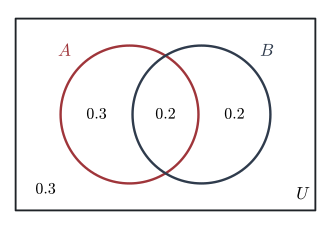
\(A\) and \(B\) are independent events such that \(\mathrm{P}(A \cap B') = 0.3\) and \(\mathrm{P}(A' \cap B) = 0.2\). Let \(\mathrm{P}(A \cap B) = x\).
(a) Show that \(50x^{2} - 25x + 3 = 0\). [3]
(b) Given also that \(\mathrm{P}(A \cup B) < 0.75\), find the value of \(x\). [3]
(c) Find \(\mathrm{P}(B \mid A \cup B)\). [2]
Total 8 marks
(a)
\(\mathrm{P}(A \cap B) = \mathrm{P}(A)\,\mathrm{P}(B)\) (independent events) M1
\(\mathrm{P}(A) = 0.3 + x\) and \(\mathrm{P}(B) = 0.2 + x\), so \(x = (0.3 + x)(0.2 + x)\) A1
\(x = 0.06 + 0.5x + x^{2}\) A1
\(x^{2} - 0.5x + 0.06 = 0\), so \(50x^{2} - 25x + 3 = 0\) AG
[3 marks]
(b)
\((5x - 1)(10x - 3) = 0\), so \(x = 0.2\) or \(x = 0.3\) M1 A1
\(\mathrm{P}(A \cup B) = 0.3 + 0.2 + x = 0.5 + x\), which is \(0.7\) or \(0.8\), so \(x = 0.2\) R1
[3 marks]
(c)
\(B \subseteq A \cup B\), so \(\mathrm{P}(B \mid A \cup B) = \dfrac{\mathrm{P}(B)}{\mathrm{P}(A \cup B)}\) M1
\(= \dfrac{0.4}{0.7} = \dfrac{4}{7}\) A1
[2 marks]
SL 3 Paper 1
A box contains \(x\) green tea bags and \(5\) black tea bags. Two tea bags are taken at random from the box, one after the other, without replacement. The probability that one tea bag of each kind is taken is \(\dfrac{5}{9}\).
(a) Show that \(x^{2} - 9x + 20 = 0\). [3]
(b) Given that there are fewer green tea bags than black tea bags in the box, find the value of \(x\). [2]
(c) Given that the two tea bags taken are the same kind, find the probability that they are both green. [3]
Total 8 marks
(a)
\(\mathrm{P}(GB) + \mathrm{P}(BG) = \dfrac{x}{x + 5} \times \dfrac{5}{x + 4} + \dfrac{5}{x + 5} \times \dfrac{x}{x + 4}\) M1
\(\dfrac{10x}{(x + 5)(x + 4)} = \dfrac{5}{9}\) A1
\(90x = 5(x^{2} + 9x + 20)\), so \(18x = x^{2} + 9x + 20\) A1
\(x^{2} - 9x + 20 = 0\) AG
[3 marks]
(b)
\((x - 4)(x - 5) = 0\), so \(x = 4\) or \(x = 5\) M1
\(x < 5\), so \(x = 4\) A1
[2 marks]
(c)
\(\mathrm{P}(\text{same kind}) = 1 - \dfrac{5}{9} = \dfrac{4}{9}\) A1
\(\mathrm{P}(GG \mid \text{same}) = \dfrac{\mathrm{P}(GG)}{\mathrm{P}(\text{same})} = \dfrac{\frac{4}{9} \times \frac{3}{8}}{\frac{4}{9}}\) M1
\(= \dfrac{3}{8}\) A1
[3 marks]
SL 4 Paper 1
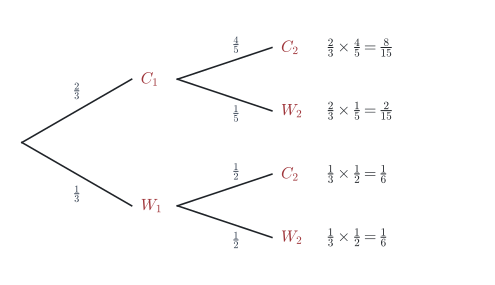
Mei uses a quiz app. The probability that she answers the first question correctly is \(\dfrac{2}{3}\). After a correct answer, the probability that she answers the next question correctly is \(\dfrac{4}{5}\). After a wrong answer, the probability that she answers the next question correctly is \(\dfrac{1}{2}\). Let \(C_k\) be the event “Mei answers question \(k\) correctly”.
(a) Draw a tree diagram to show the possible outcomes of the first two questions. [2]
(b) Show that \(\mathrm{P}(C_2) = \dfrac{7}{10}\). [2]
(c) Given that Mei answers the second question correctly, find the probability that she answered the first question correctly. [3]
(d) Determine whether the events \(C_1\) and \(C_2\) are independent. Justify your answer. [2]
(e) Find the probability that Mei answers exactly two of the first three questions correctly. [4]
(f) Mei starts \(300\) separate quiz sessions, each with at least three questions. Find the expected number of sessions in which she answers exactly two of the first three questions correctly. [2]
Total 15 marks
(a)
first branches \(C_1\): \(\dfrac{2}{3}\), \(W_1\): \(\dfrac{1}{3}\) A1
second branches \(\dfrac{4}{5}, \dfrac{1}{5}\) after \(C_1\) and \(\dfrac{1}{2}, \dfrac{1}{2}\) after \(W_1\) A1
[2 marks]
(b)
\(\mathrm{P}(C_2) = \dfrac{2}{3} \times \dfrac{4}{5} + \dfrac{1}{3} \times \dfrac{1}{2}\) M1
\(= \dfrac{16}{30} + \dfrac{5}{30} = \dfrac{21}{30} = \dfrac{7}{10}\) A1 AG
[2 marks]
(c)
\(\mathrm{P}(C_1 \mid C_2) = \dfrac{\mathrm{P}(C_1 \cap C_2)}{\mathrm{P}(C_2)}\) M1
\(= \dfrac{\frac{8}{15}}{\frac{7}{10}}\) A1
\(= \dfrac{16}{21}\) A1
[3 marks]
(d)
\(\mathrm{P}(C_1)\,\mathrm{P}(C_2) = \dfrac{2}{3} \times \dfrac{7}{10} = \dfrac{7}{15}\) A1
\(\dfrac{7}{15} \neq \dfrac{8}{15} = \mathrm{P}(C_1 \cap C_2)\), so \(C_1\) and \(C_2\) are not independent R1
Accept \(\mathrm{P}(C_2 \mid C_1) = \dfrac{4}{5} \neq \dfrac{7}{10} = \mathrm{P}(C_2)\), or \(\mathrm{P}(C_1 \mid C_2) = \dfrac{16}{21} \neq \dfrac{2}{3}\).
[2 marks]
(e)
three paths (\(C\) = correct, \(W\) = wrong): \(CCW\), \(CWC\), \(WCC\) M1
\(\mathrm{P}(CCW) = \dfrac{2}{3} \times \dfrac{4}{5} \times \dfrac{1}{5} = \dfrac{8}{75}\) A1
\(\mathrm{P}(CWC) = \dfrac{2}{3} \times \dfrac{1}{5} \times \dfrac{1}{2} = \dfrac{5}{75}\)
\(\mathrm{P}(WCC) = \dfrac{1}{3} \times \dfrac{1}{2} \times \dfrac{4}{5} = \dfrac{10}{75}\) A1
total \(= \dfrac{8 + 5 + 10}{75} = \dfrac{23}{75}\) A1
[4 marks]
(f)
\(300 \times \dfrac{23}{75}\) M1
\(= 92\) A1
[2 marks]
SL 5 Paper 1
Kai and Lena play a game. They take turns to throw a ball at a target, and Kai throws first. The first player to hit the target wins the game. Each time Kai throws, the probability that he hits the target is \(\dfrac{1}{3}\). Each time Lena throws, the probability that she hits the target is \(\dfrac{1}{4}\).
(a) Find the probability that Lena wins the game with her first throw. [2]
(b) Show that the probability that Kai wins the game with his \(n\)th throw is \(\dfrac{1}{3}\left(\dfrac{1}{2}\right)^{n - 1}\). [3]
(c) Hence find the probability that Kai wins the game. [3]
(d) Given that Kai wins the game, find the probability that he wins it with his first throw. [2]
Lena practises, and the probability that she hits the target with each throw becomes \(p\). Kai’s probability does not change, and Kai still throws first.
(e) Find the value of \(p\) for which Kai and Lena are equally likely to win the game. [4]
(f) State one assumption that you have made about the throws in this question. [1]
Total 15 marks
(a)
Kai misses, then Lena hits: \(\dfrac{2}{3} \times \dfrac{1}{4}\) M1
\(= \dfrac{1}{6}\) A1
[2 marks]
(b)
probability that both miss in one round \(= \dfrac{2}{3} \times \dfrac{3}{4} = \dfrac{1}{2}\) M1 A1
Kai wins with his \(n\)th throw if both miss in each of the first \(n - 1\) rounds and then Kai hits R1
so the probability is \(\left(\dfrac{1}{2}\right)^{n - 1} \times \dfrac{1}{3}\) AG
[3 marks]
(c)
\(\mathrm{P}(\text{Kai wins}) = \dfrac{1}{3} + \dfrac{1}{3}\left(\dfrac{1}{2}\right) + \dfrac{1}{3}\left(\dfrac{1}{2}\right)^{2} + \cdots\), a geometric series M1
\(u_1 = \dfrac{1}{3}\), \(r = \dfrac{1}{2}\) and \(|r| < 1\), so \(S_\infty = \dfrac{\frac{1}{3}}{1 - \frac{1}{2}}\) A1
\(= \dfrac{2}{3}\) A1
[3 marks]
(d)
\(\mathrm{P}(\text{first throw} \mid \text{Kai wins}) = \dfrac{\frac{1}{3}}{\frac{2}{3}}\) M1
\(= \dfrac{1}{2}\) A1
[2 marks]
(e)
both miss in one round with probability \(\dfrac{2}{3}(1 - p)\) M1
\(\mathrm{P}(\text{Kai wins}) = \dfrac{\frac{1}{3}}{1 - \frac{2}{3}(1 - p)} = \dfrac{1}{1 + 2p}\) A1
\(\dfrac{1}{1 + 2p} = \dfrac{1}{2}\) M1
\(p = \dfrac{1}{2}\) A1
[4 marks]
(f)
the throws are independent of each other (each player’s probability of a hit stays the same at every throw) R1
[1 mark]
HL questions
HL questions on this unit also use the AHL content: Bayes’ theorem, and probability found by counting with combinations and permutations, together with the SL content.
HL 1 Paper 1
Five boys and three girls sit at random in a row of eight seats.
(a) Show that the probability that no two girls sit next to each other is \(\dfrac{5}{14}\). [3]
(b) Given that no two girls sit next to each other, find the probability that a boy sits in each of the two end seats. [2]
(c) Find the probability that exactly two of the girls sit next to each other (and the third girl does not sit next to either of them). [3]
Total 8 marks
(a)
arrange the boys (\(5!\) ways), then put the girls in \(3\) of the \(6\) gaps between and around them M1
\(5! \times {}^{6}\mathrm{P}_{3} = 120 \times 120 = 14\,400\) A1
\(\mathrm{P} = \dfrac{14\,400}{8!} = \dfrac{14\,400}{40\,320} = \dfrac{5}{14}\) A1 AG
[3 marks]
(b)
the ends are boys when the girls use \(3\) of the \(4\) inner gaps M1
\(\mathrm{P} = \dfrac{5! \times {}^{4}\mathrm{P}_{3}}{5! \times {}^{6}\mathrm{P}_{3}} = \dfrac{24}{120} = \dfrac{1}{5}\) A1
Accept \(\dfrac{\binom{4}{3}}{\binom{6}{3}} = \dfrac{4}{20}\).
[2 marks]
(c)
“no two together”, “exactly two together” and “all three together” cover every case, and only one can happen M1
all three girls together: \(\dfrac{6! \times 3!}{8!} = \dfrac{3}{28}\) A1
\(1 - \dfrac{5}{14} - \dfrac{3}{28} = \dfrac{15}{28}\) A1
Accept a direct count: an ordered pair of girls (\({}^{3}\mathrm{P}_{2} = 6\) ways) in one gap and the third girl in another gap, \(5! \times 6 \times 6 \times 5 = 21\,600\), so \(\dfrac{21\,600}{40\,320} = \dfrac{15}{28}\).
[3 marks]
See 16.5.
HL 2 Paper 2
A rare condition affects \(0.8\%\) of a population. A screening test gives a positive result for \(97\%\) of people who have the condition, and for \(6\%\) of people who do not have it. A person is chosen at random from the population and takes the test.
(a) Given that the test result is positive, find the probability that the person has the condition. [3]
(b) Explain why your answer to part (a) is small, even though the test is positive for \(97\%\) of people with the condition. [1]
A person who tests positive takes the test again. Assume that, for a person with a given condition status, the results of repeated tests are independent.
(c) Given that both results are positive, find the probability that the person has the condition. [2]
(d) Find the least number of tests, all with positive results, needed for the probability that the person has the condition to be greater than \(0.95\). [2]
Total 8 marks
(a)
let \(D\) = “has the condition” and \(T\) = “tests positive”; \(\mathrm{P}(T) = 0.008 \times 0.97 + 0.992 \times 0.06\) M1
\(= 0.00776 + 0.05952 = 0.06728\) A1
\(\mathrm{P}(D \mid T) = \dfrac{0.00776}{0.06728} = 0.115 \;(0.115338\ldots)\) A1
[3 marks]
(b)
the condition is rare, so most positive results come from the large group without the condition (\(0.05952 > 0.00776\)) R1
[1 mark]
(c)
\(\dfrac{0.008 \times 0.97^{2}}{0.008 \times 0.97^{2} + 0.992 \times 0.06^{2}}\) M1
\(= 0.678 \;(0.678223\ldots)\) A1
Accept Bayes’ theorem applied again with the prior \(0.115338\ldots\) from part (a).
[2 marks]
(d)
\(\dfrac{0.008 \times 0.97^{n}}{0.008 \times 0.97^{n} + 0.992 \times 0.06^{n}} > 0.95\) M1
\(n = 2\) gives \(0.678\) and \(n = 3\) gives \(0.971\) (for example, using a table of values on a GDC), so \(n = 3\) A1
[2 marks]
See 16.3.
HL 3 Paper 1
Ten cards are numbered \(1, 2, 3, \ldots, 10\). Three cards are chosen at random, without replacement. Let \(E\) be the event “the sum of the three numbers is even” and let \(L\) be the event “the largest of the three numbers is \(8\)”.
(a) Find \(\mathrm{P}(E)\). [3]
(b) Find \(\mathrm{P}(L)\). [2]
(c) Determine whether \(E\) and \(L\) are independent. Justify your answer. [3]
Total 8 marks
(a)
total \(\dbinom{10}{3} = 120\); the sum is even when \(0\) or \(2\) of the numbers are odd M1
\(\dbinom{5}{3} + \dbinom{5}{2}\dbinom{5}{1} = 10 + 50 = 60\) A1
\(\mathrm{P}(E) = \dfrac{60}{120} = \dfrac{1}{2}\) A1
[3 marks]
(b)
the other two cards are chosen from \(1, \ldots, 7\): \(\dbinom{7}{2} = 21\) M1
\(\mathrm{P}(L) = \dfrac{21}{120} = \dfrac{7}{40}\) A1
[2 marks]
(c)
\(8\) is even, so the other two (from \(1, \ldots, 7\)) have an even sum: both odd or both even M1
\(\dbinom{4}{2} + \dbinom{3}{2} = 9\), so \(\mathrm{P}(E \cap L) = \dfrac{9}{120} = \dfrac{3}{40}\) A1
\(\mathrm{P}(E)\,\mathrm{P}(L) = \dfrac{1}{2} \times \dfrac{7}{40} = \dfrac{7}{80} \neq \dfrac{3}{40}\), so not independent R1
Accept \(\mathrm{P}(E \mid L) = \dfrac{9}{21} = \dfrac{3}{7} \neq \dfrac{1}{2} = \mathrm{P}(E)\).
[3 marks]
HL 4 Paper 1
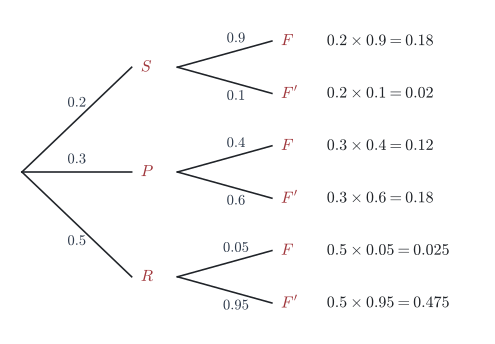
The emails that arrive in an inbox are of three types: spam (\(S\)), promotional (\(P\)) and personal (\(R\)). Of all emails, \(20\%\) are spam, \(30\%\) are promotional and \(50\%\) are personal. A filter flags an email as suspicious (\(F\)) with probability \(0.9\) if it is spam, \(0.4\) if it is promotional, and \(0.05\) if it is personal.
(a) Find the probability that an email chosen at random is flagged. [2]
(b) Given that an email is flagged, find the probability that it is spam. [2]
(c) Given that an email is not flagged, find the probability that it is personal. [3]
The filter is changed so that it flags a personal email with probability \(p\). The probabilities for spam and promotional emails do not change.
(d) Find the largest value of \(p\) for which the probability that a flagged email is personal is at most \(\dfrac{1}{25}\). [4]
One day, the folder of flagged emails holds \(12\) emails: \(7\) spam, \(4\) promotional and \(1\) personal. Three of these emails are chosen at random to be checked.
(e) Find the probability that the personal email is one of the three emails checked. [2]
(f) Find the probability that the three emails checked are all of the same type. [2]
Total 15 marks
(a)
\(\mathrm{P}(F) = 0.2 \times 0.9 + 0.3 \times 0.4 + 0.5 \times 0.05\) M1
\(= 0.18 + 0.12 + 0.025 = 0.325\) A1
[2 marks]
(b)
\(\mathrm{P}(S \mid F) = \dfrac{0.18}{0.325}\) M1
\(= \dfrac{36}{65}\) A1
[2 marks]
(c)
\(\mathrm{P}(F') = 1 - 0.325 = 0.675\) A1
\(\mathrm{P}(R \mid F') = \dfrac{0.5 \times 0.95}{0.675} = \dfrac{0.475}{0.675}\) M1
\(= \dfrac{19}{27}\) A1
[3 marks]
(d)
\(\mathrm{P}(R \mid F) = \dfrac{0.5p}{0.18 + 0.12 + 0.5p}\) M1 A1
\(\dfrac{0.5p}{0.3 + 0.5p} \leq \dfrac{1}{25} \;\Rightarrow\; 12.5p \leq 0.3 + 0.5p\) M1
\(12p \leq 0.3\), so the largest value is \(p = 0.025\) A1
[4 marks]
(e)
\(\dfrac{\binom{1}{1}\binom{11}{2}}{\binom{12}{3}} = \dfrac{55}{220}\) M1
\(= \dfrac{1}{4}\) A1
[2 marks]
(f)
\(\dfrac{\binom{7}{3} + \binom{4}{3}}{\binom{12}{3}} = \dfrac{35 + 4}{220}\) M1
\(= \dfrac{39}{220}\) A1
[2 marks]
HL 5 Paper 1
Box \(\mathrm{I}\) contains \(4\) red balls and \(6\) blue balls. Box \(\mathrm{II}\) contains \(7\) red balls and \(3\) blue balls. A fair coin is tossed. If it shows heads, Box \(\mathrm{I}\) is chosen; otherwise Box \(\mathrm{II}\) is chosen. Three balls are then taken at random from the chosen box, without replacement. Let \(W\) be the event “exactly two of the three balls are red”.
(a) Show that \(\mathrm{P}(W \mid \text{Box I}) = \dfrac{3}{10}\), and find \(\mathrm{P}(W \mid \text{Box II})\). [3]
(b) Find \(\mathrm{P}(W)\). [2]
(c) Given that exactly two of the balls are red, find the probability that they came from Box \(\mathrm{II}\). [2]
The coin is replaced by a spinner, which chooses Box \(\mathrm{I}\) with probability \(q\) and Box \(\mathrm{II}\) with probability \(1 - q\).
(d) Given that \(\mathrm{P}(\text{Box I} \mid W) = \dfrac{1}{3}\), find the value of \(q\). [3]
Now consider Box \(\mathrm{I}\) only.
(e) Balls are taken from Box \(\mathrm{I}\) at random, one at a time and without replacement, until a red ball is taken. Find the probability that more than three balls are taken. [2]
(f) All ten balls from Box \(\mathrm{I}\) are placed in a row in a random order. Find the probability that the four red balls are all next to each other. [3]
Total 15 marks
(a)
\(\mathrm{P}(W \mid \text{Box I}) = \dfrac{\binom{4}{2}\binom{6}{1}}{\binom{10}{3}} = \dfrac{36}{120}\) M1 A1
\(= \dfrac{3}{10}\) AG
\(\mathrm{P}(W \mid \text{Box II}) = \dfrac{\binom{7}{2}\binom{3}{1}}{\binom{10}{3}} = \dfrac{63}{120} = \dfrac{21}{40}\) A1
[3 marks]
(b)
\(\mathrm{P}(W) = \dfrac{1}{2} \times \dfrac{3}{10} + \dfrac{1}{2} \times \dfrac{21}{40}\) M1
\(= \dfrac{12}{80} + \dfrac{21}{80} = \dfrac{33}{80}\) A1
[2 marks]
(c)
\(\mathrm{P}(\text{Box II} \mid W) = \dfrac{\frac{21}{80}}{\frac{33}{80}}\) M1
\(= \dfrac{7}{11}\) A1
[2 marks]
(d)
\(\dfrac{\frac{3}{10}q}{\frac{3}{10}q + \frac{21}{40}(1 - q)} = \dfrac{1}{3}\) M1
\(\dfrac{12q}{12q + 21(1 - q)} = \dfrac{1}{3} \;\Rightarrow\; 36q = 21 + 12q - 21q\) A1
\(45q = 21\), so \(q = \dfrac{7}{15}\) A1
[3 marks]
(e)
more than three balls are needed when the first three are all blue: \(\dfrac{6}{10} \times \dfrac{5}{9} \times \dfrac{4}{8}\) M1
\(= \dfrac{1}{6}\) A1
Accept \(\dfrac{\binom{6}{3}}{\binom{10}{3}} = \dfrac{20}{120}\).
[2 marks]
(f)
treat the four red balls as one block: \(7!\) arrangements of the block and the \(6\) blue balls, and \(4!\) inside the block M1
\(\mathrm{P} = \dfrac{7! \times 4!}{10!}\) A1
\(= \dfrac{24}{720} = \dfrac{1}{30}\) A1
Accept the colour patterns only: the block can start in \(7\) of the \(\binom{10}{4} = 210\) positions, so \(\dfrac{7}{210}\).
[3 marks]