Unit 19 Exam Practice
Continuous Random Variables and the Normal Distribution
These questions are written in the style of IB examination questions, and they are harder than the review exercises. The marks for each part are shown in square brackets on the right, for example [3]. Paper 1 means no calculator; Paper 2 means a graphic display calculator (GDC) is allowed. Try each question under exam conditions first, then open the markscheme.
| Mark | Meaning |
|---|---|
| M | Method mark: a correct method is used, even with a small slip |
| A | Accuracy mark: a correct answer or line of working (usually needs the M mark before it) |
| R | Reasoning mark: a clear reason or justification is given |
| N | Mark for a correct final answer with no working shown |
| AG | “Answer given” in the question, so no extra mark is awarded for writing it |
The number after the letter is the number of marks, so A2 is worth 2 marks. In the exam, give answers exactly or correct to 3 significant figures (s.f.) unless the question says otherwise.
SL questions
SL 1 Paper 1
The random variable \(X\) is normally distributed with mean \(\mu\) and standard deviation \(\sigma\). It is known that \(\mathrm{P}(X < 14) = \mathrm{P}(X > 30)\) and \(\mathrm{P}(X < 18) = 0.3\).
(a) Find the value of \(\mu\). Justify your answer. [2]
(b) Find \(\mathrm{P}(18 < X < 26)\). [2]
(c) Find \(\mathrm{P}(18 < X < 22 \mid X < 26)\). [4]
Total 8 marks
(a)
the normal curve is symmetrical about \(x = \mu\), and the two tails have equal areas, so \(14\) and \(30\) are the same distance from \(\mu\) R1
\(\mu = \dfrac{14 + 30}{2} = 22\) A1
[2 marks]
(b)
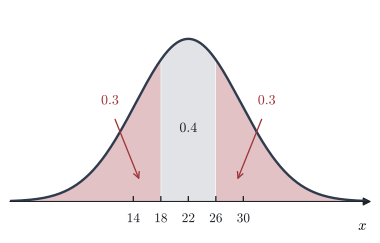
\(18 = 22 - 4\) and \(26 = 22 + 4\), so \(\mathrm{P}(X > 26) = \mathrm{P}(X < 18) = 0.3\) M1
\(\mathrm{P}(18 < X < 26) = 1 - 0.3 - 0.3 = 0.4\) A1
[2 marks]
(c)
\(\mathrm{P}(18 < X < 22 \mid X < 26) = \dfrac{\mathrm{P}(18 < X < 22)}{\mathrm{P}(X < 26)}\) (because \(18 < X < 22\) is inside \(X < 26\)) M1
\(\mathrm{P}(18 < X < 22) = 0.5 - 0.3 = 0.2\) (the mean is also the median) A1
\(\mathrm{P}(X < 26) = 1 - 0.3 = 0.7\) A1
\(\mathrm{P}(18 < X < 22 \mid X < 26) = \dfrac{0.2}{0.7} = \dfrac{2}{7}\) A1
[4 marks]
See 19.3.
SL 2 Paper 2
The time, \(T\) minutes, taken by a ferry to cross a bay is normally distributed with mean \(\mu\) and standard deviation \(\sigma\). \(25\%\) of the crossings take less than \(44\) minutes, and \(10\%\) of the crossings take more than \(52\) minutes.
(a) Find the value of \(\mu\) and the value of \(\sigma\). [5]
A crossing is late if it takes more than \(50\) minutes.
(b) A crossing takes more than \(44\) minutes. Find the probability that it is late. [3]
Total 8 marks
(a)
\(\mathrm{P}(T < 44) = 0.25\) and \(\mathrm{P}(T < 52) = 1 - 0.1 = 0.9\)
\(z\)-values (using Inverse Normal on a GDC, with \(\mu = 0\) and \(\sigma = 1\)): \(-0.674489\ldots\) and \(1.28155\ldots\) A1 A1
\(\dfrac{44 - \mu}{\sigma} = -0.674489\ldots\) and \(\dfrac{52 - \mu}{\sigma} = 1.28155\ldots\) M1
\(\mu = 46.8\) \((46.7585\ldots)\) A1
\(\sigma = 4.09\) \((4.08989\ldots)\) A1
[5 marks]
(b)
\(\mathrm{P}(T > 50 \mid T > 44) = \dfrac{\mathrm{P}(T > 50)}{\mathrm{P}(T > 44)}\) M1
\(\mathrm{P}(T > 50) = 0.214022\ldots\) (using Normal Cdf on a GDC) and \(\mathrm{P}(T > 44) = 0.75\) A1
\(= 0.285\) \((0.285363\ldots)\) A1
Accept \(0.288\) or \(0.289\) from using the 3 s.f. values \(\mu = 46.8\) and \(\sigma = 4.09\).
[3 marks]
SL 3 Paper 2
The heights, \(H\) cm, of the seedlings in a greenhouse are normally distributed with mean \(\mu\) cm. The standard deviation of the heights is one fifth of the mean. \(12\%\) of the seedlings are taller than \(18\) cm.
(a) Find the value of \(\mu\). [4]
(b) Find the interquartile range of the heights. [3]
Total 7 marks
(a)
\(\mathrm{P}(H < 18) = 0.88\), so \(\dfrac{18 - \mu}{\sigma} = 1.17498\ldots\) (using Inverse Normal on a GDC) M1 A1
\(\sigma = \dfrac{\mu}{5}\), so \(\dfrac{18 - \mu}{0.2\mu} = 1.17498\ldots\) M1
\(18 = \mu\,(1 + 0.234997\ldots)\), so \(\mu = 14.6\) \((14.5749\ldots)\) A1
[4 marks]
(b)
\(\sigma = 2.91498\ldots\), and \(Q_1 = 12.6088\ldots\), \(Q_3 = 16.5410\ldots\) (using Inverse Normal with areas \(0.25\) and \(0.75\)) M1 A1
\(\mathrm{IQR} = Q_3 - Q_1 = 3.93\) cm \((3.93225\ldots)\) A1
[3 marks]
SL 4 Paper 2
The masses, \(B\) grams, of the bananas from a plantation are normally distributed with mean \(182\) g and standard deviation \(20\) g. A banana is small if its mass is less than \(155\) g, and large if its mass is more than \(215\) g. All other bananas are medium.
(a) Find the probability that a banana chosen at random is small. [2]
(b) Find the probability that a banana chosen at random is medium. [2]
The heaviest \(4\%\) of the bananas are sold as premium bananas.
(c) Find the least mass of a premium banana. [2]
A bag contains \(12\) bananas chosen at random.
(d) Find the probability that at least \(2\) of the bananas in the bag are small. [3]
(e) Given that at least \(2\) of the bananas in the bag are small, find the probability that exactly \(2\) are small. [3]
(f) State one assumption that you made in parts (d) and (e). [1]
Bananas are now chosen at random, one at a time.
(g) Find the least number of bananas that must be chosen so that the probability of choosing at least one premium banana is greater than \(0.95\). [3]
Total 16 marks
(a)
\(\mathrm{P}(B < 155)\) (using Normal Cdf on a GDC) M1
\(= 0.0885\) \((0.0885079\ldots)\) A1
[2 marks]
(b)
\(\mathrm{P}(B > 215) = 0.0494714\ldots\) A1
\(\mathrm{P}(155 < B < 215) = 1 - 0.0885079\ldots - 0.0494714\ldots = 0.862\) \((0.862020\ldots)\) A1
[2 marks]
(c)
\(\mathrm{P}(B < m) = 0.96\) M1
\(m = 217\) g \((217.013\ldots)\) (using Inverse Normal on a GDC) A1
[2 marks]
(d)
let \(Y\) be the number of small bananas in the bag: \(Y \sim \mathrm{B}(12,\ 0.0885079\ldots)\) M1
\(\mathrm{P}(Y \geq 2) = 1 - \mathrm{P}(Y \leq 1)\) M1
\(= 0.288\) \((0.287904\ldots)\) (using Binomial Cdf on a GDC) A1
[3 marks]
(e)
\(\mathrm{P}(Y = 2 \mid Y \geq 2) = \dfrac{\mathrm{P}(Y = 2)}{\mathrm{P}(Y \geq 2)}\) M1
\(\mathrm{P}(Y = 2) = 0.204662\ldots\) (using Binomial Pdf on a GDC) A1
\(= 0.711\) \((0.710867\ldots)\) A1
[3 marks]
(f)
the masses of the bananas in the bag are independent of each other R1
Accept “each banana has the same probability, \(0.0885\), of being small”.
[1 mark]
(g)
\(1 - 0.96^{n} > 0.95\), so \(0.96^{n} < 0.05\) M1
\(n > \dfrac{\ln 0.05}{\ln 0.96} = 73.38\ldots\) (or a table of values of \(1 - 0.96^{n}\) on a GDC) A1
\(n = 74\) A1
[3 marks]
SL 5 Paper 2
A machine makes steel pins. The lengths, \(L\) mm, of the pins are normally distributed with mean \(25.0\) mm and standard deviation \(0.5\) mm. A pin is accepted if its length is between \(24.3\) mm and \(26.0\) mm. Otherwise it is rejected.
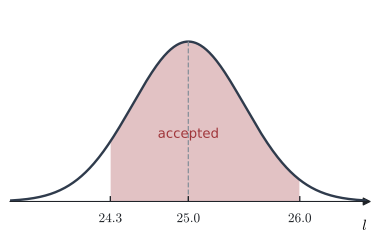
(a) Find the probability that a pin is accepted. [2]
(b) A pin is accepted. Find the probability that its length is more than \(25.5\) mm. [3]
(c) Find the length that is exceeded by \(95\%\) of the accepted pins. [4]
The mean of the machine can be changed. The standard deviation stays at \(0.5\) mm.
(d) Write down the value of the mean that gives the greatest probability that a pin is accepted. Justify your answer, and find this probability. [3]
The mean is now set at the value in part (d). The manager wants \(98\%\) of the pins to be accepted, so the machine is adjusted to a new standard deviation, \(\sigma\) mm.
(e) Find the largest possible value of \(\sigma\). [4]
Total 16 marks
(a)
\(\mathrm{P}(24.3 < L < 26.0)\) (using Normal Cdf on a GDC) M1
\(= 0.896\) \((0.896493\ldots)\) A1
[2 marks]
(b)
\(\mathrm{P}(L > 25.5 \mid \text{accepted}) = \dfrac{\mathrm{P}(25.5 < L < 26.0)}{\mathrm{P}(24.3 < L < 26.0)}\) M1
\(\mathrm{P}(25.5 < L < 26.0) = 0.135905\ldots\) A1
\(= 0.152\) \((0.151596\ldots)\) A1
[3 marks]
(c)
let the length be \(x\) mm: \(5\%\) of the accepted pins are shorter than \(x\), so \(\mathrm{P}(24.3 < L < x) = 0.05 \times 0.896493\ldots\) M1
\(\mathrm{P}(24.3 < L < x) = 0.0448246\ldots\) A1
\(\mathrm{P}(L < x) = 0.0807566\ldots + 0.0448246\ldots = 0.125581\ldots\) A1
\(x = 24.4\) mm \((24.4262\ldots)\) (using Inverse Normal on a GDC) A1
[4 marks]
(d)
mean \(= 25.15\) mm A1
the interval from \(24.3\) to \(26.0\) is symmetrical about \(25.15\), and the normal curve is highest at its mean, so the area over the interval is greatest when the curve is centred at the midpoint of the interval R1
\(\mathrm{P}(24.3 < L < 26.0) = 0.911\) \((0.910869\ldots)\) A1
[3 marks]
(e)
the interval is symmetrical about the mean, so \(\mathrm{P}(L < 26.0) = 0.99\) M1
\(z = 2.32634\ldots\) (using Inverse Normal on a GDC) A1
\(\dfrac{26.0 - 25.15}{\sigma} = 2.32634\ldots\) M1
\(\sigma = 0.365\) mm \((0.365380\ldots)\) A1
A smaller \(\sigma\) makes a larger proportion of pins accepted, so the answer is the largest possible value.
[4 marks]
HL questions
HL questions on this unit also test continuous random variables and their probability density functions (AHL 4.14), with exact integration in Paper 1.
HL 1 Paper 1
A continuous random variable \(X\) has probability density function (p.d.f.) \[ f(x) = \begin{cases} kx^{2}(3 - x), & 0 \leq x \leq 3 \\[2pt] 0, & \text{otherwise,} \end{cases} \] where \(k\) is a positive constant.
(a) Show that \(k = \dfrac{4}{27}\). [2]
(b) Find the mode of \(X\). [3]
(c) Find \(\mathrm{P}(X > 2)\). Hence determine, with a reason, whether the median of \(X\) is less than \(2\) or greater than \(2\). [3]
Total 8 marks
(a)
\(k\displaystyle\int_0^3 \left(3x^{2} - x^{3}\right)\mathrm{d}x = 1\) M1
\(k\left[x^{3} - \dfrac{x^{4}}{4}\right]_0^3 = k\left(27 - \dfrac{81}{4}\right) = \dfrac{27k}{4}\) A1
\(\dfrac{27k}{4} = 1\), so \(k = \dfrac{4}{27}\) AG
[2 marks]
(b)
\(f'(x) = \dfrac{4}{27}\left(6x - 3x^{2}\right) = 0\) M1
\(\dfrac{4}{9}x(2 - x) = 0\), so \(x = 0\) or \(x = 2\) A1
\(f(0) = f(3) = 0\) and \(f(2) = \dfrac{16}{27} > 0\), so the maximum of \(f\) is at \(x = 2\): the mode is \(2\) A1
[3 marks]
(c)
\(\mathrm{P}(X > 2) = \dfrac{4}{27}\left[x^{3} - \dfrac{x^{4}}{4}\right]_2^3 = \dfrac{4}{27}\left(\dfrac{27}{4} - 4\right)\) M1
\(= \dfrac{11}{27}\) A1
\(\mathrm{P}(X < 2) = \dfrac{16}{27} > \dfrac{1}{2}\), so half of the area is reached before \(x = 2\): the median is less than \(2\) R1
[3 marks]
HL 2 Paper 1
A continuous random variable \(X\) has p.d.f. \[ f(x) = \begin{cases} k\,\mathrm{e}^{-2x}, & 0 \leq x \leq \ln 3 \\[2pt] 0, & \text{otherwise,} \end{cases} \] where \(k\) is a positive constant.
(a) Find the value of \(k\). [2]
(b) Find the median of \(X\), giving your answer in the form \(\dfrac{1}{2}\ln\left(\dfrac{p}{q}\right)\), where \(p, q \in \mathbb{Z}^{+}\). [3]
(c) Show that \(\mathrm{E}(X) = \dfrac{4 - \ln 3}{8}\). [3]
Total 8 marks
(a)
\(k\left[-\dfrac{1}{2}\mathrm{e}^{-2x}\right]_0^{\ln 3} = 1\) M1
\(\mathrm{e}^{-2\ln 3} = \dfrac{1}{9}\), so \(\dfrac{k}{2}\left(1 - \dfrac{1}{9}\right) = \dfrac{4k}{9} = 1\), and \(k = \dfrac{9}{4}\) A1
[2 marks]
(b)
\(\dfrac{9}{4}\displaystyle\int_0^m \mathrm{e}^{-2x}\,\mathrm{d}x = \dfrac{1}{2}\) M1
\(\dfrac{9}{8}\left(1 - \mathrm{e}^{-2m}\right) = \dfrac{1}{2}\), so \(\mathrm{e}^{-2m} = \dfrac{5}{9}\) A1
\(m = -\dfrac{1}{2}\ln\left(\dfrac{5}{9}\right) = \dfrac{1}{2}\ln\left(\dfrac{9}{5}\right)\) A1
[3 marks]
(c)
\(\mathrm{E}(X) = \dfrac{9}{4}\displaystyle\int_0^{\ln 3} x\,\mathrm{e}^{-2x}\,\mathrm{d}x\), by parts with \(u = x\) and \(\dfrac{\mathrm{d}v}{\mathrm{d}x} = \mathrm{e}^{-2x}\) M1
\(\displaystyle\int x\,\mathrm{e}^{-2x}\,\mathrm{d}x = -\dfrac{x}{2}\mathrm{e}^{-2x} - \dfrac{1}{4}\mathrm{e}^{-2x} + C\) A1
\(\mathrm{E}(X) = \dfrac{9}{4}\left[\left(-\dfrac{\ln 3}{18} - \dfrac{1}{36}\right) - \left(-\dfrac{1}{4}\right)\right]\) A1
\(= \dfrac{9}{4} \times \dfrac{4 - \ln 3}{18} = \dfrac{4 - \ln 3}{8}\) AG
[3 marks]
HL 3 Paper 2
A garden centre sells two types of tomato plant. The heights of type A plants are normally distributed with mean \(32\) cm and standard deviation \(4\) cm. The heights of type B plants are normally distributed with mean \(38\) cm and standard deviation \(5\) cm. \(40\%\) of the plants are type A, and the rest are type B.
(a) A plant is chosen at random. Find the probability that it is taller than \(35\) cm. [3]
(b) A plant chosen at random is taller than \(35\) cm. Find the probability that it is type A. [2]
(c) Find the height \(h\) cm such that \(90\%\) of all the plants are shorter than \(h\) cm. [3]
Total 8 marks
(a)
let \(H_A \sim \mathrm{N}(32, 4^{2})\) and \(H_B \sim \mathrm{N}(38, 5^{2})\)
\(\mathrm{P}(\text{taller than } 35) = 0.4\,\mathrm{P}(H_A > 35) + 0.6\,\mathrm{P}(H_B > 35)\) M1
\(\mathrm{P}(H_A > 35) = 0.226627\ldots\) and \(\mathrm{P}(H_B > 35) = 0.725746\ldots\) (using Normal Cdf on a GDC) A1
\(= 0.526\) \((0.526099\ldots)\) A1
[3 marks]
(b)
\(\mathrm{P}(\text{A} \mid \text{taller than } 35) = \dfrac{0.4 \times 0.226627\ldots}{0.526099\ldots}\) M1
\(= 0.172\) \((0.172307\ldots)\) A1
[2 marks]
(c)
\(\mathrm{P}(\text{shorter than } h) = 0.4\,\mathrm{P}(H_A < h) + 0.6\,\mathrm{P}(H_B < h)\) M1
\(0.4\,\mathrm{P}(H_A < h) + 0.6\,\mathrm{P}(H_B < h) = 0.9\) (for example, the intersection of the graph with \(y = 0.9\) on a GDC) M1
\(h = 42.9\) \((42.8808\ldots)\) A1
The heights of all the plants together are not normally distributed, so Inverse Normal cannot be used with one mean and one standard deviation. Award no marks for such a method.
[3 marks]
HL 4 Paper 1
A continuous random variable \(X\) has p.d.f. \[ f(x) = \begin{cases} ax, & 0 \leq x \leq 2 \\[2pt] b(5 - x), & 2 < x \leq 5 \\[2pt] 0, & \text{otherwise,} \end{cases} \] where \(a\) and \(b\) are positive constants. The diagram shows the graph of \(y = f(x)\). The graph is continuous at \(x = 2\).
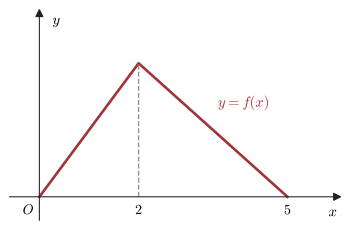
(a) Show that \(a = \dfrac{1}{5}\) and \(b = \dfrac{2}{15}\). [4]
(b) Show that \(\mathrm{E}(X) = \dfrac{7}{3}\). [3]
(c) Find \(\mathrm{Var}(X)\). [3]
(d) Find the median of \(X\), giving your answer in the form \(p - \dfrac{\sqrt{q}}{2}\), where \(p, q \in \mathbb{Z}^{+}\). [4]
(e) Write down the mode of \(X\). Hence, using your answers to parts (b) and (d), describe the skew of the distribution of \(X\). [2]
Total 16 marks
(a)
the two pieces meet at \(x = 2\): \(2a = b(5 - 2)\), so \(2a = 3b\) M1
\(\displaystyle\int_0^2 ax\,\mathrm{d}x + \int_2^5 b(5 - x)\,\mathrm{d}x = 1\) (or the area of the triangle is \(1\)) M1
\(2a + \dfrac{9b}{2} = 1\) A1
\(2a + 3a = 1\), so \(a = \dfrac{1}{5}\) A1
\(b = \dfrac{2a}{3} = \dfrac{2}{15}\) AG
[4 marks]
(b)
\(\mathrm{E}(X) = \displaystyle\int_0^2 \dfrac{x^{2}}{5}\,\mathrm{d}x + \int_2^5 \dfrac{2}{15}\left(5x - x^{2}\right)\mathrm{d}x\) M1
\(= \dfrac{8}{15} + \dfrac{2}{15}\left[\dfrac{5x^{2}}{2} - \dfrac{x^{3}}{3}\right]_2^5\) A1
\(= \dfrac{8}{15} + \dfrac{2}{15} \times \dfrac{27}{2}\) A1
\(= \dfrac{8}{15} + \dfrac{27}{15} = \dfrac{7}{3}\) AG
[3 marks]
(c)
\(\mathrm{E}(X^{2}) = \displaystyle\int_0^2 \dfrac{x^{3}}{5}\,\mathrm{d}x + \int_2^5 \dfrac{2}{15}\left(5x^{2} - x^{3}\right)\mathrm{d}x\) M1
\(= \dfrac{4}{5} + \dfrac{2}{15} \times \dfrac{171}{4} = \dfrac{13}{2}\) A1
\(\mathrm{Var}(X) = \dfrac{13}{2} - \left(\dfrac{7}{3}\right)^{2} = \dfrac{19}{18}\) A1
[3 marks]
(d)
\(\mathrm{P}(X \leq 2) = \dfrac{1}{2} \times 2 \times \dfrac{2}{5} = \dfrac{2}{5} < \dfrac{1}{2}\), so the median \(m\) is between \(2\) and \(5\) R1
\(\displaystyle\int_m^5 \dfrac{2}{15}(5 - x)\,\mathrm{d}x = \dfrac{1}{2}\) M1
\(\dfrac{(5 - m)^{2}}{15} = \dfrac{1}{2}\) A1
\(5 - m = \sqrt{\dfrac{15}{2}} = \dfrac{\sqrt{30}}{2}\) (positive, as \(m < 5\)), so \(m = 5 - \dfrac{\sqrt{30}}{2}\) A1
Accept the equation \(\dfrac{2}{5} + \displaystyle\int_2^m \dfrac{2}{15}(5 - x)\,\mathrm{d}x = \dfrac{1}{2}\) for the M1.
[4 marks]
(e)
mode \(= 2\) A1
\(\dfrac{\sqrt{30}}{2} > \dfrac{8}{3}\) (as \(30 > \dfrac{256}{9}\)), so mode \(<\) median \(<\) mean, and the distribution is positively skewed R1
Accept “the long tail is on the right” as the reason, with mode \(= 2 <\) mean.
[2 marks]
HL 5 Paper 2
A bakery makes loaves of bread. The masses, \(M\) grams, of the loaves are normally distributed with mean \(\mu\) grams and standard deviation \(15\) grams. The baker can choose the value of \(\mu\). A loaf with a mass of at least \(780\) g is sold for \(\$5\). A loaf with a mass of less than \(780\) g is sold for \(\$1\). The cost of making each loaf is \(\$0.002\mu\).
(a) For \(\mu = 800\), find \(\mathrm{P}(M < 780)\). [2]
For a general value of \(\mu\), let \(p = \mathrm{P}(M < 780)\).
(b) Show that the expected profit per loaf, \(G\) dollars, is given by \(G = 5 - 4p - 0.002\mu\). [3]
(c) Find the value of \(G\) when \(\mu = 800\). [1]
(d) Find the value of \(\mu\) that gives the greatest expected profit per loaf, and find this greatest expected profit. [3]
(e) Explain, in context, why \(G\) decreases when \(\mu\) increases beyond the value found in part (d). [1]
For the rest of the question, \(\mu\) takes the value found in part (d).
(f) Find the mass that is exceeded by \(99\%\) of the loaves. [2]
(g) A shop buys \(40\) loaves chosen at random. Find the probability that at least one of the loaves has a mass of less than \(780\) g. [3]
Total 15 marks
(a)
\(M \sim \mathrm{N}(800, 15^{2})\): \(\mathrm{P}(M < 780)\) (using Normal Cdf on a GDC) M1
\(= 0.0912\) \((0.0912112\ldots)\) A1
[2 marks]
(b)
profit \(= 5 - 0.002\mu\) with probability \(1 - p\), and \(1 - 0.002\mu\) with probability \(p\) M1
\(G = (5 - 0.002\mu)(1 - p) + (1 - 0.002\mu)\,p\) A1
\(= 5 - 5p + p - 0.002\mu\,(1 - p) - 0.002\mu\,p\) A1
\(= 5 - 4p - 0.002\mu\) AG
[3 marks]
(c)
\(G = 5 - 4 \times 0.0912112\ldots - 1.6 = 3.04\) \((3.03515\ldots)\) A1
[1 mark]
(d)
graph of \(G = 5 - 4\,\mathrm{P}(M < 780) - 0.002\mu\) as a function of \(\mu\) (for example, using the maximum point of the graph on a GDC) M1
\(\mu = 822\) g \((822.287\ldots)\) A1
greatest expected profit \(= \$3.35\) \((3.34579\ldots)\) A1
[3 marks]
(e)
almost every loaf is already sold for \(\$5\), so a larger mean hardly increases the income, but the cost \(0.002\mu\) of each loaf keeps increasing R1
[1 mark]
(f)
\(\mathrm{P}(M < w) = 0.01\), with \(M \sim \mathrm{N}(822.287\ldots, 15^{2})\) M1
\(w = 787\) g \((787.392\ldots)\) (using Inverse Normal on a GDC) A1
[2 marks]
(g)
\(p = \mathrm{P}(M < 780) = 0.00240725\ldots\) A1
\(Y \sim \mathrm{B}(40,\ 0.00240725\ldots)\), and \(\mathrm{P}(Y \geq 1) = 1 - (1 - p)^{40}\) M1
\(= 0.0919\) \((0.0919051\ldots)\) A1
Accept \(0.0973\) from using \(\mu = 822\). The value of \(p\) changes quickly with \(\mu\), so the stored value of \(\mu\) should be used.
[3 marks]